BaaS vs Building Custom Blockchain: Which One Fits Your Business in 2025?
 Aug, 3 2025
When your business is ready to use blockchain, you face a simple but critical question: Should you use a BaaS platform or build your own blockchain from scratch? There’s no one-size-fits-all answer. The right choice depends on your goals, budget, team, and how much control you actually need. Most companies start with BaaS because it’s faster and cheaper. But if you’re in healthcare, finance, or any heavily regulated industry, building your own might be the only way to meet compliance and performance demands.
What Is BaaS, Really?
Blockchain as a Service (BaaS) is like renting a fully built house instead of building one from the ground up. Providers like Microsoft Azure, Amazon Web Services, and IBM handle the servers, networks, security patches, and updates. You focus on writing smart contracts and connecting your apps. It’s cloud computing for blockchain.
With BaaS, you can spin up a blockchain network in days-not months. AWS Managed Blockchain lets you launch a Hyperledger Fabric network with a few clicks. Azure Blockchain Service automatically scales to handle 10,000 concurrent users. No need to hire a team of blockchain engineers just to get started. Pricing starts at $0.50 per hour for basic nodes, and enterprise plans run around $15,000 a month. That’s a fraction of what custom development costs.
Most BaaS platforms come with pre-built tools: consensus mechanisms like Proof-of-Authority, smart contract support for Solidity or Chaincode, and APIs to connect with your existing systems. You get SOC 2 Type II audits, FIPS 140-2 encryption, and 24/7 support with SLAs-things most small teams couldn’t afford on their own.
When BaaS Makes Sense
If you’re testing blockchain for supply chain tracking, internal document verification, or loyalty programs, BaaS is the smart play. Retailers and logistics companies love it because they can scale up or down based on seasonal demand. One company using Azure Blockchain Service cut their time-to-market by 70% compared to building in-house. They went from idea to live network in six weeks.
Small to mid-sized businesses with limited tech teams benefit the most. Developers familiar with AWS or Azure can get up to speed in 2-3 weeks. Documentation is clear, tutorials are plentiful, and support teams respond within hours for critical issues. Over 68% of enterprises start with BaaS, according to Gartner’s 2024 report. That’s not because they’re lazy-it’s because it works for most use cases.
Take TreasuryXL, a European bank. They used BaaS to verify internal documents and saved $2.1 million in Year 1. No infrastructure costs. No hiring. Just plug in, deploy, and run. Perfect for non-core systems where speed and cost matter more than deep customization.
What Building a Custom Blockchain Means
Building a custom blockchain means designing every layer yourself: how nodes communicate, how transactions are validated, how data is encrypted, how upgrades happen. It’s like building a custom race car instead of buying a sedan. You get top performance, but you also get the complexity.
Custom blockchains can hit 15,000 transactions per second (TPS) with tailored consensus algorithms-far beyond what most BaaS platforms offer. PixelPlex’s 2024 analysis found custom chains can be 30-40% faster for niche applications. But it takes time. Expect 6-9 months of development before launch. You need experts in cryptography, distributed systems, and consensus design. Most failed custom projects fail because the team didn’t have the right skills.
According to CertiK’s 2023 report, 78% of security breaches in custom blockchains came from flawed encryption or poor key management. There’s no safety net. You’re responsible for everything-even patching vulnerabilities that don’t exist yet.
When Custom Blockchain Is Necessary
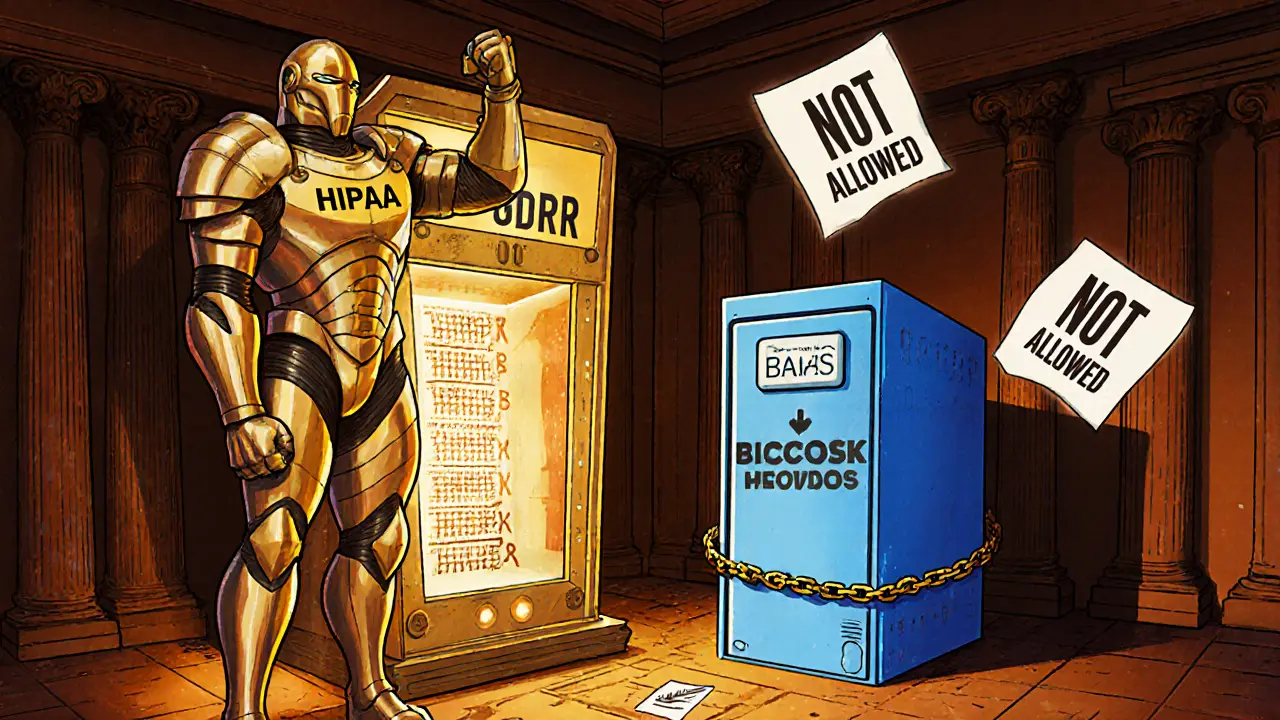
If you’re in healthcare or finance, you might not have a choice. HIPAA, GDPR, and financial regulations often require total control over data storage, access logs, and encryption methods. BaaS platforms can’t give you that.
One healthcare consortium spent $380,000 building a custom blockchain to handle patient records. The result? $1.2 million in annual compliance savings. Why? Because they built data-handling rules directly into the chain-rules no off-the-shelf BaaS platform would allow. Every access request was logged with patient consent timestamps, encrypted end-to-end, and stored only in approved jurisdictions. That’s impossible on AWS or Azure without hacking the system.
High-frequency trading firms also need custom chains. One Reddit user, FinTechDev2023, switched from Azure Blockchain Service to a custom solution after 18 months. Their platform needed a consensus algorithm that could confirm trades in under 50 milliseconds. The BaaS provider couldn’t modify the underlying protocol. They had to build their own.
Fortune 500 companies often use both: BaaS for experiments and custom blockchains for mission-critical systems. Deloitte’s 2025 survey found 67% of big firms use BaaS for non-core tasks, while 41% have custom chains running core transaction systems.
Cost Comparison: BaaS vs Custom
Here’s the hard truth: BaaS is cheaper upfront. Custom blockchain is expensive-but sometimes cheaper long-term.
BaaS Costs:
- Initial setup: $0-$20,000 (mostly developer time)
- Monthly operational cost: $8,500 average for medium use
- Scaling: Pay-as-you-go, no hardware investment
- Support: Included in subscription
Custom Blockchain Costs:
- Initial development: $150,000-$500,000
- Monthly maintenance: $15,000-$30,000 (team salaries + infrastructure)
- Scaling: Requires adding servers, tuning consensus, retesting
- Support: Relies on internal team or $150-$250/hour consultants
Debut Infotech’s 2024 analysis showed BaaS reduces initial investment by 65-80%. But here’s the catch: if your business needs to change the blockchain later, BaaS might cost you more. TreasuryXL paid $450,000 extra when their regulatory rules changed and the BaaS platform couldn’t adapt. Custom blockchains cost more to build-but they can evolve with your needs.
Security: Who’s Really Safer?
It’s not as simple as “BaaS is safer” or “custom is riskier.”
BaaS providers run regular audits, use enterprise-grade encryption, and have teams dedicated to security. Microsoft claims their BaaS platform undergoes 37% more security audits than typical custom implementations. That’s impressive.
But CertiK’s 2024 report found that when custom blockchains are built by experienced teams, they have 22% fewer critical vulnerabilities. Why? Because they’re designed for one specific use case. No shared infrastructure. No multi-tenant risks. No hidden backdoors in the provider’s code.
Here’s the real issue: most custom blockchains fail because teams don’t know how to secure them. If you don’t have a cryptographer on staff, you’re playing Russian roulette. BaaS removes that risk.
Flexibility and Lock-In
BaaS sounds flexible-until you need to change something fundamental.
63% of enterprises using BaaS reported hitting walls when trying to implement complex smart contracts. You can’t swap out the consensus algorithm. You can’t change the data structure. You’re stuck with what the provider offers.
And then there’s vendor lock-in. 58% of companies say switching BaaS providers is a nightmare. Data formats, API structures, and node configurations vary wildly between AWS, Azure, and IBM. Migrating means rebuilding your app from scratch.
Custom blockchains don’t have lock-in. You own the code. You can move it to any server, fork it, or sell it. But you also own the maintenance burden.

The Hybrid Future
The future isn’t BaaS vs custom-it’s BaaS with custom.
In March 2025, Microsoft launched Azure Blockchain Service 3.0 with customizable consensus layers. AWS introduced its Hybrid Blockchain Framework in Q1 2025, letting you plug in custom modules on top of their infrastructure. This is the new middle ground.
Gartner predicts that by 2027, 55% of enterprise blockchains will be hybrid. You use BaaS for the heavy lifting-nodes, networking, scaling-and build custom smart contracts or data layers on top. It gives you speed, control, and scalability without needing a PhD in distributed systems.
How to Decide: A Simple Checklist
Ask yourself these questions:
- Do you need to comply with strict regulations like HIPAA or GDPR? → Go custom.
- Are you building for internal use or a public-facing product? → BaaS for internal, custom for public.
- Do you have blockchain engineers on staff? → If no, start with BaaS.
- Will your blockchain need to change drastically in the next 2 years? → Custom gives you flexibility.
- Is your budget under $100,000? → BaaS is your only realistic option.
- Are you in finance, healthcare, or defense? → Custom is likely mandatory.
- Do you want to launch in 30 days? → BaaS wins.
If you answered yes to more than three of the first four questions, you’re probably better off building custom. If you answered yes to the last three, BaaS is the way to go.
Final Thought: Start Small, Think Long-Term
Don’t let the hype push you into a decision. Most companies don’t need a blockchain at all. But if you do, start with BaaS. Build a prototype. Test it with real data. See where the limits are. Then decide if the cost and risk of going custom are worth it.
Blockchain isn’t magic. It’s a tool. And like any tool, the best one is the one that solves your problem-not the one that sounds the coolest.
Is BaaS secure enough for enterprise use?
Yes, for most use cases. Major BaaS providers like Azure and AWS undergo regular security audits, use enterprise-grade encryption, and offer SLAs with 24/7 support. However, if your industry requires full control over data storage, access logs, or encryption keys (like healthcare or finance), BaaS may not meet compliance needs. Custom blockchains give you that control but require expert teams to implement securely.
Can I switch from BaaS to a custom blockchain later?
You can, but it’s expensive and complex. BaaS platforms use proprietary data formats and APIs. Migrating means rebuilding your smart contracts, re-architecting data flows, and re-testing security. Many companies find it easier to extend their BaaS setup with custom modules than to fully migrate. Hybrid models are becoming the preferred path to avoid this trap.
How long does it take to build a custom blockchain?
Typically 6 to 9 months for a production-ready system. This includes designing the consensus mechanism, writing smart contracts, testing security, deploying nodes, and training staff. BaaS solutions can be live in 1-3 months. The extra time for custom development is only worth it if you need unique performance, compliance, or control features.
What’s the biggest mistake companies make with BaaS?
Assuming it’s a permanent solution. Many companies use BaaS to quickly prototype, then realize later they need deeper customization-like changing the consensus algorithm or encrypting data differently. By then, they’re locked in. The fix? Design your BaaS implementation with a clear exit strategy. Use standard data formats and avoid vendor-specific features if you think you might switch later.
Do I need a blockchain at all?
Probably not. Many businesses think blockchain is the answer to every data problem. But if you don’t need multiple parties to verify transactions without trusting each other, a secure database is cheaper and faster. Blockchain adds complexity. Only use it when decentralization, immutability, or trustless collaboration is essential to your business model.
Which BaaS provider is best in 2025?
There’s no single “best.” AWS leads in market share (28%) and ease of use. Azure offers the most enterprise integration and now supports customizable consensus layers. IBM is strong in supply chain and finance use cases. Oracle excels in hybrid cloud environments. Choose based on your existing cloud provider, compliance needs, and the specific blockchain framework you want to use (Hyperledger, Ethereum, etc.).