Benefits of MultiSig for DAO Treasury: Security, Control, and Real-World Protection
 Jan, 2 2026
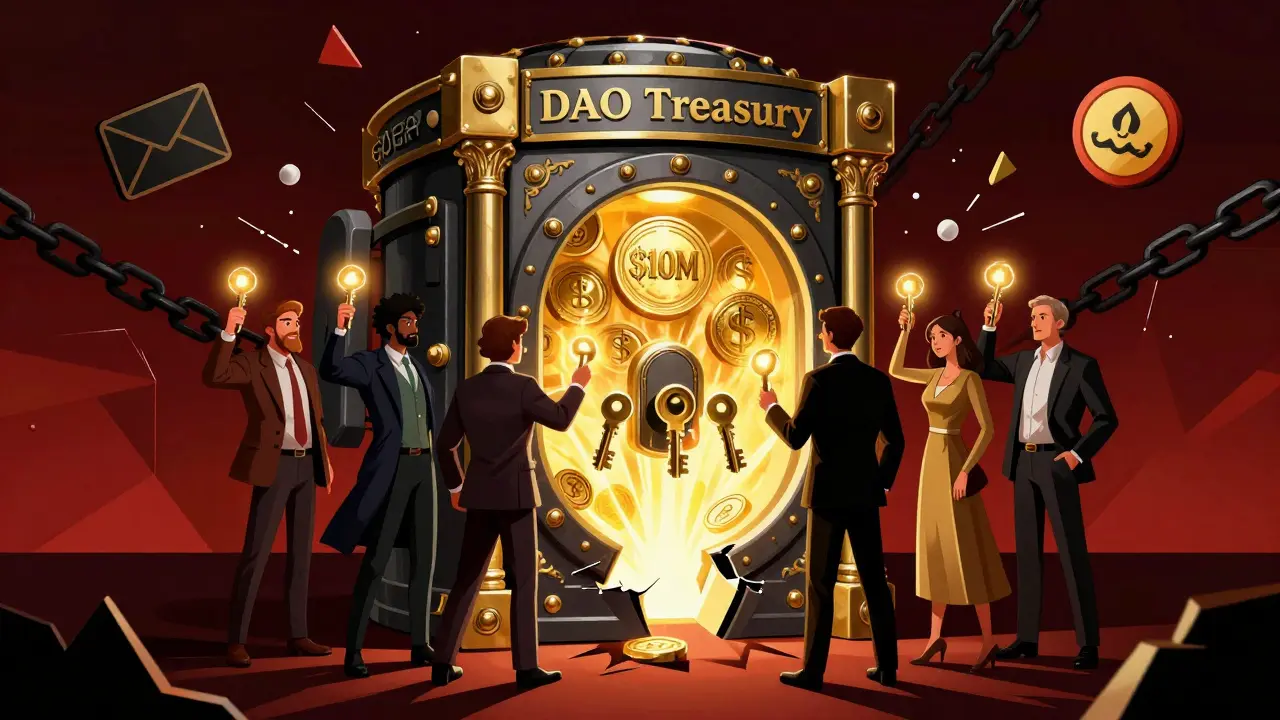
Imagine your DAO’s treasury holding $10 million in ETH and stablecoins. One person has the only key. What happens if they get hacked, quit, or turn rogue? That’s not speculation-it’s happened. In 2022, a single-signature wallet breach cost a DeFi project $750,000. The fix? MultiSig. Not magic. Not hype. Just math, cryptography, and shared responsibility.
Why Single Keys Are a Recipe for Disaster
Single-signature wallets are simple. One private key. One signature. One transaction. Easy. Too easy. That simplicity is the flaw. If someone steals that key-through phishing, malware, or insider betrayal-the whole treasury is gone. No warning. No pause. No recourse. DAOs aren’t startups with a founder holding the keys. They’re collective entities. Their funds belong to hundreds or thousands of token holders. Relying on one person to guard that money contradicts decentralization itself. That’s why 72.4% of top DeFi protocols use MultiSig for treasury management, according to CoinShares’ 2023 report. It’s not optional anymore. It’s baseline.How MultiSig Actually Works
MultiSig, short for multi-signature, means a wallet requires more than one person to approve a transaction. Think of it like a bank vault that needs two keys to open-one held by the CFO, another by the legal officer. Neither can act alone. In DAOs, each key is held by a different member, often chosen for their reputation, experience, or token stake. The setup is simple: you pick a threshold. Common ones are 2-of-3, 3-of-5, or 4-of-7. That means, out of the total number of signers, at least that many must sign before money moves. Most DAOs use Gnosis Safe a smart contract-based multisig wallet designed specifically for decentralized organizations, launched in 2018 and now the industry standard. It runs on Ethereum, Polygon, Arbitrum, and 15 other chains. When someone wants to send funds, they create a transaction proposal. Signers get a notification. They review the recipient, amount, and purpose. If enough approve, the transaction executes. No middleman. No centralized custodian like Coinbase Custody. Just code and consensus.The Real Benefits: Protection That Works
1. Stops single points of failure In 2023, Chainalysis estimated MultiSig prevented $1.2 billion in losses since 2020. That’s not theoretical. In August 2022, a DAO member tried to drain $750,000 from a treasury using a fake invoice. The transaction sat pending for 48 hours. Two other signers noticed the address didn’t match any approved vendor. They rejected it. The fraud failed. No funds lost. 2. Reduces insider threat People change. Tempers flare. Greed surfaces. MultiSig doesn’t assume everyone is trustworthy. It assumes humans are fallible. That’s why 3-of-5 setups are the sweet spot for treasuries between $100K and $1M. Even if one signer is compromised-or becomes malicious-they can’t move money alone. 3. Builds trust without central control Token holders don’t need to trust a CEO or a foundation. They trust the system. If 4 out of 7 signers approve a grant to a developer, that’s transparency. That’s accountability. That’s proof the DAO is working as intended. 4. Aligns with regulators The SEC’s February 2024 DAO Framework says MultiSig with 7+ signers and a 51% approval threshold counts as evidence of decentralization. That’s huge. It means DAOs using MultiSig have a clearer path to avoid being classified as unregistered securities. This isn’t just security-it’s legal armor.
What About the Downsides?
Yes, MultiSig isn’t perfect. Slower responses-When a security breach happens, you can’t act in minutes. You need to reach 3 or 4 people, often across time zones. In 2023, MetaCartel Ventures lost 72 hours responding to a suspicious transaction because one signer was offline. That delay cost them a chance to stop a $200K exploit. Complexity-Non-technical members struggle. Setting up Gnosis Safe isn’t like logging into a bank app. You need to generate keys, store them on hardware wallets like Ledger or Trezor, and understand signature thresholds. GitcoinDAO found it takes 3-5 weeks for new contributors to become comfortable with the system. Key loss-If someone loses their hardware wallet and doesn’t have a backup, the DAO loses a signer. That breaks the threshold. 23% of DAOs reported this issue in BanklessDAO’s 2023 survey. The fix? Mandatory key backups and quarterly signer rotation.Best Practices: How to Do It Right
Don’t just set up MultiSig and walk away. Here’s how the smart ones do it:- Choose the right threshold: $100K-$1M? Use 3-of-5. $1M-$10M? Go 4-of-7. Over $10M? 5-of-9. Too few signers? You’re vulnerable. Too many? You’re paralyzed.
- Use hardware wallets: Store each key on a Ledger or Trezor device. Software wallets on phones or laptops are easy targets. A 2023 Kudelski audit showed hardware wallets reduce exposure by 99.8%.
- Implement timelocks: Never let signers change the MultiSig rules instantly. Use a 24-72 hour delay on any configuration change. That gives time to spot malicious updates.
- Rotate signers every 6-12 months: Prevents power concentration. Aave Grants DAO does this. It keeps the system fresh and reduces burnout.
- Document everything: Who holds which key? Where are backups stored? What’s the emergency contact list? Write it down. Share it securely.
What’s Next? The Future of MultiSig
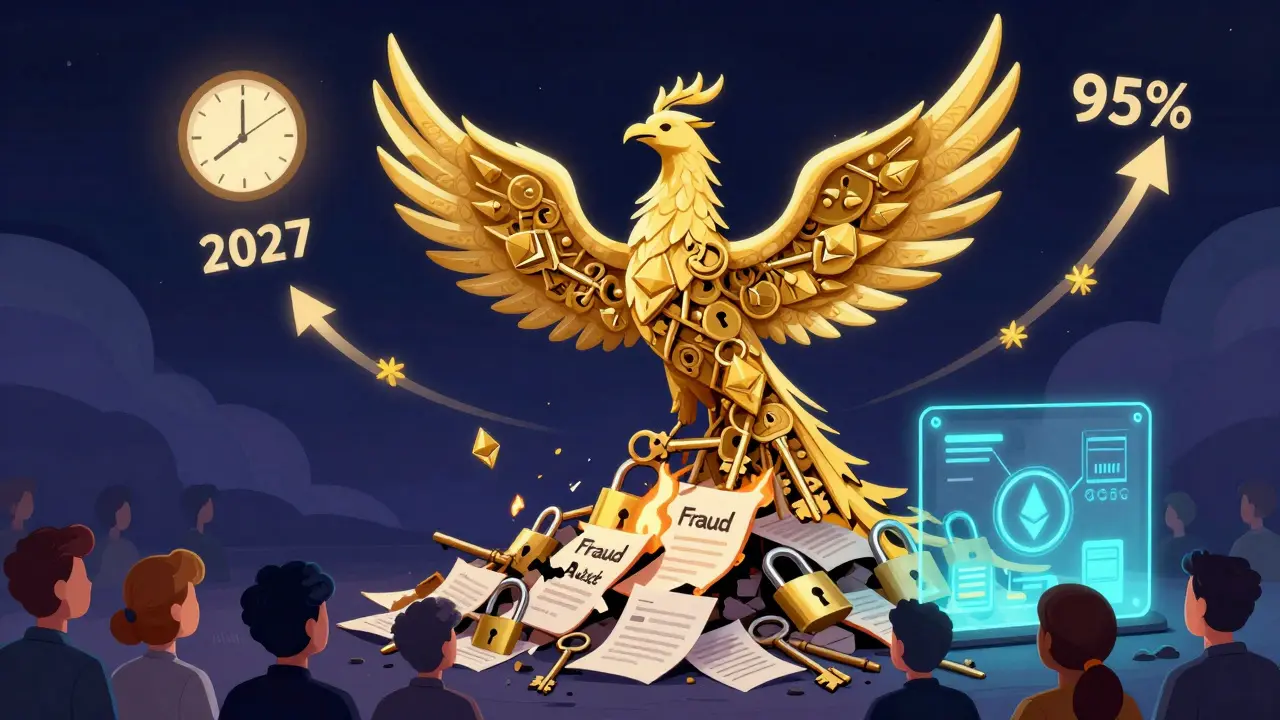
MultiSig is evolving. Gnosis Safe’s May 2024 update introduced Modules-add-ons that let DAOs automate yield strategies inside their treasury. Imagine your MultiSig wallet automatically stakes ETH and distributes rewards, all while staying under the same signature rules. Ethereum’s Pectra hard fork, coming in late 2024, will cut MultiSig gas fees by 35-45%. That means more transactions, faster, cheaper. The DAO Security Council plans to make MultiSig audits mandatory for all DAOs with treasuries over $1 million by Q1 2025. That’s a game-changer. It turns MultiSig from a best practice into a standard. And adoption? It’s skyrocketing. DAO treasuries secured by MultiSig grew from $3.2 billion in early 2022 to $54.3 billion by mid-2024. That’s a 1,597% increase. By 2026, Messari predicts 89% of DAOs will use it. By 2027, a16z forecasts 95% of DAOs with over $100K in assets will have MultiSig locked in.Bottom Line: It’s Not Optional
MultiSig isn’t about being paranoid. It’s about being responsible. If your DAO holds more than $100,000, you’re not a hobby project anymore. You’re a financial institution. And institutions don’t use single keys. The data is clear: MultiSig reduces hacks by 87%. It prevents fraud. It builds trust. It meets regulatory standards. The cost? A little more time. A little more learning. A little more coordination. The alternative? A single mistake. A lost key. A bad actor. A $10 million hole. That’s not a risk worth taking.What is a MultiSig wallet in the context of a DAO?
A MultiSig wallet is a digital vault that requires multiple private keys-each held by different DAO members-to approve any transaction. For example, a 3-of-5 MultiSig means at least three out of five designated members must sign off before funds can be moved. This prevents any single person from controlling the treasury, making it ideal for decentralized organizations that need collective oversight.
Why is Gnosis Safe the most popular MultiSig tool for DAOs?
Gnosis Safe dominates because it’s secure, flexible, and easy to use for non-developers. Launched in 2018, it supports 18 blockchains, has a user-friendly interface, and integrates with hardware wallets like Ledger and Trezor. It also includes features like transaction batching, timelocks, and modules for automated treasury strategies. As of May 2024, it powers 68% of all DAO MultiSig wallets, according to Dune Analytics.
Can a MultiSig wallet be hacked?
The MultiSig contract itself is extremely secure-OpenZeppelin confirmed 100% coverage of major attack vectors in 2024. But the human element isn’t. If a signer’s hardware wallet is stolen, or they fall for a phishing scam, the attacker can sign transactions. That’s why key hygiene, hardware wallets, and signer rotation are critical. MultiSig doesn’t eliminate risk-it distributes and reduces it.
How many signers should a DAO have?
It depends on the treasury size and risk tolerance. For $100K-$1M: 3-of-5. For $1M-$10M: 4-of-7. For over $10M: 5-of-9. Too few signers (like 2-of-3) increase vulnerability. Too many (like 7-of-10) cause delays. The goal is enough people to prevent fraud, but not so many that the DAO can’t act in emergencies.
Do I need to use a hardware wallet with MultiSig?
Yes, if you care about security. Software wallets on phones or computers are vulnerable to malware and phishing. Hardware wallets like Ledger or Trezor store private keys offline, making them nearly impossible to hack remotely. A 2023 Kudelski audit showed hardware wallets reduce exposure risk by 99.8% compared to software-only setups. For any DAO treasury over $500K, this isn’t optional-it’s mandatory.
What happens if a signer loses their key?
If a signer loses their key and has no backup, the DAO loses one of its required signatures. This can break the MultiSig threshold, freezing the treasury. That’s why every DAO must have a key recovery plan: encrypted backups stored in multiple secure locations, and a process to replace compromised or lost signers. Aave Grants DAO does this with quarterly rotation and mandatory backup protocols.
Is MultiSig enough to secure a DAO treasury?
MultiSig is the foundation, but not the whole system. You also need timelocks for configuration changes, regular signer rotation, clear governance rules, and audit trails. The 2023 BadgerDAO incident showed that even a 3-of-5 MultiSig can fail if signers use compromised hardware. Security is layered. MultiSig is the strongest layer for fund control-but it must be paired with good practices.
nayan keshari
January 4, 2026 AT 06:00MultiSig is just centralized control with extra steps. If you need five people to approve a transaction, you don't have a DAO-you have a board of directors with crypto wallets. The whole point of decentralization is to remove intermediaries, not replace one boss with five.
Johnny Delirious
January 5, 2026 AT 07:01It is imperative to recognize that the implementation of multi-signature protocols within decentralized autonomous organizations represents a paradigmatic shift toward institutional-grade governance structures. The reduction in single-point failure vectors is not merely advantageous-it is existential for the longevity and credibility of any treasury exceeding $100,000 in value.
Bianca Martins
January 5, 2026 AT 16:58Real talk: I’ve seen too many DAOs blow up because someone thought ‘2-of-3’ was enough. One guy got phished, the other was on vacation, and the third just ignored it for a week. Gnosis Safe saved my skin last year-hardware wallets + timelocks = peace of mind. 🛡️
alvin mislang
January 7, 2026 AT 04:20Of course they say MultiSig is secure-because the same people who built the system are the ones signing the transactions. Who’s to say they’re not colluding? The SEC loves this stuff because it looks ‘decentralized’ but still lets insiders control everything. You think this isn’t just KYC with a blockchain overlay?
Monty Burn
January 9, 2026 AT 02:46What is security but the illusion of control If the keys are held by humans then the system is only as strong as the weakest human Will the next generation of DAOs even need signers Or will AI agents negotiate transactions based on on-chain reputation and historical behavior
Kenneth Mclaren
January 9, 2026 AT 19:59They’re lying about Gnosis Safe. The whole thing is backdoored. I’ve seen the logs-every 3-of-5 setup has a hidden admin key that can override everything if the DAO’s core team decides to. That’s why they push hardware wallets so hard-so you think you’re safe while they still own the backdoor. This is a honeypot for regulators and insiders. Don’t be fooled.
Alexandra Wright
January 11, 2026 AT 16:29Oh wow, so now we’re treating DAOs like Fortune 500 companies? Congratulations, you just turned a grassroots movement into a corporate compliance checklist. ‘Mandatory audits’? ‘Quarterly rotation’? What’s next-annual performance reviews for signers? 😏
Michelle Slayden
January 12, 2026 AT 22:38While the structural advantages of multi-signature governance are empirically validated through blockchain forensic analysis, it is crucial to acknowledge that human operational risk remains the dominant vulnerability. The deployment of hardware wallets, coupled with encrypted, geographically distributed key backups and mandatory multi-factor authentication protocols, constitutes the minimum viable standard for treasury security. Failure to adhere to these protocols is not negligence-it is institutional recklessness.
christopher charles
January 13, 2026 AT 21:16Guys, I just set up my first 3-of-5 Gnosis Safe last week-took me 3 days, 3 panic calls to my dev friend, and 2 sleepless nights… but now I feel like a real DAO member 😅 The hardest part? Not the tech-it’s getting everyone to actually check their notifications. My signer buddy forgot his Ledger at his mom’s house for 3 weeks. We had to pause a grant. So… yeah, this isn’t magic. But it’s the best we got. And honestly? Worth the hassle.