Best Balanced Crypto Exchange in 2025: Security, Fees, and Usability Compared
 Oct, 19 2025
Crypto Exchange Comparison Tool
Recommended Exchange
Why this exchange?
Choosing a crypto exchange in 2025 isn’t about finding the one with the most coins or the lowest fees. It’s about finding the right balanced crypto exchange-one that keeps your money safe, doesn’t charge you a fortune, and actually works when you need it. After the crashes of 2022 and 2023, only the strongest platforms survived. The ones that kept their heads down, followed the rules, and invested in real security. This isn’t a list of hype machines. It’s a real look at who’s still standing-and why.
Security Isn’t a Feature. It’s the Foundation.
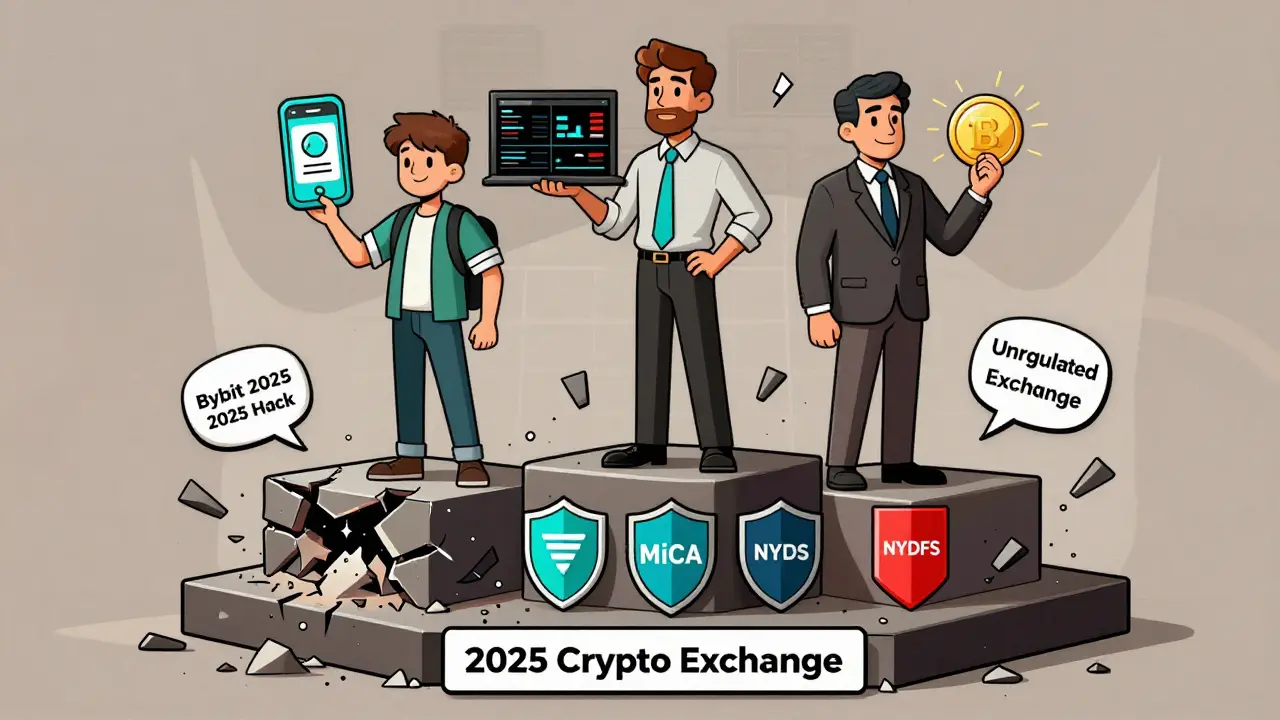
Before you even think about trading, ask this: if the exchange got hacked, would you get your money back? In 2025, the answer isn’t "maybe." It’s "yes, if they’re doing it right." OKX and Kraken are the clear leaders here. OKX publishes monthly proof-of-reserves reports, showing every dollar of user funds is backed 100%. That’s not marketing. That’s transparency. Kraken has gone 10 years without a major breach-even during the FTX collapse, they stayed up and fully funded. Their cold storage system is built like a vault, with multi-sig keys split across geographically separated locations. Bybit had a $1.4 billion hack in February 2025. That’s huge. But here’s the twist: they responded fast. Withdrawals were restored within 72 hours, and they paid out all affected users. Still, 63% of users on Trustpilot say they’re nervous about future risks. That’s the cost of cutting corners on hot wallet management. Gemini and Coinbase Pro are regulated by U.S. authorities. Gemini is licensed by the NYDFS, which means they’re subject to audits, capital requirements, and daily reporting. That’s not something you get from a startup in the Cayman Islands. It’s expensive, but it’s real protection. If you’re holding more than a few thousand dollars, avoid exchanges that don’t publish proof-of-reserves or aren’t regulated in major markets. No exceptions.
Fees: What You’re Really Paying
Look at the fee structure like this: is this exchange charging you to trade, or are they charging you to use their platform?
OKX and Bybit lead in low fees: 0.08% maker, 0.1% taker for spot trades. Futures? Even lower-0.02% maker, 0.05% taker. That’s competitive with institutional brokers. MEXC and Pionex offer zero maker fees, but they’re not regulated. You’re trading on a platform that could disappear tomorrow.
Coinbase is the opposite. Their "Simple Buy" interface charges up to 3.99%. That’s like paying $40 to buy $1,000 worth of Bitcoin. Use their Advanced Trade platform instead-it drops to 0.50% taker. But even then, you’re paying more than OKX.
Kraken’s fees are volume-based. If you trade under $50,000 a month, you pay 0.16% taker. Above $500,000? You drop to 0.04%. That’s why professional traders stick with them.
Robinhood has zero fees-but you’re not getting a fair deal. They sell your order flow to market makers, meaning you get worse prices than you’d see on other platforms. You save on fees, but lose on execution. That’s a hidden cost.
Decentralized exchanges like Uniswap and PancakeSwap have no direct fees, but they have slippage. On average, you lose 1.2% to price movement when trading on Uniswap. On centralized exchanges, it’s 0.3%. That’s $120 lost on a $10,000 trade. For beginners, that’s a brutal surprise.
What You Can Actually Trade
More coins doesn’t mean better. It means more risk.
OKX and Bybit offer over 670 trading pairs. That’s great for traders chasing altcoins. But if you’re holding a new token listed yesterday, you’re taking on huge volatility-and possibly a scam. Most of those coins have no real use case.
Kraken supports 350+ assets. Enough for serious traders, without the noise. Coinbase has 235. Still plenty for most people. Gemini? Only 73. But every one is vetted, audited, and compliant. If you want Bitcoin, Ethereum, and maybe Solana or Chainlink, Gemini is clean and simple.
Robinhood? Just 25 coins. That’s not a weakness-it’s a feature. If you’re a beginner who just wants to buy Bitcoin and hold, you don’t need 600 options. You need clarity.
For institutional traders, Kraken Prime 2.0 and Coinbase’s new FairX platform now offer tokenized real-world assets: gold, real estate, bonds. That’s the future. And it’s only available on regulated platforms.
User Experience: For Beginners and Pros
Can you open the app and buy Bitcoin in under 90 seconds? That’s the baseline.
Coinbase wins here. Their interface is clean, intuitive, and designed for people who’ve never seen a blockchain before. NerdWallet gave it a 4.6/5 for usability. Setup takes 1.5 hours on average-fastest in the industry.
Kraken is the opposite. It’s cluttered. The dashboard looks like a trading floor. But if you know what you’re doing, it’s powerful. You can set limit orders, stop-losses, trailing stops, and API integrations without switching screens.
Decentralized exchanges? Forget beginner-friendly. Connecting a wallet, paying gas fees, understanding slippage, dealing with failed transactions-it takes 3-5 hours of tutorials just to get started. 82% of new users need outside help, according to Consensys.
Customer support matters more than you think. Kraken has 24/7 live chat with a 47-second average response time. Coinbase? Email only. Average reply: 18 hours. Trustpilot reviews are full of people stuck for days on account verification.
Regulation: The Silent Winner
2025 is the year regulation stopped being optional. The EU’s MiCA law, which fully kicked in in June 2024, forced exchanges to prove they’re solvent, transparent, and secure. Exchanges without a license can’t operate in Europe.
OKX paid a $200 million fine to enter the U.S. market in April 2025. That’s not a failure-it’s a sign they’re serious. Bybit got their MiCA license in Austria in May 2025, letting them serve all 30+ European countries under one license.
Exchanges that didn’t adapt? Gone. 37% of exchanges vanished between 2022 and 2023. The survivors are the ones that spent money on compliance, not marketing.
Why does this matter? Because in the next downturn, only regulated exchanges will be able to pay out users. The others? They’ll disappear overnight.
Who Should Use What?
- Beginners: Start with Coinbase. Simple, safe, and educational. Avoid Robinhood if you plan to learn beyond buying.
- Active traders: OKX or Kraken. Low fees, deep liquidity, advanced tools. Use Kraken if you want institutional-grade security. Use OKX if you want the most trading pairs.
- Long-term holders: Gemini. Fewer coins, but every one is vetted. You won’t find obscure tokens, but you won’t lose your life savings to a rug pull.
- Institutional investors: Kraken Prime 2.0 or Coinbase’s regulated derivatives platform. Sub-millisecond execution, prime brokerage access, real-world asset trading.
- DeFi users: Uniswap or PancakeSwap-but only if you understand gas fees and slippage. Use them for small, experimental trades, not your life savings.
The Big Picture
The crypto exchange market isn’t growing anymore. It’s consolidating. Only 10 exchanges handle 78% of all trading volume. The rest are fading out.
By 2027, Fitch Ratings predicts only 8-10 major exchanges will remain. Why? Because compliance costs are now 18-25% of revenue. Smaller exchanges can’t afford it.
Regulation isn’t killing innovation. It’s cleaning it up. The exchanges that survive are the ones that treat security like a product-not a checkbox. The ones that charge fair fees. The ones that actually help users understand what they’re doing.
If you’re still using an exchange that doesn’t publish proof-of-reserves, doesn’t have a license, or charges 4% fees to buy Bitcoin-you’re not trading crypto. You’re gambling.
What makes a crypto exchange "balanced"?
A balanced crypto exchange combines strong security, fair fees, regulatory compliance, and a usable interface. It doesn’t sacrifice one for the other. For example, Kraken offers low fees and top-tier security but has a complex interface. OKX has more trading pairs and lower fees but faced regulatory issues. A balanced platform finds the middle ground-like Coinbase for beginners or Gemini for safety-focused holders.
Is OKX safe to use in 2025?
Yes, but with conditions. OKX has a perfect 10/10 Trust Score, publishes monthly proof-of-reserves, and uses top-tier cold storage. After paying a $200 million fine and launching a U.S.-compliant entity in April 2025, it’s now regulated in major markets. However, its history with regulatory violations means you should still use strong security practices like 2FA and hardware keys.
Why are Kraken’s fees lower than Coinbase’s?
Kraken uses a volume-based fee structure. The more you trade, the lower your fees. Coinbase’s Simple Buy feature is designed for casual users and includes a markup to cover customer support and marketing. Their Advanced Trade platform has fees closer to Kraken’s, but it’s not the default view. If you trade regularly, Kraken saves you money. If you buy Bitcoin once a month, Coinbase’s simplicity may be worth the extra cost.
Should I use a decentralized exchange like Uniswap?
Only if you understand gas fees, slippage, and self-custody. DEXs like Uniswap give you full control, but they’re not beginner-friendly. You’ll pay 1.2% in slippage on average, versus 0.3% on centralized exchanges. They’re great for trading new tokens early, but risky for large amounts. Use them for small, experimental trades-not your main portfolio.
What’s the safest crypto exchange for beginners?
Coinbase is the safest for beginners. It’s regulated in the U.S., has a simple interface, and offers educational resources. While its fees are higher on the Simple Buy platform, the trade-off is ease of use and customer support. Avoid exchanges that don’t require KYC or don’t have a clear regulatory status. Safety matters more than low fees when you’re starting out.
Do I need to use two-factor authentication (2FA)?
Yes. Always. SMS-based 2FA is better than nothing, but an authenticator app (like Google Authenticator or Authy) is stronger. For maximum security, use a hardware security key (like YubiKey) on Kraken, Gemini, or Coinbase Pro. Over 90% of exchange hacks happen because users rely on weak passwords or SMS 2FA. Don’t be the statistic.
Alan Brandon Rivera León
December 4, 2025 AT 16:34I’ve been on Kraken since 2021 and honestly? They’re the only one I trust with my life savings. Not because they’re flashy, but because they never flinched when everyone else panicked. I watched FTX collapse live on my screen while my Kraken balance stayed solid. No drama, no delays. Just quiet, boring reliability.
And yeah, the interface is clunky-but if you’re trading more than $10k a month, you don’t need a TikTok app. You need a terminal that doesn’t lag when the market dumps 8% in 3 minutes.
Mohamed Haybe
December 4, 2025 AT 21:42USA regulators are just scared of real innovation. Kraken and OKX are clean. But they still get slapped with fines because some bureaucrat in DC doesn’t understand blockchain. Meanwhile China runs 70% of mining and India has 200M crypto users and no one talks about that. Stop pretending regulation = safety. It’s just control.
And Gemini? 73 coins? Bro that’s not safety that’s laziness. You’re not investing you’re collecting stamps.
Andrew Brady
December 6, 2025 AT 03:15Proof of reserves? Please. Every exchange publishes it. They’re just showing you the tip of the iceberg. The real reserves? Hidden in offshore shell companies. The $200M fine OKX paid? That’s pocket change for a firm that’s laundering through crypto-to-fiat gateways.
And don’t get me started on MiCA. The EU is just trying to lock out American platforms so their state-backed banks can take over. This isn’t regulation. It’s economic warfare. You think your Bitcoin is safe? It’s just being moved from one controlled vault to another.
Sharmishtha Sohoni
December 7, 2025 AT 01:14What’s the actual slippage on Uniswap for stablecoins? I’ve heard it’s way lower than 1.2%.
Steve Savage
December 7, 2025 AT 02:07There’s something beautiful about how crypto is cleaning itself. No more hype. No more influencers selling memecoins like they’re lottery tickets.
The exchanges that survived didn’t do it by promising moonshots. They did it by being boring. By showing up every day. By paying their taxes. By not lying.
It’s not sexy. But it’s real. And if you’re still chasing the next 100x, you’re not ready for this phase. This isn’t 2021. It’s 2025. And the winners are the ones who stayed calm.
Joe B.
December 8, 2025 AT 08:47Let’s be real-Coinbase’s 3.99% fee on Simple Buy is a scam, but it’s a *strategic* scam. They’re not trying to make money on trades. They’re trying to make money on *onboarding*. They turn new users into data points. Your buying habits. Your time spent on the app. Your demographic. That’s the product. The Bitcoin? Just the bait.
And don’t even get me started on Robinhood’s order flow. You think you’re getting free trades? Nah. You’re getting the worst possible fills. You’re the product. They’re selling your trades to hedge funds like you’re a commodity. And guess what? Your 0.5% slippage isn’t from the market-it’s from their middlemen. 🤡
Meanwhile Kraken’s volume-based fees? That’s how real finance works. You pay for value, not convenience. And if you can’t handle a dashboard with more than 3 buttons? Maybe you shouldn’t be trading. Maybe you should just buy Bitcoin and HODL in a cold wallet. 📉
Layla Hu
December 9, 2025 AT 10:41I just use Gemini. Simple. I don’t need 600 coins. I don’t need low fees. I just want to know my money won’t vanish because some dev got lazy with their hot wallet. That’s enough for me.
Nora Colombie
December 11, 2025 AT 03:22Oh please. You’re all acting like Kraken is some saint. They’re a Wall Street puppet. They got their license because they paid off regulators. They’re not safe-they’re *corporate*. And OKX? They’re Chinese. You think the CCP doesn’t have backdoor access to every transaction? You’re not protecting your assets-you’re just swapping one government for another. And Gemini? 73 coins? That’s not safety, that’s censorship. You’re not investing, you’re obeying.
Greer Dauphin
December 12, 2025 AT 00:57Wait so if I use Uniswap and lose 1.2% to slippage, but I’m not trusting a centralized exchange… am I just being a crypto purist or a masochist? 🤔
Also-2FA? YubiKey? I got a YubiKey but I still forgot my password once and had to wait 3 days for support. So… maybe I’m just bad at this? 😅
Darlene Johnson
December 12, 2025 AT 14:14You think this is about security? It’s about control. The real reason Kraken and OKX survived is because they were bought out by private equity firms who saw an opportunity to monopolize the market under the guise of compliance. The ‘balanced’ exchanges? They’re not balanced-they’re consolidated. And the minute you trust one of them, you’re trusting a corporation that answers to shareholders, not you.
And don’t even get me started on the ‘proof of reserves’-it’s all just snapshots. They could be holding 10% of what they claim and still pass the audit. The blockchain doesn’t lie-but the auditors? Totally flexible.
Real freedom? You don’t need an exchange. You don’t need a wallet. You need to own your keys. And if you’re still on Coinbase? You’re not holding crypto. You’re holding IOUs.