Best Crypto-Friendly Jurisdictions for Your Blockchain Business in 2026
 Apr, 29 2026
Picking a place to register your company isn't just about a fancy address; in the world of Web3, it's a survival strategy. If you pick a spot with vague laws, you risk a surprise audit or a sudden shutdown. If you pick a high-tax zone, your margins vanish. The goal is to find a crypto-friendly jurisdiction that balances legal clarity with financial breathing room, ensuring you can scale without constantly looking over your shoulder.
| Goal | Best Destination | Primary Advantage |
|---|---|---|
| Zero Tax & Clarity | UAE | 0% tax + strong federal guidance |
| Institutional Stability | Switzerland | Mature banking & legal history |
| Investment Funds | Cayman Islands | Comprehensive no-tax regime |
| Asian Market Access | Singapore | High-tech hub with VASP framework |
| Radical Innovation | El Salvador | Bitcoin as legal tender |
Where the Laws Actually Make Sense
You want a place where the regulators speak your language. Some countries just "tolerate" crypto, which is a dangerous game. True crypto-friendly spots have written the rules into law. For instance, Bermuda is a territory that uses the Digital Asset Business Act (DABA) to provide a clear roadmap for blockchain companies. The Bermuda Monetary Authority doesn't leave you guessing; they tell you exactly what's required to operate legally.
Then there's the United Arab Emirates (UAE). They've taken a massive lead by combining zero tax with regulatory certainty across different emirates. If you're looking for a spot that treats digital assets as a legitimate pillar of the economy rather than a risky experiment, this is it. Most basic corporate setups here take about 2 to 4 weeks, which is a breeze compared to the red tape in the US or EU.
The Tax Game: Keeping More of Your Gains
Let's be honest: taxes are usually the biggest driver here. Some jurisdictions don't just lower taxes-they remove them entirely. The Cayman Islands is the gold standard for this, offering a total no-tax regime. No corporate tax, no income tax, and no capital gains tax. It's why almost every major crypto investment fund calls the Caymans home.
If you're based in Europe, Germany offers a rare loophole. If you hold your crypto for more than 12 months, your gains are often tax-free. This makes it a strategic base for long-term investors who still want the prestige and market access of the European Union. Similarly, Portugal has been a magnet for nomads due to its favorable treatment of long-term gains and the Non-Habitual Resident (NHR) program.
On the extreme end, El Salvador did the unthinkable by making Bitcoin legal tender. For foreign investors, this means zero capital gains tax on Bitcoin profits. It's a bold move that has turned the country into a living laboratory for blockchain adoption.
Matching Your Business Model to a Map
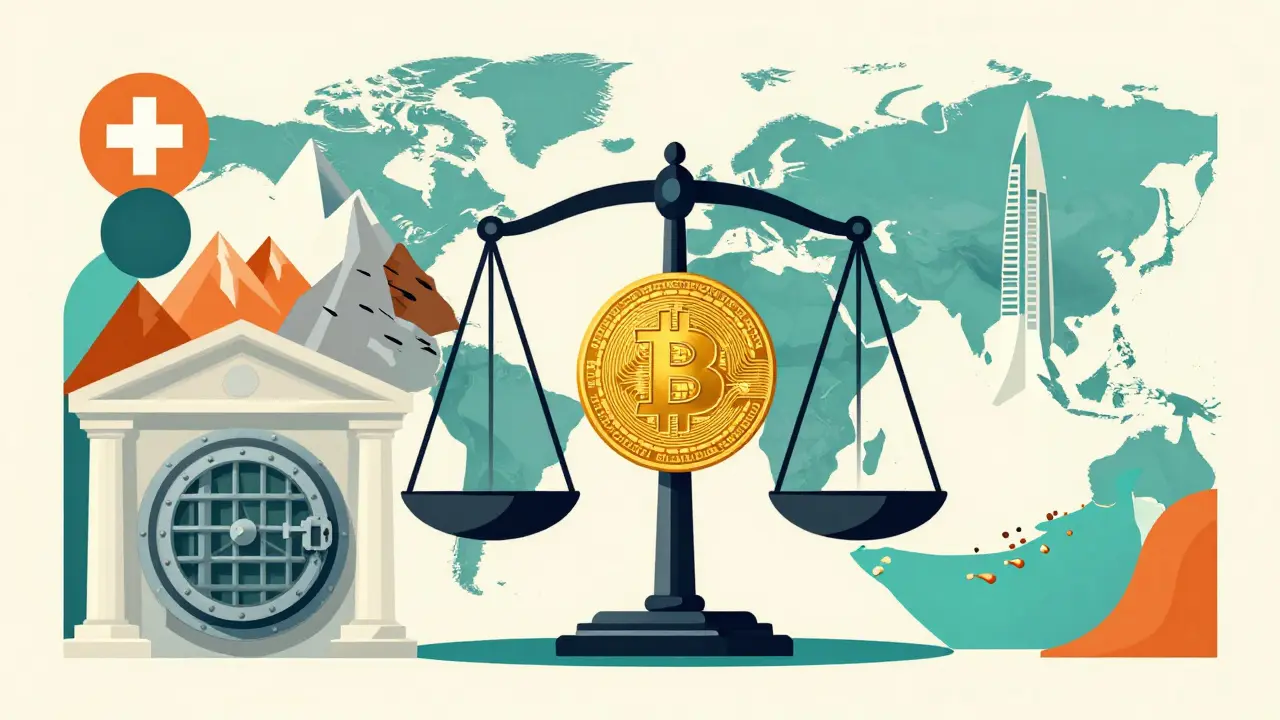
Not every "friendly" spot is right for every business. A DeFi protocol has different needs than a crypto hedge fund or a gaming studio. If you're building a heavy institutional product, Switzerland is your best bet. It's not the cheapest, and it takes 6-8 weeks to get your banking and legal ducks in a row, but the political stability is unmatched. You're operating in a region where banks actually understand how to handle digital assets without freezing your account on a whim.
For those who want to be at the heart of the Asian explosion, Singapore is the place. They have a sophisticated Virtual Asset Service Provider (VASP) licensing system. It's a stricter process-expect to spend 3 to 6 months getting approved-but once you're in, you have a level of credibility that opens doors across Asia.
If you're a lean, digital-first startup, Estonia is a hidden gem. Their e-residency program lets you run a company remotely. You can get your crypto service provider license in about 2-3 months without ever stepping foot in Tallinn. It's the ultimate "laptop lifestyle" jurisdiction.
The Hidden Traps: What to Watch Out For
Don't let a "zero tax" headline blind you to operational risks. For example, while the Cayman Islands are great for taxes, getting a traditional bank account for a crypto-focused business there can be a nightmare. You might have the legal right to operate, but if no bank will touch your money, you're stuck.
Another thing to consider is the "regulatory pivot." Some countries are friendly today because they want to attract wealth, but they might tighten the screws tomorrow. This is why diversifying your legal presence-perhaps having a holding company in one spot and operations in another-is a common move for seasoned founders.
Also, keep an eye on EU-wide regulations. If you're relying on a specific tax break in Portugal or Germany, remember that the EU likes to harmonize rules. A directive from Brussels can overwrite a local tax advantage faster than a flash crash wipes out a leveraged long position.
Step-by-Step Setup Framework
Once you've picked your spot, don't just wing it. Follow this sequence to ensure you're compliant from day one:
- Entity Structuring: Decide if you need a Limited Company, an LLC, or a Foundation. For funds, a Cayman segregated portfolio company is often the go-to.
- Licensing Application: If you're exchanging assets or providing custody, apply for your VASP or DABA license immediately. This is usually the longest part of the process.
- Banking Integration: Find a crypto-native bank or a traditional bank with a dedicated digital asset desk. Do this before you finalize your incorporation to ensure the jurisdiction is actually viable for your specific flow of funds.
- Tax Nexus Setup: Establish where your "mind and management" reside to avoid accidental tax liabilities in your home country.
Which country is truly the most crypto-friendly?
It depends on your priority. For pure tax avoidance and regulatory clarity, the UAE is currently the leader. For those wanting a state-backed Bitcoin ecosystem, El Salvador is the most progressive. For institutional credibility, Switzerland wins.
How long does it take to set up a blockchain business in Singapore?
Getting the basic company registered is fast, but obtaining the necessary VASP licenses for operational approval typically takes between 3 to 6 months due to rigorous compliance checks.
Is Estonia still a good choice for remote crypto founders?
Yes, thanks to the e-residency program. It allows entrepreneurs to manage their business entirely online and provides a transparent legal framework for obtaining service provider licenses within 2-3 months.
What is the main advantage of the Cayman Islands for crypto?
The primary draw is the comprehensive no-tax regime, meaning zero corporate, income, or capital gains taxes, making it ideal for high-volume trading operations and investment funds.
Does Germany really have zero tax on crypto?
In many cases, yes. Germany allows zero tax liability on cryptocurrency holdings if they are held for 12 months or longer, which is a significant advantage within the EU.
Next Steps for Your Launch
If you're just starting, don't try to do this with a generic business lawyer. You need a specialist who understands the difference between a utility token and a security. Your first move should be a feasibility study on 2-3 jurisdictions to compare the actual cost of compliance versus the tax savings.
For those already operating in a restrictive zone, consider a "migration strategy." Instead of moving everything at once, set up a new entity in a friendly jurisdiction and gradually shift your intellectual property and operations over to minimize disruption and tax triggers.
Jimmy vasquez
April 29, 2026 AT 14:15The point about banking integration is honestly the most critical part of this whole process. I've seen so many founders get their legal entity sorted in the Caymans or UAE only to realize three weeks later that no reputable bank will actually open an account for them because they're "high risk". It's a total nightmare. Always vet the banking partners first before you spend a dime on the incorporation fees.
Rushell Perry
April 30, 2026 AT 23:19really glad you mentioned the e-residency in estonia its a game changer for those of us trying to stay lean while growing something meaningful
its me
May 2, 2026 AT 09:45It is interesting how we seek a "sanctuary" for our capital, yet we ignore the ethical void created when we detach our businesses from the societies that actually provide the infrastructure for our existence. We call it optimization, but perhaps it is just a sophisticated form of avoidance. One must wonder if the pursuit of a zero-tax paradise eventually erodes the very purpose of building a sustainable business in the first place, as we trade civic duty for a few extra percentage points in a digital ledger.
Carli Bates
May 4, 2026 AT 07:02imagine actually thinking a "tax haven" is a personality trait lol. sure keep chasing that 0% dream while the regulators eventually figure out how to reach you across borders anyway. it is just such a vibe to think a fancy address in the middle of the ocean makes you a mastermind of finance
Ipsita Seal
May 6, 2026 AT 03:14too much reading for something that basically just says go to the UAE
Andrew Todd
May 6, 2026 AT 10:32USA is the only place that actually matters for real money. These other spots are just for people who are too scared to play in the big leagues or too broke to handle real taxes. Why would anyone want to register a business in some random island or a desert when the real power is right here in the states. All these "havens" are just playgrounds for losers who can't handle a real economy.
Gabrielle Danis
May 7, 2026 AT 08:54To expand on the German tax loophole, it is important to note that this typically applies to private assets. If you are operating as a commercial trader (Gewerbetreibender), the rules change significantly and you may be subject to trade tax and income tax regardless of the holding period. Please ensure you consult with a Steuerberater who specializes in digital assets to avoid costly mistakes.
Janis Naglis
May 8, 2026 AT 13:44This is such a high-value roadmap!!! The synergy between the VASP frameworks and the operational scalability is just incredible...!!! I love how this empowers founders to optimize their cap table and navigate the regulatory moat effectively!!! Keep pushing these boundaries!!!
Barbara Jones
May 9, 2026 AT 14:07definitely agree with the part about bank accounts... i had a friend try this in the past and he spent moonts just tryin to get a basic account open without getting flagged for money launderin. its a real pain in the neck
Kathleen Warren
May 11, 2026 AT 11:47I can see how scary it feels to start a business when you don't know where you fit in legally. For anyone feeling overwhelmed, just remember that you can start small. You don't have to move to Switzerland on day one. Maybe start with something simple like a local LLC and then look into these other options as you grow and your needs change. We are all learning this together.