Cambodia's Banking Restrictions on Crypto Transactions: What You Need to Know in 2026
 Feb, 1 2026
Cambodia’s crypto banking restrictions are some of the strictest in Southeast Asia
When you try to send Bitcoin to a friend in Cambodia, or cash out Ethereum for riel, you hit a wall. Not because the technology doesn’t work - it does. But because the banks won’t let you. Since early 2025, the National Bank of Cambodia (NBC) has enforced a two-tier system that lets only two licensed platforms handle crypto transactions. Everyone else - including big names like Binance and Coinbase - are blocked. The result? A financial system that’s tightly controlled, but also painfully slow and exclusionary for millions of unbanked Cambodians.
How the ban evolved from outright prohibition to controlled access
In 2018, Cambodia didn’t just discourage crypto - it banned it outright. Banks were told not to touch it. Exchanges were shut down. The message was clear: crypto is not legal tender, and we won’t be part of it. But by late 2024, things shifted. Pressure from the U.S. Treasury, which sanctioned Cambodian-linked online scam centers using crypto, forced regulators to rethink. Instead of a blanket ban, they created a narrow legal pathway. Only entities approved by the Securities and Exchange Regulator of Cambodia (SERC) could offer crypto services. And even then, only under strict rules.
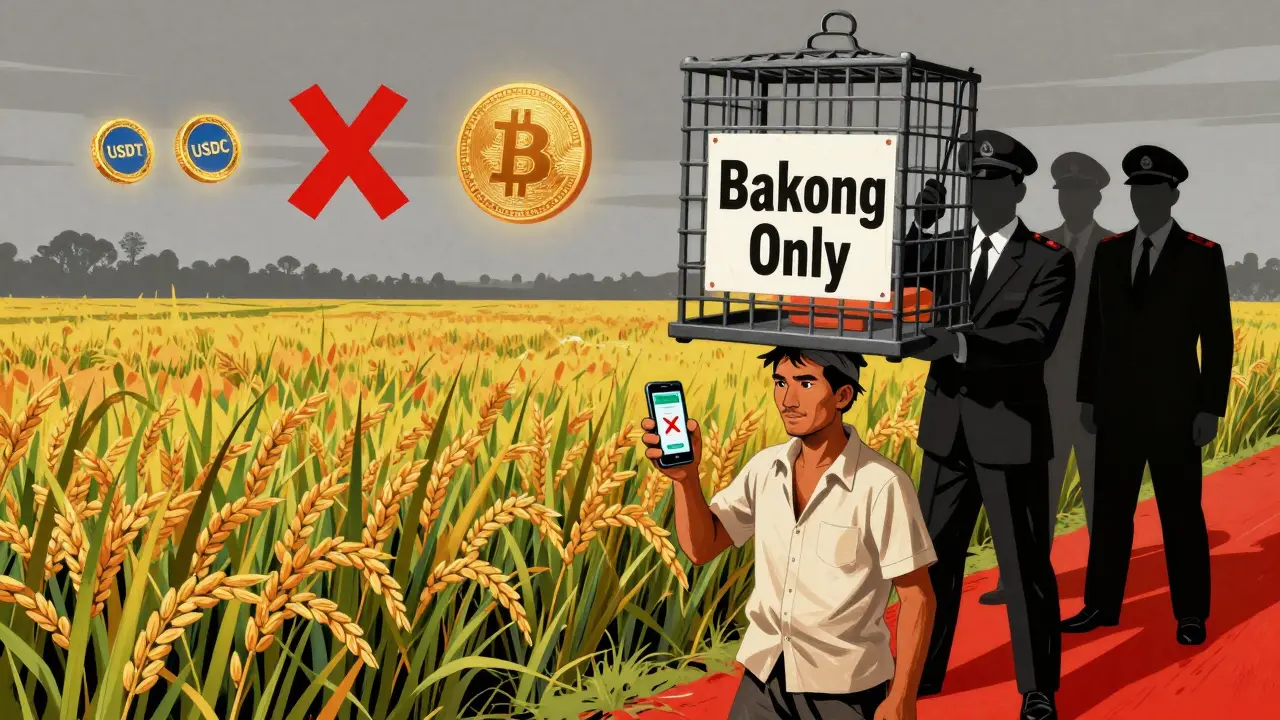
Today, just two players are allowed: Royal Group Exchange and platforms built on Bakong, Cambodia’s own state-backed digital payment system. Everything else - even peer-to-peer trades through Wing Money or other apps - is flagged, frozen, or blocked. The NBC didn’t just say no to crypto. They built a cage around it.
Group 1 vs Group 2: The two types of crypto that matter in Cambodia
The NBC doesn’t treat all crypto the same. It divides assets into two groups. Group 1 includes tokenized securities and stablecoins fully backed by real assets - like USDT or USDC if they’re approved. Banks can hold these, but only up to 15% of their tier 1 capital. Group 2? That’s Bitcoin, Ethereum, Solana - anything not backed by traditional assets. Banks can’t hold these at all. Not on their books. Not in their wallets. Not even as collateral.
This distinction is critical. It means Cambodian banks can facilitate conversions between USDT and riel - but only if you’re using a licensed platform. You can’t buy Bitcoin directly. You can’t send it to an overseas wallet. You can’t use it to pay for goods. The system is designed to let you move in and out of stablecoins, but never hold them as an asset. It’s not about innovation. It’s about control.

Why banks won’t let you use crypto - even if you want to
Imagine you’re a small business owner in Siem Reap. You want to accept crypto payments from tourists. You’re told no. Why? Because the NBC requires banks to screen every transaction against 12 FATF red flags. A $50 transfer from a P2P buyer? Could trigger a 14-day account freeze. No explanation. No appeal. Just silence.
Wing Money users on Reddit report being locked out for weeks after small crypto trades. Trustpilot reviews for licensed platforms show 78% of complaints are about paperwork - needing utility bills, ID copies, proof of income, even letters from employers. The process takes 10 to 15 days. Meanwhile, in Vietnam, crypto remittances clear in 24 hours. In Laos, fees are 4.2%. In Cambodia, they’re 6.8%.
The banks aren’t being stubborn for fun. They’re terrified. After Thailand’s Bitkub exchange collapsed in 2024, wiping out $100 million in customer funds, the NBC decided Cambodia couldn’t afford that risk. So they built a system where only two entities can operate - and even those are capped at $15 million in crypto exposure per bank. ANZ Royal Bank has clients asking for $200 million in services. They can only offer $15 million. The system is broken by design.
The Bakong paradox: A digital payment win, but not a crypto win
Cambodia’s Bakong system is one of the most successful CBDC-like projects in the developing world. Launched in 2020 with help from Japan, it now serves 12.4 million people - 65% of the population. You can pay for street food, bus tickets, or school fees with your phone. No cash needed.
But here’s the catch: Bakong doesn’t connect to open blockchains. It doesn’t let you send crypto. It doesn’t let you hold Bitcoin. It’s a closed-loop digital riel system. The NBC says this is intentional. Governor Chea Chanto said in late 2024: “We won’t recognize private cryptocurrencies until Bakong is stable.”
That’s a problem for financial inclusion. Sixty-eight percent of rural Cambodians have no bank account. Many turned to crypto as their only way to save or send money. Now, they’re locked out. The system that was supposed to bring people in is now keeping them out - not because they lack phones, but because the rules won’t let them use crypto.

Who wins? Who loses? The real impact of Cambodia’s crypto freeze
On paper, Cambodia looks better on paper. Its anti-money laundering rating jumped from “partially compliant” to “largely compliant” in 2024. That’s thanks to the strict controls. The IMF, however, warns this could cost Cambodia $1.2 billion in lost fintech investment by 2027. Startups can’t raise capital. Investors won’t come. Developers leave for Thailand or Singapore.
Meanwhile, the underground market is growing. Chainalysis data shows illicit crypto activity in Cambodia rose 37% in 2024. Why? Because people still need to move money. If the banks won’t let you, you find another way. And that’s where sanctioned entities like Huione Guarantee come in. In 2024, South Korean exchanges processed $8.93 million in USDT transactions with them - a 1,400x jump from the year before. The U.S. Treasury is watching. More sanctions are coming.
For the average Cambodian, the result is simple: you can’t use crypto legally. And if you try, you risk losing your bank account. The only winners are the two licensed platforms - and the criminals who operate outside the system.
What’s next? Tighter controls, more frustration
The NBC’s 2025-2026 roadmap is clear: no more loopholes. All crypto-fiat conversions must be monitored in real time. P2P platforms will be further restricted. Banks must block any transaction linked to unlicensed offshore exchanges - even if they’re based in the U.S. or Singapore.
For enterprise users, it’s still possible. AgriTech startup RiceX raised $2 million in stablecoins through NBC-approved channels. But it took 10 days of paperwork. For individuals? The path is narrow, slow, and full of traps.
There’s no sign the NBC will loosen up. Their priority isn’t innovation. It’s stability. And in a country where inflation is still under 7% while neighbors face 15%, they’ve got a point. But at what cost? Cambodia is choosing control over access. And millions of people are paying the price.
Can you still use crypto in Cambodia in 2026?
Technically, yes - but only if you use Royal Group Exchange or a Bakong-linked platform. You can convert USDT to riel, or vice versa. You can hold stablecoins. But you can’t buy Bitcoin. You can’t send it abroad. You can’t use it to pay bills. And if you try to do it through Wing, Wave, or any other app, your account might vanish for weeks.
The system is designed to make crypto use so frustrating that people give up. And for most, they do.
Crystal Underwood
February 1, 2026 AT 10:49This is what happens when you let technocrats run a country like it’s a corporate compliance audit. Cambodia didn’t ban crypto because it’s dangerous - they banned it because they’re terrified of losing control. The NBC is basically running a financial prison where only two guards get the keys. Meanwhile, real people? They’re locked out while the state’s Bakong system pretends to be innovation. It’s not financial inclusion - it’s financial apartheid with a digital veneer.
And don’t even get me started on how they call USDT ‘Group 1’ like it’s some sacred asset. It’s still a private token. The only difference is the government gave it a badge. That’s not regulation - it’s branding with a side of tyranny.
They think they’re protecting the economy? Nah. They’re just protecting their own power. And when you crush innovation under the weight of ‘stability,’ you don’t get stability - you get a black market that grows like mold in a basement. Chainalysis data doesn’t lie: the underground is booming because the system is broken. The winners? The same people who were already laundering money. The losers? Every Cambodian who just wants to send money to their sister in Phnom Penh without waiting 14 days for a bank to ‘review’ their transaction.
This isn’t policy. It’s performance art for the IMF. And the audience? Millions of people who can’t afford to play by these rules.
Raymond Pute
February 3, 2026 AT 06:08Look, I get the paranoia - but let’s be honest, the NBC’s approach is less ‘financial sovereignty’ and more ‘we didn’t get our CBDC funded by Japan so we’re gonna make crypto the villain.’ The Bakong system is impressive, sure - 12.4 million users is no joke - but the fact that they’ve built this entire digital infrastructure and then deliberately severed it from any open blockchain? That’s not caution. That’s intellectual cowardice.
They’re treating Bitcoin like it’s a virus that’ll infect the riel, when in reality, the real threat is their own institutional inertia. The U.S. Treasury sanctions? That’s a red herring. The real issue is that Cambodia’s financial elite don’t want competition. They don’t want a world where a farmer in Kampong Speu can bypass the banking cartel and send value peer-to-peer. That’s why they’re forcing everyone through Royal Group Exchange - because they own it. It’s not about risk. It’s about rent-seeking disguised as regulation.
And the 6.8% fees? That’s not market pricing - that’s a tax on desperation. In Vietnam, you get 24-hour settlements. In Laos, you pay 4.2%. In Cambodia? You pay 6.8% and wait two weeks for paperwork. That’s not a financial system. That’s a toll road for the poor.
Meanwhile, the startups fleeing to Singapore? They’re not running away from regulation - they’re running away from a government that thinks innovation is a bug, not a feature.
Jack Petty
February 5, 2026 AT 00:26They didn’t ban crypto. They weaponized it.
Now every P2P trade is a potential crime scene. Every $50 transfer? A FATF red flag. The system isn’t designed to stop crime - it’s designed to make everyone feel guilty for trying to use money. The real scam? The government made the only legal way to use crypto so slow and expensive that people start using the *illegal* way - and then they punish them for it.
It’s a trap. A beautiful, bureaucratic trap. And the U.S. is clapping because Cambodia ‘improved’ its AML rating. Congrats. You just turned a country of 17 million people into a financial ghost town where the only people who win are the ones who never had to play by the rules.
Next stop: mandatory crypto KYC at the market stall. Bring your utility bill to buy mangoes.
Meenal Sharma
February 6, 2026 AT 01:01The regulatory framework implemented by the National Bank of Cambodia, while restrictive, must be understood within the broader context of systemic financial vulnerability in developing economies. The absence of robust investor protection mechanisms, coupled with the historical precedent of exchange collapses in neighboring jurisdictions, necessitates a precautionary approach.
It is not merely a matter of control, but of systemic preservation. The elevation of stablecoins under Group 1 reflects a pragmatic concession to market demand, while the exclusion of volatile assets safeguards the integrity of the national financial architecture.
Furthermore, the integration of Bakong as a state-controlled digital infrastructure represents a strategic alignment with long-term monetary sovereignty objectives. The deliberate isolation of this system from decentralized networks is not an oversight, but a calculated safeguard against external volatility and illicit capital flows.
While the short-term exclusion of unbanked populations is lamentable, the long-term stability of the monetary system may ultimately enable broader inclusion - provided the regulatory framework evolves with technological maturity and institutional capacity.
Tressie Trezza
February 6, 2026 AT 09:37I get why the NBC is scared. After Bitkub, who wouldn’t be? But locking people out of crypto isn’t protection - it’s just pushing them into the shadows. What if they let people use crypto, but made it super simple? Like, one-click conversion through Bakong, no 10-page forms, no 14-day freezes? Imagine if a grandma in Battambang could send her grandkid $20 in USDT with a tap.
The real tragedy isn’t the ban. It’s that the government had this beautiful digital payment system - Bakong - and then refused to let it connect to the real world. It’s like building a highway to nowhere. The tech works. The people want it. The only thing stopping it is fear.
Maybe instead of punishing users, they could’ve built a sandbox: let people try crypto with small limits, track everything, learn from mistakes. But nah. They went full lockdown. And now the criminals are laughing while the rest of us just… give up.