Central Bank of Kuwait Crypto Prohibition: Complete Ban on Digital Assets in 2025
 Dec, 21 2025
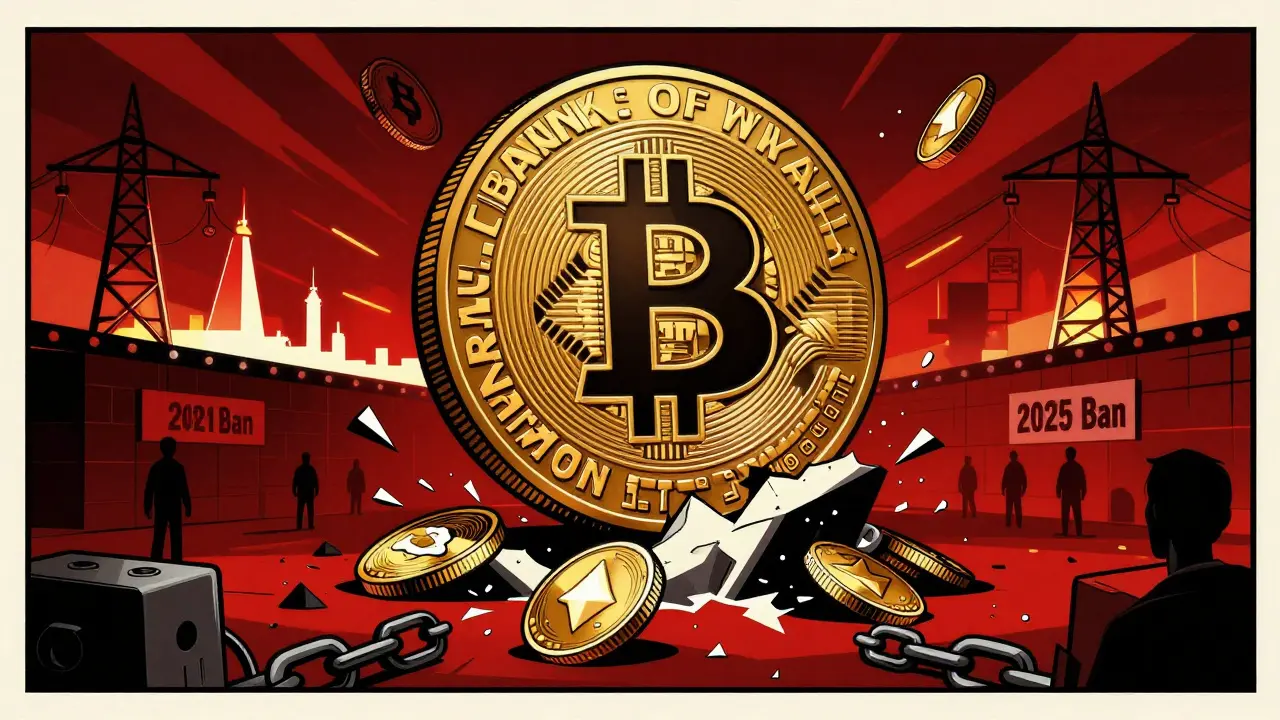
Kuwait doesn’t just discourage cryptocurrency-it bans it completely. Since July 2023, the Central Bank of Kuwait has enforced an absolute prohibition on all cryptocurrency activities, making it the strictest crypto stance in the entire Gulf region. This isn’t a warning. It’s a legal wall. No trading. No mining. No payments. No investments. Not even helping someone else trade crypto is allowed under Kuwaiti law.
What Exactly Is Banned?
The ban isn’t vague. It’s detailed. Four government agencies worked together to close every possible loophole. The Central Bank of Kuwait told all banks and financial firms: don’t touch crypto. No buying, selling, holding, or processing crypto payments. Not even as a middleman. If you’re a bank in Kuwait, your systems can’t even recognize Bitcoin or Ethereum as money. The Capital Markets Authority added that you can’t offer crypto as an investment. No crypto funds. No crypto ETFs. No advising clients to buy Bitcoin. The Insurance Regulatory Unit made it clear: insurance companies can’t cover crypto-related losses. And the Ministry of Commerce and Industry issued a public warning to consumers, telling them crypto is risky, unregulated, and illegal. Mining? Totally outlawed. Even if you’ve got cheap electricity-Kuwait had the lowest Bitcoin mining costs in the world in 2022-running a mining rig is a crime. The government estimates over 1,000 illegal mining operations were found across the country in early 2025. These rigs drain power. They overload grids. In a country where electricity is heavily subsidized, that’s not just wasteful-it’s dangerous.Why Is Kuwait So Strict?
Kuwait’s reasoning isn’t about fear of tech. It’s about control. The Central Bank of Kuwait sees crypto as a threat to its financial system. Unlike the UAE or Saudi Arabia, which are building crypto-friendly zones and testing digital currencies, Kuwait refuses to even consider crypto as money. It’s not legal tender. It’s not property. It’s not recognized in any official transaction. The ban also ties directly to international standards. Kuwait’s move was designed to meet Financial Action Task Force (FATF) Recommendation 15, which pushes countries to prevent money laundering through digital assets. By shutting down crypto entirely, Kuwait says it’s reducing risks like fraud, ransomware payments, and underground finance. There’s also a practical side. Crypto mining in Kuwait used to cost as little as $1,400 per Bitcoin-cheaper than anywhere else on Earth-because electricity is almost free. But mining one Bitcoin uses about 1,400 kWh. Multiply that by thousands of rigs, and you’re talking about power usage rivaling entire countries. The Ministry of Electricity, Water, and Renewable Energy confirmed that illegal mining was causing blackouts and straining infrastructure. Protecting the grid became a national security issue.Who Enforces the Ban?
This isn’t just a banking rule. It’s a full-government crackdown. The Ministry of Interior leads enforcement. They’ve cited specific laws that crypto mining violates: the Industry Law (1996), the Penal Code (1960), the Communications and Information Technology Regulatory Authority Law (2014), and the Kuwait Municipality Law (2016). That means police, not just financial regulators, can raid homes and warehouses where mining rigs are hidden. If you’re caught mining, you’re not just fined. You could face criminal charges. The government has made it clear: violators will be referred to investigative authorities. No warnings. No second chances. Even companies trying to offer crypto services-like wallets or exchanges-are blocked. No licenses have ever been issued. And the government says none will be. The Ministry of Commerce and Industry has been instructed to actively warn businesses that offering crypto services is illegal.
How Does Kuwait Compare to Neighbors?
Kuwait stands alone in the Gulf. While the UAE has Dubai’s Virtual Assets Regulatory Authority, Saudi Arabia has its own crypto sandbox, and Bahrain has licensed exchanges, Kuwait says no. Qatar was once as strict as Kuwait-but in 2025, Qatar’s Financial Centre is preparing to launch a legal framework for digital assets. Kuwait isn’t following. Even more telling: Kuwait is studying a Central Bank Digital Currency (CBDC). That’s important. It means the government isn’t against digital money-it’s against private digital money. They want control. They want a digital dinar issued by the state, not Bitcoin or Ethereum. This distinction matters. Kuwait isn’t anti-tech. It’s anti-decentralization.What About Islamic Finance?
Some assume crypto might be allowed under Islamic law. But Kuwait’s stance doesn’t bend for religion. In fact, the government is strengthening traditional Islamic finance tools. The new Sukuk Law makes it easier to issue Sharia-compliant bonds, giving investors a legal, regulated alternative to crypto. And with the recent passage of the Financing & Liquidity Law, Kuwait can now issue up to KWD30 billion ($97 billion) in public debt-another signal that the government prefers state-backed, transparent financial instruments over unregulated digital assets.
What Happens If You Try to Use Crypto Anyway?
You risk more than losing money. You risk legal trouble. Banks will freeze accounts linked to crypto transactions. The police can seize mining equipment. Fines can be steep. Criminal records are possible. Even sending crypto to a friend could be seen as facilitating illegal activity. There’s no gray area. If you’re in Kuwait, crypto is illegal. Period. No exceptions. No loopholes. No “but I’m just holding it.” The government doesn’t care if you bought it overseas. If it’s in your wallet, or if you mined it here, you’re breaking the law.Is There Any Hope for Change?
Not anytime soon. Kuwait has doubled down since 2023. Enforcement has only gotten tighter. The 2025 crackdown on 1,000+ mining sites shows they’re serious. And with a CBDC in the works, the government is investing in its own digital future-not someone else’s. The message is clear: Kuwait wants financial stability, energy security, and state control. Crypto doesn’t fit that vision. And unless the country’s leadership changes, this ban isn’t going anywhere.Is cryptocurrency legal in Kuwait?
No. Cryptocurrency is completely illegal in Kuwait. The Central Bank of Kuwait and multiple government agencies banned all crypto activities-including trading, mining, payments, and investment-starting in July 2023. There are no exceptions.
Can I mine Bitcoin in Kuwait?
No. Crypto mining is strictly prohibited and considered a criminal offense under Kuwaiti law. Authorities have identified over 1,000 illegal mining operations as of April 2025. Mining rigs are seized, and operators face fines or criminal charges.
Why did Kuwait ban crypto when other Gulf countries are allowing it?
Kuwait prioritizes financial control, energy security, and compliance with international anti-money laundering rules. Unlike the UAE or Saudi Arabia, Kuwait views decentralized digital assets as incompatible with its banking system and infrastructure. It’s also concerned about massive electricity use from mining, which threatens public power supply.
Can I buy crypto overseas and bring it into Kuwait?
Possessing or using crypto in Kuwait is still illegal, regardless of where you bought it. The ban applies to all activities within Kuwait’s jurisdiction. Banks can freeze accounts linked to crypto, and authorities can investigate anyone suspected of using digital assets.
Is Kuwait planning to launch its own digital currency?
Yes. Kuwait is exploring a Central Bank Digital Currency (CBDC)-a government-issued digital version of the Kuwaiti dinar. This shows the country isn’t against digital money; it just wants full control over it. Private cryptocurrencies like Bitcoin remain banned.
What laws are broken by crypto mining in Kuwait?
Crypto mining violates several Kuwaiti laws, including the Industry Law (1996), the Penal Code (1960), the Communications and Information Technology Regulatory Authority Law (2014), and the Kuwait Municipality Law (2016). These cover unauthorized industrial activity, energy misuse, and illegal operation of electronic equipment.
Janet Combs
December 22, 2025 AT 15:08Wow, this is wild. I mean, I get they’re worried about power usage and money laundering, but banning crypto entirely? That’s like banning bicycles because some people use them to steal stuff. At least let people try it and regulate it, don’t just slam the door shut.
Also, 1,000 mining rigs? That’s like a whole secret tech underground. I wanna know who’s running them and if they’re just chilling in AC-free basements with fans blowing on GPUs.
Also also-why does every country seem to be either banning crypto or building their own digital currency? It’s like the world’s having a identity crisis about money.
Sheila Ayu
December 22, 2025 AT 22:33So… you’re telling me… if I send my cousin in Kuwait a single Bitcoin… as a birthday gift… I’m committing a CRIME??
WHAT. IS. THIS. MADNESS.
And they’re banning mining because it uses electricity? But they’re still subsidizing it?? Then why not just charge miners 10x the rate??
They’re not stopping crypto-they’re just making it a black-market sport. And now they’ll have to spend millions policing it. Brilliant.
Also-CBDC? So… they’re fine with a government spy-tracker that monitors every cent you spend… but Bitcoin is evil??
And who wrote this article?? It’s like a government press release with extra steps.
Shubham Singh
December 23, 2025 AT 22:11How is it even possible that a nation with such a robust sovereign wealth fund and oil reserves feels threatened by decentralized finance? The irony is thick enough to spread on toast.
Kuwait’s leadership is not anti-crypto; it is anti-innovation. They fear loss of control, not loss of capital. Their CBDC is not progress-it is digital feudalism.
Meanwhile, India, with its 1.4 billion people and zero infrastructure for crypto, still allows regulated exchanges. But Kuwait, with 4 million citizens and 100% state-controlled energy? They panic at the sight of a wallet.
It’s not about security. It’s about ego.
And yes-I did just compare Kuwait’s policy to a toddler refusing to share their toys.
Radha Reddy
December 25, 2025 AT 04:59As someone from India, where cryptocurrency regulation is still evolving, I find Kuwait’s approach quite rigid-but not entirely surprising.
In many developing nations, financial stability is prioritized over experimental systems, especially when infrastructure is fragile. The energy concerns raised here are valid-electricity grids in hot climates are already under strain.
That said, I respect the clarity of their stance. No gray areas mean no confusion for citizens. And their focus on Sukuk and CBDC shows they’re not rejecting digital finance-they’re choosing a path they believe is sustainable.
Perhaps other nations can learn from their caution, even if they don’t agree with it.
roxanne nott
December 25, 2025 AT 10:11