Code Review Best Practices for Blockchain
 Feb, 7 2026
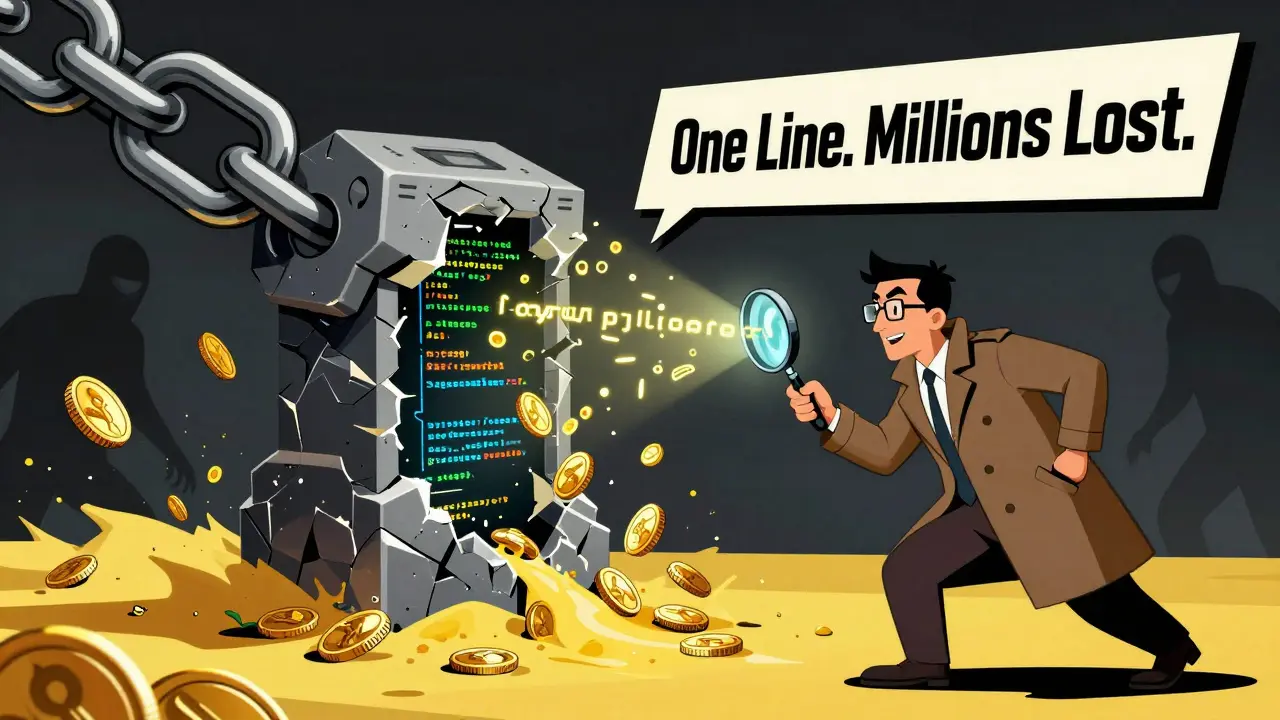
Blockchain code isn’t like regular software. One tiny mistake can cost millions. In 2021, the Poly Network hack drained $610 million because of a flaw that slipped past every review. That’s not a one-off. Since 2016, over $3 billion has been lost to smart contract exploits - and nearly all of them were preventable. The difference between a secure blockchain and a disaster isn’t luck. It’s code review.
Why Blockchain Code Review Is Different
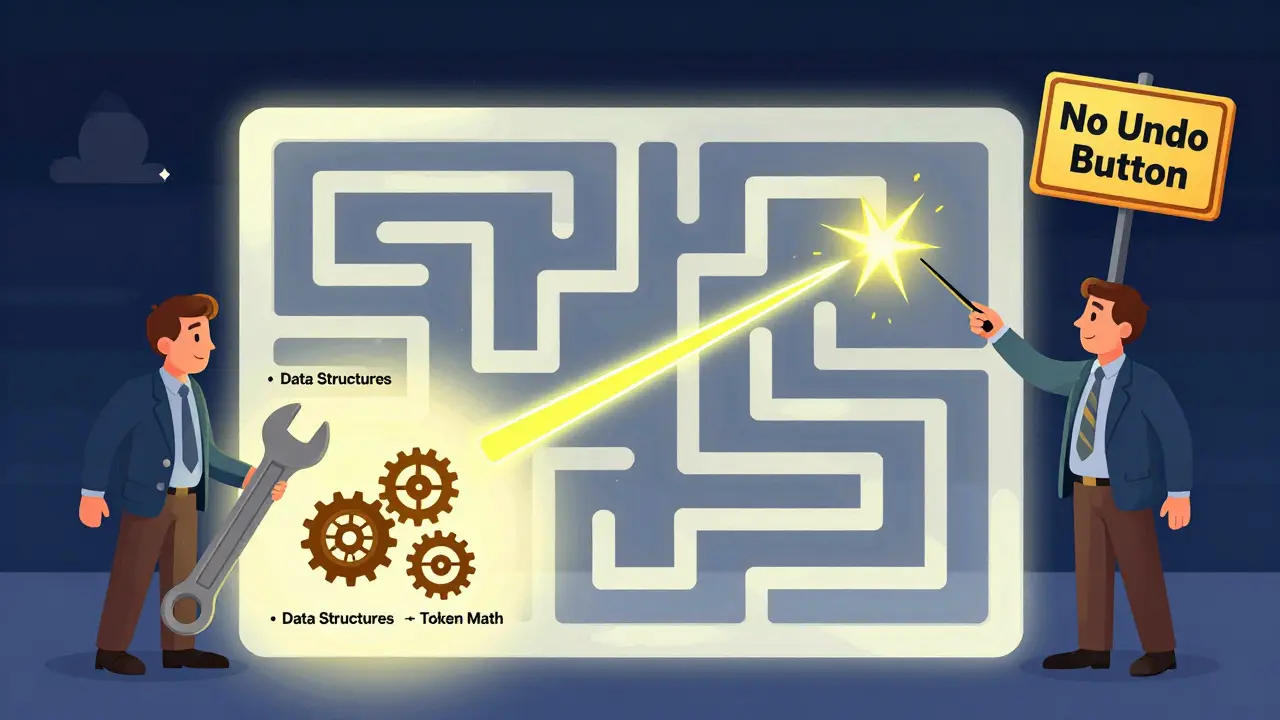
Most software can be patched. If a bug slips into an app, you push an update. Users download it. Problem solved. Blockchain doesn’t work that way. Once code hits the chain, it’s permanent. No backdoors. No undo button. That’s why reviewing blockchain code isn’t just important - it’s the last line of defense. Traditional code reviews look for bugs, performance issues, or messy logic. Blockchain reviews look for exploits. Not just any exploit - the kind that lets someone drain a wallet, freeze funds, or manipulate the entire network. The stakes are higher because the value is concentrated. A single smart contract might hold millions in user funds. If it’s flawed, attackers don’t need to break into a server. They just need to find one line of bad math. Nethermind’s 2022 study found that 73% of smart contract vulnerabilities could be caught before deployment. But only if someone was looking for them the right way.The Two Approaches: Bottom-Up vs Top-Down
There are two main ways to review blockchain code. Neither is better - it depends on your experience. The Bottom-Up Approach is for beginners. Start with the smallest pieces. Look at data structures first - how are addresses stored? How are tokens calculated? Then move up: transaction execution, block validation, consensus rules. Sigma Prime recommends this for anyone new to Ethereum clients. You’re not trying to see the whole system. You’re learning how the parts work before you see how they fail together. The Top-Down Approach is for experts. Start at the entry point - a user call, a transaction, an API endpoint. Trace every path the code takes. Follow the execution like a depth-first search. Where does it branch? Where does it loop? What happens if someone sends a negative value? What if the gas runs out halfway? This method finds logic holes that automated tools miss. It’s faster once you know the system, but it’s useless if you don’t understand how the blockchain engine works under the hood.Automated Tools Are Not Enough
You’ll see tools like SonarQube, OWASP ZAP, or Veracode pushed hard. They’re useful. But they catch maybe 30-40% of the real problems. Why? Because they look for patterns, not intent. A tool can spot a missing check for integer overflow. It can’t tell if a function that transfers tokens should only be callable by the owner - unless that rule is explicitly coded into its database. That’s where humans come in. Sigma Prime’s engineers say this clearly: "LLMs and scanners are for initial understanding, not final security." If an AI suggests a fix, trace the code yourself. Does it really solve the issue? Or does it just move the bug somewhere else? Automated tools are your first filter. They catch the low-hanging fruit: unvalidated inputs, hardcoded keys, duplicate functions. But the real dangers - the ones that cost millions - live in the business logic. Only a person who understands how the protocol is supposed to work can find those.The Five Core Practices
Devcom’s 2023 research boiled blockchain code review down to five non-negotiable practices:- Define clear objectives - Are you reviewing for security? Performance? Compliance? Don’t start until you know what success looks like.
- Combine automated and manual - Use scanners for speed. Use humans for depth. Never pick one over the other.
- Encourage collaboration - The best reviews happen when a smart contract dev, a consensus engineer, and a security auditor all sit together. Different eyes catch different flaws.
- Maintain dynamic checklists - Your checklist isn’t a PDF you print once. It evolves. Every time you find a new vulnerability, add it. Every time a new exploit happens (like the 2023 Wormhole breach), update it.
- Use the right tools - Not all tools are equal. For Ethereum, use Slither and MythX. For Solana, use Solana Analyzer. For Cosmos, use CosmWasm’s built-in linters. Match the tool to the chain.
What to Look For: The Checklist
A good review checklist isn’t a list of buzzwords. It’s a practical guide. Here’s what you need to verify:- Input validation - Are all user inputs checked for size, type, and range? Can someone send a negative number? A zero? A string where a number is expected?
- Error handling - Does the contract fail gracefully? Or does it leak stack traces, private keys, or internal state? Never expose system details.
- Authentication - Who can call this function? Is it restricted? Is multi-factor or signature verification properly implemented? Or is it just "if msg.sender == owner"?
- API security - Are external calls to other contracts checked for reentrancy? Are gas limits respected? Are you using the pull-over-push pattern?
- Infrastructure security - Is the node running on a hardened server? Are RPC endpoints rate-limited? Is the private key stored in a hardware wallet or a secure vault?
- Data protection - Is sensitive data encrypted at rest with AES-256? Is it encrypted in transit with TLS 1.3? Are databases using TDE or column-level encryption?
Why Formal Verification Is the Future
Nethermind predicts that by 2025, 60% of high-value smart contracts will use formal verification. That’s not marketing jargon. It’s math. Formal verification uses mathematical models to prove that a contract behaves correctly under every possible condition. Not 99%. Not 99.9%. Every single path. It’s like proving a theorem - if the logic holds, the code is safe. It’s not magic. It’s slow. It’s expensive. But for DeFi protocols holding billions, it’s becoming standard. Projects like Aave and Compound now use it. It doesn’t replace code review - it complements it. You still need humans to define the rules the math checks against.Industry Trends and Regulatory Pressure
The market is changing fast. In 2022, blockchain security was worth $1.14 billion. By 2032, it’ll be $15.68 billion. Why? Because institutions won’t risk it anymore. 87% of enterprise blockchain projects now require third-party audits before going live. The EU’s MiCA regulation (effective 2024) mandates standardized code review for crypto service providers. That means if you’re running a wallet, exchange, or DeFi app in Europe, you don’t get to skip the review. You’re legally required to have one. And it’s not just Europe. The U.S. SEC is watching. State regulators are starting to require audit reports for token offerings. If you’re not doing proper code review, you’re not just risking funds - you’re risking your license.
Common Mistakes and How to Avoid Them
Here are the top three things teams get wrong:- Waiting until the last minute - Reviews done the day before launch are useless. Start early. Review after every major feature. Make it part of your CI/CD pipeline. 63% of teams now run automated scans on every commit.
- Using one reviewer - One person can miss something. Two can catch more. Three with different backgrounds? That’s when the real flaws surface. Always pair review.
- Ignoring the ecosystem - Your contract doesn’t live in isolation. Are you calling a library that’s been compromised? Are you using a token standard that has known issues? Review the whole stack, not just your code.
What Skills Do Reviewers Need?
You can’t review blockchain code if you don’t understand it. That means:- Knowing how consensus works (PoS, PoA, BFT)
- Understanding cryptographic primitives (signatures, hashing, Merkle trees)
- Experience with smart contract languages (Solidity, Rust, Vyper)
- Familiarity with common attack patterns (reentrancy, overflow, front-running)
- Ability to trace execution flow across multiple contracts
Final Thought: Review Like Your Money Depends On It
Because it does. Every line of blockchain code you ship is a promise to users. A promise that their funds are safe. A promise that the system won’t collapse. That promise isn’t kept by luck. It’s kept by discipline. By process. By people who take the time to look closely. Don’t treat code review as a checkbox. Treat it like a lifeboat. If you skip it, you’re not saving time. You’re gambling with real money - real people’s savings. And in blockchain, there are no second chances.Why can’t blockchain code be patched after deployment?
Blockchain code runs on a distributed ledger that’s designed to be immutable. Once a transaction or smart contract is confirmed and added to the chain, it cannot be altered. Unlike traditional software where updates can be pushed to servers, blockchain systems rely on consensus across thousands of nodes. Changing code after deployment would require rewriting history - which defeats the entire purpose of decentralization and trustlessness. That’s why every line of code must be thoroughly reviewed before it goes live.
Are automated tools sufficient for blockchain code review?
No. Automated tools like SonarQube or Slither can catch common vulnerabilities - such as integer overflows or missing access controls - but they miss about 60-70% of critical flaws. These include logic errors, flawed business rules, and subtle reentrancy patterns. For example, a tool might not realize that a function meant to be called only by the owner can be triggered through a chain of external calls. Only human reviewers with deep blockchain knowledge can identify these issues. Automated tools are a starting point, not a solution.
What’s the difference between a smart contract audit and a code review?
A smart contract audit is a formal, often third-party, security assessment focused specifically on smart contracts - usually delivered as a report. A code review is a broader, ongoing process that includes audits but also covers infrastructure, API design, data handling, and system integration. Think of it this way: an audit is a deep medical scan. A code review is daily health monitoring. Both are necessary. Many teams skip regular reviews and only do audits, which leaves them vulnerable between audits.
How long does a blockchain code review take?
It depends on the size and complexity. A simple token contract might take 1-3 days. A DeFi protocol with multiple interacting contracts, oracles, and governance modules can take 2-4 weeks. For core blockchain nodes (like an Ethereum client), reviews can take 3-6 weeks. The key is starting early. Waiting until the end of development means rushing, and rushing leads to missed flaws. Best practice: review incrementally as features are built.
Do I need to hire an external firm for code review?
Not always, but it’s strongly recommended for anything handling significant value. Internal teams often miss blind spots because they’re too close to the code. External auditors - like Halborn, Sigma Prime, or Certus - bring fresh eyes and experience from hundreds of audits. For high-value projects (DeFi, exchanges, institutional use cases), third-party audits are now standard. Many investors and regulators require them. For small projects, a well-structured internal review with multiple reviewers can work - but never skip the checklist.
Oliver James Scarth
February 8, 2026 AT 23:29Let’s be brutally honest: if your blockchain code isn’t reviewed like it’s the last gate before Armageddon, you’re not a developer-you’re a financial arsonist. The fact that $3 billion has vanished because people treated smart contracts like WordPress plugins is not a bug-it’s a systemic failure of humility. I’ve seen teams deploy with ‘it works on my machine’ and wonder why the world burned down. No more. Every line must be dissected like a bomb defusal. There is no ‘soon.’ There is only now. And if you’re not reviewing like your reputation, your investors’ capital, and your own sanity depend on it-you’re already late.
Kieren Hagan
February 10, 2026 AT 01:47The bottom-up vs top-down approach is spot-on. I’ve reviewed over 120 contracts across Ethereum, Solana, and Polygon. Beginners who jump into top-down end up lost in the weeds of gas optimization while missing a trivial reentrancy. And experts who stick to bottom-up? They miss the forest for the trees. The real skill is knowing when to switch modes. I always start bottom-up for new teams, then pivot to top-down once the core logic is understood. Tools like Slither are great for initial scans, but they’ll never catch a flawed access control that only makes sense in the context of your tokenomics. Human intuition + structured methodology = the only reliable combo.
sachin bunny
February 11, 2026 AT 16:08Olivette Petersen
February 12, 2026 AT 09:39This is the kind of post that reminds me why I love this space. Yes, the stakes are terrifying-but that’s also what makes this work so meaningful. Every review is a chance to protect someone’s life savings. I’ve been on teams where we caught a vulnerability that would’ve drained a $40M pool just because we took an extra day to trace a function call. It’s not glamorous. It’s not viral. But it matters. Keep pushing for rigor. Keep demanding better. The future of finance is being written in these lines of code-and we’re the ones holding the pen.
Michelle Anderson
February 14, 2026 AT 05:29Formal verification? Cute. You think math saves you? Look at the Wormhole hack. They used formal verification. Still got roasted. The truth? No amount of math fixes bad architecture. If your protocol requires 12 external calls to mint a token, no verifier in the world will help. Stop fetishizing tools and start asking: why does this even exist? Why is it this complicated? The real vulnerability isn’t in the code-it’s in the arrogance of the devs who thought they could outsmart chaos.
Paul Gariepy
February 14, 2026 AT 11:07Just wanted to say-this is one of the clearest, most practical breakdowns I’ve seen. I’ve been doing this for 8 years, and I still re-read this every time I onboard a new dev. The five core practices? Non-negotiable. Especially #4: dynamic checklists. We used to have a static PDF. Then we lost $2.3M because we didn’t update it after the 2022 zkSync exploit. Now we automate it. Every new exploit gets added to our Notion page. Team gets pinged. We pause deployment. No exceptions. It’s not sexy. But it works. And yes, pairing reviews? Mandatory. One person misses the edge case. Two people? Suddenly you see the whole picture.
Molly Andrejko
February 15, 2026 AT 22:23Thank you for writing this. I’ve been trying to convince my team that code review isn’t a bottleneck-it’s the foundation. Too many devs treat it like a hurdle to clear before launch. But if you build review into every sprint, it becomes part of the culture. We started doing 15-minute ‘review huddles’ after daily standups. Just one contract, one feature. No pressure. Just curiosity. And guess what? We caught three critical issues in the last month that automated tools missed. It’s not about perfection. It’s about persistence. Keep showing up. Keep looking closer. The system will thank you.
perry jody
February 16, 2026 AT 16:53Love this. The part about ecosystem review hit home. We once thought our contract was solid-until we realized we were using a deprecated token standard that had a known front-running flaw. We didn’t even touch that code. But it was in our dependencies. Now we scan all third-party contracts with Slither + manual review before integration. Also, yes-start early. I’ve seen teams delay review until the day before mainnet. That’s not a timeline. That’s a suicide note. Build review into CI. Make it a gate. No merge without it. Simple. Non-negotiable. And if your CI pipeline doesn’t have a review step… you’re already hacked.
Paul Jardetzky
February 17, 2026 AT 09:10Agreed with everything. But let’s talk about the human factor. The best reviewers aren’t the ones with the most certs. They’re the ones who ask, ‘What happens if…’ over and over. That’s the mindset. Not ‘is this correct?’ but ‘could this be weaponized?’ I had a junior dev ask, ‘What if the owner’s wallet gets hacked?’ We hadn’t even considered it. That one question led to a multi-sig overhaul that saved $18M. So yes, tools help. But curiosity? That’s the real superpower.