Compliance Challenges in DeFi: What You Need to Know in 2026
 Mar, 5 2026
DeFi was supposed to be the future of finance - no banks, no middlemen, just code running on a blockchain. But in 2026, that dream is running headfirst into reality. Governments aren’t ignoring it anymore. Regulators are stepping in, and the rules they’re writing don’t fit neatly into smart contracts. If you’re using DeFi, you’re already caught in the middle of a regulatory storm - whether you realize it or not.
Why DeFi Doesn’t Fit the Old Rules
Traditional finance runs on paperwork, licensed institutions, and centralized control. Banks verify your identity. Exchanges log your transactions. Regulators audit records. DeFi flips all that. You interact with a smart contract using a wallet address. No name. No government ID. No human in the loop. That’s the beauty - and the problem. The core issue? DeFi is a financial system built on permissionless, decentralized networks with no single entity responsible for compliance. When a bank fails to report a suspicious transaction, there’s a clear person to hold accountable. When a DeFi protocol like Uniswap or Aave is used to move laundered funds, who do you sue? The developers? The users? The blockchain itself?The Regulatory Wall: MiCA, FATF, and the Travel Rule
In 2024, the European Union’s Markets in Crypto-Assets Regulation (MiCA) became fully enforceable. It’s the first comprehensive DeFi rulebook. MiCA doesn’t just apply to exchanges - it targets decentralized protocols that offer services like lending, trading, or staking. If your DeFi app lets users swap tokens or earn interest, you’re now a regulated entity. Then there’s the Financial Action Task Force (FATF) Travel Rule. Updated in 2025, it requires any service handling crypto transfers over €1,000 to share sender and receiver details. That sounds simple - until you realize DeFi doesn’t have accounts. It has wallet addresses. And those addresses aren’t tied to real names. To comply, DeFi projects are forced to build KYC layers on top of their protocols. Some do it at the front-end: users must verify their identity before connecting their wallet. Others embed compliance into the smart contract itself - which is technically impossible without breaking decentralization. The result? A patchwork of half-solutions that undermine the original promise of DeFi.How Cross-Chain Laundering Makes Compliance Harder
Illicit actors don’t stay on one chain. They move money across Ethereum, Solana, Polygon, Arbitrum, and even Bitcoin’s sidechains. This is called cross-chain laundering. Each chain has different reporting standards. Some have no monitoring tools. Others are too slow to update. Regulators can’t keep up. A wallet might receive stolen funds on Ethereum, swap them for stablecoins on Uniswap, bridge them to Solana, then convert into privacy coins like Monero. By the time authorities trace the trail, the money’s already scattered. DeFi protocols can’t monitor every chain. They don’t have the infrastructure. And even if they did, it would require massive computational power and global data-sharing agreements - which don’t exist yet.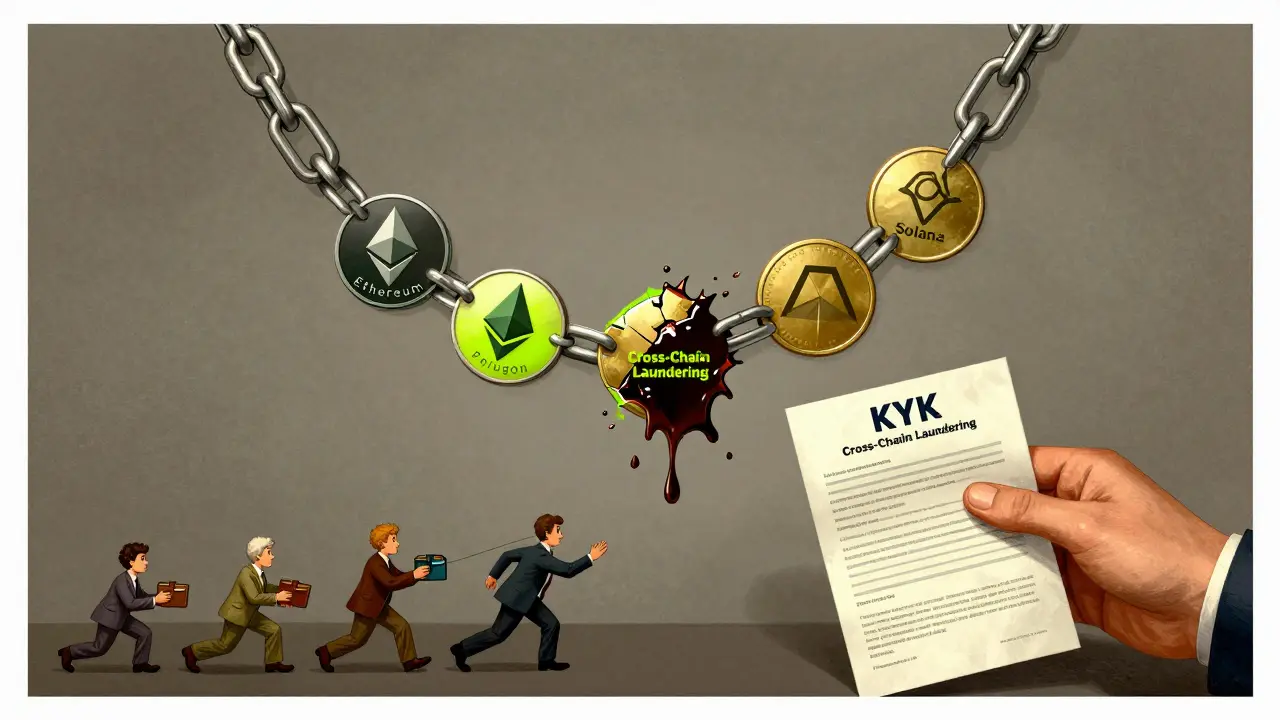
The Custody Problem: Who Owns Your Assets?
In traditional finance, your money is held by a bank or broker. The SEC requires these custodians to be licensed and insured. But in DeFi, you hold your own keys. Your assets are locked in a smart contract - maybe in a liquidity pool on Curve, or staked on Lido. No third party controls them. No bank holds them. That’s freedom - until regulators come knocking. The U.S. SEC’s Custody Rule (Rule 206(4)-2) says investment managers must keep client assets with a qualified custodian. In 2025, the SEC settled a case with Galois Capital for $225,000 - not because they lost funds, but because they didn’t use a regulated custodian. That’s a wake-up call. If you’re managing crypto for clients through DeFi, you’re already in violation.AI, Social Engineering, and the New Attack Surface
The biggest risks today aren’t code bugs. They’re people. As DeFi becomes more mainstream, it’s drawing in users who don’t understand blockchain. That’s a goldmine for scammers. AI-generated deepfakes impersonate project teams. Fake support chats trick users into signing malicious transactions. Phishing sites mimic popular DeFi dashboards. In 2025, over 60% of DeFi losses came from social engineering - not hacks. Regulators now demand AI-native transaction monitoring. That means systems that don’t just flag large transfers, but detect behavioral patterns: a user suddenly sending funds to 15 new wallets in 10 minutes, or interacting with a known mixer after a large deposit. Building this requires machine learning models trained on blockchain data - something most DeFi teams can’t afford.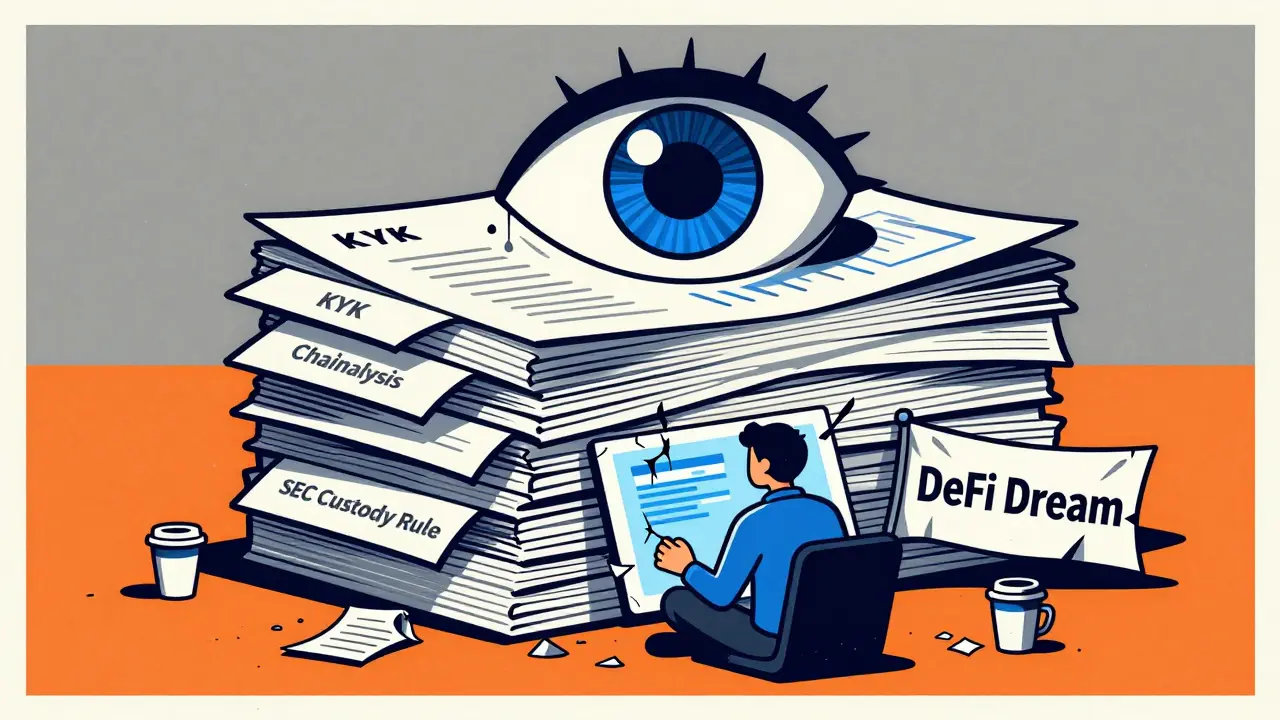
The Cost of Compliance Is Killing Small Projects
Implementing compliance isn’t just hard - it’s expensive. A small DeFi startup might spend $500,000 on KYC integration, blockchain analytics tools (like Chainalysis or Elliptic), legal counsel, and ongoing audits. That’s money most early-stage teams don’t have. The result? A two-tier system. Big players like Aave, Compound, and Uniswap can afford compliance. Smaller protocols get pushed out. Or worse - they ignore the rules and get shut down by regulators. The decentralized dream is becoming a monopoly of the well-funded.What Happens If You Ignore Compliance?
If you’re a retail user, you might think: "I’m just swapping tokens. What’s the harm?" But regulators don’t care if you’re a user or a developer. If your wallet interacts with a non-compliant protocol that’s later flagged for money laundering, you could be flagged for suspicion. In some countries, simply using a mixer or bridge to obscure transaction history is enough to trigger a financial investigation. In 2025, the UK’s FCA froze the assets of a DeFi lending platform that didn’t implement KYC. In South Korea, unlicensed DeFi apps were banned outright. In the U.S., the IRS started requiring users to report DeFi income - even if they didn’t cash out. You don’t need to be a company to be caught in the net. Your wallet address is now a target.The Future: Compliance or Collapse?
DeFi can’t stay wild forever. Regulators aren’t going away. The question isn’t whether DeFi will comply - it’s how. Some projects are trying to build "regulatory-friendly" protocols. Think of them as DeFi with guardrails: automated KYC at the wallet level, real-time AML flags, and compliance modules baked into smart contracts. It’s clunky. It’s not fully decentralized. But it’s the only path forward. Others are doubling down on privacy - using zero-knowledge proofs to prove compliance without revealing identity. ZK-Tech is still experimental, but projects like Tornado Cash are testing the limits. Will regulators accept privacy-preserving compliance? Maybe. But right now, they’re still in "prove you’re not a criminal" mode. The next five years will decide DeFi’s fate. Will it become a regulated financial sector - slow, safe, and boring? Or will it die under the weight of its own ideals?One thing’s clear: if you’re using DeFi today, you’re not just investing in crypto. You’re betting on whether freedom can survive regulation.
Is DeFi illegal?
No, DeFi itself isn’t illegal. But many DeFi protocols operate without licenses, which makes them non-compliant with financial regulations in most countries. Using DeFi isn’t against the law - but interacting with unregulated platforms can put you at risk of being flagged for money laundering or tax evasion. Regulators are targeting platforms, not users - but users are still being caught in the crossfire.
Do I need to do KYC to use DeFi?
Not always - but increasingly yes. Many DeFi apps now require KYC before you can connect your wallet. This is especially true for protocols that offer lending, staking, or yield farming. If you’re a retail user and you want to avoid KYC, you can still use decentralized exchanges like Uniswap without identity verification - but you’ll be limited to smaller transactions and may not be able to access certain features. The trend is clear: KYC is becoming standard, not optional.
What happens if I use a DeFi protocol that gets shut down?
If a DeFi protocol is shut down by regulators, your funds may be frozen or locked in the smart contract. Unlike banks, there’s no insurance or recovery system. You might lose access to your assets permanently. In some cases, regulators will seize the protocol’s treasury or freeze associated wallet addresses. There’s no guarantee you’ll get your money back - even if you did nothing wrong.
Can I be taxed on DeFi transactions?
Yes. The IRS, HMRC, and other tax agencies treat DeFi transactions like taxable events. Swapping tokens, earning interest, or providing liquidity can trigger capital gains or income tax. Even if you don’t cash out, you still owe taxes. Many users don’t realize this - and end up with penalties. Tools like Koinly or TokenTax help track DeFi activity, but it’s your responsibility to report it.
Are there any DeFi platforms that are fully compliant?
A few are trying. Aave and Compound have added KYC options for institutional users. Some newer protocols, like Maple Finance and Centrifuge, are built specifically for regulated lending. But no DeFi protocol is fully compliant in the traditional sense - because true decentralization and strict regulation are still at odds. The most compliant DeFi apps are hybrids: they offer a decentralized layer for users who don’t need KYC, and a regulated layer for institutions.
Christina Young
March 7, 2026 AT 02:25DeFi isn’t dying. It’s being force-fed regulatory steroids until it collapses under its own weight. No one asked for KYC layers on smart contracts. This isn’t innovation - it’s corporate capture dressed up as compliance.
Steven Lefebvre
March 8, 2026 AT 15:31I get why regulators are scared - crypto moves fast, and money laundering is real. But the solution isn’t forcing DeFi to act like a bank. It’s building new tools that work with blockchain, not against it. We need on-chain identity verification that doesn’t kill decentralization, not more middlemen.
nalini jeyapalan
March 8, 2026 AT 23:05You think this is bad? Wait till the SEC starts auditing individual wallet addresses. They already have the tech. They just need the political will. And they’ll get it. Every time someone uses a mixer, they’re handing regulators another reason to shut down the whole ecosystem. This isn’t about crime - it’s about control.
Drago Fila
March 9, 2026 AT 20:36Look, I’m all for freedom, but let’s be real - DeFi can’t be a free-for-all forever. People are getting scammed daily. AI deepfakes are making fake Aave apps that drain wallets. We need guardrails, not chaos. The question isn’t whether we regulate - it’s how we do it without killing the innovation.
Jeffrey Dean
March 10, 2026 AT 21:32The entire premise is flawed. You assume regulation is inevitable. What if the real answer is to let DeFi exist outside the state’s jurisdiction entirely? Governments don’t own money. Blockchains do. The moment you try to force compliance, you betray the entire philosophy. This isn’t a problem to solve - it’s a revolution to preserve.
Brian T
March 11, 2026 AT 04:10So what? People lose money. Big deal. That’s capitalism. Why are we treating crypto like it’s supposed to be safe? If you can’t handle the risk, don’t touch it. Stop trying to make DeFi a bank. It never was one.
Issack Vaid
March 11, 2026 AT 16:50Let’s not pretend this is about money laundering. It’s about power. Regulators don’t want to stop crime - they want to control the flow of value. The moment a protocol becomes truly permissionless, it threatens their monopoly on finance. That’s why MiCA and the Travel Rule are designed to fail - not to protect, but to dominate.
And yes, I’m aware this sounds like a conspiracy theory. But ask yourself: why do the same three firms - Chainalysis, Elliptic, CipherTrace - get hired by every regulated DeFi platform? Coincidence? Or a cartel?
Shawn Warren
March 12, 2026 AT 07:59Compliance costs are killing innovation and that is a fact not a opinion
Small teams cannot afford legal teams and blockchain analytics
So they vanish
And what remains is a few big names that can pay the toll
This is not evolution
This is consolidation disguised as regulation
Jackson Dambz
March 13, 2026 AT 23:20The idea that users are being "caught in the crossfire" is a romanticized fantasy. If you’re using DeFi, you’re participating in a system designed to evade oversight. You’re not a victim. You’re a participant. And if regulators come after you, you have no moral high ground. Stop pretending this is about freedom - it’s about accountability.
Megan Lutz
March 15, 2026 AT 15:23Here’s the uncomfortable truth: DeFi’s greatest strength - anonymity - is also its fatal flaw. You can’t have a financial system that operates outside the law and expect to survive in a world governed by nation-states. The solution isn’t to ban it. It’s to evolve it. ZK-proofs, decentralized identity, and on-chain compliance modules aren’t compromises - they’re the next iteration. The dream wasn’t to escape regulation. It was to build a better one.