Core Principles of Web3 Technology Explained Simply
 Jan, 9 2026
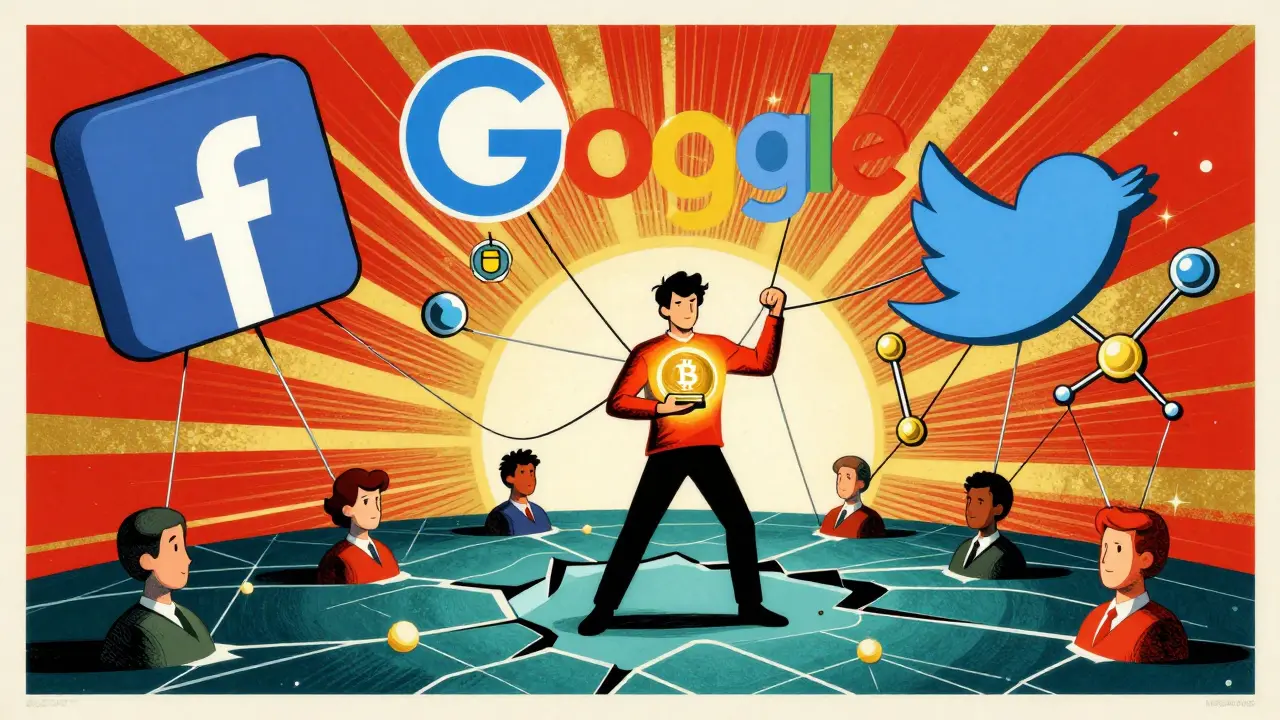
Web3 isn’t just another tech buzzword. It’s a rewrite of how the internet works-putting power back in your hands instead of big companies. If you’ve ever felt like your data, your content, or your digital stuff belongs to Facebook, Google, or Twitter more than it belongs to you, Web3 is the answer people are building. It’s not about faster apps or prettier interfaces. It’s about ownership. Real ownership. And it’s built on blockchain technology.
What Web3 Actually Means
Web3 is the third generation of the internet. Web1 was the early web-read-only. You visited websites, read articles, and that was it. Web2 came next: social media, apps, comments, likes, uploads. But here’s the catch: you created all the content, and companies made billions off it. They sold your data, tracked your habits, and controlled your accounts. You didn’t own anything-not really. Web3 flips that. It’s read-write-own. You read, you write, and you own what you create. Your digital photos, your music, your in-game items, even your profile-those aren’t stored on a company’s server. They’re yours. Locked in a crypto wallet you control. No middleman. No lockouts. No bans.Decentralization: No More Single Points of Control
Think about how your bank works. You trust them to hold your money. If they go down, you’re stuck. Same with Facebook-if they shut down your account, you lose years of memories. Web3 removes those single points of failure. Instead of one company running a server, Web3 uses thousands of computers around the world, all connected in a network. This is called decentralization. No single entity owns it. No CEO can delete your NFT. No board can change the rules overnight. The rules are written in code-on the blockchain-and enforced by everyone participating. Ethereum, the main blockchain powering most Web3 apps today, runs on over 100,000 nodes. That’s not just a backup system-it’s the entire foundation. If one node goes offline, the network keeps going. That’s resilience.User Ownership: Your Data, Your Wallet, Your Rules
In Web2, your identity is tied to an email and password. In Web3, your identity is tied to a crypto wallet. Think of it like a digital keychain. You hold the private keys. No one else can access your assets unless you give them permission. That means:- You own your NFTs-no platform can take them away.
- You own your digital art, music, or collectibles-sell them anywhere, anytime.
- You can prove you created something without relying on a corporation to verify it.
Native Payments: No Banks, No Fees, No Delays
In Web2, if you want to pay someone online, you go through PayPal, Stripe, or your bank. They take a cut. They hold your money. They can freeze your account. Web3 removes all that. Transactions happen directly between users using cryptocurrency. No bank. No middleman. No waiting days for a wire transfer. A payment can settle in seconds-even across borders. And because it’s built into the protocol, every app can accept it. A game, a marketplace, a social platform-all use the same money: ETH, SOL, or other tokens. That’s why DeFi (decentralized finance) exploded. Platforms like Uniswap let you swap crypto without a bank. You lend, borrow, earn interest-all without anyone asking for your ID. It’s financial freedom, built into code.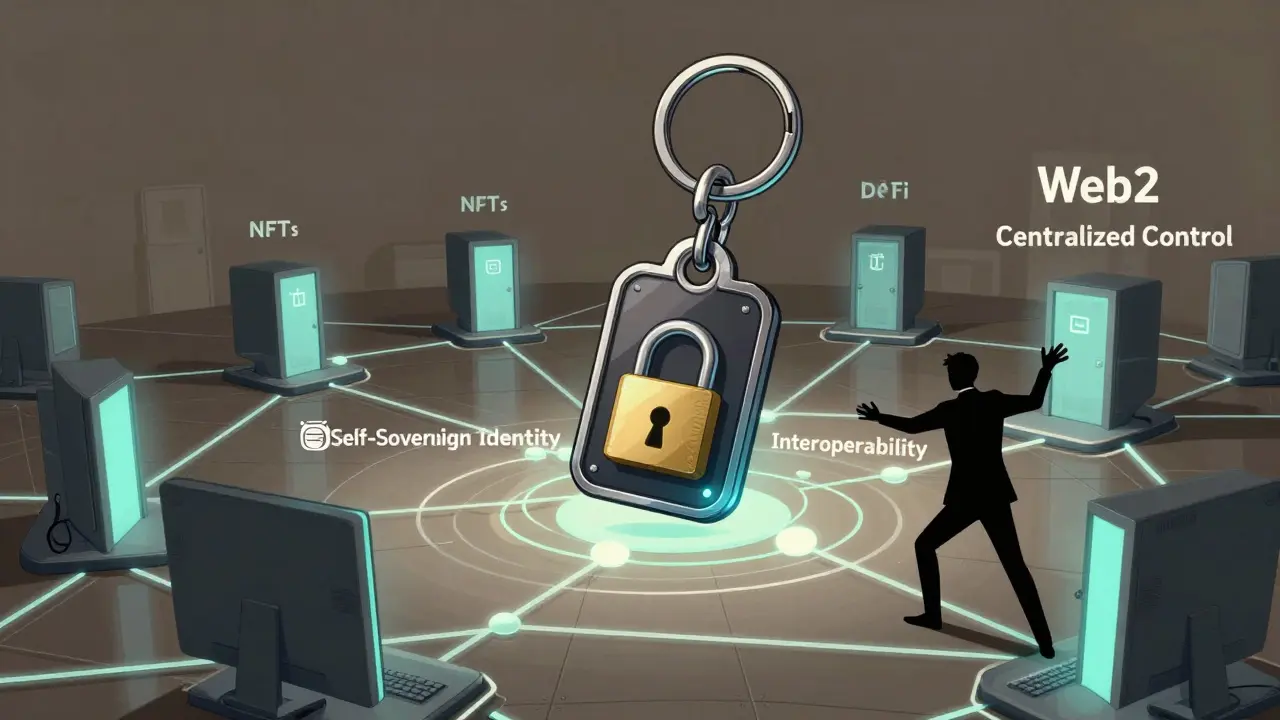
Trustlessness: Don’t Trust. Verify.
Web3 doesn’t ask you to trust a company. It asks you to verify the code. You don’t need to believe that a platform is honest. You can look at the smart contract-the code running the app-and check it yourself. If it’s open-source (which most are), anyone can audit it. That’s called trustlessness. It’s not about mistrusting people-it’s about removing the need to trust institutions. For example, when you buy an NFT on OpenSea, you’re not trusting OpenSea to hold it for you. You’re trusting the Ethereum blockchain to record the transaction. Once it’s confirmed, the NFT is yours. OpenSea can’t take it back. They’re just a storefront. This changes everything. No more shady terms of service. No more hidden fees. If the code says you get 5% royalties on resales, you get them. Period.Interoperability: Your Stuff Works Everywhere
In Web2, your Spotify playlist doesn’t work on Apple Music. Your Instagram followers don’t show up on TikTok. Your game skins are locked to one platform. Web3 breaks those walls. Because everything is built on open protocols and standardized tokens, your digital assets can move across apps. An NFT you buy on one marketplace can be used in a game on another. A token earned in a virtual world can be spent in a different one. This is interoperability. It’s like the internet finally got a universal language. No more walled gardens. No more vendor lock-in. Your digital life becomes portable.Why Web3 Still Struggles
Let’s be real: Web3 isn’t perfect. It’s messy. And right now, it’s hard to use. Most people quit after their first try. Why? Because managing a crypto wallet feels like doing taxes in a foreign language. Lose your seed phrase? Your money is gone-forever. No customer support can help you. That’s not a bug-it’s a feature. But it’s terrifying for newcomers. Then there’s speed. Ethereum, the backbone of Web3, handles only 15-20 transactions per second. Visa handles 24,000. That’s why gas fees spike during busy times. A simple NFT mint can cost $200. That’s not sustainable. Layer-2 solutions like Arbitrum and Optimism are fixing this. They’re like express lanes on the blockchain, handling thousands of transactions per second at a fraction of the cost. But most users still don’t know they exist. And regulation? Still a mess. The SEC is chasing tokens like they’re securities. Europe is trying to create rules. The U.S. is stuck in political gridlock. That uncertainty scares off big companies.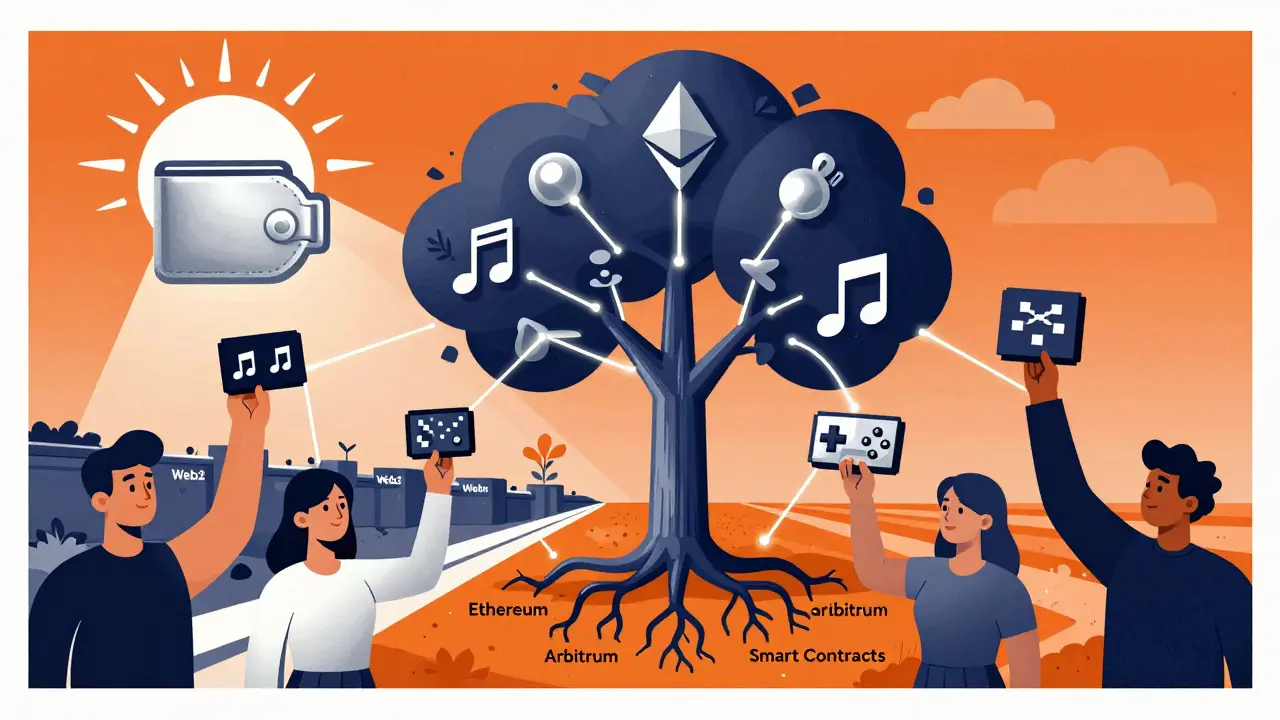
Who’s Actually Using Web3?
Despite the hurdles, real people are using it-and loving it. There’s ConstitutionDAO, where 17,500 people pooled $47 million in ETH to try and buy a rare copy of the U.S. Constitution. They didn’t own it together-they just funded the bid. That’s collective ownership in action. On Reddit, users say things like: “I finally feel like my digital stuff is mine.” After losing two Twitter accounts with years of content, they found crypto wallets and never looked back. NFT marketplaces like OpenSea hit $23 billion in sales in 2021. DeFi platforms handled over $1 trillion in trades between 2020 and 2023. That’s real economic activity-not speculation. And enterprises? 61% of Fortune 500 companies are experimenting with blockchain. Not for crypto. For supply chain tracking, loyalty programs, and digital certificates. They see the value in verifiable ownership.Where Web3 Is Headed
The Ethereum Merge in 2022 cut energy use by 99.95%. That killed the biggest criticism: “Blockchain is bad for the planet.” Now, upgrades like Dencun (coming in early 2024) will slash layer-2 costs by up to 90%. That’s a game-changer. More wallets are getting user-friendly. MetaMask now has social recovery. You can recover your wallet using trusted friends-not just a 12-word phrase. Governance tokens let communities vote on changes. If a project wants to update its rules, it doesn’t go to a CEO. It goes to the token holders. That’s democracy in action. The goal isn’t to replace the internet. It’s to fix its broken incentives. Web3 doesn’t need to be perfect. It just needs to be better than what we have.How to Get Started
You don’t need to be a coder to start with Web3. Here’s how:- Get a wallet: Install MetaMask (browser extension) or Trust Wallet (mobile app).
- Buy a little ETH: Use Coinbase or Kraken to buy $10-$20 worth.
- Send it to your wallet: Never send crypto to an exchange address. Only to your wallet.
- Try a simple dApp: Visit a decentralized marketplace like OpenSea or a lending platform like Aave.
- Write down your seed phrase: On paper. Not in a note on your phone.
Final Thought: It’s Not About Tech. It’s About Power.
Web3 isn’t about blockchain. It’s not about NFTs. It’s not even about crypto prices. It’s about who controls the internet. Right now, it’s a handful of corporations. Web3 says: let the users decide. It’s messy. It’s slow. It’s confusing. But it’s real. And it’s growing. The question isn’t whether Web3 will work. The question is: do you want to be part of it-or still be the product?Is Web3 the same as cryptocurrency?
No. Cryptocurrency is one tool Web3 uses-like money. Web3 is the whole system: decentralized apps, user-owned data, blockchain networks, and smart contracts. You can have crypto without Web3 (like Bitcoin as just digital gold). But Web3 needs crypto to function.
Can I lose my money in Web3?
Yes-and no one can help you. If you lose your private key or seed phrase, your assets are gone forever. There’s no “forgot password” button. That’s why security is critical. Never share your keys. Never click random links. Always verify smart contract addresses before interacting.
Do I need to be tech-savvy to use Web3?
Not anymore. Wallets like MetaMask and Trust Wallet are designed for regular users. You don’t need to understand cryptography. You just need to know how to click “Connect Wallet” and confirm a transaction. The hard part is learning the risks-not the tools.
Is Web3 just for investors and speculators?
No. While speculation drove early adoption, real use cases are growing fast. Artists sell NFTs directly to fans. Musicians earn royalties on every resale. Gamers own their skins and trade them across platforms. Communities govern apps with tokens. Web3 is becoming a platform for ownership-not just trading.
What’s the biggest risk in Web3?
The biggest risk isn’t hacking or scams-it’s losing control of your keys. Most losses come from users misplacing their seed phrases or falling for phishing scams. The technology is secure. The human element isn’t. Education is the best defense.
Will Web3 replace the regular internet?
Not replace-augment. Most websites will still be centralized. But for things that matter: identity, ownership, money, and governance-Web3 will become the default. Think of it like email: you still use Gmail, but now you can also use a self-hosted, encrypted version. Web3 gives you that choice.
Ritu Singh
January 9, 2026 AT 19:13Web3 is just the elite’s new way to control us under the guise of freedom
They say ‘own your data’ but really they just want you to pay gas fees to prove you exist
Every time I see someone bragging about their NFT monkey I think: this is what capitalism looks like when it runs out of ideas
No one actually uses this stuff daily-it’s all theater for rich guys with crypto wallets
And don’t get me started on ‘decentralization’-the top 10 wallets own 40% of all ETH
It’s not liberation-it’s rebranding exploitation with blockchain glitter
They took power from Big Tech and gave it to crypto bros who think ‘HODL’ is a philosophy
Wake up. This isn’t the future. It’s the same pyramid scheme with a new logo
kris serafin
January 10, 2026 AT 02:04Yessss!! 🚀 This is exactly what the internet needed!
Finally, something where I don’t feel like a product
My NFT art collection? Mine. No one can delete it. No algorithm can bury it.
And the best part? I sold one last week and got paid in ETH-no bank, no wait, no fees 😍
Web3 isn’t perfect-but it’s the first time tech actually put users first
Try MetaMask, buy $5 worth of ETH, and mint a free NFT on Foundation. Just to feel what ownership is like.
Trust me-you’ll never go back to ‘user accounts’ again. 🌐✨
Jordan Leon
January 11, 2026 AT 10:02While the enthusiasm for Web3 is understandable, I find myself hesitant to embrace its ideological framing.
Ownership, as described, assumes a level of technical literacy and economic access that remains inaccessible to most.
The notion of ‘trustlessness’ is rhetorically elegant but practically precarious-human error, not protocol failure, is the dominant vector of loss.
Moreover, the energy required to maintain these networks, even post-Merge, remains nontrivial.
And while interoperability is a noble goal, the fragmentation of standards across chains introduces new silos.
I admire the ambition, but I question whether this model scales ethically-or if it merely displaces power rather than democratizing it.
Perhaps the real innovation lies not in blockchain, but in reimagining digital rights within existing structures.
Rahul Sharma
January 11, 2026 AT 16:58Web3 is good for small artists and creators.
Before, Instagram took 30% of my sales. Now I sell NFTs directly.
No middleman. No rules. I keep 100%.
My daughter drew a cat. I made 10 NFTs. Sold all in 2 hours.
She got $80. That’s her first real money from art.
Web3 is not for everyone. But for those who create? It’s life-changing.
Start small. Learn one thing. Don’t listen to the hype. Just try it.
Wallet. ETH. MetaMask. That’s all you need.
Gideon Kavali
January 12, 2026 AT 13:56THIS IS THE MOST IMPORTANT TECHNOLOGICAL SHIFT SINCE THE INVENTION OF THE INTERNET-AND YOU’RE ALL TALKING ABOUT NFT MONKEYS?!
WE’RE NOT TALKING ABOUT ‘CRYPTO’-WE’RE TALKING ABOUT THE FOUNDATION OF CIVIL LIBERTY IN THE DIGITAL AGE!
WHEN A CORPORATION CAN DELETE YOUR ACCOUNT, THEY OWN YOU!
WEB3 ISN’T ‘A CHOICE’-IT’S A CIVIC DUTY!
THE SEC IS TRYING TO CRUSH FREEDOM UNDER THE PRETENSE OF ‘REGULATION’!
IF YOU DON’T OWN YOUR IDENTITY, YOU’RE NOT FREE-YOU’RE A SLAVE TO SILICON VALLEY!
STOP BEING A COWARD. GET A WALLET. LEARN THE KEYS. STAND UP.
THEY WANT YOU TO THINK IT’S TOO COMPLICATED-SO THEY CAN KEEP CONTROLLING YOU!
THEY’RE AFRAID OF YOU BEING ABLE TO OWN YOUR OWN DATA!
THIS ISN’T TECHNOLOGY-THIS IS A REVOLUTION!
AND IF YOU’RE NOT ON THE RIGHT SIDE OF IT, YOU’RE ON THE SIDE OF OPPRESSION!
Allen Dometita
January 13, 2026 AT 07:33Man, I tried Web3 last year and got scared off by the seed phrase thing 😅
But then I saw my buddy use it to get paid for his music-no label, no waiting, just straight ETH
So I gave it another shot-got MetaMask, bought $10 ETH, connected to a cool little art site
And boom-I uploaded my doodles and sold one for $15
Didn’t even need to understand blockchain
Just clicked ‘connect’ and ‘mint’
Now I feel like I actually made something that’s mine
Yeah, it’s weird at first-but it’s like learning to ride a bike
Once you get past the fear, it just… works
And honestly? It’s kinda fun now 🤙
Brittany Slick
January 13, 2026 AT 08:34I used to think Web3 was just a hype cycle… until I saw a 72-year-old grandma in Ohio mint her first NFT of her quilt patterns.
She didn’t care about crypto prices or gas fees.
She cared that her life’s work couldn’t be erased by a corporate policy change.
That’s the quiet magic of this-no fanfare, no influencers.
Just people reclaiming what was always theirs.
It’s not about becoming rich.
It’s about no longer being afraid to lose what you’ve made.
And that? That’s worth the learning curve.