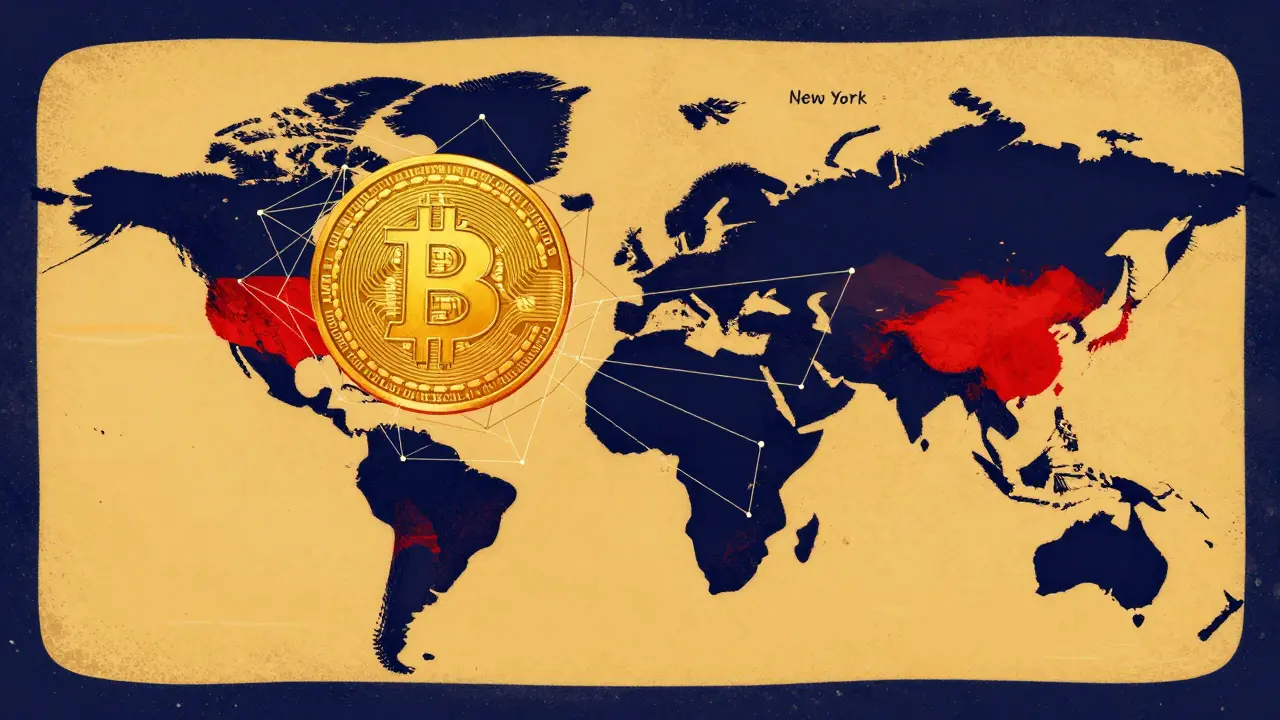
Cross-Border Crypto Monitoring: How International Authorities Track Digital Assets in 2026
 Apr, 22 2026
| Focus Area | Key Mechanism | Primary Goal |
|---|---|---|
| Identity Tracking | Travel Rule / KYC | Link wallets to real people |
| Regional Law | MiCA (EU) / BSA (US) | Standardize business licenses |
| Illicit Flow | Blockchain Analysis | Stop sanctions evasion & money laundering |
The Digital Paper Trail: Understanding the Travel Rule
If you use a centralized exchange, you've already encountered the most powerful tool in the regulator's kit. Travel Rule is a regulatory requirement where Virtual Asset Service Providers (VASPs) must share sender and receiver information for transactions exceeding a specific threshold. In the United States, this benchmark is set at $3,000. When a transfer hits this mark, the exchange doesn't just send the coins; it sends a digital packet of data containing the name, address, and account numbers of both the sender and the beneficiary. This isn't just a US quirk. The Financial Action Task Force (or FATF) is a global money laundering and terrorist financing watchdog that set these standards for hundreds of countries. Because the FATF coordinates these rules, it creates a "domino effect." If one country refuses to enforce the Travel Rule, they risk being grey-listed, making it nearly impossible for their local banks to interact with the global financial system.Who Is Actually Watching? The Power Players
Monitoring isn't handled by one single "global crypto police" force, but rather a network of agencies that share data. In the US, the Financial Crimes Enforcement Network (known as FinCEN) is the primary agency tasked with analyzing transactions to combat domestic and international money laundering. They treat crypto businesses as financial institutions under the Bank Secrecy Act (BSA). This means an exchange isn't just a tech platform; it's legally viewed as a money transmitter. Meanwhile, the European Union has taken a more structured approach with MiCA (Markets in Crypto-Assets) which is a comprehensive regulatory framework that provides a single set of rules for crypto-assets across all EU member states. While the US often regulates by enforcement (suing companies after the fact), MiCA creates a clear licensing roadmap. If you want to operate in Europe, you must prove you have the tech to monitor transactions in real-time and report suspicious activity immediately.
The Cat-and-Mouse Game: How Authorities Fight Obfuscation
Regulators know that sophisticated actors don't just send Bitcoin in a straight line. They use "layering"-a process of moving funds through multiple wallets to hide the source. To counter this, authorities are focusing on three specific vulnerabilities:- VPNs and Geofencing: Sanctioned individuals often use Virtual Private Networks to appear as if they are in a legal jurisdiction. Authorities now use advanced device fingerprinting to see past the VPN and identify the user's true location.
- Mixing Services: Tools that scramble the origin of coins are now huge red flags. If a wallet's history shows it interacted with a known mixer, many exchanges will freeze the funds immediately upon deposit, demanding a full "Proof of Funds" audit.
- Unhosted Wallets: This is the final frontier. A wallet on a hardware device (like a Ledger) doesn't have a KYC process. FinCEN has pushed for rules requiring banks to verify the identity of anyone transferring funds to an unhosted wallet, effectively bridging the gap between the regulated and unregulated worlds.
The Transatlantic Alliance: A New Standard for Compliance
One of the most significant shifts in 2025 and 2026 has been the formation of the UK-US Transatlantic Task Force. For years, the lack of coordination meant that a crypto firm could simply move its headquarters to a more "friendly" country. This task force is designed to kill that strategy. By aligning their standards on stablecoins, custody, and disclosures, the UK and US are essentially creating a "gold standard" for regulation. When these two massive capital markets agree on a rule, most other countries follow suit to ensure their own firms can still trade in London or New York. This bilateral cooperation makes cross-border crypto monitoring far more effective because it removes the gaps where illicit funds used to hide.
Practical Implications for Businesses and Users
If you're a business integrating crypto payments, you can't just ignore the legal side. Many companies now use licensed Third-Party Providers to handle the "rails" of the transaction. This allows them to accept stablecoins without having to build their own massive AML (Anti-Money Laundering) department. However, the risk remains: if your partner has weak KYC processes, you could inadvertently facilitate a transaction for a sanctioned entity, which carries heavy penalties. For the average user, this means the days of "no-KYC" exchanges are fading. Even instant exchange services, which used to be a loophole for converting fiat to crypto without ID, are being pressured by banking partners to implement identity checks. If a service doesn't have a way to verify who you are, it will likely lose its ability to process credit cards or bank wires.Does the Travel Rule apply to all crypto transactions?
No, it primarily applies to transactions between Virtual Asset Service Providers (VASPs). In the US, the threshold is generally $3,000. Small transfers between private wallets (peer-to-peer) generally aren't covered by the Travel Rule, though they can still be flagged by blockchain analysis tools if they link to illegal activity.
Can authorities actually track private wallets?
While they can't see your name on the blockchain, they use "heuristics." By analyzing patterns-such as when you move funds from a private wallet to a KYC-verified exchange-they can link a physical identity to a set of anonymous addresses. Once that link is made, every transaction that wallet ever made becomes visible.
What is the difference between MiCA and US regulation?
MiCA is a comprehensive, written law that covers the entire EU, providing a clear license for providers. US regulation is more fragmented, involving multiple agencies like the SEC and CFTC, and often relies on court cases and enforcement actions to set precedents.
What happens if a crypto company ignores these monitoring rules?
The consequences are severe. They can face massive fines, the loss of their operating license, and in extreme cases, criminal charges for executives. Regulators have increasingly used "deferred prosecution agreements" where companies pay billions in fines to avoid total shutdown.
Will stablecoins be treated differently than Bitcoin?
Yes. Because stablecoins are pegged to fiat currencies, they are often viewed as "monetary instruments." Regulators are imposing stricter reserve requirements and monitoring on stablecoin issuers to ensure they don't trigger a systemic financial crash.
Ali Tate
April 25, 2026 AT 15:17just another attempt by the decaying western hegemony to shackle the digital frontier with their archaic red tape truly a symphony of bureaucratic mediocrity designed to keep the plebeians in line while the elite play by different rules it's practically laughable how they think a few PDFs from the FATF can stop the inevitable tide of decentralization
Benjamin Forg
April 26, 2026 AT 16:00the travel rule is just the tip of the iceberg they want a total digital panopticon where every single satoshi is tagged to a biometric ID and probably linked to your social credit score it starts with crypto then it is everything else the globalists are just consolidating the grid to make sure we can never actually opt out of their financial slavery again wake up people
Greg Reynolds
April 27, 2026 AT 23:11Actually, the notion that this effectively ends the 'wild west' era is a fundamental misunderstanding of how privacy coins and atomic swaps operate. While centralized exchanges are now essentially arms of the state, the core protocol of blockchain remains immutable and permissionless. Most users simply lack the technical literacy to move away from KYC platforms, which creates an illusion of total control for the regulators. They aren't actually stopping the flow; they are just narrowing the gates through which the average person enters. Furthermore, the Transatlantic Task Force is largely performative, as the fundamental divergence between the SEC's enforcement-led approach and the EU's legislative approach remains too wide to bridge with a simple agreement on stablecoins. It's an exercise in optics rather than a genuine structural change in the nature of the technology.
Guy Bianco
April 29, 2026 AT 18:07It is certainly a complex transition for everyone involved. :) We should strive to understand these regulations as a way to bring legitimacy to the asset class, even if it feels restrictive to some. Learning to navigate these waters is the best way to ensure long-term stability for our portfolios. 💼
Larry Yang
May 1, 2026 AT 11:14imagine thinking this is actually a "sophisticated web" when it's basically just a giant database of names and numbers lol. totaly overestimating the competence of governmnt agents who still use excel spreadsheets from 2005. its cute how they think they're playing 4D chess while the real players are just using basic privacy tools they dont even know exist
praveen subbiah
May 2, 2026 AT 05:57Oh man this is just wild! India is going to absolutely crush this space with our own systems and we won't even need to follow these Western scripts! Our brilliance will shine through and we will lead the digital world while these other guys are still arguing about their little task forces! It is just so exciting to see the shift in power happening right now! Absolute glory to our tech scene!