Crypto Taxation in Australia: How CGT Rules Affect Your Gains
 Dec, 2 2025
Crypto Capital Gains Tax Calculator
How This Calculator Works
Calculate your potential capital gains tax liability for cryptocurrency transactions in Australia. This tool applies ATO rules including the 50% discount for holdings over 12 months.
Transaction Details
How to Use
Enter transaction details from your cryptocurrency sale or trade. The tool will calculate your capital gains tax based on ATO rules and your tax bracket.
Important: This tool assumes your cost base includes purchase price and transaction fees. For accurate calculations, you must track all costs including exchange fees and acquisition costs as per ATO guidelines.
This calculator is for informational purposes only. It does not constitute tax advice. Always consult with a qualified tax professional for your specific circumstances.
When you sell, trade, or spend cryptocurrency in Australia, the Australian Taxation Office (ATO) treats it like selling a piece of property-not cash. That means every time you move crypto, you might owe capital gains tax (CGT). It doesn’t matter if you bought Bitcoin in 2020 and sold it in 2025, or traded Ethereum for Solana last week. The ATO sees each transaction as a taxable event.
What Triggers a CGT Event?
You don’t need to cash out to crypto to AUD to trigger tax. Any disposal counts:- Selling crypto for Australian dollars
- Trading one crypto for another (like BTC for ETH)
- Spending crypto to buy goods or services
- Gifting crypto to someone who isn’t your spouse
- Paying transaction fees in crypto
Even paying a network fee using Bitcoin counts. If you used 0.001 BTC to pay a $5 fee, you’ve triggered a CGT event on that 0.001 BTC. You need to calculate its value in AUD at the time you sent it, then subtract your original cost base. The difference is your capital gain-or loss.
How the 50% CGT Discount Works
The biggest relief for Australian crypto investors is the 50% CGT discount-if you hold your asset for more than 12 months. This isn’t a loophole. It’s a rule that applies to all capital assets, from shares to real estate to crypto.Here’s how it breaks down:
- Held less than 12 months: Full capital gain added to your taxable income. Taxed at your marginal rate (19% to 45% + 2% Medicare levy).
- Held 12 months or more: Only half the gain is taxed. Your effective tax rate drops by nearly half.
Example: You bought 1 ETH for $2,500 in March 2024. You sell it in May 2025 for $4,000. Your capital gain is $1,500. Because you held it over 12 months, only $750 is taxable. If you’re in the 37% tax bracket, your tax bill is $277.50-not $555.
That’s why so many Australians wait. A University of Sydney survey in January 2025 found 78% of crypto holders intentionally keep assets over 12 months to qualify for the discount. It’s not just smart-it’s financially essential for anyone with meaningful gains.
What About Personal Use?
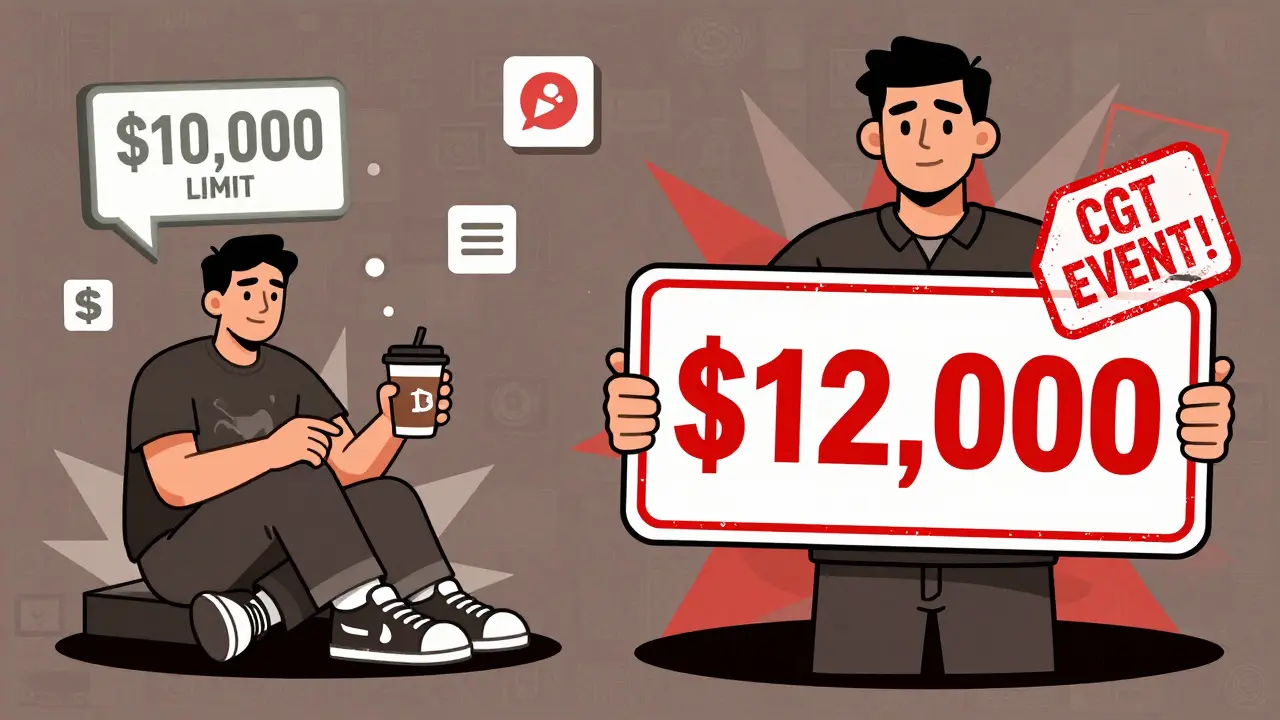
There’s a common myth: if you spend crypto on a coffee or a pair of shoes, it’s tax-free. Not quite.The ATO allows a personal use asset exemption-but only if two conditions are met:
- The crypto was used to buy goods or services for personal use or consumption
- The total value of the crypto used was $10,000 or less
So if you bought a $9,000 laptop with Bitcoin you bought for $5,000, you’re fine. No tax. But if you bought a $12,000 NFT as a gift? That’s a CGT event. The ATO doesn’t care if you “meant it as a gift.” If the value exceeds $10,000, it’s taxable.
And here’s the trap: if you bought $8,000 worth of crypto in January and spent $5,000 in February on a vacation, then spent another $4,000 in March on a phone, you’ve triggered a CGT event on the second $4,000. The $10,000 limit applies to the total value of all personal use purchases in a single financial year-not per transaction.
Cost Base Calculation: It’s Not as Simple as Buy Low, Sell High
Your cost base isn’t just what you paid. It includes:- Price paid for the crypto
- Transaction fees paid in AUD
- Costs to acquire it (e.g., exchange fees, withdrawal fees)
The ATO requires the specific identification method. That means you must track exactly which coins you bought, when, and for how much. You can’t use FIFO (first in, first out) unless you’re using software that tracks it correctly.
Imagine you bought:
- 0.5 BTC on Jan 15, 2024, for $28,000
- 0.3 BTC on June 10, 2024, for $32,000
- 0.2 BTC on Dec 5, 2024, for $35,000
You sell 0.6 BTC on July 1, 2025, for $40,000. Which coins did you sell? If you sell the first 0.5 BTC ($28,000) and 0.1 BTC from the second purchase ($10,667), your cost base is $38,667. Your gain is $1,333. If you’d sold the most expensive coins instead, your gain would be lower. The ATO lets you choose-but you must document your choice.
Staking, Airdrops, and Mining: Income, Not Capital Gains
This is where people get tripped up. If you earn crypto through staking, mining, or airdrops, it’s treated as ordinary income, not capital gain.You pay tax on the AUD value of the crypto when you receive it. For example:
- You earn 2 SOL from staking on April 10, 2025, worth $400. That $400 is added to your taxable income.
- You get a 100-token airdrop from a new DeFi project. Each token is worth $0.50. That’s $50 taxable income.
- You mine Bitcoin and receive 0.05 BTC valued at $3,000. That’s $3,000 in income.
Later, if you sell that staked SOL, you’ll pay CGT on any gain above the $400 value you already paid tax on. You’re taxed twice-but on different events: income when received, CGT when sold.
The ATO confirmed this in its 2025 guidance and backed it up in the Commissioner of Taxation v Bitcoin Trader case (2024), where mining rewards were ruled as assessable income.
Traders vs. Investors: The Line Is Thin
If you’re buying and selling crypto frequently-say, 100+ trades a year-you might not be an investor. You might be a trader.The ATO doesn’t define “trader” by numbers alone. They look at:
- Frequency of trades
- Systematic approach (e.g., using charts, leverage, day trading strategies)
- Business-like organization (dedicated workspace, trading journal, software)
- Intent to profit from short-term price movements
If you’re classified as a trader, the ATO treats your crypto activity like a business. That means:
- No 50% CGT discount applies
- All gains are taxed as ordinary income
- You can claim business expenses (software, internet, education)
But you also open yourself up to audits. The ATO’s 2025-26 compliance program specifically targets traders with over 100 transactions. One user on Reddit reported being audited after filing 117 trades in one year-even though they held some assets long-term. The ATO said their pattern showed “commercial intent.”
There’s no clear line. If you’re unsure, assume you’re an investor unless you’re running a structured trading operation.

Record Keeping: Your Best Defense
The ATO doesn’t just ask for records. They demand them. And they’re getting better at getting them.Since February 2025, major Australian exchanges-including Swyftx, CoinSpot, and Independent Reserve-have been sharing transaction data directly with the ATO under the Tax Agent Services Act 2009. That means if you traded on these platforms, the ATO already has your records.
You need to keep:
- Date of each transaction
- Type of transaction (buy, sell, trade, transfer)
- Amount and type of crypto
- AUD value at time of transaction
- Cost base for each asset
- Wallet addresses involved
Most people spend 15-20 hours a year just gathering this data. A CoinLedger survey found 42% of users struggle with cost base tracking, especially when they’ve bought crypto on multiple exchanges or received airdrops.
Third-party tools like Koinly, CoinTracker, and CryptoTaxCalculator are used by 67% of Australian crypto investors. They connect to exchanges, auto-import transactions, and calculate gains using the ATO’s rules. Many users say it’s the only way to stay sane.
What’s Changing in 2026 and Beyond?
The ATO isn’t slowing down. In May 2025, Treasury released a draft proposal for a centralized crypto reporting system. If passed, exchanges would have to report all transactions over $10,000. That’s not just for Australians-foreign exchanges that serve Australian users may also be required to report.By Q2 2026, the Digital Asset Data Exchange (DADX) will go live. It will link exchange data, wallet addresses, and tax filings. KPMG predicts compliance rates will jump from 65% to over 85% by 2027.
Staking and DeFi are next on the ATO’s list. Right now, there’s ambiguity around whether liquidity provision rewards are income or capital gains. The ATO says it will clarify by 2026. Expect new guidance on yield farming, automated market makers, and wrapped tokens.
But the 50% CGT discount? That’s safe. EY’s Jane Kelly says it’s “politically popular.” The government won’t touch it. It’s the one rule Australians love-and the reason so many hold crypto for the long term.
What to Do Now
If you’ve traded crypto in the 2024-25 financial year:- Export all transaction history from every exchange and wallet.
- Use a crypto tax tool to calculate your cost base and gains.
- Separate income (staking, airdrops) from capital gains.
- Apply the 50% discount only to assets held over 12 months.
- File your return by October 31, 2025.
If you’re planning to sell:
- Wait until you’ve held it 12 months and one day.
- Use capital losses from previous years to offset gains.
- Don’t assume small purchases are tax-free-check the $10,000 limit.
- If you’re trading often, talk to a tax professional before filing.
The system isn’t perfect. It was built for stocks and real estate, not 24/7 volatile digital assets. But it’s clear. And if you follow the rules, you won’t get hit with penalties-or a surprise tax bill.
Do I pay tax if I just buy crypto and hold it?
No. Buying crypto is not a taxable event. You only pay tax when you dispose of it-sell, trade, spend, or gift it. Holding crypto, even for years, doesn’t trigger any tax liability.
Can I use losses from one crypto to offset gains from another?
Yes. Capital losses from selling one cryptocurrency can be used to offset capital gains from selling another. You can carry forward unused losses to future years. For example, if you lost $5,000 on an NFT and gained $8,000 on Bitcoin, you can reduce your taxable gain to $3,000.
What if I transferred crypto between my own wallets?
No tax is owed. Transferring crypto between wallets you own-even across different exchanges-is not a disposal. The ATO only taxes sales or trades to third parties. But you still need to track the cost base for future sales.
Are airdrops and staking rewards taxed twice?
Technically, yes-but it’s not double taxation. You pay income tax when you receive the reward. Then, if you later sell it, you pay CGT on the gain above that original value. For example, if you received 10 tokens worth $100 and sold them for $300, you paid tax on $100 as income and $200 as capital gain.
What happens if I don’t report my crypto gains?
The ATO has direct access to exchange data and can match your filings with your transactions. If you don’t report, you’ll likely get a notice. Penalties range from 25% to 75% of the unpaid tax, plus interest. In serious cases, it can lead to criminal charges for tax evasion. Most people who get caught didn’t mean to cheat-they just didn’t know the rules.
Do I need to report crypto if I made a loss?
Yes. Even if you lost money, you must report all disposals. This lets you claim the loss to offset future gains. If you don’t report it, you lose the right to use that loss later. The ATO requires full disclosure, not just profitable trades.
Is there a tax-free threshold for crypto gains?
Yes. The $18,200 tax-free threshold applies to crypto gains just like regular income. If your total taxable income-including crypto gains-is below $18,200, you pay no tax. But if you’re already earning $20,000 from your job and make $5,000 in crypto gains, the full $5,000 is taxed at your marginal rate.
Sarah Roberge
December 2, 2025 AT 07:36so like... if i buy btc and just hold it forever, does that mean the ato will just... forget about it? like, i'm not spending it, not selling it, just letting it sit there like a digital heirloom? i feel like this system is designed to make people panic-sell so they can tax the 'gain'... which is literally just inflation and market cycles. we're being taxed on phantom wealth. and yet, i still hold. because what else is there?
Jess Bothun-Berg
December 2, 2025 AT 07:56Wow. Just... wow. This is the most overcomplicated tax code I've ever seen. Who thought this up? A robot? A CPA who hates fun? You're telling me I have to track every single satoshi I ever touched? And if I spend 0.001 BTC on a coffee? TAX EVENT. That's not taxation. That's harassment with a spreadsheet.
Rod Filoteo
December 3, 2025 AT 00:36They're watching you. Always. The ATO doesn't care if you're just holding. They don't care if you're 'investing.' They see your wallet. They see your transactions. They see your history. And they're building a profile. You think this is about fairness? Nah. It's about control. Crypto was supposed to be free money. Now it's just another paycheck they're taxing. And don't even get me started on staking - you pay income tax on the reward, then CGT when you sell? That's double taxation disguised as 'fairness.' It's a trap. And they want you to fall for it.
Layla Hu
December 4, 2025 AT 22:49Thanks for laying this out clearly. I’ve been terrified of filing my crypto taxes this year - this helped me realize I just need to use Koinly and keep records. No need to overthink it. Just do the work.
Nora Colombie
December 5, 2025 AT 21:02Why are we even letting Australians tell us how to tax crypto? This is ridiculous. In the U.S., we don’t treat Bitcoin like it’s a second house. We treat it like money - because it is. This whole 'capital gains' nonsense is just socialist tax envy wrapped in a spreadsheet. If you buy something and sell it later? That’s not a crime. That’s capitalism. And if you hold it for a year? That’s discipline. Not a loophole. The ATO is just jealous they can’t control it.
Reggie Herbert
December 6, 2025 AT 17:55Let’s be precise: The 50% CGT discount applies to individuals under the Income Tax Assessment Act 1997, Section 115-25. It’s not a ‘loophole.’ It’s a statutory concession. The ATO’s position on disposal events is consistent with case law (e.g., FC of T v. The Estate of Johnstone). Cost base inclusion of fees is mandated under CGT Event A1. And yes - staking rewards are ordinary income per TR 2023/3. This isn’t opinion. It’s codified law. Stop calling it ‘harassment.’ It’s compliance.
Tatiana Rodriguez
December 8, 2025 AT 16:04Okay, I’ve been reading this whole thing and I’m just… emotionally exhausted. Like, I get it - the ATO is trying to keep up with tech that moves faster than any tax code ever could. But the fact that I have to track whether I spent 0.002 BTC on a burrito in 2023 and calculate its AUD value on that exact Tuesday? It’s absurd. I love crypto. I believe in decentralization. But this? This feels like the government took a chainsaw to my peace of mind. I’m not a tax accountant. I’m just someone who bought some ETH because I believed in it. Why does it have to be this hard? I just want to hold my digital gold and not feel guilty every time I swipe my phone to pay for coffee.
justin allen
December 9, 2025 AT 05:40They're gonna make you pay tax on your NFT dog pics next. Next thing you know, you'll need a CPA just to send a crypto birthday gift. This is the end of freedom. We're not in America anymore. We're in taxland. And the taxman is always watching. And he's got blockchain access.
samuel goodge
December 10, 2025 AT 22:21There’s a deeper issue here - and it’s not just about tax law. It’s about how we define value. The ATO treats crypto as property because, legally, it lacks the status of currency. But that’s a relic of 20th-century finance. Crypto isn’t ‘property’ in the same way a house is - it’s a protocol, a network effect, a consensus mechanism. Taxing every tiny transfer as a ‘disposal’ ignores its function as money. We’re applying analog rules to a digital-native asset. The system isn’t broken - it’s anachronistic. The real solution isn’t better tracking software. It’s redefining legal classification. Until then? We’re all just playing by rules written for typewriters… while using smartphones.