DeFi Growth Statistics and Adoption Trends in 2025
 Dec, 10 2025
DeFi Growth Estimator
Project future Total Value Locked (TVL) in DeFi protocols based on historical growth rates from the article. Input your estimates to see how different growth scenarios affect the market.
Current TVL (2025): $123.6B | Historical Growth Rate: 41% (2024-2025)
Enter values to see projections
DeFi isn’t just a buzzword anymore. It’s a functioning financial system running on blockchains, letting people lend, borrow, trade, and earn interest without banks. And it’s growing fast-faster than most people realize. In 2025, the total value locked (TVL) in DeFi protocols hit $123.6 billion, up 41% from the year before. That’s not a small number. It’s more than the entire market cap of many public companies. But behind that number is a deeper story: who’s using it, why, and where it’s headed.
How Big Is the DeFi Market Really?
There’s no single answer to this question. Different research firms use different methods, and that leads to wildly different numbers. Grand View Research says the DeFi market was worth $20.48 billion in 2024. CoinLaw puts it at $30.07 billion. NextMSC says $29.05 billion. Precedence Research, the most optimistic, claims it was already $32.36 billion in early 2025. Statista, the outlier, expects only $14.6 billion by 2026. Why the gap? It comes down to what each firm counts. Some include only core lending and exchange protocols. Others add stablecoins, synthetic assets, and cross-chain bridges. Some track on-chain activity. Others include off-chain derivatives. The truth? DeFi’s market is messy, but it’s undeniably expanding.Looking ahead, the projections get even more extreme. Precedence Research predicts DeFi will hit $1.56 trillion by 2034. That’s 50 times its 2025 size. Grand View Research expects $231 billion by 2030. NextMSC forecasts $390 billion by the same year. Even the most conservative estimates show growth-just slower. The common thread? Every firm agrees: DeFi isn’t fading. It’s evolving.
Stablecoins Are the Backbone
You can’t talk about DeFi without talking about stablecoins. They’re the fuel. In June 2025, $146 billion in stablecoins were actively circulating inside DeFi protocols. That’s more than half the total TVL. USDC is everywhere-used in 92% of the top lending and exchange platforms. DAI, the decentralized stablecoin, has $8.4 billion in supply, and over 70% of it is locked in DeFi apps. Tether (USDT) is bigger overall, but only 58% of its supply is actually used in DeFi. That tells you something: not all stablecoins are created equal when it comes to trust and integration.New players are moving fast. Ethena’s USDe hit $1.9 billion in DeFi usage within six months of launch. That’s faster than most crypto projects reach $1 billion. Meanwhile, decentralized-only stablecoins like sUSD and LUSD have combined to reach $2.7 billion. These aren’t just alternatives-they’re proof that users want systems that don’t rely on centralized issuers. And they’re not just for trading. They’re used as collateral for loans, as yield-bearing assets, and even to back synthetic gold, real estate, and stocks. The market for these synthetic assets hit $3.2 billion in 2025.

Where Is DeFi Growing the Fastest?
North America still leads in total market size. The U.S. alone had a $5.84 billion DeFi market in 2024. Why? Strong tech infrastructure, venture capital, and a culture of early crypto adoption. But the fastest growth? That’s in Asia-Pacific. Countries like India, Indonesia, and the Philippines are seeing explosive adoption. Mobile phones, cheap data, and high unbanked rates make DeFi a practical alternative to traditional banking. Local startups are building apps in local languages, with simple interfaces designed for people who’ve never used a wallet before.Europe is catching up too. Regulatory clarity in the EU and U.S. is giving institutions the confidence to dip their toes in. Mordor Intelligence found that regulatory certainty added 1.8% to the projected growth rate. That might sound small, but in finance, that’s huge. It means banks, hedge funds, and asset managers are starting to explore DeFi-not just as a gamble, but as a legitimate part of their portfolios.
What’s Driving Adoption?
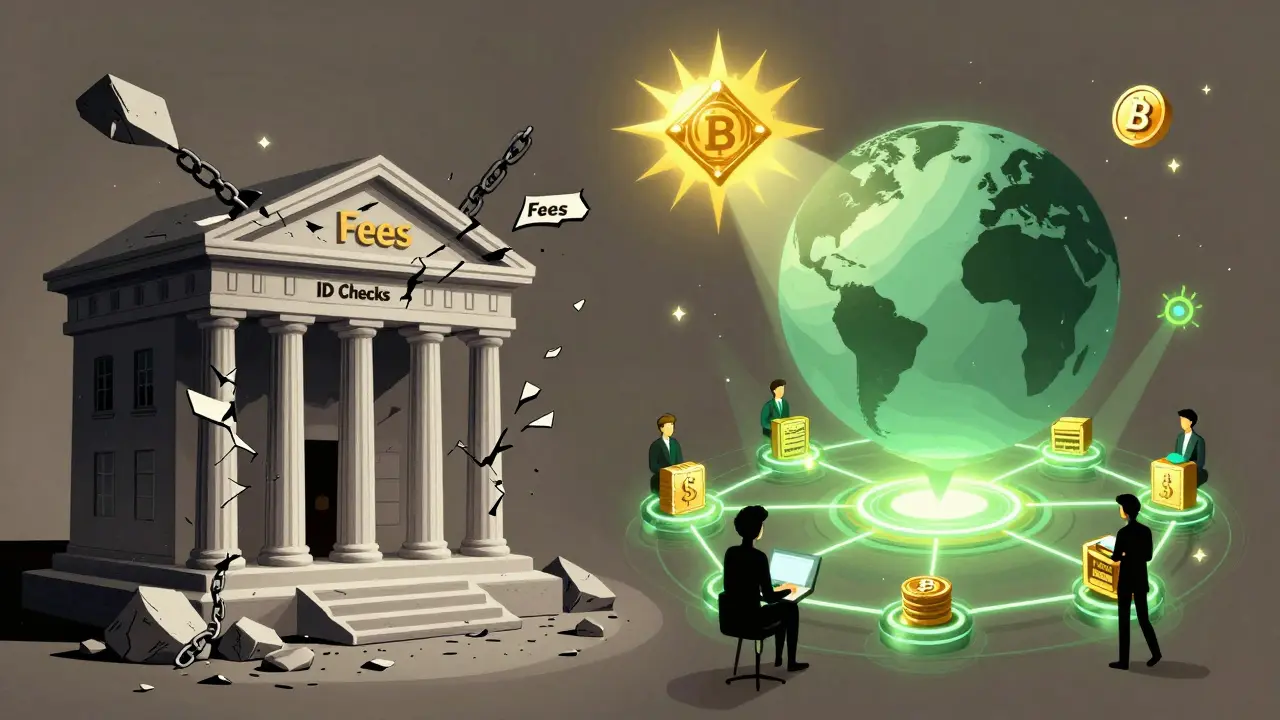
Three things are pushing DeFi forward: financial inclusion, cost reduction, and automation.There are 1.4 billion adults worldwide without a bank account. DeFi doesn’t need ID, credit scores, or a physical branch. All you need is a phone and an internet connection. That’s why adoption spikes in places where banks are slow, expensive, or just absent.
Then there’s cost. Traditional remittances can cost 6-8% in fees. DeFi bridges cut that to under 1%. Cross-chain stablecoin transfers processed over $12.6 billion in the first half of 2025 alone. That’s not just tech-it’s real savings for real people.
And now, AI is stepping in. Robo-agents are starting to automate yield farming and lending strategies. Instead of manually switching between protocols to chase the best APY, users can set a goal-“maximize returns with low risk”-and let an AI agent handle it. Mordor Intelligence estimates this adds 0.9% to long-term growth. It’s not sci-fi. It’s happening now.
The Big Problem: Security
Despite all the growth, DeFi still has a trust issue. Smart contract bugs, exploited vulnerabilities, and rug pulls are still common. NextMSC calls this a “key challenge” deterring institutional investors. One major exploit in 2024 wiped out $200 million in user funds. That kind of news makes people nervous. And it should. No system is perfect. But the industry is responding. Audits are becoming standard. Insurance protocols like Nexus Mutual and Cover Protocol are gaining traction. And more protocols are using formal verification-mathematical proofs that code behaves as intended.The real test? Will institutions wait until everything is flawless? Or will they accept that DeFi, like the early internet, will evolve through trial and error? So far, the answer seems to be the latter.
What’s Next?
The next big wave will come from real-world assets (RWAs). Tokenized U.S. Treasuries, commercial real estate, and even carbon credits are now being traded on DeFi platforms. These aren’t crypto-native assets-they’re traditional ones, digitized. And they’re growing fast. Mordor Intelligence estimates this trend adds 1.2% to long-term growth. Companies like Maple Finance and Centrifuge are already processing billions in RWA-backed loans.Payment networks are also starting to connect. Visa and Mastercard are testing DeFi integrations. PayPal now lets users convert crypto to fiat in-app. These aren’t full DeFi adoption yet-but they’re bridges. They’re making it easier for mainstream users to move between traditional finance and DeFi without even realizing it.
By 2030, DeFi won’t be a niche. It won’t be a “crypto thing.” It’ll be a layer underneath finance-like TCP/IP is to the internet. You won’t see it. But you’ll use it every day.
What is the current total value locked (TVL) in DeFi?
As of 2025, the total value locked (TVL) across all DeFi protocols reached $123.6 billion, representing a 41% year-over-year increase. This metric measures the amount of cryptocurrency deposited into DeFi smart contracts for lending, staking, and liquidity provision.
Which stablecoin is most used in DeFi?
USDC is the most integrated stablecoin in DeFi, appearing in 92% of the top lending and decentralized exchange protocols. DAI, a decentralized stablecoin, is also widely used, with over 71% of its $8.4 billion supply locked in DeFi applications.
Why is Asia-Pacific the fastest-growing DeFi region?
Asia-Pacific is growing fastest due to high mobile penetration, rising internet access, and large unbanked populations. Local startups are building simple, user-friendly DeFi apps tailored to regional needs, making financial services accessible without traditional banking infrastructure.
Is DeFi safer than traditional finance?
DeFi isn’t inherently safer-it has different risks. While traditional finance relies on legal systems and insurance, DeFi depends on code. Smart contract exploits and hacks still occur, but the ecosystem is improving through audits, insurance protocols, and formal verification. Many users now treat DeFi like early internet: useful but requiring caution.
What role does AI play in DeFi growth?
AI-driven robo-agents are automating yield strategies, such as switching between lending pools or rebalancing collateral. These tools help users maximize returns without constant manual oversight. Mordor Intelligence estimates AI contributes +0.9% to DeFi’s long-term growth rate by making participation easier and more efficient.
Will DeFi replace banks?
DeFi won’t replace banks overnight, but it’s already replacing parts of them. DeFi offers faster, cheaper, and more transparent services for lending, trading, and earning interest. Banks are responding by building their own blockchain solutions. The future isn’t DeFi vs. banks-it’s DeFi as a new layer in global finance, used alongside traditional systems.
What are real-world assets (RWAs) in DeFi?
Real-world assets (RWAs) are physical assets like U.S. Treasuries, real estate, or commodities that are tokenized and traded on DeFi platforms. In 2025, the market for RWA-backed DeFi products reached $3.2 billion. This trend is attracting institutional investors who want blockchain efficiency without leaving traditional asset classes.
Anselmo Buffet
December 10, 2025 AT 23:01DeFi’s just the internet of money finally waking up. No banks, no paperwork, just code doing what it’s told. Simple. Clean. It’s not magic-it’s math.
Ike McMahon
December 11, 2025 AT 00:58USDC dominating DeFi makes sense-it’s regulated, transparent, and backed by real reserves. DAI’s the real hero though, decentralized and trustless. Both needed.
Lloyd Cooke
December 11, 2025 AT 21:12One cannot help but contemplate the ontological shift occurring here: the decentralization of value itself. No longer is capital a function of institutional sanction; it is an emergent property of cryptographic consensus. The $123.6 billion TVL is not merely a metric-it is a manifesto written in Solidity, signed by millions of anonymous actors who have, in quiet rebellion, opted out of the feudal economy of interest-bearing debt. The stablecoin is the new currency of the soul-USDC, the polished idol; DAI, the ascetic monk. And yet, we must ask: does the temple of DeFi, with its audited contracts and formal verifications, truly liberate-or merely re-enslave under a new priesthood of developers?
The rise of RWAs is not a betrayal, but a maturation. Tokenized treasuries are not an abandonment of crypto ideals-they are the inevitable assimilation of the old world into the new, like rivers flowing into the sea. The institutions that once feared blockchain now sip from its cup, not out of conviction, but because they have no choice. The future is not DeFi versus banks. The future is DeFi as the substrate beneath all finance-like electricity, invisible until you need it.
AI agents? They are the silent librarians of yield, turning chaos into order. No longer must the individual chase APY like a dog after its tail. The algorithm, benevolent and tireless, now tends the garden. And yet-we must not forget: no code is perfect. The $200 million exploit was not a failure of technology, but a failure of humility. We built a cathedral and forgot to light the candles.
Asia’s explosion is not merely economic-it is existential. In Jakarta, a mother uses DeFi to send money home, bypassing remittance fees that once stole her child’s lunch. In Manila, a street vendor earns interest on her daily takings. This is not speculation. This is survival. And the West watches, dazzled by charts, while the real revolution is happening on Android phones with cracked screens.
So let us not call it ‘growth.’ Let us call it rebirth. The old gods of Wall Street are fading. Their temples are crumbling. And in their place, something quieter, stranger, and far more human is rising.
Kurt Chambers
December 13, 2025 AT 13:47usa still the only real player in this whole thing. everyone else is just copying our tech. china? nah. india? lol. they got phones but they dont got vision. we built this. and if you think stablecoins are the backbone, you aint seen nothin yet. wait till the feds launch their own cbdc and crush all this. then well see who really runs the show.
Joey Cacace
December 14, 2025 AT 12:32I’m so impressed by how DeFi is quietly transforming lives-especially in regions where banking access has been a luxury. The fact that someone in rural Indonesia can now earn interest on their savings without a single piece of paper… it’s beautiful. And the AI agents? They’re like having a financial advisor who never sleeps, never gets tired, and never charges a fee. I just hope the security improvements keep pace with the innovation. We’re building something sacred here.
Taylor Fallon
December 14, 2025 AT 21:35DeFi is the quiet revolution no one talks about in the news… but everyone’s using. I love how it’s not about hype anymore-it’s about utility. People aren’t trading just to get rich… they’re using it to pay rent, send money to family, buy food. And the real-world assets? That’s the bridge. It’s not replacing banks… it’s making them better. I’m so proud to be part of this. 🌱
JoAnne Geigner
December 15, 2025 AT 15:55Watching DeFi evolve feels like witnessing the birth of a new language-one that doesn’t need translators, only understanding. The fact that USDC and DAI coexist, not as rivals but as complementary forces, tells me this ecosystem is maturing beyond ideology. And AI agents? They’re not replacing human judgment-they’re amplifying it. I’ve used one to automate my yield strategy, and it freed up hours of my week. That’s not just efficiency; it’s dignity. We’re not just building protocols-we’re building freedom. And yes, there are risks. But every great leap forward has had them. The question isn’t whether DeFi is perfect-it’s whether we’re brave enough to keep building, even when the code isn’t flawless.
Asia’s growth isn’t a surprise. It’s justice. When the system fails you, you don’t wait for permission-you build your own. And that’s what’s happening. Real people. Real solutions. No permission needed.
I used to think DeFi was for techies. Now I know it’s for anyone who’s ever been told, ‘You don’t qualify.’ That’s the real story here.