FATCA and Cryptocurrency Reporting for US Citizens: What You Must Know in 2025
 Aug, 1 2025
If you're a U.S. citizen holding cryptocurrency on a foreign exchange, you could be in serious trouble-even if you never sold a single coin. The IRS isn't just watching your bank account anymore. They're tracking your Bitcoin, Ethereum, and other digital assets held overseas through FATCA, and failing to report them can cost you thousands in penalties.
What FATCA Actually Covers
FATCA, or the Foreign Account Tax Compliance Act, was passed in 2010 to stop Americans from hiding money in offshore accounts. It forces foreign banks and financial institutions to report details about U.S. account holders to the IRS. If you have more than $50,000 in foreign financial assets at year-end (or over $75,000 at any point during the year), you must file Form 8938 with your tax return.Here’s the catch: the IRS considers cryptocurrency held on foreign platforms as a financial asset. That means if you keep your Bitcoin on Binance, Kraken, or any other non-U.S. exchange, and your total holdings across all foreign accounts exceed those thresholds, you’re legally required to report them-even if you never cashed out.
Thresholds That Matter
The amount you need to report depends on your filing status and where you live:- Single filers living in the U.S.: Report if you had over $50,000 on the last day of the year, or more than $75,000 at any time during the year.
- Married filing jointly in the U.S.: Report if you had over $100,000 at year-end, or more than $150,000 at any point.
- Single filers living abroad: Higher thresholds apply-usually $200,000 on year-end or $300,000 during the year.
- Married filing separately: Same as single filers, even if you live abroad.
These numbers aren’t just suggestions. The IRS can hit you with a $10,000 penalty for missing Form 8938-and another $10,000 for each 30-day period you stay non-compliant after being notified. That’s $10,000 per month until you fix it.
Why Cryptocurrency Falls Under FATCA
FATCA defines "specified foreign financial assets" broadly. It includes:- Financial accounts held at foreign institutions
- Stocks or securities issued by non-U.S. companies
- Financial instruments with non-U.S. counterparties
While the IRS hasn’t issued a clear rule saying "crypto = FATCA asset," the definition covers anything that acts like a financial account with a foreign entity. Most major crypto exchanges-Binance, Coinbase International, Bitstamp, KuCoin-are registered as Foreign Financial Institutions under FATCA. That means they’re legally required to report your holdings to the IRS if you’re a U.S. person.
Even if the exchange doesn’t send you a 1099, the IRS already knows you’re there. FATCA is a two-way street: the foreign platform reports you, and you’re supposed to report yourself. If you don’t, you’re the only one hiding something.

FBAR Is Also Coming for Your Crypto
Don’t think you’re safe just because you file Form 8938. There’s another form you might need: FinCEN Form 114, better known as FBAR.For years, FBAR only applied to bank accounts and brokerage accounts. But in 2024, FinCEN proposed new rules to include foreign cryptocurrency accounts. If you hold more than $10,000 in crypto on foreign platforms at any time during the year, you’ll need to file FBAR-even if you never traded.
FBAR is filed separately from your tax return, through the BSA E-Filing System. The deadline is April 15, with an automatic extension to October 15. Penalties for non-filing? Up to $10,000 per violation, and up to $100,000 or 50% of the account balance if the IRS proves willful non-compliance.
So now, you might need to file both Form 8938 (for tax purposes) and FBAR (for financial reporting)-for the same crypto holdings. That’s double the paperwork, double the risk, double the penalties.
How to Value Your Crypto for Reporting
Cryptocurrency prices swing wildly. One day you have $60,000 in ETH. The next day, it’s $45,000. Which number do you use?The IRS says use the fair market value on the last day of the tax year. If you’re reporting at year-end, take the closing price on December 31. If you’re reporting the highest value during the year, use the peak price you hit between January 1 and December 31.
But here’s the problem: most foreign exchanges don’t give you a clean year-end statement. You might have to manually track your balances across multiple wallets and platforms. Tax pros recommend keeping daily snapshots of your holdings in a spreadsheet. Use CoinGecko or CoinMarketCap for historical prices-they’re widely accepted as reliable sources.
If you can’t get an account number from the exchange (because crypto platforms don’t use traditional account numbers), just write "unknown" or describe your access method: "Access via Binance.com login: [email protected]". The IRS has said this is acceptable.
What About Trading Crypto? You Still Need to Report That Too
FATCA and FBAR are about holding assets. But every time you trade, sell, or use crypto to buy something, you trigger a taxable event.You must report capital gains or losses on Form 8949 and summarize them on Schedule D. If you earn crypto as income (from staking, airdrops, or mining), report it as ordinary income on Form 1040. The IRS requires FIFO accounting unless you specifically identify the units you’re selling.
Example: You bought 1 BTC in 2021 for $30,000. You bought another 1 BTC in 2023 for $50,000. In 2025, you sell 1.5 BTC for $70,000. Under FIFO, you’re selling the first 1 BTC ($30,000 cost) and half of the second ($25,000 cost). Your gain is $70,000 - $55,000 = $15,000. That’s taxable.
Most people use crypto tax software like Koinly, CoinTracker, or ZenLedger to automate this. But if you’re holding crypto overseas, you still need to manually track the foreign exchange holdings for FATCA and FBAR.
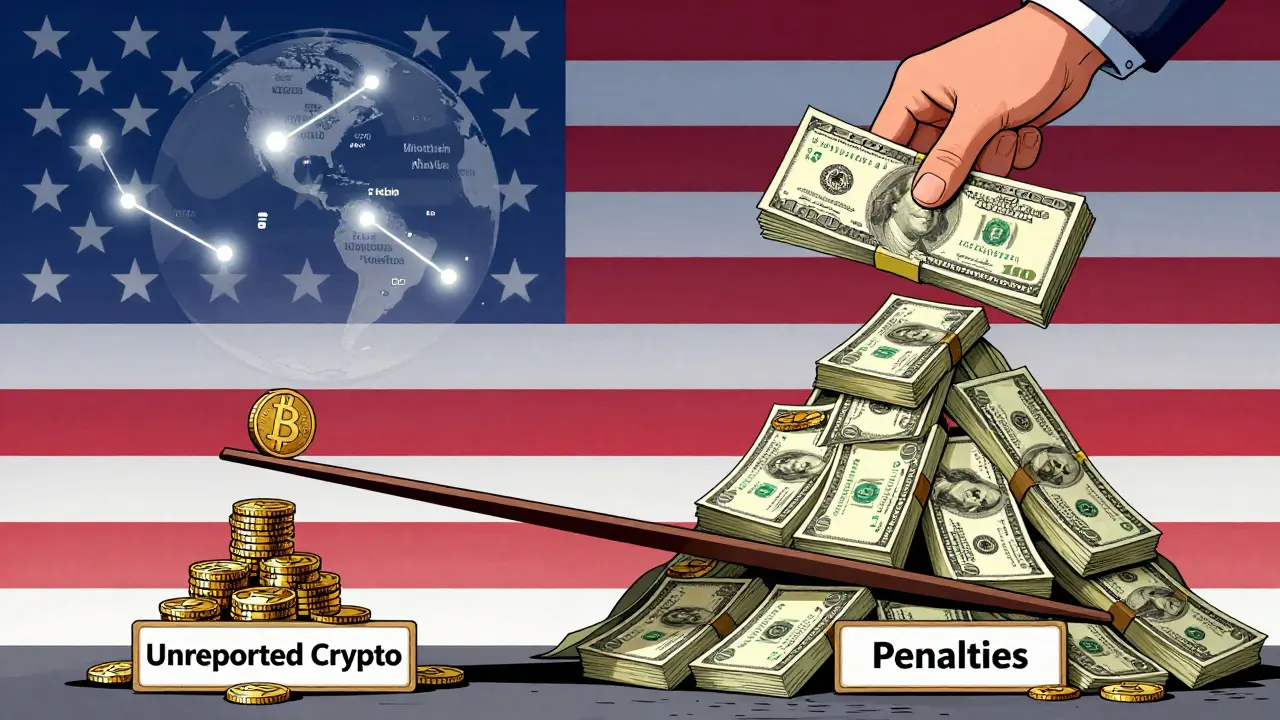
What Happens If You Don’t Report?
The IRS has been cracking down hard. Since 2019, they’ve sent over 10,000 letters to crypto holders. In 2023, they launched the Crypto Enforcement Task Force. They’re using data from FATCA, FBAR, and even blockchain analytics firms like Chainalysis to match wallet addresses with taxpayer identities.If you get caught:
- Missed Form 8938? Up to $10,000 per year, plus interest.
- Missed FBAR? Up to $10,000 per violation, or up to $100,000 if willful.
- Underreported income? 20% accuracy penalty, plus 75% fraud penalty if the IRS thinks you lied.
- Failure to file tax return? Criminal charges possible.
The worst part? Many people think, "I didn’t sell anything, so I don’t owe taxes." But FATCA and FBAR aren’t about taxes-they’re about disclosure. You’re required to report the asset, even if you didn’t realize a gain.
What Should You Do Right Now?
If you hold crypto on foreign platforms:- Calculate your total value across all foreign accounts as of December 31, 2024.
- Check if you exceeded the FATCA threshold ($50,000/$75,000).
- Check if you ever held over $10,000 in foreign crypto at any time in 2024.
- If yes to either, file Form 8938 and/or FBAR with your 2024 tax return.
- If you didn’t file in prior years, consider the IRS’s Streamlined Filing Compliance Procedures to catch up with reduced penalties.
Don’t wait for the IRS to find you. The voluntary disclosure window is still open, and penalties are much lower if you come forward on your own.
The Bottom Line
FATCA and cryptocurrency reporting aren’t optional. They’re not "gray areas"-they’re legal obligations with serious consequences. The IRS isn’t bluffing. They have the data, the tools, and the will to catch you.Whether you hold $5,000 or $500,000 in crypto overseas, the rules apply. The only way to stay safe is to report everything, keep good records, and when in doubt-disclose.
It’s not about being suspicious. It’s about being compliant. And in 2025, that’s the only way to avoid a very expensive surprise.
Vidyut Arcot
December 4, 2025 AT 04:34Been holding some ETH on Binance for years and never thought this applied to me. Guess I’ve been lucky so far. Time to dig up my old wallet logs and figure out what I actually had on Dec 31. Better safe than sorry.
Heather Hartman
December 5, 2025 AT 01:08This is such an important wake-up call. I know so many people who think "if I didn’t sell, I didn’t owe anything"-but this isn’t about taxes, it’s about transparency. The IRS isn’t playing around anymore. If you’ve got crypto overseas, start organizing your records now. You’ll thank yourself later.
Reggie Herbert
December 6, 2025 AT 10:21Actually, FATCA doesn't explicitly cover crypto. The IRS is stretching the definition of "financial asset" beyond statutory intent. The statute says "financial accounts," not "digital asset wallets." They’re using regulatory overreach to close a loophole that never existed in law. You’re being scammed into compliance by fear, not legal clarity.
Akash Kumar Yadav
December 6, 2025 AT 11:09USA thinks it can police the whole world’s crypto with FATCA? Get real. I’ve got my coins on Binance because I don’t trust your banking cartel. You want my data? Come get it. Meanwhile, I’m moving everything to a hardware wallet and never touching a foreign exchange again. You can’t tax what you can’t access.
samuel goodge
December 6, 2025 AT 14:09It’s fascinating how FATCA, designed for traditional offshore banking, has been retrofitted to cover decentralized, pseudonymous assets-without legislative amendment. The legal logic is shaky, but the practical enforcement is terrifyingly effective. The IRS doesn’t need to prove intent; they just need to prove existence. And with blockchain analytics, existence is trivial to trace. We’re in uncharted territory: compliance without clarity.
alex bolduin
December 6, 2025 AT 22:10So if I had $45k in BTC on Kraken in March and $48k in December, I’m fine? No form needed? But if I had $51k on Dec 31, even if I lost it all the next day, I’m in trouble? That’s wild. The IRS doesn’t care about your actual gains-they care about your balance sheet on one day. Makes you wonder if the system was built for humans or spreadsheets.
Alan Brandon Rivera León
December 7, 2025 AT 04:25Just want to say-this isn’t about fear. It’s about dignity. If you’re a U.S. citizen living abroad or managing your own finances, you deserve to know the rules. This post doesn’t try to scare you-it gives you the facts. And honestly? That’s more than most people get. If you’ve been ignoring this, don’t panic. Just start. One spreadsheet. One date. One exchange. You’ve got this.
Ankit Varshney
December 7, 2025 AT 11:53Thanks for this. I’ve been putting this off for months. Starting tonight.