Fiat vs Digital Currency: Understanding the Global Monetary Shift
 Apr, 4 2026
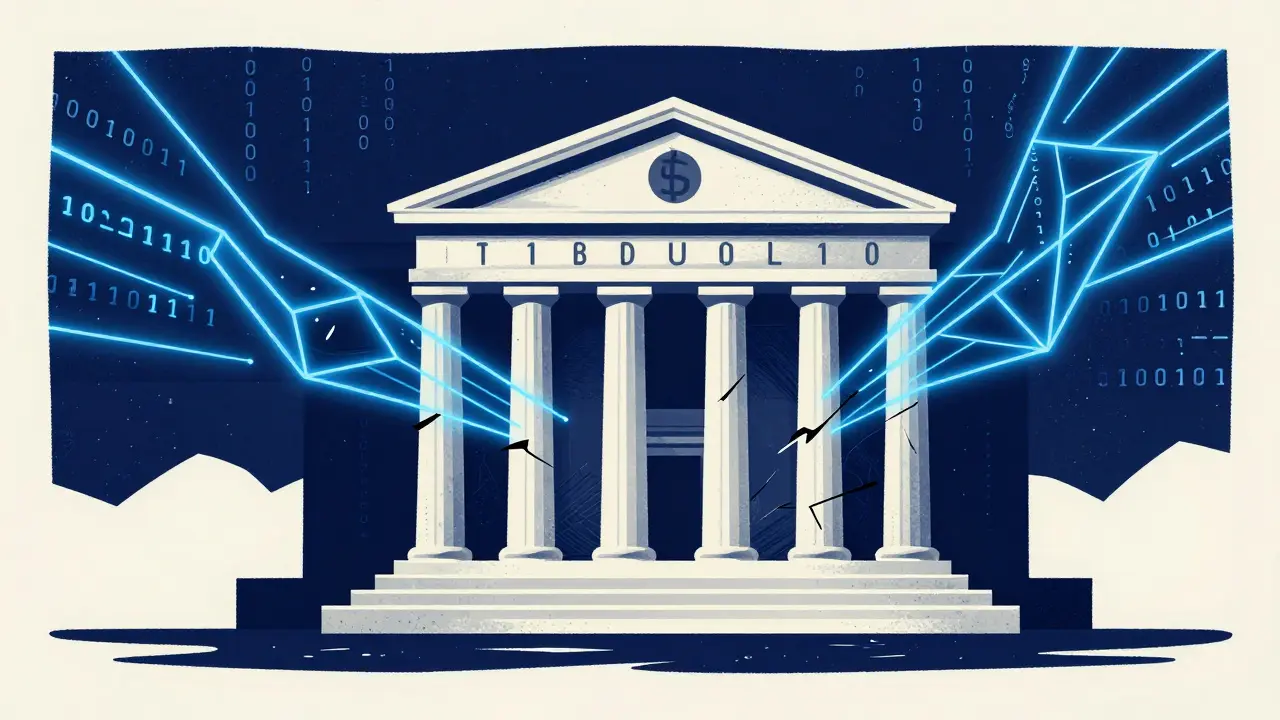
Imagine a world where your money isn't just a number in a bank app or a piece of paper in your wallet, but a line of code on a global, shared ledger that no single government can freeze or inflate away. For decades, we've relied on the word of central banks to keep our economy stable. But recently, the very nature of value has changed. We are seeing a massive move toward digital currency, and it isn't just about speculators getting rich on volatile coins-it is a fundamental rewrite of how humans exchange value.
The Power Struggle: Centralization vs Decentralization
The biggest clash between old and new money is who holds the remote control. In the traditional world, Central Banks (like the Federal Reserve in the US) act as the ultimate authority. They decide interest rates and how much money enters the economy. While this allows them to fight recessions, it also creates a single point of failure. If the central authority makes a mistake, everyone feels it.
Digital currencies, specifically those built on Blockchain Technology, flip this script. Instead of one bank in charge, the network is spread across thousands of computers globally. No one person can decide to "print" more coins unless the code allows it. This shift moves the trust from a human institution to a mathematical protocol.
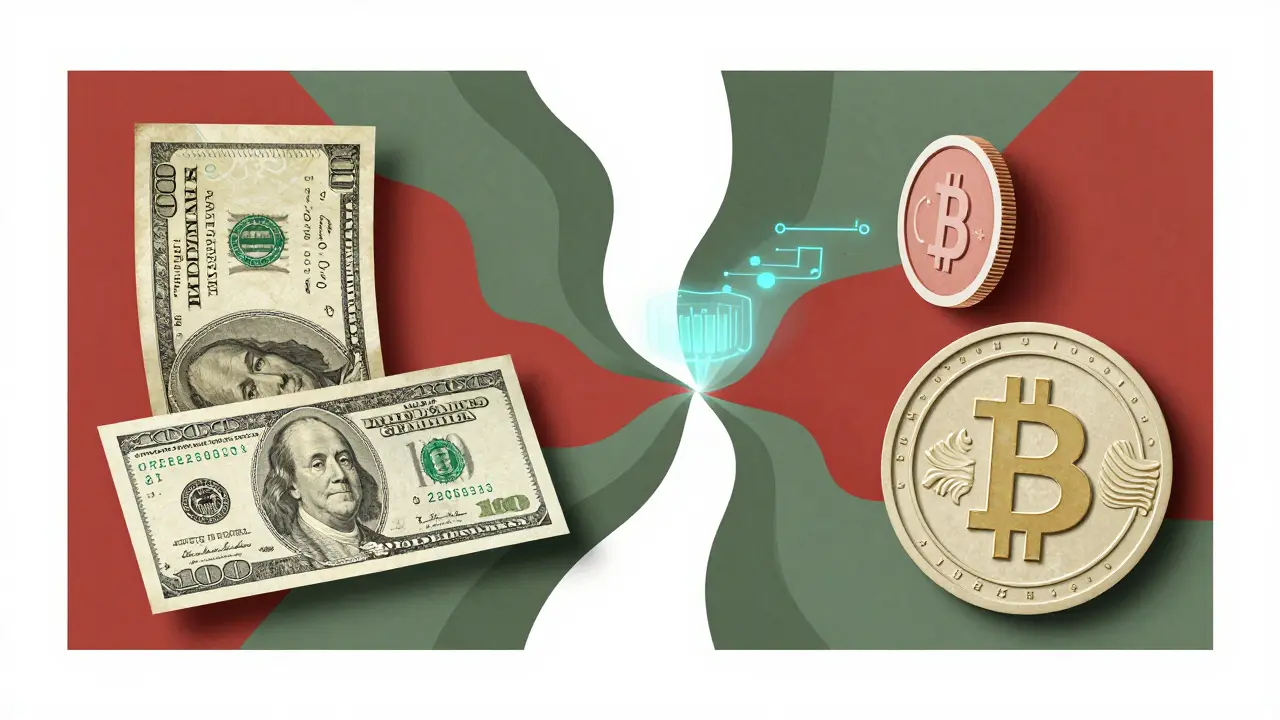
| Attribute | Fiat Currency | Digital Currency (Crypto) |
|---|---|---|
| Control | Centralized (Government) | Decentralized (Network) |
| Trust Basis | Institutional Trust | Cryptographic Trust |
| Issuance | By Decree / Policy | Algorithmic / Pre-set |
| Speed | Slow (Intermediary dependent) | Fast (Peer-to-peer) |
| Stability | Relatively Stable | High Volatility |
Trusting Math Instead of Men
Why would someone trade a stable dollar for a volatile digital asset? It comes down to how we define trust. Fiat money depends on institutional trust. You trust that the bank won't go bust and the government won't trigger hyperinflation. But history is full of examples where that trust was betrayed.
Digital assets use a "trustless" system. This doesn't mean you can't trust it; it means you don't have to trust a stranger or a politician. Instead, you trust Cryptography. Every transaction is signed with a digital key and verified by a network. Once a transaction is written into the blockchain, it is immutable-meaning it cannot be erased or changed. This transparency is a breath of fresh air for people living in countries with corrupt banking systems.
Breaking the Banking Bottleneck
Have you ever tried to send money to a relative in another country? You usually have to deal with a nightmare of fees, 3-5 business day waiting periods, and several intermediaries like SWIFT or Western Union. This is because fiat money requires a chain of trusted middlemen to verify that the funds actually exist.
Digital currencies remove the middleman entirely. Whether you are sending money to your neighbor or someone in Tokyo, the process is the same: Wallet A sends to Wallet B. With the addition of Smart Contracts-self-executing contracts with the terms directly written into code-we can now automate payments. For example, a payment can be released automatically the moment a shipping carrier confirms a package has arrived, without needing a bank to escrow the funds.

The Trade-off: Stability vs. Autonomy
It isn't all sunshine and rainbows for digital currency. The most glaring issue is volatility. While a dollar is generally worth a dollar tomorrow, a digital asset can swing 20% in a single afternoon. This makes it a great speculative tool for investors but a terrible way to price a loaf of bread.
On the other hand, fiat isn't exactly a "safe haven." Inflation is the silent thief of fiat currency. When governments print money to cover debts, the purchasing power of every single dollar in your pocket drops. This is why many see Bitcoin as "digital gold." Because it has a hard cap on the total number of coins that will ever exist, it cannot be inflated by a government's printing press.
Privacy, Security, and the Environmental Cost
One of the biggest misconceptions is that digital currency is completely anonymous. It's actually pseudonymous. While your real name isn't attached to your wallet, every single transaction is recorded on a public ledger for the world to see. If someone links your identity to your wallet address, your entire financial history becomes an open book.
Security is another double-edged sword. In the fiat world, if you lose your credit card, you call the bank and get a new one. In the digital world, if you lose your private keys, your money is gone forever. There is no "forgot password" button for a decentralized wallet.
We also can't ignore the energy problem. Many early digital currencies use Proof-of-Work (PoW), a process where powerful computers solve complex puzzles to secure the network. This consumes massive amounts of electricity. To combat this, newer systems have moved to Proof-of-Stake (PoS), which reduces energy consumption by over 99%, making the shift toward digital money more sustainable.
The Middle Ground: CBDCs and Hybrid Systems
Governments aren't just sitting back and watching. They are fighting back with Central Bank Digital Currencies (known as CBDCs), which are essentially digital versions of fiat currency. A CBDC gives you the speed and efficiency of a blockchain but keeps the control in the hands of the government.
This creates a fascinating hybrid future. We will likely have a three-tier system:
- Traditional Fiat: For those who prefer physical cash and legacy banking.
- CBDCs: For government-regulated, high-efficiency digital payments.
- Decentralized Crypto: For those seeking autonomy, censorship resistance, and a hedge against inflation.
Will digital currency completely replace fiat money?
It is unlikely. While digital currencies offer huge advantages in speed and autonomy, fiat money provides stability and legal certainty that businesses need for long-term planning. The most likely outcome is a coexistence where different currencies are used for different purposes-CBDCs for taxes and government services, and decentralized assets for investment and global transfers.
Is digital currency safer than a traditional bank account?
It depends on what you mean by "safe." Digital currencies are mathematically secure and cannot be counterfeited. However, they lack the consumer protections found in banks (like FDIC insurance). If you are hacked or lose your keys, there is no authority to help you recover the funds. Bank accounts are safer for the average person, but digital wallets are safer from government seizure or systemic institutional collapse.
What is the main cause of cryptocurrency volatility?
Volatility is primarily driven by market speculation and the lack of a stabilizing central authority. Because most digital currencies don't have an underlying government to manage the supply or a set of traditional earnings to value them against, their price is driven almost entirely by supply and demand. As more institutional investors enter the market, this volatility tends to decrease over time.
How do smart contracts differ from regular bank transfers?
A regular bank transfer is a simple move of funds from A to B, often requiring manual approval or a third-party processor. A smart contract is a programmable "if/then" statement. For example, "If the shipping company marks the item as delivered, then release the payment to the seller." This happens automatically without any one party needing to trust the other.
Are CBDCs the same as Bitcoin?
No, they are opposites in philosophy. Bitcoin is decentralized, meaning no one is in charge. CBDCs are centralized, meaning the government has full control over the ledger. While both use digital technology to move money, CBDCs are essentially "digital dollars" that allow the government to monitor and control transactions more closely than physical cash does.
What to do next?
If you are new to this shift, don't jump in with all your savings. Start by researching the difference between a custodial wallet (where a company holds your keys) and a non-custodial wallet (where you are your own bank). If you're worried about inflation, look into assets with fixed supply caps. If you're interested in the tech, experiment with a small amount of a stablecoin to see how fast international transfers actually are. The goal isn't to pick a "winner" between fiat and digital, but to understand which tool is right for your specific financial goal.
vijendra pal
April 4, 2026 AT 19:25Everyone talkin bout volatility but they dont realize how the L1 scalability is the real game changer here!! 🚀 if u actually study the tokonomics u see that fiat is just a dying legacy system lol. most people just dont get how smart contracts can literally automate an entire economy without some suit in a bank takin a cut 💸🤑
Suvoranjan Mukherjee
April 4, 2026 AT 21:11The integration of Layer 2 solutions like Optimism or Arbitrum really mitigates those gas fee issues that usually scare off new users. It's all about enhancing the throughput while maintaining the security of the mainnet. For those in emerging markets, the ability to bypass the legacy SWIFT system is a massive catalyst for financial inclusion and capital efficiency! Keep learning, the ecosystem is evolving fast!
Manisha Sharma
April 5, 2026 AT 03:08The sheer obsolescence of Western financial hegemony is simply a mathematical certainty that the mediocre mind fails to grasp. While you lot fret over a few percentages of volatility, we are witnessing the birth of a new digital dharma where the sovereign individual finally transcends the clumsy dictates of the Federal Reserve. It is quite amusing, really, how the global south is leapfrogging your archaic banking infrastructure with a level of sophistcation that makes your 'stable' fiat look like a children's playmoney set. The intellectual poverty of trusting a central bank is a disease of the colonial mindset, a relic of a time when power was measured by gold bars rather than hash power. We are not just changing currency; we are restructuring the very ontology of value itself, a shift that requires a cognitive leap most are too terrified to take. Truly, the arrogance of the old world is its own funeral pyre, and the code is the only truth that remains when the institutions crumble under their own hypocrisy and inefficiency. Only those with the vision to see beyond the immediate noise will inherit this digital empire, while the rest cling to their decaying paper dreams in a state of perpetual, blissful ignorance. Your stability is an illusion, a fragile veneer over a void of debt and desperation that can no longer be sustained by printing more zeros onto a ledger. The transition is inevitable, the logic is immutable, and the result will be a total reconfiguration of global power dynamics that favors the meritocratic nature of the blockchain over the nepotism of the boardroom.
Robert Coskrey
April 7, 2026 AT 00:10I find the analysis regarding the three-tier system to be quite reasonable, indeed... it seems a plausible trajectory for the global economy!!!
JERRY ORTEGA
April 7, 2026 AT 23:11just a heads up for anyone getting into this, definitely check out hardware wallets like ledger or trezor. keeping your assets on an exchange is basically just trusting another middleman which defeats the whole purpose of decentralization
Adriana Gurau
April 8, 2026 AT 11:04Imagine thinking a line of code is a revolution when most of you can't even manage a basic budget 🙄 the irony of 'trustless' systems is that you're just trusting a bunch of devs who will probably rug-pull you by next Tuesday. typical :)
June Coleman
April 9, 2026 AT 07:50Oh sure, because trusting a nameless group of programmers is *so* much safer than trusting a government that has a history of basically functioning like a circus. I'm just vibrating with confidence here!
Emily 2231
April 11, 2026 AT 02:58CBDCs are a trap for total surveillance. The state will track every single cent you spend and freeze your assets if you say something they dont like. It is the ultimate tool for the New World Order to implement a social credit system. wake up people. the privacy of physical cash is the only thing keeping us from total digital slavery
shubhu patel
April 12, 2026 AT 00:17I honestly feel that while the transition to digital assets is quite exciting and holds a lot of potential for those of us who have seen how restrictive traditional banking can be, we should probably just take a moment to appreciate that for many people, the stability of a traditional bank is the only thing keeping their families afloat during a crisis, so we should be mindful of how we push these changes on others without considering their risk tolerance.
Brooke Herold
April 13, 2026 AT 14:02It's interesting to see how different cultures perceive this shift, as some regions embrace it out of necessity while others do it for speculation.