Hydax Exchange Crypto Exchange Review: Fees, Security, and Why Regulation Matters
 Feb, 14 2026
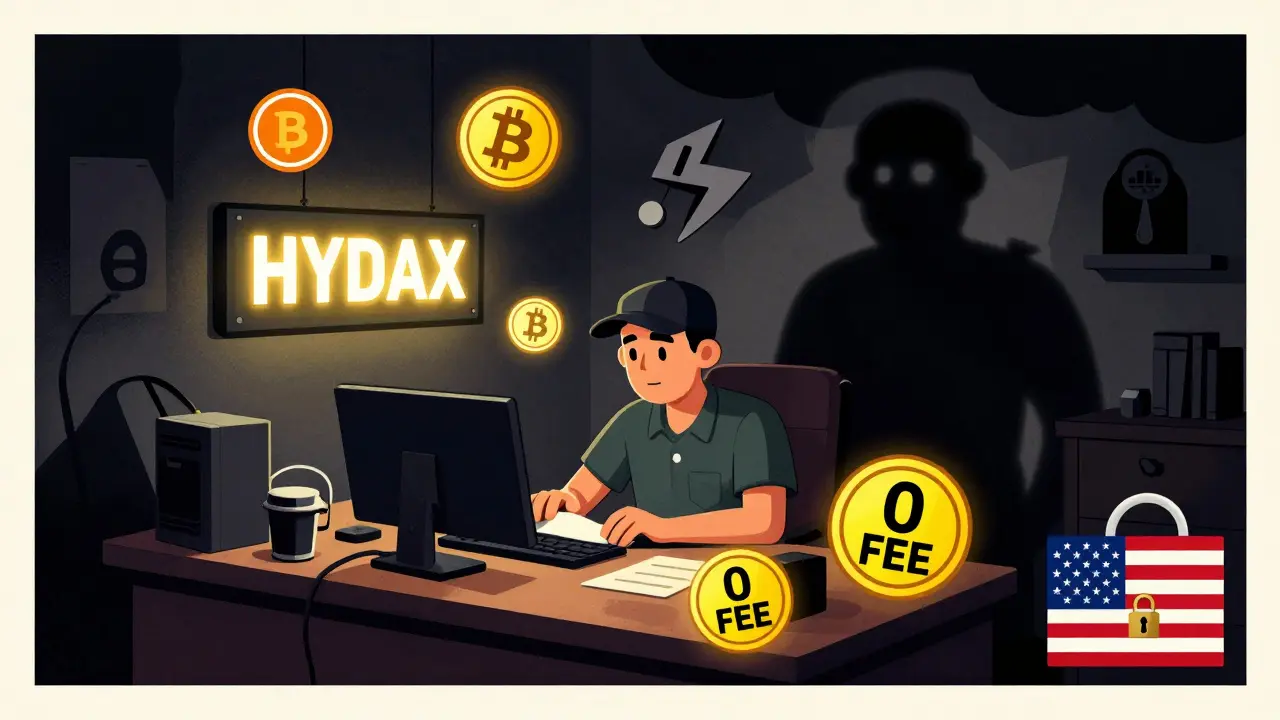
When you're looking for a crypto exchange, you want three things: low fees, solid security, and confidence your money won’t vanish overnight. Hydax Exchange promises all of that - but here’s the catch: it’s not regulated. That changes everything.
Launched in 2019 and based in Singapore, Hydax markets itself as a global platform with support for over 100 cryptocurrencies. It serves users in China, Korea, Russia, Indonesia, Mexico, and parts of Africa. But if you’re in the United States? You’re locked out. That’s not a technical glitch - it’s a deliberate choice. Hydax operates without any government oversight, which means no insurance, no legal recourse, and no accountability if things go wrong.
Trading Fees: Competitive, But Not the Lowest
Hydax’s spot trading fee is a flat 0.20%. That’s lower than the industry average of 0.25%, and it doesn’t matter if you’re a maker (adding liquidity) or a taker (removing it). That’s rare. Most exchanges charge makers less - sometimes nothing - to encourage orders on their books. Hydax treats everyone the same. For casual traders, this is simple. No surprises.
For futures and contract trading, the fees are more nuanced. Takers pay 0.06%, which is slightly below the average of 0.063%. Makers pay 0.02%, a bit higher than the typical 0.018%. Not a huge gap, but it’s worth noting if you’re doing high-volume trading.
Compare that to Kraken, Binance US, or Coinbase. Kraken’s fees range from 0% to 0.4%. Binance US charges 0% to 0.6%. Coinbase? It can go as high as 3.99% depending on how you pay. So yes - Hydax is cheaper than some big names. But it’s not beating the new wave of exchanges like Bybit or KuCoin, which offer 0.10% or even 0.05% for high-volume users.
Withdrawal Fees: Where Hydax Actually Wins
This is where Hydax stands out. Zero withdrawal fees. Period.
Most exchanges charge you extra on top of the blockchain network fee. You send BTC? They add $1, $2, or even $5 just for processing. Hydax doesn’t. You pay only what the miners charge - usually under $1 for Bitcoin, less for Ethereum or USDT. That’s a real win, especially if you move crypto often. Many users don’t even realize how much they’re losing on withdrawal fees until they switch.
Compare that to Binance, which sometimes charges $10 to withdraw BTC, or Coinbase, which tacks on a flat fee on top of network costs. Hydax’s policy is rare among unregulated platforms. It’s one of the few that truly passes savings to users.
Security: Strong Rules, Weak Backing
Hydax doesn’t cut corners on security protocols. You need:
- Email verification
- Phone number confirmation
- Two-factor authentication (2FA)
- A separate login password
- A separate asset password (for withdrawals and trades)
It also uses both hot and cold wallets. Hot wallets hold small amounts for fast trades. Cold wallets - offline, air-gapped, encrypted - store the bulk of user funds. That’s standard practice among serious exchanges.
But here’s the problem: none of this matters if there’s no regulator watching.
Regulated exchanges like Coinbase and Kraken are required to carry insurance. If they get hacked, your funds are covered. Hydax? No insurance. No legal obligation to reimburse you. If someone steals your funds through a phishing attack or a breach, you’re on your own. No government agency will step in. No court will force them to pay.
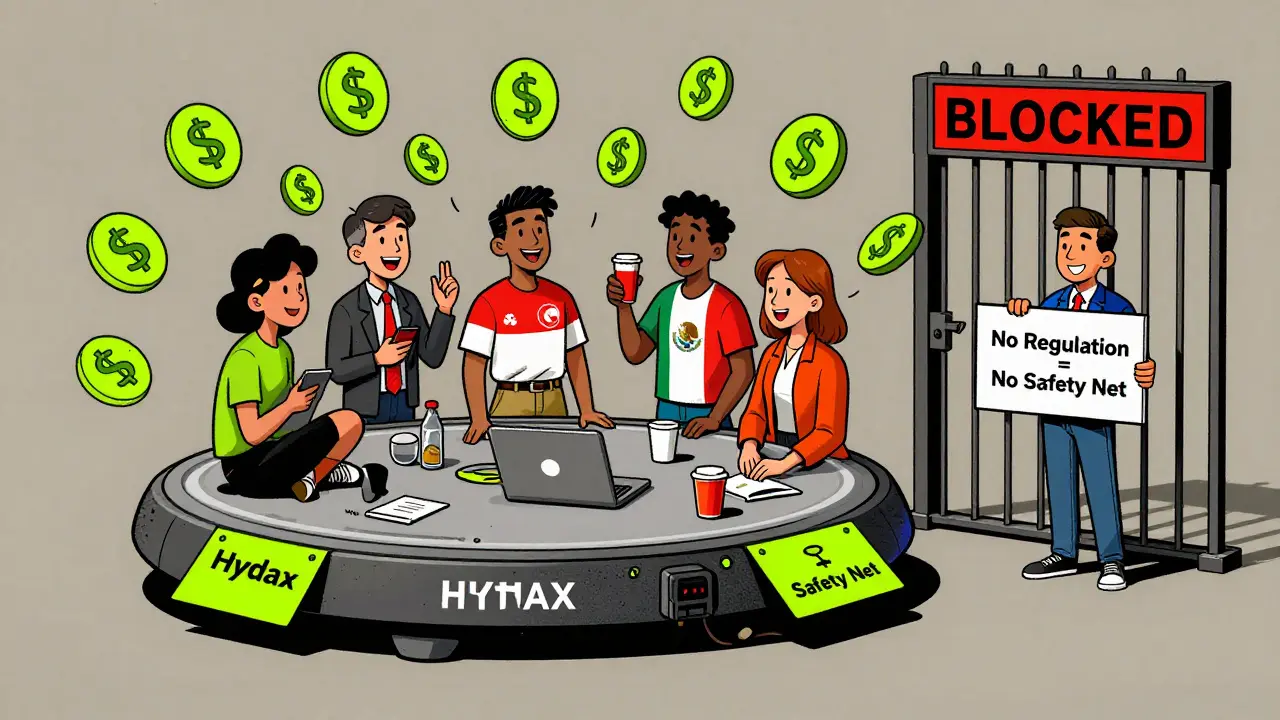
And that’s not speculation. In 2023, unregulated exchanges lost over $1.2 billion to hacks and scams, according to Chainalysis. Hydax isn’t named in those reports - but it’s in the same category. No regulation = no safety net.

What You Can Trade
Hydax supports over 100 cryptocurrencies. That includes Bitcoin, Ethereum, Solana, Cardano, Dogecoin, and even some lesser-known tokens like $SHIB, $PEPE, and $TIA. You won’t find every DeFi coin, but you’ll get most of the major ones.
Compare that to Kraken, which lists over 350 assets, or Binance, which offers 500+. Hydax isn’t the most diverse. But it’s more than enough for most traders. If you’re just trading BTC, ETH, and a few altcoins, you’re covered.
The platform doesn’t support fiat on-ramps like credit cards or bank transfers in most countries. You’ll need to buy crypto elsewhere - like Coinbase or a peer-to-peer platform - then send it to Hydax. That’s a hassle, but it’s common among unregulated platforms trying to avoid banking partnerships.
Why Regulation Isn’t Just a Buzzword
Let’s be clear: regulation isn’t about red tape. It’s about trust.
Regulated exchanges must follow KYC (Know Your Customer) rules. They report suspicious activity. They undergo audits. They keep funds separate from company money. They’re legally required to protect your data. If they fail, they get fined. Or shut down.
Hydax does none of that. It doesn’t need to. And that’s the trade-off.
Some users like unregulated exchanges because they offer anonymity. You don’t have to submit your ID. You can trade without government tracking. But that freedom comes with risk. If you’re depositing $10,000 or more, you’re not just risking loss - you’re risking total disappearance.
There’s no public record of Hydax ever being hacked. But there’s also no public record of it being audited, insured, or legally accountable. That silence speaks louder than any marketing slogan.
Who Is Hydax For?
Hydax isn’t for beginners. It’s not for people who want peace of mind. It’s for experienced traders who:
- Understand crypto risk
- Already hold crypto elsewhere
- Want to avoid withdrawal fees
- Are comfortable with zero legal protection
- Live outside the U.S. and can’t use regulated platforms
If you’re looking for a safe place to store Bitcoin long-term? Look elsewhere. If you’re day trading altcoins and want to save on fees? Hydax might be worth a try - but only with money you can afford to lose.
Final Verdict
Hydax Exchange offers low trading fees, zero withdrawal charges, and decent selection. Its security setup is solid on paper. But without regulation, it’s a high-risk platform.
It’s not a scam. It’s not a Ponzi. But it’s also not a safe haven. It’s a tool - useful for some, dangerous for others.
If you’re in a country where regulated exchanges are blocked or too expensive, Hydax gives you options. But if you’re looking for reliability, insurance, or legal protection - walk away. The fees might be low, but the cost of a mistake? It could be everything.
Is Hydax Exchange regulated?
No, Hydax Exchange is not regulated by any government or financial authority. It operates as an unregulated platform based in Singapore, meaning it doesn’t follow rules like KYC enforcement, fund segregation, or insurance requirements that regulated exchanges must meet. This gives it flexibility but removes legal protections for users.
Can I use Hydax if I live in the United States?
No, Hydax explicitly blocks users from the United States. This is due to the strict regulatory environment in the U.S., where most crypto exchanges must register with FinCEN and comply with state-level laws. Hydax avoids this by restricting access to U.S. IP addresses and accounts.
What are Hydax’s trading fees?
Hydax charges a flat 0.20% fee for spot trading, regardless of whether you’re a maker or taker. For contract trading, takers pay 0.06% and makers pay 0.02%. These rates are competitive with traditional exchanges but higher than newer platforms like Bybit or KuCoin, which offer lower fees for high-volume traders.
Are there withdrawal fees on Hydax?
No, Hydax does not charge any withdrawal fees. You only pay the blockchain network fee (miner fee) when sending crypto out of the platform. This is one of Hydax’s biggest advantages over exchanges like Binance or Coinbase, which often add their own withdrawal charges on top of network fees.
Is Hydax Exchange safe to use?
Hydax has strong security features - including 2FA, separate asset passwords, and cold storage - but its unregulated status makes it inherently risky. There is no insurance for user funds, no legal recourse if hacked, and no oversight. It’s safe only if you understand the risks and treat it like a speculative trading tool, not a bank.
How many cryptocurrencies does Hydax support?
Hydax supports over 100 cryptocurrencies, including major coins like Bitcoin, Ethereum, Solana, and Litecoin, as well as popular memecoins and DeFi tokens. While this is fewer than Kraken (350+) or Binance (500+), it covers the most commonly traded assets for active traders.
Beth Erickson
February 16, 2026 AT 06:00US users get hammered with compliance because we actually have laws. Hydax doesn't care if your funds vanish. They don't even have to answer to anyone. That's not innovation. That's chaos with a UI.
Ruby Ababio-Fernandez
February 17, 2026 AT 07:22Jenn Estes
February 18, 2026 AT 10:56Jeremy Fisher
February 19, 2026 AT 06:09Lauren Brookes
February 19, 2026 AT 09:25James Breithaupt
February 19, 2026 AT 19:58sruthi magesh
February 21, 2026 AT 17:16Lisa Parker
February 23, 2026 AT 06:15Nova Meristiana
February 24, 2026 AT 16:26Aileen Rothstein
February 24, 2026 AT 18:02