Isolated Margin vs Cross Margin: Which One Should You Use for Crypto Trading?
 Oct, 8 2025
Margin Risk Calculator
Trading Parameters
Risk Analysis
Key Insight: Isolated margin protects your entire account if one trade fails, while cross margin uses all your funds for protection but can lead to total loss if multiple positions move against you.
Risk Analysis Results
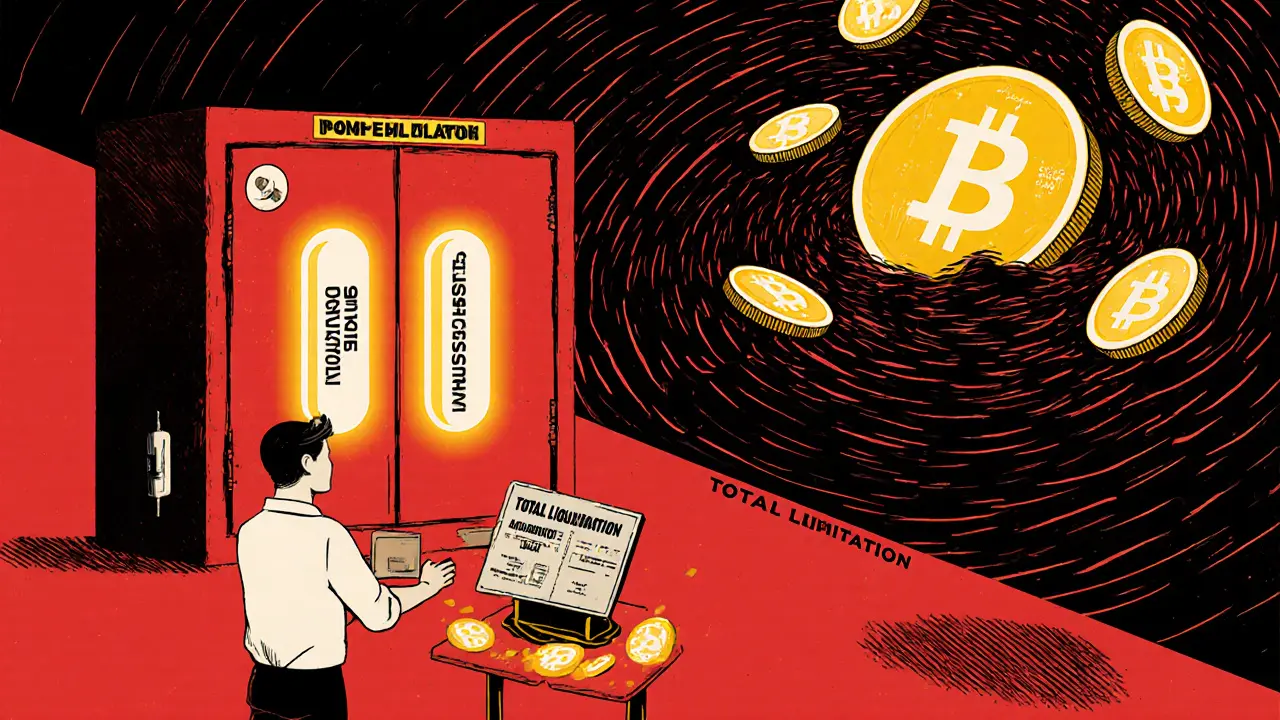
When you trade crypto with leverage, your account doesn’t just sit there waiting for the price to move. It’s actively fighting to stay alive. One wrong move, and your position gets wiped out - fast. That’s where isolated margin and cross margin come in. They’re not just settings on your trading platform. They’re your first line of defense against total loss. Pick the wrong one, and you could lose more than you planned. Pick the right one, and you can control your risk like a pro.
What Is Isolated Margin?
Isolated margin is like locking your money in a vault for one trade. You decide exactly how much of your balance to risk - say, 0.05 BTC - and that’s it. No more, no less. If that trade goes bad, only that 0.05 BTC is gone. The rest of your account stays untouched.This setup is perfect if you’re making a bold bet. Maybe you think Bitcoin will crash to $50K next week, and you want to short it with 50x leverage. You don’t want that one trade to drag down your entire portfolio. With isolated margin, you put in just enough to open the position, and the exchange won’t touch anything else. Even if your other trades are losing money, this one stays separate.
On platforms like Binance and Margex, you manually set the margin amount before opening the trade. The system calculates your liquidation price based only on that allocated amount. If the price hits that level, the position closes - and only that part of your balance is lost. You can even open multiple isolated positions at once, each with its own risk limit. One might be 0.02 BTC, another 0.1 BTC. No overlap. No surprises.
It’s also great for testing new strategies. You can try a high-leverage trade with just $100 of your $10,000 account. If it fails, you’re down $100. If it wins, you walk away with a nice profit. No emotional stress about losing your whole account.
What Is Cross Margin?
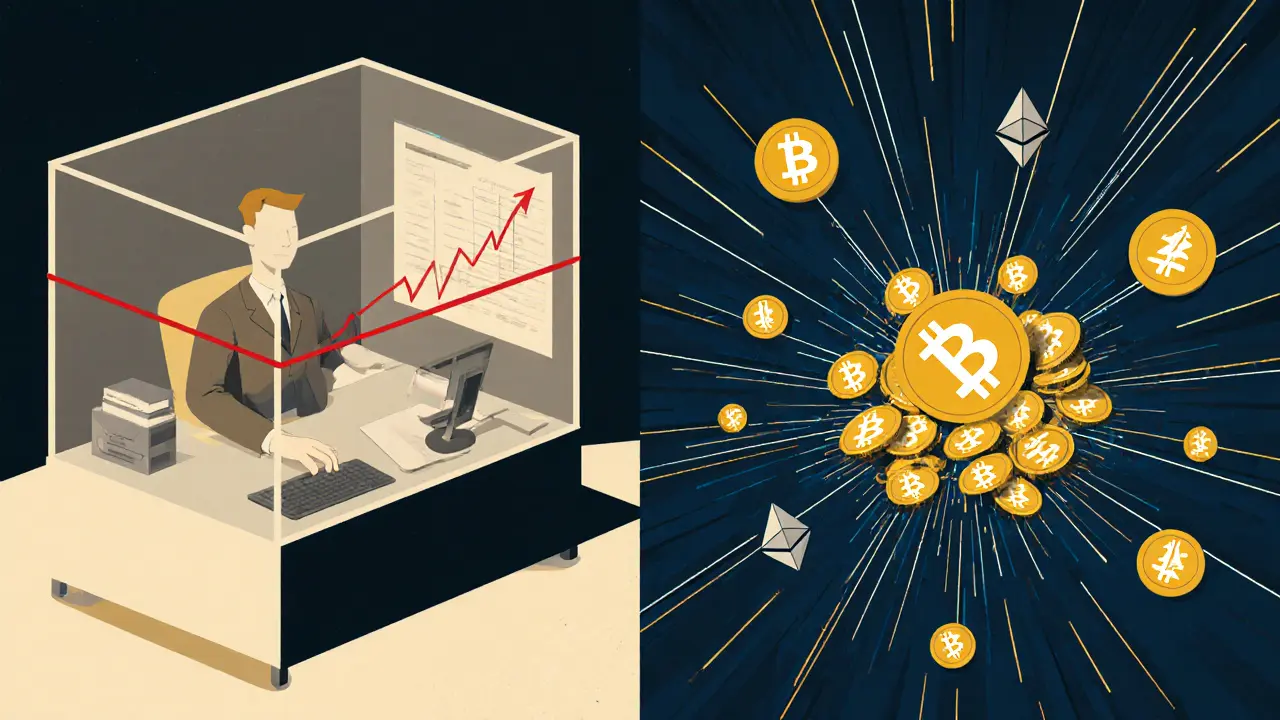
Cross margin works differently. Instead of locking money to one trade, it uses your entire account balance as backup. Every open position shares the same pool of funds. If one trade starts losing, the system automatically pulls money from your other holdings to keep it alive.Think of it like a safety net. You’re long Ethereum, and it drops 10%. Your position is under pressure. But you’re also holding Solana that just went up 15%. Cross margin takes that unrealized profit and uses it to cover your Ethereum loss. No need to add funds. No panic. The trade stays open.
This is why cross margin is the default on most exchanges like BitMEX and PrimeXBT. It’s hands-off. You don’t have to monitor each position’s margin level. The system does it for you. It’s especially useful if you’re holding several positions that might offset each other - like going long BTC and short ETH at the same time. One moves up, the other down, and your overall risk stays balanced.
But here’s the catch: if everything goes wrong at once, your whole account can vanish. If BTC, ETH, and SOL all crash together, cross margin doesn’t protect you - it accelerates the fall. The system keeps pulling from your balance until it’s empty. No warning. No limit. Just liquidation.
How They Handle Risk Differently
Isolated margin gives you control. You set the max loss. You know exactly what you’re risking on each trade. That’s why professional traders use it for high-leverage plays. A 100x position with isolated margin might only risk $50. If it blows up, you’re out $50. Clean. Simple.Cross margin gives you breathing room. It lets you ride out short-term dips. If you’re holding a portfolio of 10 coins and one drops 20%, cross margin might save your position - even if you didn’t have cash to add. But that same feature can turn a $200 loss into a $2,000 loss if the market turns against you.
Let’s say you have $5,000 in your account. You open two cross margin positions:
- Long BTC with 20x leverage ($2,500 position)
- Long ETH with 15x leverage ($2,500 position)
If BTC drops 10%, your BTC position loses $250. Cross margin pulls $250 from your ETH position’s unrealized gains to cover it. No problem. But if ETH drops 10% too, you lose another $250. Now both positions are under pressure. The system keeps pulling from your remaining balance. Within minutes, your entire $5,000 is gone - and both positions are liquidated.
With isolated margin, you’d have set each position to risk only $500. Even if both dropped 10%, you’d lose $500 each - $1,000 total. You’d still have $4,000 left. That’s the difference between controlled loss and total wipeout.
Which One Is Better for Beginners?
If you’re new to leveraged trading, cross margin feels safer. It’s automatic. You don’t need to calculate liquidation prices or worry about adding margin. You just open a trade and let the system handle the rest.But here’s the trap: beginners often don’t realize how quickly cross margin can erase their account. They think, “It’s protecting me,” when really, it’s just delaying the inevitable. If you open three high-leverage positions all at once with cross margin, and the market swings hard, you’re not getting saved - you’re getting wiped out faster than you expected.
Isolated margin forces you to think. You have to decide: How much am I willing to lose on this trade? That’s a good habit to build. It teaches discipline. It makes you respect risk.
Most experts agree: beginners should start with isolated margin. Use small amounts. Keep leverage low - 5x to 10x. Learn how liquidation prices work. Watch how your position reacts to price changes. Once you understand that, you can explore cross margin.
Which One Do Pros Use?
Professional traders rarely use just one. They mix both.They use isolated margin for high-risk, high-reward bets - like trading a new altcoin with 50x leverage. They lock in $100 and let it ride. If it wins, they make $5,000. If it loses, they lose $100. No big deal.
For their core positions - like holding BTC and ETH with 5x to 10x leverage - they use cross margin. It lets them ride out volatility without constantly adding funds. They know these positions are less likely to go against them, so they trust the system to protect them.
On platforms like Binance and Bybit, pros often run hybrid strategies. One isolated position for a speculative play. Five cross margin positions for their main portfolio. It’s not about choosing one over the other. It’s about using each for the right job.

When to Switch Between Them
You don’t have to pick one and stick with it forever. The market changes. Your strategy should too.Use isolated margin when:
- You’re trading a volatile coin with unknown price action
- You’re using high leverage (20x or more)
- You want to test a new strategy without risking your whole account
- You’re making a directional bet with low probability but high reward
Use cross margin when:
- You’re holding a diversified portfolio of coins
- Your positions are somewhat hedged (e.g., long BTC, short ETH)
- You’re using low to medium leverage (5x-15x)
- You want to avoid constant margin management
Some traders even switch modes mid-trade. They open a position with cross margin to ride the trend, then move it to isolated margin if the market gets choppy. It’s advanced, but it works if you’re paying attention.
Common Mistakes to Avoid
Here’s what most traders get wrong:- Using cross margin for high-leverage trades - you think you’re protected, but you’re just setting yourself up for a total loss.
- Assuming isolated margin is “safer” - it’s not. It just limits your loss. If you open 10 isolated positions with 50x leverage, you can still lose everything - just slower.
- Ignoring liquidation prices - both modes show them. Check them before you open a trade. If your liquidation price is too close to the current price, you’re one candle away from being out.
- Not adjusting margin when the market moves - if your position is profitable, you can add more margin to isolated trades to lower your liquidation price. Cross margin doesn’t let you do that manually - it’s automatic.
Most exchanges let you test both modes in demo mode. Use it. Open fake trades. Watch what happens when the price moves. You’ll learn faster than reading any guide.
Final Take: It’s Not About Better - It’s About Right
There’s no “best” margin type. Only the one that fits your style.Isolated margin is for control freaks. For people who want to know exactly how much they can lose on each trade. It’s precise. It’s disciplined. It’s not for lazy traders.
Cross margin is for hands-off traders. For people who want their positions to survive short-term crashes. It’s forgiving. It’s efficient. But it’s dangerous if you’re reckless.
The market doesn’t care if you’re right. It only cares if you’re still standing. Choose your margin type like you choose your armor - not because it looks cool, but because it keeps you alive.
Can I switch from cross margin to isolated margin after opening a trade?
No. Once a position is open, you can’t change its margin type. You must close the trade first, then reopen it with the new setting. Always double-check your margin mode before opening any position.
Does cross margin increase my chances of getting liquidated?
It doesn’t increase your chances - it delays them. Cross margin uses your whole account to keep positions alive, so you might stay in trades longer. But if the market moves against all your positions at once, your entire balance can vanish faster than with isolated margin. It’s not safer - it’s just less obvious until it’s too late.
Is isolated margin better for short-term trading?
Yes. Short-term traders often make quick, high-leverage bets. Isolated margin lets them risk only what they’re willing to lose on each trade. It prevents one bad trade from ruining their entire strategy. That’s why scalpers and day traders prefer it.
Can I use both margin types at the same time?
Yes. Most major exchanges let you open multiple positions, each with its own margin type. You can have five cross margin positions and one isolated margin position in the same account. This is a common strategy among experienced traders.
Why do most exchanges make cross margin the default?
Because it’s easier for beginners. It reduces the number of support tickets from people getting liquidated because they didn’t understand margin. But it also encourages riskier behavior. Exchanges benefit when traders trade more - even if they lose more. That’s why they make it the default.
Vaibhav Jaiswal
November 28, 2025 AT 00:48Man, I remember my first leveraged trade like it was yesterday - cross margin on, thought I was invincible. Then BTC dropped 15% in 20 minutes and my whole account vanished like it never existed. 😅 Isolated margin saved me after that. Now I treat every trade like it’s my last $50 - because it might be.
Joel Christian
November 29, 2025 AT 22:45cross margin is for noobs who dont wanna think lol. i got wiped so hard using it i started cryin in my cubicle. isolated is the only way. you set your limit and you stick to it. no drama. no magic safety net. just you and the charts. 🤡
jeff aza
December 1, 2025 AT 08:00There's a fundamental misalignment in the prevailing narrative here: cross-margin isn't 'dangerous' - it's a systemic risk amplifier under correlated market conditions. Isolated margin, by contrast, enforces position-level VaR constraints, thereby reducing tail-risk exposure at the portfolio level. That said, the assumption that beginners should use isolated margin is empirically sound - behavioral finance literature (e.g., Kahneman & Tversky, 1979) demonstrates that bounded rationality leads to over-leveraging under cognitive load. Cross-margin obscures this via liquidity illusion. Bottom line: isolated = intentional; cross = institutionalized complacency.
Vance Ashby
December 3, 2025 AT 00:04lol i use cross for btc/eth and isolated for shitcoins. it's not about which is better - it's about which one lets you sleep at night. also, never trust an exchange's default. always double-check. i've lost money twice because i didn't. 🙃
Felicia Sue Lynn
December 3, 2025 AT 12:23It’s interesting how these tools reflect deeper philosophical divides in how we relate to risk. Isolated margin embodies the stoic ideal - acceptance of finite loss, deliberate boundaries, self-imposed discipline. Cross margin, by contrast, mirrors a romanticized trust in systems - the belief that collective resilience will protect the individual. But markets do not reward belief. They reward awareness. Perhaps the real question isn’t which margin to use - but which version of ourselves we wish to become through our trading.
Eddy Lust
December 5, 2025 AT 04:58bro i just opened a 50x isolated on shib and it went to zero in 3 mins... but i only lost $20 so i laughed and made a meme. cross margin would’ve taken my rent money too. now i use isolated for everything except my core btc hold - that one’s cross. i’m not smart, but i’m not dumb either 😎