Largest Bitcoin Mining Pools in 2026: Hash Rate, Fees & Centralization Risks
 May, 10 2026
Who really controls the Bitcoin network? If you look at the raw data from late 2025 and early 2026, the answer might surprise you. A handful of massive Bitcoin mining pools are collective groups of miners who combine computational power to solve blocks and share rewards control roughly 70% of the known network hash rate. This isn't just a technical detail; it’s the backbone of how Bitcoin stays secure, yet it raises serious questions about decentralization.
If you’re running ASIC miners or thinking about joining a pool, knowing which one fits your goals is critical. Are you chasing the highest efficiency with zero fees? Do you need predictable daily payouts for payroll? Or do you prioritize privacy above all else? The landscape has shifted dramatically since the 2021 bans in China, pushing power northward and consolidating influence among fewer players. Let’s break down the current giants, their payout models, and what this means for the future of Bitcoin security.
The Current Market Leaders: Who Holds the Power?
As of mid-2026, the hierarchy remains relatively stable, though the gaps between the top tiers are widening. Based on data from Blockchain.com’s real-time hashrate distribution metrics from October 2025, five entities dominate the scene. These aren’t just random servers; they are sophisticated infrastructure providers that handle billions of shares daily.
Foundry USA sits firmly at the top, controlling approximately 30% of the total network hash rate. Launched by Digital Currency Group in 2020, its rapid ascent reflects the broader trend of institutional capital flooding into North American mining infrastructure. Behind it is Antpool, operated by Bitmain Technologies since 2014, holding an 18.76% share. F2Pool follows with 12.39%, while ViaBTC commands 10.55%. Finally, Braiins Pool (formerly Slushpool), the industry pioneer founded in 2010, holds an estimated 5-7%.
What’s striking is that despite these five controlling nearly three-quarters of the known hash rate, "unknown" entities still account for over 53% of the network. This anonymity layer actually helps decentralization by obscuring geographic concentration, as noted by Nick Carter of Castle Island Ventures in September 2025. However, when you dig into the known players, the centralization risk becomes a tangible concern for many purists.
| Pool Name | Market Share | Primary Payout Model | Fee Structure | Key Feature |
|---|---|---|---|---|
| Foundry USA | ~30% | FPPS | Inclusive of block rewards & fees | Largest scale, strict KYC |
| Antpool | ~18.76% | PPLNS / PPS+ | 0% (PPLNS) / 4%+2% (PPS+) | Dual options, Bitmain backed |
| F2Pool | ~12.39% | PPLNS / PPS | Standard competitive rates | Multi-currency support |
| ViaBTC | ~10.55% | PPLNS / FPPS | Low latency focus | Advanced analytics dashboard |
| Braiins Pool | ~5-7% | FPPS / PPLNS | 0% pool fees | BraiinsOS+ firmware integration |
Understanding Payout Models: FPPS vs. PPLNS vs. PPS+
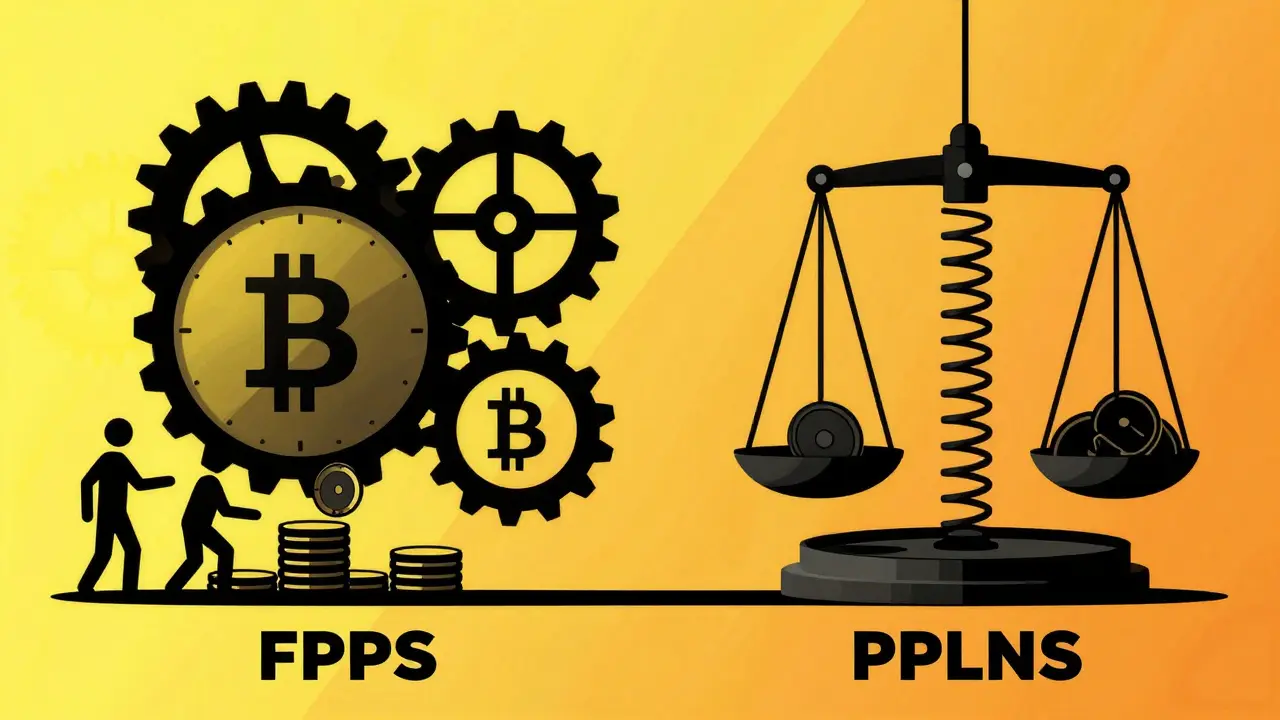
You can’t choose a pool without understanding how you get paid. The terminology can be dense, but the impact on your wallet is simple. Most major pools offer variations of three core models: FPPS, PPLNS, and PPS+.
FPPS (Full Pay Per Share) is the gold standard for predictability. Used heavily by Foundry USA and Braiins, it guarantees you earn your share of both the block subsidy and transaction fees, regardless of whether the pool finds a block or not. It smooths out variance, making cash flow easier to manage. Foundry USA’s implementation ensures consistent earnings, which is why it’s favored by large operations needing to pay electricity bills on time.
PPLNS (Pay Per Last N Shares) is older and riskier but often cheaper. Antpool offers this with 0% fees. You only get paid if the pool finds a block within a specific window of shares. If the pool gets unlucky, you might go days without a payout. However, because there’s no administrative overhead to calculate individual shares instantly, fees are lower. It rewards loyalty to the pool over time.
PPS+ (Pay Per Share Plus) is a hybrid used by Antpool. It charges a higher fee-typically 4% from the block reward plus 2% from mining fees-but offers more stability than pure PPLNS. It’s a middle ground for miners who want some predictability without committing to the full FPPS model.
For most solo miners or small farms, FPPS is the safest bet. For those trying to squeeze every satoshi out of their hardware and willing to accept variance, PPLNS on Antpool or Braiins makes sense.
The Centralization Debate: Is Bitcoin Still Decentralized?
This is the elephant in the room. When Foundry USA controls 30% of the hash rate, does that threaten the network? Dr. Alex de Vries, founder of Digiconomist, warned in October 2025 that such concentration creates significant risks to Bitcoin’s decentralized ethos. The fear is a 51% attack, where a single entity could rewrite transactions or double-spend coins.
However, context matters. The 30% figure represents *known* hash rate. As mentioned, over half the network is anonymous. Furthermore, a 51% attack requires not just hash power, but the willingness to burn billions in reputation and value. Most experts agree that while centralization is a long-term structural risk, it is not an immediate threat to transaction integrity.
There’s also a regulatory angle. Dr. David Schwartz testified before the U.S. House Financial Services Committee in October 2025 that pools like Foundry USA, which enforce strict KYC (Know Your Customer) requirements, actually enhance compliance. They prevent illicit actors from dominating the network. On the flip side, privacy advocates argue that mandatory KYC barriers exclude legitimate users who value pseudonymity, pushing them toward less compliant, potentially riskier alternatives.
Technical Edge: Firmware, Latency, and Stratum V2
It’s not just about who pays well; it’s about who keeps your miner efficient. Braiins Pool has carved out a niche here by offering 0% pool fees through its proprietary BraiinsOS+ firmware. According to Godex’s July 2025 assessment, this software increases mining efficiency by up to 25% by optimizing hash rate and reducing downtime. If you’re using Antminer S19j Pro units, this integration is a game-changer.
Latency also plays a huge role. Every millisecond counts when submitting shares. ViaBTC prides itself on a low-latency global server network, ensuring your work is accepted quickly. Meanwhile, the industry is shifting toward Stratum V2. This newer protocol improves security through end-to-end encryption, protecting against man-in-the-middle attacks. By October 2025, 78% of new connections were using Stratum V2. Foundry USA and ViaBTC support this standard, keeping your connection secure and private.

User Experience: Support, Documentation, and Trust
When things go wrong-and they will-you need support. User sentiment from Reddit’s r/BitcoinMining and Trustpilot reviews in late 2025 reveals clear winners and losers.
Braiins Pool consistently receives high praise for its user-friendly interface and responsive support. Test inquiries showed an average response time of 1.8 hours via email. Their documentation is also top-tier, with comprehensive API endpoints that developers love. Users report consistent daily payouts with zero downtime over extended periods.
Antpool, while robust, faces criticism for payment delays during network congestion. One user documented 36-hour payout delays during the April 2025 halving event, despite meeting withdrawal thresholds. Their support response time averages 8.3 hours, which can be frustrating during critical outages.
Foundry USA scores high on reliability (4.7/5 stars) but struggles with accessibility due to its strict KYC requirements. For privacy-focused miners, the 3-5 business day onboarding process involving business documentation is a dealbreaker. It’s built for institutions, not hobbyists.
Future Outlook: Regulation and Consolidation
The mining pool market is shrinking. We went from over 50 active pools in 2020 to about 15 major players today. J.P. Morgan projects that by 2027, just 3-4 dominant pools will control over 60% of the hash rate. This consolidation is driven by economies of scale and regulatory pressure.
Regulations are tightening globally. The EU’s MiCA framework requires all pools serving European customers to implement full KYC by Q1 2026. This will likely push European miners toward compliant pools like Foundry USA or Braiins, further concentrating hash rate. Meanwhile, the SEC’s October 2025 guidance classifying certain pool reward structures as securities could impact PPS+ models, forcing operators to rethink their financial engineering.
Innovation continues, however. Foundry USA announced zero-knowledge proof integrations in September 2025 to verify operations without revealing miner identities. Braiins launched Farm 2.0 software to reduce connection overhead by 40%. The battle for efficiency and compliance is far from over.
Which Bitcoin mining pool is best for beginners in 2026?
For beginners, Antpool is often recommended due to its user-friendly interface and quick setup time (under 15 minutes). It offers flexible payout options like PPLNS (0% fee) and PPS+, allowing new miners to experiment with different models. However, if you prefer zero fees and don't mind a slightly smaller community, Braiins Pool is an excellent alternative, especially if you use compatible Antminer hardware.
Is Foundry USA too centralized to be safe?
While Foundry USA controls ~30% of the known hash rate, it does not pose an immediate 51% attack risk because over 53% of the network hash rate is held by unknown or distributed entities. However, long-term centralization remains a theoretical risk to Bitcoin's decentralization ethos. Most experts view it as a manageable infrastructure development rather than an imminent threat.
What is the difference between FPPS and PPLNS payouts?
FPPS (Full Pay Per Share) guarantees you receive your proportional share of both block rewards and transaction fees every day, regardless of whether the pool finds a block. It offers stability. PPLNS (Pay Per Last N Shares) only pays you if the pool finds a block within a recent window of shares. It carries more variance but typically has lower fees (often 0%).
Do I need KYC to join a Bitcoin mining pool?
It depends on the pool. Foundry USA requires mandatory KYC verification, especially for hash rates above 10 PH/s. Braiins Pool allows anonymous mining with instant setup for smaller operations but may require verification for larger scales. Antpool and F2Pool generally have lighter KYC requirements for individual miners, though regulations like the EU's MiCA framework are pushing all pools toward stricter compliance by 2026.
How does BraiinsOS+ improve mining efficiency?
BraiinsOS+ is custom firmware developed by SatoshiLabs that optimizes the performance of Antminer ASICs. It reduces downtime, manages heat more effectively, and can increase overall hash rate efficiency by up to 25%. Additionally, using Braiins Pool with this firmware allows miners to enjoy 0% pool fees, maximizing net profitability.