Legal Risks for Tunisian Crypto Users and Traders: The 2018 Ban Explained
 May, 1 2026
Buying Bitcoin in Tunisia isn't just risky; it's a criminal offense. If you are holding digital assets or thinking about trading them while living in or visiting Tunisia, you need to understand that the country maintains one of the strictest prohibitions on cryptocurrency in the world. There is no gray area here. The Central Bank of Tunisia (BCT) has enforced a complete ban since 2018, and violating these rules can lead to severe fines, asset seizure, and even imprisonment.
This article breaks down exactly what is illegal, who enforces these laws, and the real-world consequences you face if you decide to trade, mine, or use crypto in Tunisia despite the restrictions.
The Legal Framework: A Total Prohibition
To understand the risk, you first need to look at the law itself. In 2018, the BCT issued a directive that explicitly prohibits all transactions involving virtual currencies. This isn't a guideline or a suggestion; it is a binding regulation that criminalizes the buying, selling, mining, and using of cryptocurrencies like Bitcoin, Ethereum, and stablecoins.
The ban covers every aspect of the crypto ecosystem:
- Trading: You cannot buy or sell crypto through exchanges, peer-to-peer networks, or informal arrangements.
- Mining: Operating mining hardware is prohibited. Importing ASIC miners or GPUs specifically for mining is illegal and subject to confiscation by customs.
- Payments: Merchants cannot accept crypto for goods or services. Using crypto to pay for rent, groceries, or online subscriptions is a violation.
- Financial Services: No local entity can offer custody, exchange, or wallet services. Banks are legally required to block any transfer linked to crypto activities.
The law does not distinguish between "safe" stablecoins and volatile altcoins. All virtual assets fall under the same prohibition. This means there is no legal way to hold crypto in Tunisia without breaking the law.
Who Enforces the Ban?
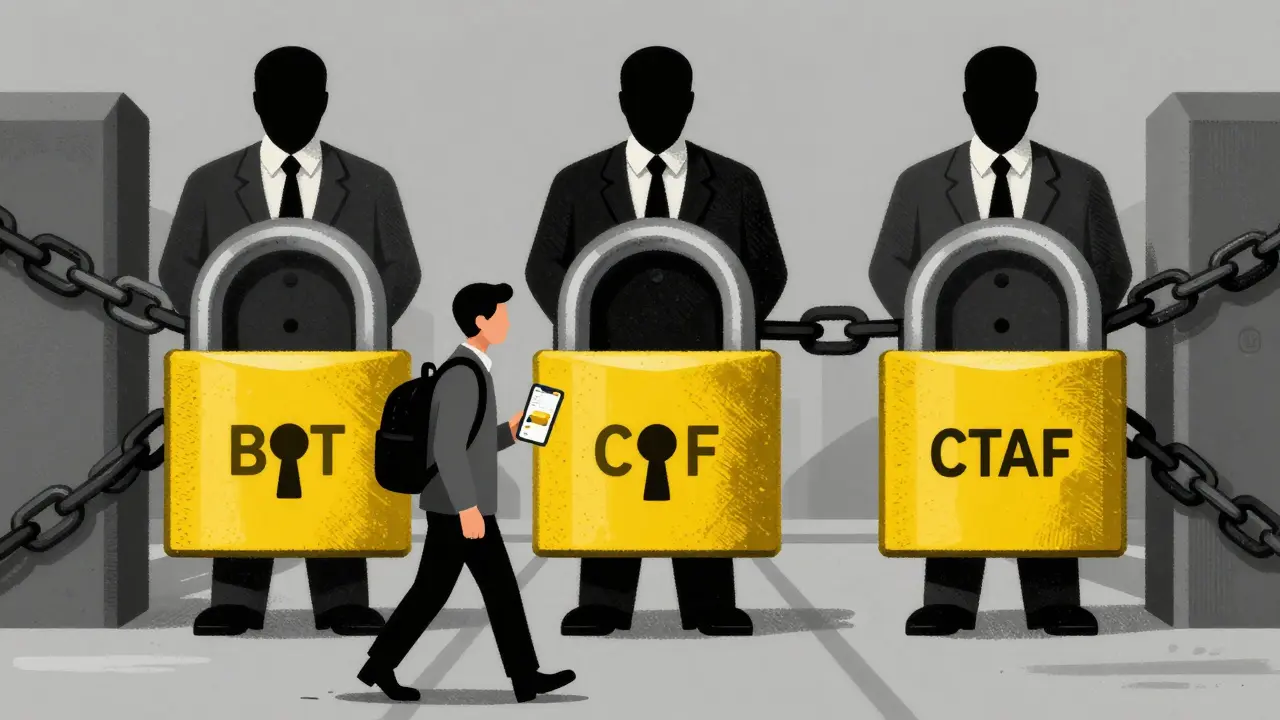
The enforcement mechanism in Tunisia is robust because three major government bodies work together to police financial activities. Understanding who is watching helps you realize how difficult it is to stay under the radar.
| Agency | Role in Crypto Enforcement |
|---|---|
| Central Bank of Tunisia (BCT) | Issues the prohibitive directives, monitors banks, and manages the limited fintech sandbox. |
| Financial Market Council (CMF) | Oversaw capital markets; would regulate security tokens if they were ever permitted (currently they are not). |
| National Anti-Money-Laundering Commission (CTAF) | Monitors suspicious transactions, requires banks to report anomalies, and investigates illicit flows. |
Banks play a critical role in this enforcement. They are legally obligated to deny transfers related to crypto. If your bank account receives funds from an offshore exchange or shows patterns consistent with P2P crypto trading, the bank will likely freeze your account and report you to the CTAF. This creates a massive barrier for anyone trying to move money in or out of the country using digital assets.
Penalties: Fines, Seizure, and Prison
What happens if you get caught? The penalties are severe. Under Tunisia's currency control code, violations can result in:
- Imprisonment: Up to five years in prison for individuals involved in unauthorized virtual-money transactions.
- Fines: Substantial financial penalties determined by the value of the transaction or the severity of the violation.
- Asset Seizure: Any profits made from crypto activities are considered illegal gains and will be confiscated by the state. This includes the crypto itself and any fiat currency converted from it.
For businesses, the risks are even higher. Companies cannot record crypto assets on their accounting books. If a business is found accepting crypto payments or holding digital assets, it faces the same maximum penalty of five years imprisonment for responsible executives plus heavy fines. Customs authorities actively inspect shipments for mining equipment, seizing rigs upon discovery.
The "Sandbox" Exception: What It Means for You
You might hear about the BCT's "regulatory sandbox" and wonder if this offers a loophole. It does not. The sandbox is a controlled environment for specific startups to test blockchain technology, but it is strictly limited.
Startups like VFunder (crowdfunding) or Hydro E-Blocks (carbon tracking) operate under special exemptions. However, these projects:
- Are approved by the BCT after rigorous review.
- Operate on permissioned ledgers, not public blockchains.
- Do not involve public trading of tokens or cryptocurrencies.
- Often host their infrastructure outside Tunisia to comply with international standards.
If you are an individual trader or miner, the sandbox does not apply to you. It is designed for enterprise solutions focused on transparency and supply chain management, not for speculative trading or decentralized finance.
Real-World Risks for Users
Despite the ban, interest in crypto remains high in Tunisia. Many users turn to informal peer-to-peer (P2P) networks, encrypted messaging apps, and VPNs to access offshore exchanges. While this might seem like a safe workaround, it carries significant hidden dangers.
Bank Account Freezes: This is the most common consequence. Banks monitor for unusual international transfers. If you receive funds from a known exchange or show rapid inflows/outflows typical of trading, your account will be frozen pending investigation. Unfreezing it can take months and may require legal representation.
Scams and Fraud: Because there is no legal recourse, P2P traders are vulnerable to scams. If someone sends you fake proof of payment or runs off with your crypto, you cannot go to the police. Reporting the crime would mean admitting you participated in an illegal activity.
Surveillance: Authorities have increased monitoring of international money transfers. Several documented cases exist where accounts were flagged for suspected crypto connections, leading to audits and potential prosecution.
Future Outlook: Will the Ban Lift?
As of 2026, there is no indication that the total ban will be lifted soon. While some parliamentary discussions have touched on classifying crypto as "virtual assets" subject to anti-money laundering rules, this would likely mean stricter regulation, not legalization. The government remains firm on protecting the national currency and preventing capital flight.
The trend among Tunisian tech entrepreneurs is to relocate operations to more crypto-friendly jurisdictions like Switzerland, Canada, or neighboring countries with clearer regulations. This "brain drain" continues as long as the domestic legal environment remains hostile to digital assets.
Practical Advice for Residents and Visitors
If you live in Tunisia or plan to visit, here is how to navigate this landscape safely:
- Avoid Local Trading: Do not attempt to buy or sell crypto within Tunisia. Use no local exchanges or P2P platforms based in the country.
- Separate Finances: Keep your banking activities strictly separate from any crypto-related movements. Do not link your Tunisian bank account to foreign exchanges.
- Understand the Risk: Recognize that any participation is illegal. There is no "legal" way to trade crypto in Tunisia currently.
- Consult a Lawyer: If you are involved in blockchain development or fintech, consult with a local attorney specializing in financial law before launching any product. Do not rely on general advice.
The gap between global crypto adoption and Tunisia's restrictive laws creates a complex reality for residents. Until the regulatory framework changes, the safest approach is complete avoidance of cryptocurrency activities within the country's borders.
Is it legal to own Bitcoin in Tunisia?
No. Owning, buying, selling, or using Bitcoin is illegal under the 2018 directive issued by the Central Bank of Tunisia. Possession alone can lead to legal action, especially if discovered during a financial audit or bank investigation.
Can I use a VPN to trade crypto in Tunisia?
Using a VPN does not make the activity legal. While it may help you access offshore exchanges, the underlying act of trading crypto remains a criminal offense. Additionally, banks monitor transaction patterns, so funding such trades through local banks still exposes you to account freezes and reporting to authorities.
What are the penalties for crypto mining in Tunisia?
Mining is strictly prohibited. Penalties include confiscation of mining equipment by customs, substantial fines, and potential imprisonment of up to five years. Importing ASIC rigs or specialized GPUs for mining purposes is also illegal.
Are there any exceptions for blockchain technology?
Yes, but only for specific startups operating within the BCT's regulatory sandbox. These projects focus on non-financial applications like supply chain tracking or carbon credits and must use permissioned ledgers. Public token sales or crypto trading are not included in these exceptions.
Will my bank account be frozen if I trade crypto?
It is highly likely. Tunisian banks are required to report suspicious transactions to the National Anti-Money-Laundering Commission (CTAF). Transfers linked to crypto exchanges or unusual P2P patterns often trigger automatic account freezes and investigations.
Is there any chance the crypto ban will be lifted soon?
As of 2026, there is no timeline for lifting the ban. While some legislative discussions mention regulating virtual assets for anti-money laundering purposes, the current government stance remains firmly against open-market cryptocurrency trading to protect the national currency.
Carli Bates
May 2, 2026 AT 20:29so the state decides what you can hold in your pocket and suddenly it becomes a crime to exist outside their control
its always about power not safety
Brendan Thraxton
May 4, 2026 AT 11:26hey everyone looking at this situation in tunisia its actually pretty wild how strict they are but i get where they are coming from with capital flight being such a huge issue for developing economies
the banking sector there is basically the only thing holding the economy together right now so when you see banks freezing accounts its not just bureaucracy its survival mode for the financial system
i think people forget that crypto was designed specifically to bypass these kinds of controls which makes it a direct threat to central bank authority
if you are living there though you have to be super careful because the penalties are real and not just theoretical fines
i would suggest keeping everything completely separate if you have any exposure to digital assets abroad
maybe look into jurisdictions like switzerland or even neighboring morocco where the rules might be slightly more navigable for remote workers
it sucks that tech entrepreneurs have to leave to do what they love but its better than going to jail right
stay safe out there folks
its me
May 6, 2026 AT 06:24you people really think freedom means ignoring the social contract
the government exists to protect the currency stability and you want to undermine it for speculative gains
its selfish and dangerous for the whole population
Iestyn Lloyd
May 7, 2026 AT 18:30from a uk perspective this is quite fascinating
we have seen similar debates here regarding stablecoins and regulatory sandboxes
tunisia has taken a much harder line than most european nations currently
the use of permissioned ledgers for supply chain tracking seems like a sensible compromise as mentioned in the article
it allows innovation without threatening monetary sovereignty
i suspect we will see more countries adopt this hybrid model rather than total bans as technology matures
the key is balancing anti-money laundering requirements with technological progress
Ipsita Seal
May 8, 2026 AT 04:26ugh another boring legal post
why does anyone care about tunisian laws anyway
just move if you dont like it
people are so dramatic about money
Tracy McBurney
May 10, 2026 AT 00:16The enforcement mechanism described herein is remarkably efficient precisely because it leverages existing banking infrastructure.
Banks act as the primary filter, identifying anomalies through standard transaction monitoring protocols.
This creates a multi-layered defense strategy that is difficult for individual actors to circumvent effectively.
The involvement of the CTAF ensures that any detected violations are escalated appropriately.
It is a classic example of using traditional financial controls to suppress decentralized alternatives.
edie rosa
May 10, 2026 AT 08:14its disgusting how these governments treat their own citizens like criminals for trying to save their savings
they know the currency is collapsing and instead of fixing it they punish the people who find alternatives
you should feel ashamed for supporting this regime
no wonder everyone wants to leave
Rushell Perry
May 11, 2026 AT 15:13you got this
staying informed is the first step to navigating tricky situations
keep your head up and stay safe out there
we are all learning together
April D Thompson
May 12, 2026 AT 17:43oh wow so you are telling me that owning a piece of code is a crime now
that is absolutely terrifying and also kind of hilarious in a dystopian way
imagine telling someone they cant have an idea because the government says so
but sure lets lock people up for five years over virtual coins
what a world we live in where privacy is a felony and compliance is mandatory happiness
i am literally shaking right now thinking about the surveillance state required to enforce this
its not just about money its about control pure and simple
good luck to anyone stuck in that web of lies
Kara Spadone
May 14, 2026 AT 01:42the truth is often bitter :)
these bans are not about protecting you from scams
they are about maintaining the monopoly on value creation
once you understand that you realize why they are so aggressive
its a battle for the future of finance and the old guard is fighting dirty
stay woke my friends :)