PSA Registration Requirements for Crypto Exchanges in Japan
 Oct, 12 2025
PSA Registration Capital Calculator
Calculate Your Eligibility
Check if your company meets Japan's minimum capital requirements for PSA registration under the Payment Services Act
Running a cryptocurrency exchange in Japan isn’t just about setting up a website and accepting Bitcoin. If you want to operate legally, you must register under the Payment Services Act (PSA) - and the bar is one of the highest in the world. The Financial Services Agency (FSA) doesn’t just check your paperwork. They dig into your entire business structure, your security systems, your finances, and even how you store customer coins. Failure to comply? You could face criminal penalties - including confinement punishment - and your business could be shut down overnight.
What Exactly Is the PSA?
The Payment Services Act, amended in 2017 and updated through 2025, defines cryptocurrency as a legal payment method and property in Japan. It’s not a gray area. If you’re buying or selling crypto as a business - even if you’re based overseas - you must register with the FSA as a Crypto Asset Exchange Service Provider (CAESP). This isn’t optional. It’s the law.Unlike some countries that treat crypto as a commodity or asset class, Japan classifies it as a payment mechanism. That means Bitcoin, Ethereum, and other major tokens fall squarely under the PSA. But not everything counts. Prepaid cards tied to yen or dollars? Those are excluded. Only non-fiat-denominated digital assets that can be used to pay unidentified people qualify.
Who Can Apply for PSA Registration?
You can’t just walk in with a startup idea. The FSA only accepts applications from two types of entities:- Japanese stock companies (kabushiki-kaisha)
- Foreign companies that set up a Japanese subsidiary (not a branch)
Yes, you read that right. Foreign firms can’t apply as branches. Every single foreign exchange that’s registered in Japan - including Binance, Kraken, and Coinbase - had to create a fully owned Japanese subsidiary. That means hiring local staff, opening a physical office, and complying with Japanese corporate law. There’s no shortcut.
Financial Requirements: You Need Real Money
The FSA doesn’t let just anyone in. To even start the application, you need:- Minimum capital of JPY 10 million (about $65,000 USD)
- Positive net assets - meaning your total assets must exceed your liabilities
These aren’t suggestions. They’re hard cutoffs. The FSA wants to make sure you can survive a market crash, a hack, or a sudden spike in customer withdrawals. A small crypto startup with $50,000 in funding? You won’t qualify. A well-funded firm with $2 million in reserves? That’s a better fit.
Organizational Structure: No More Fly-by-Night Operations
The FSA isn’t just checking your bank balance. They’re auditing your company’s DNA. You must prove you have:- A clear corporate structure with named directors and officers
- A compliance department that reports directly to the board
- Internal controls for anti-money laundering (AML) and know-your-customer (KYC) checks
- A documented risk management system
You can’t outsource your compliance to a third party and call it done. The FSA requires that your internal systems are fully owned and operated by your company. That means hiring dedicated compliance officers, training staff, and keeping audit trails for every transaction.
Asset Segregation: Customer Coins Are Not Your Money
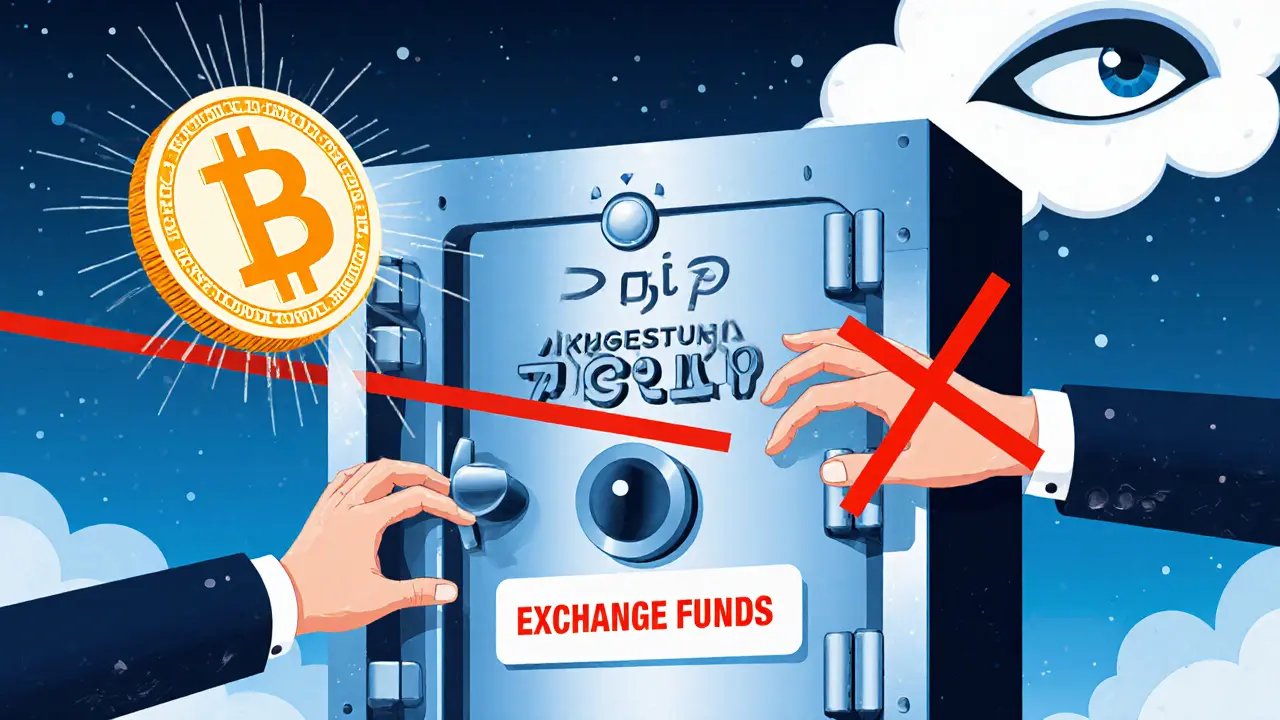
This is where most exchanges fail. The PSA demands that customer crypto assets be completely separated from your company’s funds. No commingling. No borrowing. No using customer coins to cover operational costs.Here’s the hard rule: At least 95% of customer assets must be stored in offline cold wallets. That means air-gapped hardware devices, kept in secure vaults, with multi-signature access controls. The remaining 5% can be in hot wallets for day-to-day withdrawals - but even those must be insured and monitored 24/7.
The FSA also requires you to prove, through regular audits, that every customer’s holdings are fully accounted for. If you’re holding 1,000 BTC for users, you must be able to show exactly where each coin is stored - and that none of it was moved to your own wallet.
Application Process: Six Months Just to Get Started
The registration process isn’t a form you fill out online. It’s a six-month marathon of documentation, interviews, and revisions. You’ll need to submit:- Company registration documents
- Proof of capital and financial statements
- Names and backgrounds of all directors and key staff
- Details of every crypto asset you plan to trade
- Step-by-step descriptions of your trading, withdrawal, and security systems
- Outsourcing agreements (if you use third-party custody or tech providers)
And that’s just the start. The FSA will likely request multiple rounds of revisions. They’ll ask for more details on your KYC process, your server locations, your incident response plan. If you’re missing one document, they’ll send it back - no exceptions.
Advertising Rules: No Hype, No Promises
You can’t run ads saying “Get Rich Quick with Bitcoin!” or “Earn 20% Monthly Returns.” The FSA bans any marketing that implies guaranteed profits, uses misleading statistics, or creates false urgency.Ads must be factual, clear, and include risk disclosures. For example: “Cryptocurrency prices are volatile. You may lose your entire investment.” That’s not a suggestion - it’s a legal requirement.
What Happens If You Don’t Register?
Operating without PSA registration is a criminal offense. Before June 1, 2025, the penalty was up to three years in prison and a fine of JPY 3 million. Now, under Japan’s updated Penal Code, imprisonment has been replaced with “confinement punishment” - a form of detention without prison, but still a serious legal consequence.On top of that, the FSA can shut down your website, freeze your bank accounts, and block your domain. Your customers will lose trust. Your reputation will be destroyed. And you’ll be barred from ever applying again.
How the FSA Keeps Track
Registration isn’t the end. It’s the beginning. The FSA conducts ongoing supervision. Registered exchanges must submit quarterly reports, undergo annual audits, and respond to FSA inquiries within strict deadlines.The FSA works with two self-regulatory bodies: the Japan Virtual Currency Exchange Association (JVCEA) and the Japan Security Token Offering Association (JSTOA). JVCEA members must follow additional standards beyond the PSA - including stricter security protocols and transparency rules.
If you’re found violating rules - even minor ones - the FSA can issue warnings, suspend trading, or revoke your license. There’s no grace period. Compliance is continuous.
Why Japan’s Rules Matter
Japan isn’t trying to kill crypto. It’s trying to make it safe. The PSA creates a clear, predictable environment. If you’re registered, you can operate with confidence. Customers know your exchange is legit. Banks will work with you. Investors will trust you.But that safety comes at a cost. The registration process is expensive, slow, and complex. It favors large firms with legal teams and deep pockets. Smaller players often can’t afford it. That’s why Japan has only about 20 registered crypto exchanges - far fewer than the U.S. or Europe.
Still, for those who make it through, the payoff is real. Japan is one of the most crypto-friendly advanced economies in the world. It recognizes digital assets as property. It allows full trading. It protects users. And it gives businesses a clear path forward - if they’re willing to do the work.
What’s Next for Japan’s Crypto Rules?
In 2025, a new bill was submitted to Japan’s Diet to strengthen the PSA further. It gives the FSA direct authority to order specific actions - like freezing assets, halting operations, or forcing changes to internal systems - without going through court.This means regulators now have even more power to act fast. If an exchange shows signs of instability or misconduct, the FSA can shut it down before customers lose money.
It’s not about stopping innovation. It’s about making sure innovation doesn’t come at the cost of people’s savings.
Can a foreign company register for PSA without setting up a Japanese subsidiary?
No. The Financial Services Agency (FSA) has never approved a foreign crypto exchange registered as a branch in Japan. All foreign firms must establish a fully owned Japanese subsidiary (kabushiki-kaisha) to apply for PSA registration. This means incorporating under Japanese law, hiring local staff, and maintaining a physical office in Japan.
What happens if a registered exchange fails to keep 95% of assets in cold storage?
The FSA requires at least 95% of customer crypto assets to be stored offline in cold wallets. If an exchange fails to meet this standard, it will be issued a formal warning. Repeated violations can lead to suspension of trading, fines, or revocation of the PSA license. In extreme cases, the FSA may force the exchange to shut down and compensate affected users.
Is Bitcoin legal in Japan under the PSA?
Yes. Bitcoin and other major cryptocurrencies are legally recognized as "Crypto Assets" under the Payment Services Act. They can be bought, sold, traded, and held as property. Japan was one of the first countries to explicitly legalize cryptocurrency as a payment method and asset class.
Do I need to register if I only accept crypto for payments, not trade it?
No. If you’re a business that accepts Bitcoin or other crypto as payment for goods or services - and you don’t buy or sell crypto as part of your business model - you don’t need PSA registration. The law only applies to entities that operate as crypto exchange service providers.
How long does PSA registration take?
The FSA’s official review period is up to six months, but most applications take longer. Preparation - building compliance systems, securing capital, hiring staff, and preparing documentation - can take 6 to 12 months before you even submit. The process is intentionally slow to ensure only serious, well-prepared operators enter the market.
Are there any crypto assets excluded from the PSA?
Yes. Prepaid cards or digital tokens that are denominated in Japanese yen or foreign currencies - like bank-issued e-money or gift cards - are not considered crypto assets under the PSA. Only non-fiat-denominated digital assets that can be used to pay unidentified parties qualify as Crypto Assets.
Can I use a third-party custodian for my customer assets?
Yes, but you’re still fully responsible. You can outsource cold storage to a licensed custodian, but the FSA holds your company accountable for any loss or mismanagement. You must document the custodian’s security protocols, audit them annually, and prove that customer assets are never commingled with your own.
What’s the difference between PSA and FIEA licensing?
The Payment Services Act (PSA) covers plain spot trading of crypto assets like Bitcoin and Ethereum. The Financial Instruments and Exchange Act (FIEA) applies to tokens that act like securities - such as tokenized stocks, revenue-sharing tokens, or investment contracts. FIEA licensing is stricter, with higher capital requirements and ongoing reporting obligations. Most exchanges start with PSA unless they’re dealing with security tokens.
George Kakosouris
November 25, 2025 AT 16:44The PSA is a goddamn fortress. You think you're building a crypto exchange? Nah, you're applying for a federal security clearance with a balance sheet. FSA doesn't care if you're 'disruptive'-they care if your cold wallet keys are stored in a vault with biometric locks and two-man rule. If your CTO thinks 'multi-sig' is a new iPhone feature, you're already dead. This isn't regulation-it's a rite of passage for serious players.
Tony spart
November 27, 2025 AT 06:28Japan's got the right idea. America's a joke-half these crypto firms are run by guys who thought 'blockchain' was a new type of yoga. If you can't afford JPY 10M in capital, you shouldn't be touching crypto. This isn't a startup playground. It's a financial institution. Get your act together or get out.
Mark Adelmann
November 27, 2025 AT 23:12Really appreciate this breakdown. A lot of people think Japan is being too strict, but honestly? It’s why you can trust a Japanese exchange. I’ve had friends lose everything on shady platforms-no audits, no cold storage, no transparency. Japan’s model isn’t perfect, but it’s the closest thing we’ve got to real consumer protection in this space. If you’re serious, the grind is worth it.
Angel RYAN
November 28, 2025 AT 10:2195% cold storage is non-negotiable and honestly it should be global standard. Why are we still letting exchanges hold hot wallets like it’s 2014? The tech exists. The cost is low. The risk is too high to cut corners. This isn’t about control-it’s about not being the next Mt. Gox
stephen bullard
November 29, 2025 AT 16:56It’s funny how we call this 'heavy regulation' but in reality, it’s just basic responsibility. We regulate banks because we know money matters. Why should crypto be any different? The FSA isn’t trying to kill innovation-they’re trying to stop people from getting crushed by the very thing that’s supposed to empower them. Safety isn’t the enemy of progress. Recklessness is.
SHASHI SHEKHAR
November 29, 2025 AT 23:02Bro this is gold 🙌 Japan’s approach is like the Swiss watch of crypto regulation-precise, durable, no fluff. I’ve worked with 3 exchanges trying to get registered here and let me tell you-the paperwork is insane. But once you’re in? Banks actually return your calls. Investors don’t ask 'is this legit?' they ask 'how much can I put in?' The 6-month wait? Totally worth it. Also, cold storage isn’t optional-it’s your lifeline. One hack and you’re done. No second chances. Use multi-sig, use geofenced vaults, use hardware that’s older than your phone. Safety > convenience. Always. 🇯🇵🔥
Michael Labelle
December 1, 2025 AT 05:11Foreign companies can’t just open a branch? That’s actually smart. Too many offshore firms treat Japan like a loophole. You want access to this market? Then live here. Hire here. Be accountable here. It’s not about nationalism-it’s about responsibility. If you’re going to handle people’s money, you owe them more than a website and a whitepaper.
Joel Christian
December 1, 2025 AT 09:39why do they make it so hard?? like i just wanna trade btc and they make me hire a compliance officer and open a bank account in tokyo?? this is bullsh*t. i dont even know what a kabushiki-kaisha is. someone pls explain. i think i need a lawyer and a therapist
jeff aza
December 3, 2025 AT 06:11Let’s be real: the PSA isn’t about safety-it’s about protecting incumbent banks and stifling competition. The JPY 10M capital requirement? Arbitrary. The subsidiary mandate? Protectionist. The FSA’s 'ongoing supervision'? A bureaucratic nightmare disguised as consumer protection. This isn’t regulation-it’s rent-seeking dressed up in compliance jargon. And don’t even get me started on the 'confinement punishment'-that’s not law, that’s theater. Japan wants to look tough, not smart.