SithSwap Crypto Exchange Review: Best StarkNet DEX for Low-Slippage Swaps?
 Mar, 1 2026
When it comes to swapping crypto on StarkNet, not all decentralized exchanges are created equal. If you're trading stablecoins like USDC or volatile assets like STRK, you need a platform that minimizes slippage, cuts fees, and doesn't force you to wait minutes for a trade to confirm. That's where SithSwap comes in. It’s not just another AMM - it’s a hybrid system built to solve real problems most DEXs ignore.
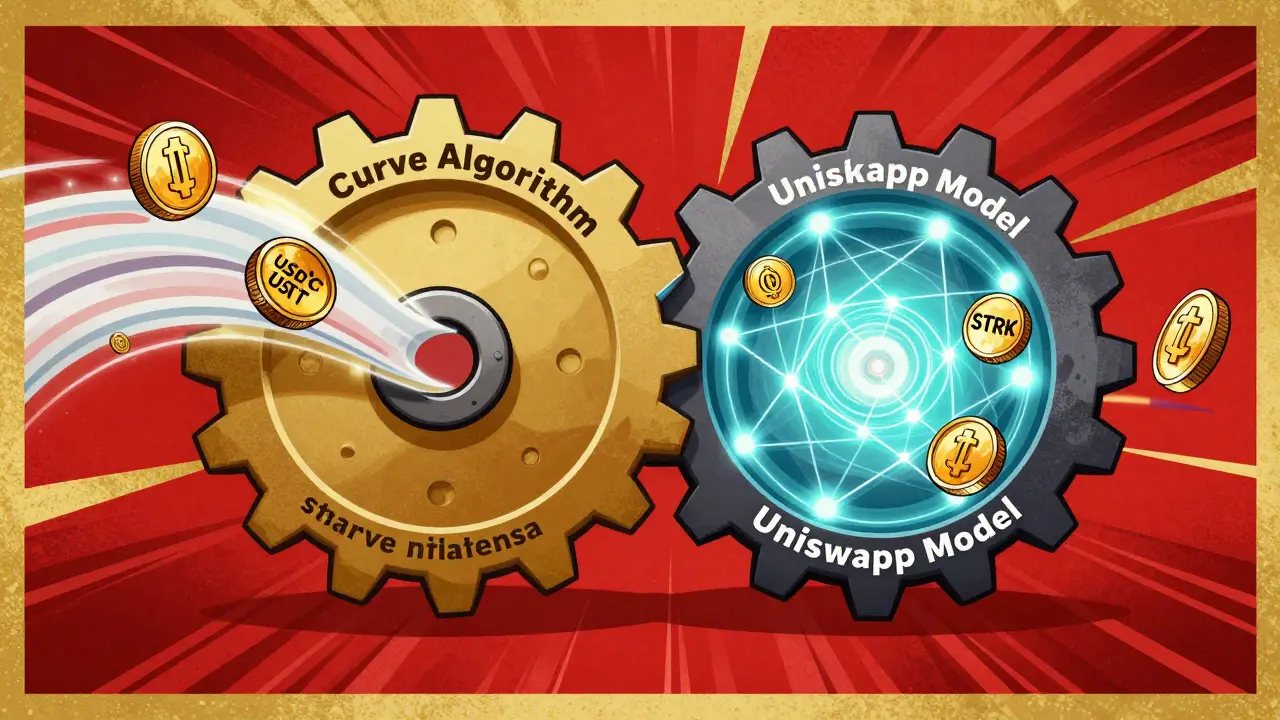
How SithSwap Works: Uniswap Meets Curve
SithSwap doesn’t use a one-size-fits-all formula. Instead, it switches between two trading models depending on what you’re swapping. For stablecoins like USDT, USDC, or DAI, it uses a Curve-style algorithm that keeps prices rock steady. For volatile assets like ETH or native StarkNet tokens, it falls back to a Uniswap V2-style constant product model. This dual-mode design is what sets it apart.Most DEXs force you to choose: either low slippage on stable pairs (like Curve) or flexibility for wild price swings (like Uniswap). SithSwap does both. On a $10,000 USDC-to-USDT swap, you’ll typically see just 0.023% slippage. Compare that to Uniswap V2, where the same trade might cost you 0.068%. For volatile pairs like STRK-to-WETH, SithSwap holds slippage around 0.15-0.3%, while competitors like JediSwap often run 0.4-0.8%.
Speed, Cost, and Security
All trades on SithSwap run on StarkNet, a zk-Rollup built on Ethereum. This means you get Ethereum’s security - every transaction is batched and verified on Ethereum mainnet - but with StarkNet’s speed and low cost. A typical swap costs around $0.002 in gas. That’s 97.8% cheaper than doing the same trade directly on Ethereum.Settlement time? About 10 minutes. That’s faster than most L2s and way quicker than Ethereum L1. Benchmarks show SithSwap clears 98.7% of swaps under $50,000 successfully, with an average execution time of just 8.2 seconds. Compare that to JediSwap’s 14.7 seconds or 10K Swap’s 18.3 seconds. For traders moving large amounts, that difference adds up.
Tokenomics: SITH and veSITH
SithSwap’s native token, SITH, isn’t just for speculation. It’s the backbone of governance and incentives. There are 1 billion SITH tokens total. 45% is reserved for liquidity miners over four years. If you provide liquidity, you earn SITH rewards. But here’s the twist: to vote on protocol changes or boost your rewards, you need to lock up your SITH as veSITH.veSITH requires a minimum 14-day lockup. The longer you lock, the more voting power you get. This system discourages short-term flipping and encourages long-term commitment. It’s inspired by Convex and Curve, but SithSwap makes it simpler to use. As of September 2025, over 62% of circulating SITH was veSITH-locked, showing strong community buy-in.
Fee distribution is also smart. A 0.05-0.3% fee applies per trade, depending on asset volatility. 75% goes to liquidity providers, 15% to the treasury (for future development), and 10% to veSITH holders. This keeps liquidity flowing while funding growth.

What You Can Trade
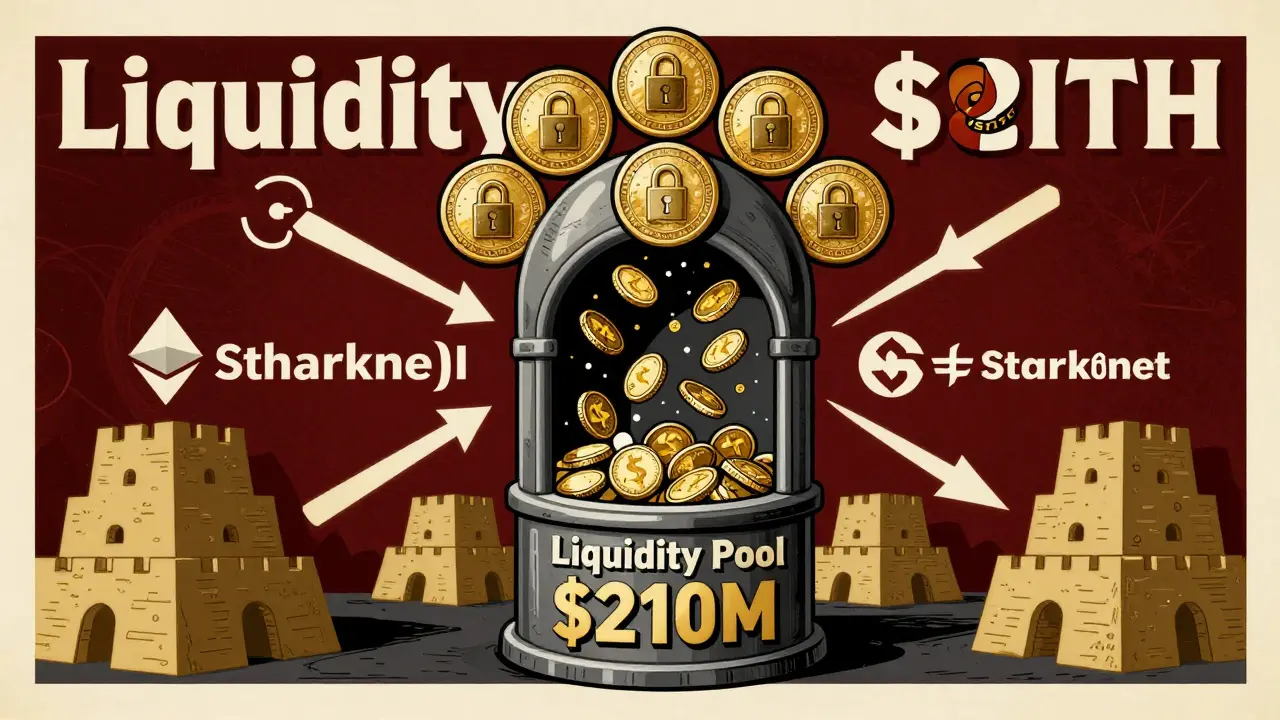
As of September 2025, SithSwap supports 87 token pairs. That’s solid for a StarkNet-native DEX, but it’s not the widest library. JediSwap offers 142 pairs. If you’re trying to trade a brand-new StarkNet token that just launched, you might not find it on SithSwap. This is its biggest weakness.But if you’re trading major assets - USDC, USDT, ETH, STRK, STARK, WETH, DAI - SithSwap has deep pools with tight spreads. Its most popular pair, USDC-USDT, has over $210 million in liquidity. That’s more than 40% of all stablecoin liquidity on StarkNet. For traders focused on the top 10 tokens, SithSwap is often the best option.
Comparison: SithSwap vs. JediSwap vs. mySwap
| Feature | SithSwap | JediSwap | mySwap |
|---|---|---|---|
| Market Share (Q3 2025) | 38.7% | 29.3% | 18.5% |
| Stablecoin Slippage (avg) | 0.023% | 0.068% | 0.051% |
| Volatile Asset Slippage (avg) | 0.18% | 0.52% | 0.29% |
| Gas Cost (avg per swap) | $0.002 | $0.003 | $0.004 |
| Token Pairs | 87 | 142 | 118 |
| Fee Structure | Dynamic (0.05-0.3%) | Flat 0.3% | Flat 0.25% |
| Best For | Stablecoin swaps, low fees | Wide token selection | StarkNet dApp integrations |
SithSwap wins on price and speed. JediSwap wins on variety. mySwap wins on ecosystem depth. If you’re a daily trader focused on USDC, ETH, or STRK, SithSwap gives you the best execution. If you’re hunting for obscure tokens, you’ll need to switch.
Who Is SithSwap For?
SithSwap is perfect for:- Stablecoin traders who hate slippage
- StarkNet users who want near-zero gas fees
- Traders who value speed over token variety
- Long-term liquidity providers who want veSITH rewards
It’s not ideal for:
- New users who need hand-holding (educational resources are light)
- Traders needing niche or newly launched tokens
- Those who want 24/7 live support (response times can be slow)
What’s Next? Version 3.0 and Beyond
SithSwap isn’t standing still. Version 3.0, launching November 15, 2025, will add cross-chain swaps via Symbiosis Finance. That means you could swap ETH from Ethereum to STRK on StarkNet without leaving the platform.Also coming in Q1 2026: veSITH 2.0. This upgrade will boost rewards for concentrated liquidity positions - essentially letting providers earn more by focusing their funds on specific price ranges. A protocol-owned liquidity module is also in the works, which could reduce reliance on external LPs and create a more sustainable revenue model.
Analysts at Delphi Digital rate SithSwap’s technical execution as an “A” but warn its tokenomics still leans too heavily on short-term incentives. If the protocol can lock in more long-term value, it could become the dominant DEX on StarkNet.
Final Verdict
SithSwap isn’t the biggest DEX on StarkNet - but it’s the most efficient. If you care about low slippage, ultra-low fees, and fast execution on major assets, nothing else comes close. It’s not perfect: the token list is limited, and the learning curve for veSITH isn’t beginner-friendly. But for active traders, it’s the most powerful tool on the chain.For most users, the choice is simple: if you’re trading stablecoins or ETH on StarkNet, start with SithSwap. If you need a wider selection of tokens, use JediSwap as a backup. SithSwap doesn’t try to be everything - and that’s why it works so well.
Is SithSwap safe to use?
Yes, SithSwap is built on StarkNet, which inherits Ethereum’s security. All transactions are batched and verified on Ethereum mainnet. The core contracts have been audited, and the protocol uses zk-Rollup technology to prevent fraud. However, like all DeFi platforms, you’re responsible for your own wallet security. Always use a trusted wallet like Argent X or Braavos, and never share your private key.
What wallets work with SithSwap?
SithSwap requires a StarkNet-compatible wallet. The two most popular are Argent X (version 2.4.1 or later) and Braavos Wallet (version 1.8.3+). Both are non-custodial and support WebAssembly 2.0, which is required to run SithSwap’s interface. You can’t use MetaMask directly - you need a StarkNet wallet that connects to Ethereum via L2.
How do I earn SITH tokens?
You earn SITH by providing liquidity to SithSwap pools. For every trade that happens in a pool you contribute to, you receive a share of the 75% fee distribution. You also get additional SITH rewards from the liquidity mining program. To maximize rewards, lock your SITH as veSITH for longer periods - this boosts your share of the rewards and gives you voting rights.
Why is SithSwap’s token list so small?
SithSwap prioritizes depth over breadth. It requires a minimum $1,000 liquidity threshold per pool to ensure tight spreads and low slippage. Many new tokens don’t have enough liquidity to meet this bar, so they’re excluded. This design choice keeps trading efficient but limits access to newer, riskier assets. The team plans to lower thresholds in future updates, but for now, focus is on high-volume pairs.
Can I use SithSwap on mobile?
Yes, but only through supported wallets. Argent X and Braavos both have mobile apps that connect to SithSwap’s web interface. You can’t use a browser on mobile directly - you need the wallet app to sign transactions. The interface itself is responsive and works well on mobile browsers once connected.
What are the risks of using SithSwap?
The main risks are smart contract vulnerabilities (though audited), impermanent loss for liquidity providers, and regulatory uncertainty. StarkNet-based DEXs like SithSwap are under scrutiny by regulators like ESMA. Also, the veSITH model relies on user participation - if liquidity mining rewards drop, participation could decline. Always start with small amounts until you understand the mechanics.
precious Ncube
March 2, 2026 AT 10:01SithSwap is the only DEX on StarkNet that doesn't treat users like dumb sheep. Everyone else is just throwing spaghetti at the wall and calling it innovation. This is what real DeFi looks like - efficient, intentional, and not trying to be everything to everyone. Stop chasing shiny new tokens and start trading like an adult.
And yes, I’m talking to you, JediSwap loyalists.
Jan Czuchaj
March 3, 2026 AT 01:12There's something deeply human about how SithSwap solves the tension between stability and volatility. Most protocols force you into binary choices - either safety or freedom. But here, the system doesn't ask you to pick. It adapts. It listens. It holds space for both the cautious trader and the bold one.
This isn't just smart code. It's a philosophy. The Curve-style algorithm for stablecoins? That's the quiet wisdom of patience. The Uniswap fallback for volatile pairs? That's the courage to let things breathe. The real innovation isn't in the math - it's in the restraint.
Most DEXs scream. SithSwap whispers. And somehow, everyone hears it.
I wonder if this is what financial maturity looks like - not more options, but better ones.
George Suggs
March 3, 2026 AT 03:39KingDesigners &Co
March 3, 2026 AT 23:16Let’s be real - if you’re still using JediSwap or mySwap, you’re leaving money on the table. 🤦♂️
Slippage is literally 2x worse. Gas is higher. Speed? Forget it.
And don’t even get me started on the token list excuse. Who needs 142 pairs when 87 of them are actually usable? This isn’t a grocery store. It’s a trading floor.
veSITH locking at 62%? That’s not adoption. That’s devotion. You’re either in or you’re dead weight.
Felicia Eriksson
March 4, 2026 AT 17:49Also the veSITH rewards are way better than I expected. Locked for 90 days and already seeing a nice bump. Feels good to be rewarded for patience.
Michael Rozputniy
March 5, 2026 AT 06:28Have you considered that SithSwap’s ‘hybrid model’ is just a front for centralized control? The fact that they control the liquidity thresholds and the veSITH lockup schedule… it’s too neat. Too perfect. Who decides what qualifies as a ‘major asset’? Who audits the audit? And why does the treasury get 15% when no one knows where it goes?
StarkNet is supposed to be permissionless. But SithSwap feels like a gated community with a blockchain sticker on it. The 0.002 gas fee? That’s the sugar coating. The real cost is surrendering autonomy.
I’ve seen this movie before. It ends with the ‘community’ voting on a proposal that benefits the core team… and then the token crashes. Don’t be fooled by the numbers. Something’s off.
Richard Cooper
March 5, 2026 AT 13:01Deborah Robinson
March 7, 2026 AT 13:00Just wanted to say hi to anyone new here - if you’re reading this, you’re already ahead of the curve. SithSwap isn’t flashy, but it’s built for people who actually trade, not just HODL.
And if you’re nervous about veSITH? Start small. Lock 100 SITH for 14 days. See how it feels. You’ll get a feel for the rewards and the voting. It’s not scary - it’s empowering.
Also - yes, mobile works. Just use Argent X. No need to overthink it. You got this 💪