Successful Utility Token Examples That Power Real Blockchain Use Cases
 Feb, 8 2026
Not all cryptocurrencies are created equal. While some coins rise and fall on memes and social media hype, the most enduring ones solve real problems. Utility tokens are the backbone of functional blockchain ecosystems - they aren’t just traded, they’re used. If you remove them, the whole system breaks. That’s what makes them different. These aren’t speculative bets; they’re the fuel, the key, and the voting card rolled into one.
What Makes a Utility Token Truly Successful?
A utility token isn’t just a coin with a fancy name. It needs to be essential. Think of it like electricity in your home. You don’t trade it for fun - you need it to run your lights, fridge, and charger. Same with utility tokens. If a platform can’t function without it, that’s real utility. The best examples aren’t just popular - they’re unavoidable. Users pay for services with them. They stake them to earn. They vote with them. And if the token disappeared, the whole ecosystem would collapse.
Ethereum (ETH): The Foundation of Web3
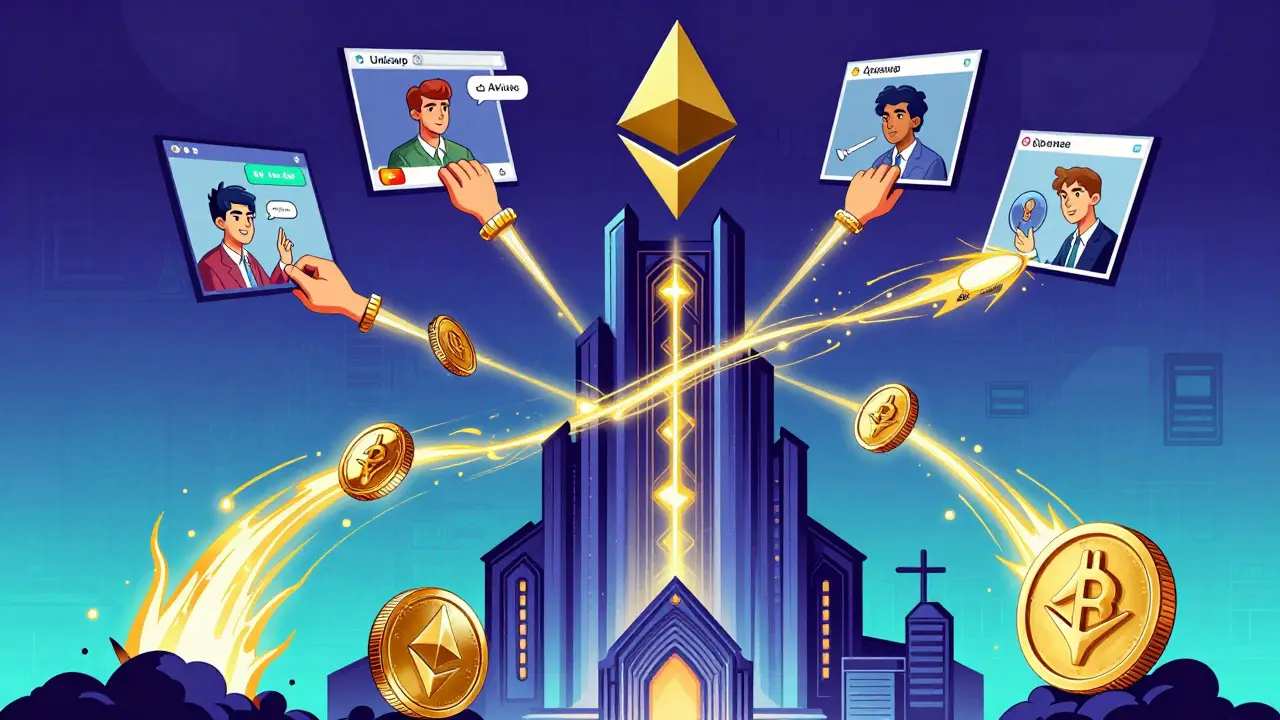
If blockchain had a backbone, Ethereum would be it. ETH isn’t just another crypto - it’s the gas that powers every smart contract, dApp, and DeFi protocol on its network. Every time you swap tokens on Uniswap, lock funds in Aave, or buy an NFT on OpenSea, you pay a fee in ETH. That’s not optional. It’s required.
After switching to proof-of-stake in 2022, ETH became even more valuable. Holders can now stake their ETH to help secure the network and earn rewards. This isn’t just a bonus - it’s built into the system. As of 2025, ETH remains the second-fastest-growing cryptocurrency after Bitcoin, according to Money.com. Why? Because every single action on Ethereum demands ETH. No substitute. No workaround.
Chainlink (LINK): Bringing Real Data On-Chain
Blockchains are isolated. They can’t access live data like stock prices, weather, or flight schedules - unless Chainlink steps in. LINK is the token that pays oracle nodes to feed real-world information into smart contracts. Without LINK, DeFi platforms wouldn’t know how much ETH is worth in USD. Insurance bots couldn’t verify if a flight was delayed. Supply chains couldn’t trigger payments when goods arrive.
By 2025, Chainlink’s Cross-Chain Interoperability Protocol (CCIP) had become critical infrastructure. It’s now used by banks, governments, and major DeFi protocols to move value across chains. The more usage, the more LINK is consumed. It’s not a speculation play - it’s a utility meter. You pay for data, and you pay in LINK.
Ripple (XRP): The Bank’s Secret Weapon
While most crypto projects chase retail traders, XRP quietly became the preferred tool for banks. The XRP Ledger moves money across borders in under four seconds with near-zero fees. That’s faster and cheaper than SWIFT. RippleNet, the payment network built on XRP, now connects over 100 financial institutions globally.
After years of legal battles, regulators began to see XRP’s role differently. By mid-2025, XRP had surged over 380% year-to-date. Why? Because institutions aren’t buying it to flip it. They’re using it to settle international payments. The token isn’t optional - it’s the engine. A Ripple ETF is even under consideration, signaling institutional trust in its core function.
Solana (SOL): Speed Meets Scale
Solana doesn’t just offer blockchain services - it offers them at lightning speed. With transactions processed in under 400 milliseconds and fees under a penny, SOL is the go-to token for high-volume dApps. From NFT marketplaces to DeFi protocols, every interaction on Solana requires SOL to pay for compute power.
By October 2025, ZebPay ranked SOL among the top ten crypto investments, not because it’s flashy, but because it’s functional. Developers build on Solana because it’s cheap and fast. Users interact because it’s affordable. And stakers help secure the network by locking up SOL. The token isn’t a side feature - it’s the heartbeat of the network.
Uniswap (UNI): Voting Power in DeFi
Uniswap is the largest decentralized exchange in crypto. But UNI isn’t used to trade. It’s used to decide. UNI holders vote on everything: fee structures, new token listings, protocol upgrades. No UNI? No say. No vote? No influence.
This is governance as utility. It’s not about hoarding - it’s about participation. The value of UNI isn’t tied to trading volume. It’s tied to how many people rely on Uniswap’s decisions. As of May 2025, Binance’s analysis confirmed UNI as a key utility token because it gives real power to users - not just access.
EarthMeta (EMT): Owning a Piece of the Metaverse
Metaverse tokens often sound like fantasy. But EarthMeta is different. To buy land, run a business, or vote on city rules in the EarthMeta world, you need EMT. It’s not a bonus - it’s mandatory. According to MEXC’s 2025 analysis, you can’t even start building without it.
Here’s the kicker: staking $1,000 worth of EMT doesn’t just earn you interest. It gives you a free city NFT - actual digital property. That’s utility layered with ownership. EMT isn’t a currency you hold. It’s the key that unlocks the entire ecosystem. Remove it, and the metaverse turns into an empty playground.
SushiSwap (SUSHI): Beyond Swaps
SushiSwap started as a DeFi exchange. Now it’s a multi-chain powerhouse operating across 40 blockchains. And SUSHI is the glue. It lets users vote on upgrades, earn a share of trading fees by staking xSUSHI, and access advanced tools like SushiXSwap for cross-chain swaps.
Unlike simple AMMs, SushiSwap uses its token to reward participation. The more you use it, the more you benefit. The token isn’t just a symbol - it’s a permission slip to advanced features. That’s why, as of May 2025, Disrupt Africa still listed SUSHI as a top utility token.
Ondo Finance (ONDO): Tokenizing Real-World Assets
ONDO isn’t about crypto speculation. It’s about turning real assets into blockchain tokens. Think U.S. Treasury bills, corporate bonds, and ETFs - all digitized and traded on-chain. ONDO holders govern the protocol through the Ondo DAO. They vote on which assets to tokenize, how to structure them, and how to distribute fees.
By 2025, Ondo Finance had over $1 billion locked in its protocols. The token’s value comes from its role in managing real financial instruments - not from hype. With listings on Coinbase, Binance, and Bybit, ONDO is proving utility tokens can bridge Wall Street and Web3.
Hedera (HBAR): Enterprise-Grade Infrastructure
Hedera doesn’t use blockchain. It uses hashgraph - a faster, more efficient consensus system. And HBAR is the fuel. It pays for transactions, smart contracts, and file storage on a network backed by Google, IBM, Boeing, and others.
Real-world use cases? Tracking carbon credits, verifying supply chains, and securing digital identities. In 2025, Money.com called HBAR the "enterprise DLT" - and for good reason. It’s not for traders. It’s for corporations that need reliability, speed, and compliance. HBAR isn’t optional - it’s the only way to interact with the network.
Why These Tokens Survive While Others Fade
Utility tokens that win aren’t the loudest. They’re the ones you can’t ignore. ETH, LINK, XRP, SOL - they’re not just traded. They’re consumed. Used. Required. Meme coins rise on TikTok. Utility tokens rise because the system can’t run without them.
The lesson? Look for tokens that:
- Are needed to pay for services
- Grant access to core features
- Enable governance or voting
- Are required for staking or security
- Would break the platform if removed
If a token checks even one of these, it’s not just another coin. It’s infrastructure.
Are utility tokens better than meme coins?
Yes - if you care about long-term value. Meme coins thrive on hype and social trends. Utility tokens thrive on necessity. If a platform can’t function without its token, that token has real, lasting demand. ETH, LINK, and XRP aren’t popular because they’re trendy - they’re essential. Meme coins can vanish overnight. Utility tokens power systems that keep running.
Can utility tokens be used as investments?
Absolutely - but not like gambling. Their value grows as usage grows. If more people use Chainlink’s oracles, LINK demand rises. If more banks use XRP for payments, its value increases. Utility tokens are investments in infrastructure, not speculation. They’re tied to real-world adoption, not social media trends.
Do I need to hold utility tokens to use a service?
Sometimes, yes. On Ethereum, you need ETH to pay gas. On Solana, you need SOL to run a dApp. On Uniswap, you need UNI to vote on changes. If the platform requires the token for core functions, you can’t avoid it. Some services let you pay in other currencies, but the native token is always the primary fuel.
How do I know if a token has real utility?
Ask: What happens if this token disappears? If the platform stops working, the token has utility. If it’s just an optional bonus, it doesn’t. Look at whether it’s required for transactions, governance, staking, or access. If yes, it’s real. If it’s just used for discounts or rewards, it’s likely a marketing tool - not a utility.
Are utility tokens regulated?
It depends. Tokens like ETH and LINK are generally seen as non-securities because they’re used for network function, not investment. But regulators look at how they’re sold and marketed. If a project promises profits from the token, it might be classified as a security. Utility tokens that focus on access and usage - not returns - have a stronger legal position.
Brendan Conway
February 8, 2026 AT 22:29Katie Haywood
February 9, 2026 AT 08:20Matt Smith
February 9, 2026 AT 08:33orville matibag
February 9, 2026 AT 22:24Josh Flohre
February 11, 2026 AT 00:08Udit Pandey
February 12, 2026 AT 05:38