Bitcoin Difficulty: What It Is and Why It Matters for Miners and Investors
When you hear Bitcoin difficulty, the measure of how hard it is to find a new block in the Bitcoin blockchain. It's not a number you see on a price chart, but it's one of the most important forces behind Bitcoin's stability and security. Every two weeks, the network automatically adjusts this difficulty based on how much computing power is being used. If more miners join, it gets harder. If miners leave, it gets easier. This keeps new blocks coming roughly every 10 minutes—no matter what.
This system is built on Proof of Work, the consensus mechanism that requires real computational effort to validate Bitcoin transactions. Miners compete to solve complex math puzzles, and the first to solve it gets rewarded with new Bitcoin. But if everyone had easy access to the solution, the network would be flooded, and Bitcoin’s scarcity would break. That’s where mining difficulty adjustment, the automated process that recalibrates the puzzle’s complexity every 2,016 blocks comes in. It’s what keeps the system honest and prevents inflation from too many blocks being mined too fast.
Bitcoin difficulty doesn’t just affect miners. It shapes the whole ecosystem. When difficulty spikes, small miners with old hardware get pushed out. That pushes mining toward large, efficient farms—often in places with cheap electricity like Kazakhstan, Texas, or Pakistan. When difficulty drops, it can signal a market downturn, as miners shut down rigs to save money. That’s why traders watch difficulty trends closely. A sudden drop might mean miners are giving up, which could hint at a bottom. A steady climb often means confidence is growing.
It also ties into network security. Higher difficulty means more total computing power securing the chain. That makes it harder and more expensive for anyone to try to attack Bitcoin. If you’re holding Bitcoin, you want this number to go up—not because it makes your coins more valuable directly, but because it makes the whole system more trustworthy.
Below, you’ll find real-world examples of how Bitcoin difficulty interacts with global events—like Angola’s mining ban, Pakistan’s massive electricity allocation, and how miners react when energy costs rise. You’ll also see how difficulty trends relate to bear markets, regulatory crackdowns, and the shifting geography of mining. These aren’t abstract concepts. They’re the hidden mechanics behind every Bitcoin transaction you make.
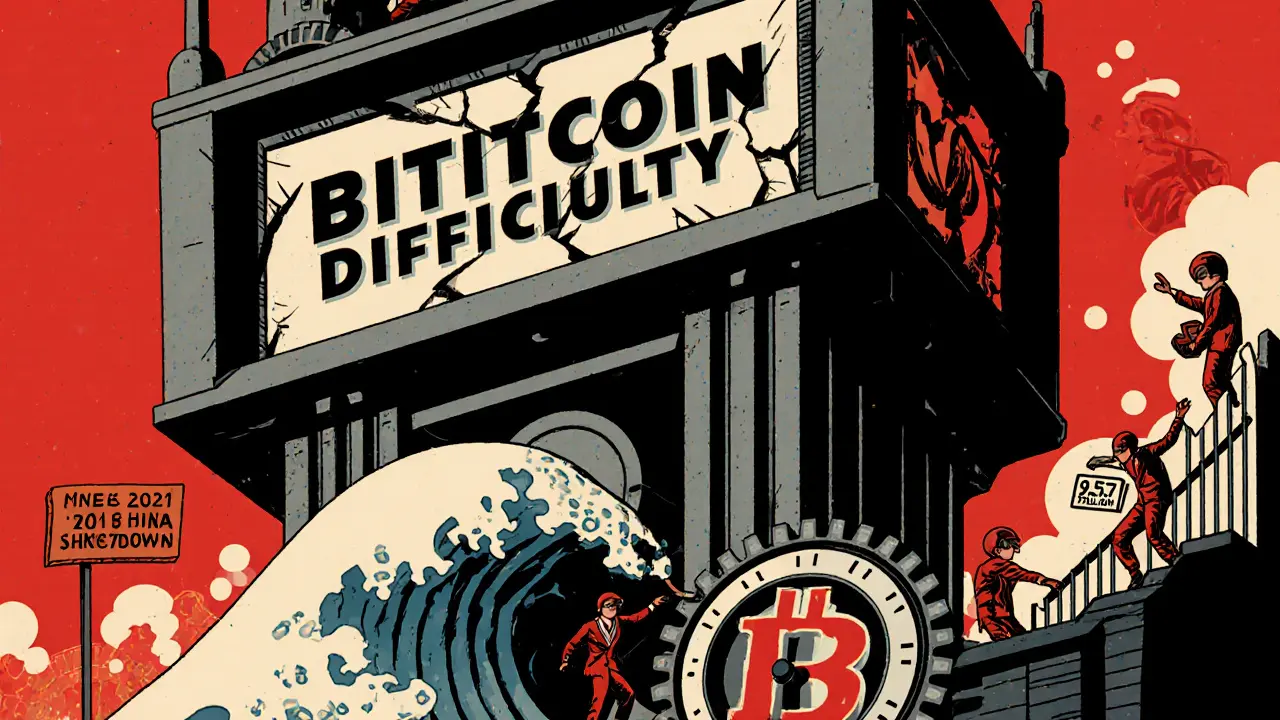
Future of Adaptive Mining Difficulty in Blockchain Networks
Adaptive mining difficulty is transforming blockchain networks by replacing slow, fixed adjustments with real-time tuning. It improves security, cuts energy waste, and prevents attacks - making Proof of Work sustainable for the future.
Read More