Understanding SHA-256 in Bitcoin Mining: How It Secures the Blockchain
 Aug, 23 2025
SHA-256 Hash Calculator
Compute SHA-256 hashes and see how the avalanche effect works in Bitcoin's security system
Input Data
Avalanche Effect Demonstration
Small input changes produce completely different hashes:
Bitcoin doesn’t run on magic. It runs on math. Specifically, it runs on SHA-256-a cryptographic hash function that turns any piece of data into a 64-character string of letters and numbers. This simple-looking string is what keeps Bitcoin secure, decentralized, and tamper-proof. Without SHA-256, Bitcoin wouldn’t work. And understanding how it works is the key to understanding why Bitcoin is so hard to break.
What SHA-256 Actually Does
SHA-256 takes any input-whether it’s a single word, a book, or a full block of Bitcoin transactions-and turns it into a fixed-size output: 256 bits, or 32 bytes. That output always looks like a random string of 64 hexadecimal characters. For example:
Input: "Hello world"
Output: "64ec88ca00b268e5ba1a35678a1b5316d212f4f366b2477232534a8aeca37f3c"
Change just one letter-say, "hello world" with a lowercase ‘h’-and the output becomes completely different:
Output: "f7847938382e79884503760723125144321247178a31b4b2f3f5d5e3e12e2d3c"
This is called the avalanche effect. It’s not a bug-it’s the whole point. Even the tiniest change in input creates a wildly different output. That’s what makes SHA-256 perfect for Bitcoin. Miners don’t need to know what’s inside a block. They just need to find a number that, when plugged in, makes the hash start with a bunch of zeros.
How Bitcoin Uses SHA-256: The Double Hash
Bitcoin doesn’t use SHA-256 once. It uses it twice. This is called hash256: SHA-256(SHA-256(data)). Why? Because it adds an extra layer of security. Early hash functions like SHA-1 had weaknesses. Double hashing makes it even harder for attackers to find patterns or exploit flaws. It’s like locking your door and then putting a steel gate behind it.
This double hash is used for two main things in Bitcoin:
- Creating block headers
- Verifying transaction integrity
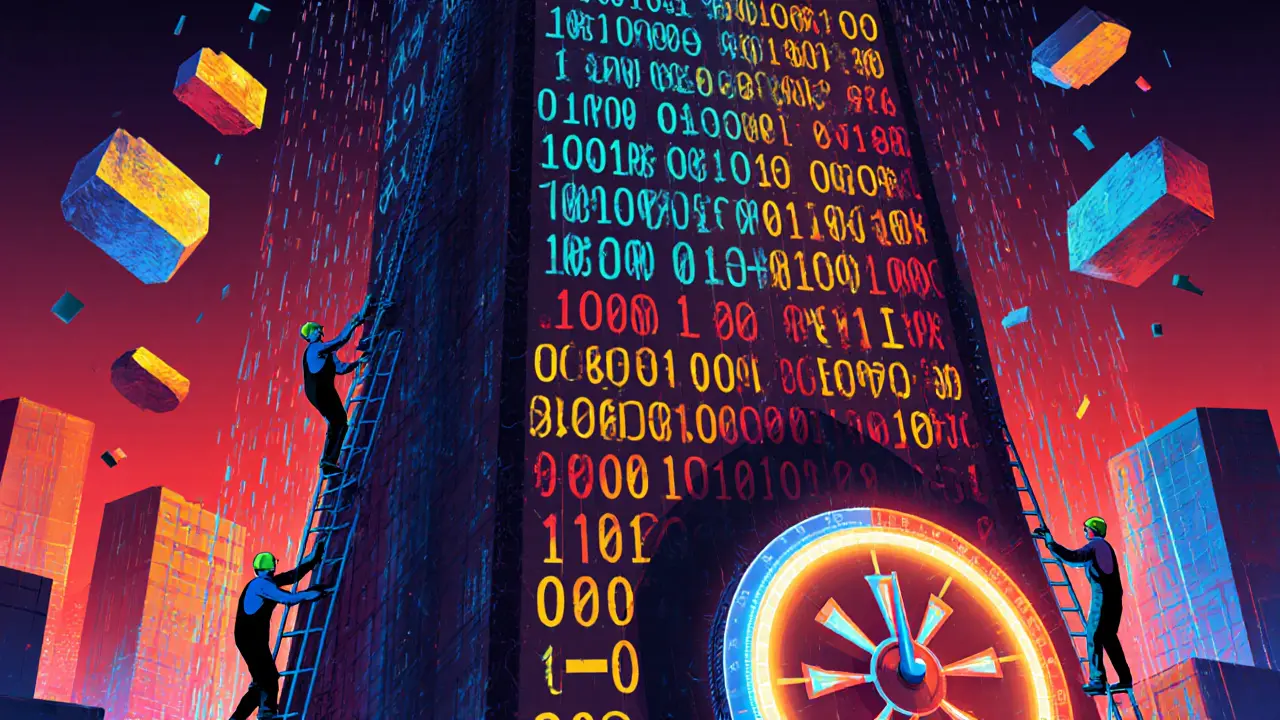
Every Bitcoin block has a header. It includes six pieces of data: the version number, the hash of the previous block, the Merkle root (a summary of all transactions in the block), a timestamp, the target difficulty, and the nonce. The nonce is the only part miners can change. Everything else is fixed. Miners keep changing the nonce-starting at 0, then 1, then 2, and so on-until the double SHA-256 hash of the entire header produces a number lower than the current target.
The Mining Process: Finding the Right Hash
Imagine you’re trying to guess a secret code. You don’t know what it is. All you know is that it has to start with at least 18 zeros. You can only change one digit at a time, and each guess takes a second. That’s what Bitcoin mining feels like.
Miners take the block header, run it through SHA-256 twice, and check the result. If it doesn’t start with enough zeros, they change the nonce and try again. Billions of times per second. The network’s current hashrate is around 600 exahashes per second (EH/s). That means miners are trying 600 quintillion combinations every second.
Why does this matter? Because finding a valid hash proves that someone spent real computing power. That’s the Proof-of-Work. It’s expensive and slow. And that’s exactly the point. It makes it too costly for anyone to try to rewrite history. If you wanted to change a transaction from last week, you’d have to redo every single block since then-faster than the entire network. With 600 EH/s, that’s impossible.
Why SHA-256 Is Cryptographically Strong
SHA-256 isn’t just random math. It’s built on three core properties that make Bitcoin secure:
- Preimage resistance: You can’t reverse-engineer the input from the hash. Even if you know the hash, you can’t figure out what data created it.
- Collision resistance: It’s practically impossible to find two different inputs that produce the same hash. No one has ever found a collision in SHA-256, even after 15 years of trying.
- Determinism: The same input always gives the same output. This is critical for consensus. Everyone on the network must agree on the same result.
These properties are why SHA-256 is still approved by NIST (National Institute of Standards and Technology) under FIPS 180-4. It’s not just a Bitcoin thing-it’s a global standard for secure systems. Banks, governments, and military networks rely on it too.
The Cost of Security: Energy and Centralization
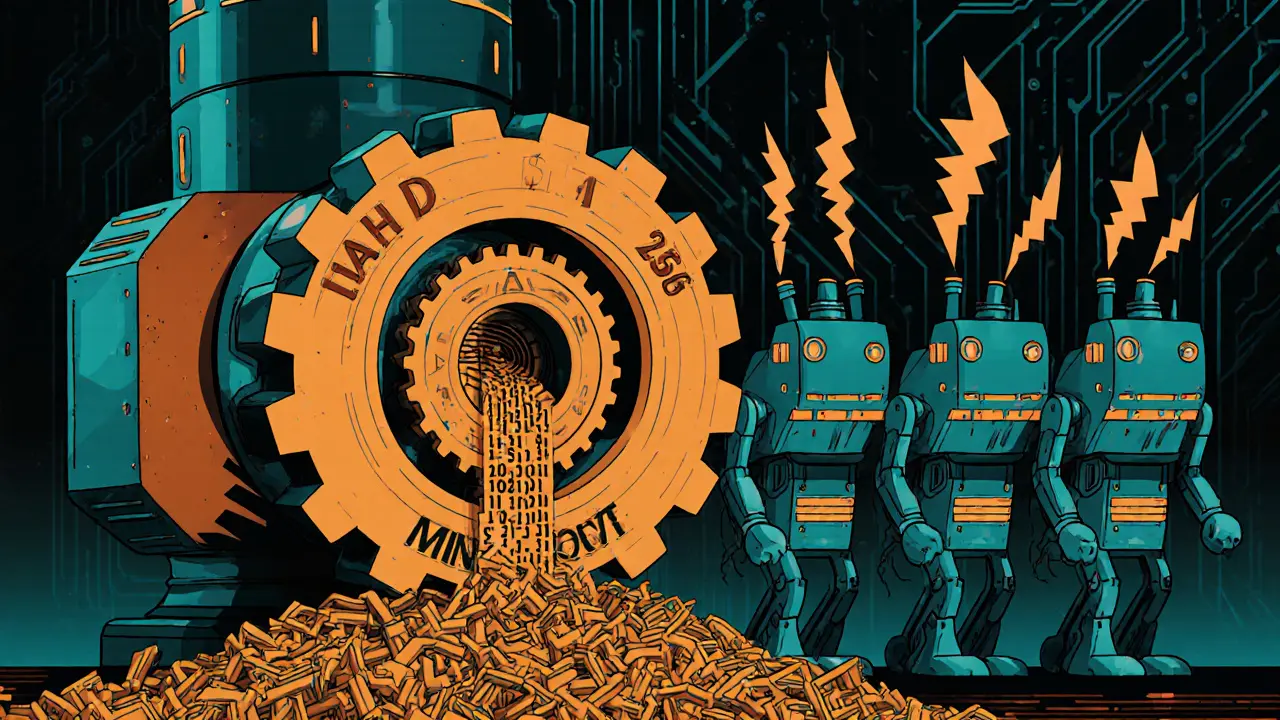
SHA-256’s strength comes at a price: energy. The Bitcoin network uses about 121 terawatt-hours per year-more than Argentina. Why? Because mining is a race. The more powerful your hardware, the more guesses you can make per second. That’s why miners use ASICs-specialized chips designed only to run SHA-256 as fast as possible.
Today’s top ASICs, like the Bitmain Antminer S21, use 33.5 joules per terahash. That’s efficient-but still power-hungry. A single miner can draw as much electricity as a small refrigerator running nonstop. And since mining rewards halve every four years, miners are under constant pressure to cut costs. That’s led to geographic concentration: 46.5% of Bitcoin’s hash rate is now in the U.S., mostly in Texas where electricity is cheap.
But here’s the catch: SHA-256 mining is no longer for individuals. In 2016, regular people made up 32% of the network. Today, it’s under 7%. The rest is controlled by big companies and mining pools. Three pools-Antpool, F2Pool, and Viabtc-control nearly 60% of the network. That’s not what Satoshi envisioned. But it’s the reality of a system that rewards scale.
SHA-256 vs. Other Algorithms
Not all cryptocurrencies use SHA-256. Litecoin and Dogecoin use Scrypt, which was designed to be more memory-heavy and harder to mine with ASICs. Ethereum used Ethash, which was also ASIC-resistant, until it switched to Proof-of-Stake in 2022. These alternatives were created because people wanted to avoid the energy waste and centralization of SHA-256.
But they come with trade-offs. Scrypt and Ethash were eventually cracked by ASICs too. And Proof-of-Stake, while energy-efficient, relies on trust-your coins are locked up, and you’re betting that others won’t cheat. SHA-256 doesn’t need trust. It needs electricity. And that’s why Bitcoin still uses it.
What’s Next for SHA-256 Mining?
The next Bitcoin halving in April 2024 will cut miner rewards in half-from 6.25 BTC to 3.125 BTC per block. That means miners will need to rely more on transaction fees to stay profitable. Right now, fees make up less than 5% of miner income. By 2040, they could make up 90%.
Hardware is getting better. The upcoming Antminer S21 Hyd aims for 24 J/TH-20% more efficient than current models. But efficiency gains are slowing. The low-hanging fruit is gone. The real challenge now isn’t just mining-it’s surviving.
Regulators are watching. The EU’s MiCA rules, effective in December 2024, will require miners to prove they’re using sustainable energy. Some U.S. states are banning mining outright. Others are offering tax breaks. The future of SHA-256 mining won’t be decided by technology. It’ll be decided by politics, energy policy, and economics.
Can SHA-256 Be Replaced?
Some say yes. Others say no. Bitcoin’s core developers have no plans to change it. Why? Because changing the hash function would require near-unanimous agreement from miners, nodes, and users. And no one has a better alternative that’s as battle-tested.
SHA-256 has survived 15 years of attacks, quantum computing fears, and billion-dollar mining empires. It’s not perfect. It’s not green. But it’s reliable. And in Bitcoin’s world, reliability matters more than efficiency.
The energy you see in a mining rig? It’s not wasted. It’s the cost of trust. Every hash is a vote for the blockchain’s integrity. And as long as SHA-256 keeps doing its job, Bitcoin will keep running-even if the world tries to shut it down.
What is SHA-256 used for in Bitcoin?
SHA-256 is used in Bitcoin to secure the blockchain through Proof-of-Work mining. Miners hash block headers using SHA-256 twice (hash256) to find a value that meets the network’s difficulty target. This process validates transactions, links blocks together, and prevents tampering by making it computationally impossible to alter past data without redoing all the work.
Why does Bitcoin use double SHA-256 instead of just one?
Bitcoin uses double SHA-256 to add an extra layer of security against potential cryptographic attacks. While SHA-256 itself is secure, applying it twice makes it harder to exploit weaknesses that might exist in the algorithm or its implementation. This design choice was made early on to future-proof Bitcoin’s security, even before the full extent of cryptographic threats was understood.
Can you mine Bitcoin with a regular computer today?
No. Mining Bitcoin with a CPU or GPU is no longer possible due to the extreme difficulty of the network. The current hash rate is around 600 exahashes per second, which requires specialized hardware called ASICs. These machines cost thousands of dollars and are designed solely for SHA-256 mining. Even the most powerful consumer GPUs can’t compete with a single ASIC miner.
How does SHA-256 make Bitcoin immutable?
SHA-256 links each block to the one before it through its hash. If someone tries to change a transaction in an old block, the hash of that block changes. That breaks the link to the next block, which then also changes hash-and so on. To fix it, an attacker would need to redo all the Proof-of-Work for every subsequent block, faster than the rest of the network. With 600 EH/s, that’s mathematically impossible.
Why is SHA-256 mining so energy-intensive?
SHA-256 mining is energy-intensive because it relies on brute force. Miners must try trillions of nonce values per second until one produces a valid hash. Each attempt requires electricity. The more miners there are, the harder the network gets, forcing everyone to use more powerful hardware. This arms race drives up energy use. Bitcoin’s design intentionally makes mining expensive to ensure security.
Is SHA-256 vulnerable to quantum computers?
SHA-256 is not easily broken by quantum computers, unlike some public-key cryptography systems like RSA. While quantum computers could theoretically reduce the time needed to find collisions using Grover’s algorithm, they’d still need an enormous number of qubits and error correction-far beyond what exists today. Even then, SHA-256 would still require 2^128 operations to crack, which remains computationally infeasible. Bitcoin could upgrade to a quantum-resistant hash function if needed, but it’s not an immediate threat.
What You Need to Know
If you’re just holding Bitcoin, you don’t need to mine. But if you want to understand why it’s secure, you need to understand SHA-256. It’s the glue holding the system together. The energy, the hardware, the centralization-all of it stems from one simple idea: make it expensive to cheat, and no one will try.
SHA-256 isn’t flashy. It doesn’t make headlines. But every time you send Bitcoin, every time a block is confirmed, every time the network resists a hack-it’s because of SHA-256 working in the background. Quietly. Reliably. Forever.
Grace Zelda
November 26, 2025 AT 23:04SHA-256 is the unsung hero of Bitcoin - no flashy animations, no influencer tweets, just pure math holding the whole damn thing together. I love how it’s so dumbly simple: guess until you win. No trust, no middlemen, just electricity and persistence. It’s like playing the lottery but with a supercomputer and a death wish.
Kristi Malicsi
November 27, 2025 AT 22:16Every time I hear someone say bitcoin is a bubble I just laugh because they don’t get that the math doesn’t care what you think
Sierra Myers
November 29, 2025 AT 18:44Okay but let’s be real - SHA-256 isn’t magic, it’s just really good at being boring. No one wants to admit it but the whole system runs on brute force and boredom. You’re not solving a puzzle, you’re just spamming inputs until the universe gives you a win. And the fact that it’s still standing after 15 years? That’s the real miracle.
Also, ASICs are the reason your GPU is now a fancy paperweight. They didn’t just outpace you, they made mining a factory job. And yeah, that’s kinda sad.
But here’s the kicker - if you could reverse SHA-256, you wouldn’t be on Reddit. You’d be in a bunker in Switzerland with a vault full of Bitcoin and a very quiet life.
Michael Fitzgibbon
December 1, 2025 AT 04:53I’ve always thought of SHA-256 as the quiet librarian of the blockchain - never shouts, never takes credit, but somehow makes sure everyone plays by the rules. It’s not glamorous, but without it, the whole library burns down.
The energy use is wild, sure. But I think we’re mistaking the cost of security for waste. You don’t get a vault that can’t be broken without making it heavy. And Bitcoin’s vault? It’s built to outlast nations.
Also, the fact that no one’s cracked it after a decade and a half of quantum hype? That’s not luck. That’s engineering.
Maybe the real question isn’t ‘why so much power?’ but ‘why hasn’t anything better come along?’
People want shiny new solutions, but sometimes the oldest lock is the one that still works.
Komal Choudhary
December 2, 2025 AT 21:18Bro why do you think the US is dominating mining? It’s not about electricity, it’s about control. The government is quietly backing these ASIC farms because they know if they own the hash, they own the ledger. And if they own the ledger, they own your money. SHA-256 isn’t decentralized - it’s just a really expensive way to centralize power under a different name.
Tina Detelj
December 3, 2025 AT 03:22Okay but like… SHA-256 is literally the only reason Bitcoin hasn’t turned into a giant meme already??
Think about it - every time you send a transaction, you’re not just sending coins, you’re sending a tiny prayer into the void of computational chaos, hoping that somewhere, some ASIC farm in Texas is still grinding away, turning your $2 fee into a permanent, unchangeable, unerasable, un-hackable mark on the fabric of digital reality.
And it’s all because of a 64-character string that looks like someone sneezed on a keyboard… and then did it again. And again. And again. For 15 years.
It’s beautiful. It’s absurd. It’s perfect.
I love that the entire global financial alternative is held together by a function that doesn’t even have a cool name - just a number and a hyphen. SHA-256. Like a tax form. But it’s the tax form that won’t let the IRS touch your Bitcoin.
Also, I just whispered ‘SHA-256’ into my microphone and my smart speaker didn’t respond. That’s power.
Wilma Inmenzo
December 4, 2025 AT 23:57SHA-256? More like SHA-256-WE-ALL-LOVE-THE-FED-AND-THIS-IS-OUR-NEW-BANKING-CONTROL-TOOL.
They made it expensive to mine so only the rich and the connected can play - then they call it ‘decentralized’? LOL. The ‘nonce’ is just a euphemism for ‘pay-to-play.’
And don’t even get me started on the ‘double hash’ - that’s not security, that’s obfuscation. They’re hiding the fact that the whole thing is a giant honeypot for ASIC manufacturers and Wall Street-backed mining pools.
Quantum computers? Nah. The real threat is a congressional bill. Watch. They’ll ban mining, then ‘regulate’ it into a Fed-controlled sidechain. SHA-256 isn’t the future - it’s the Trojan horse.
priyanka subbaraj
December 5, 2025 AT 07:24Miners are just glorified electricity addicts.
George Kakosouris
December 6, 2025 AT 22:48Let’s not romanticize SHA-256 - it’s a legacy algorithm with exponential energy OPEX and zero innovation runway. The real issue isn’t quantum computing, it’s the lack of algorithmic agility in Bitcoin’s consensus layer. You can’t upgrade the hash function without a hard fork, and with >60% hash concentration in three pools, you’ve got a governance monoculture masquerading as decentralization.
Meanwhile, Ethereum ditched PoW because they understood that computational waste is a regulatory liability. SHA-256 mining is the last gasp of analog security in a digital age - and it’s being outmaneuvered by capital efficiency, not cryptography.
Next halving? That’s not a reward cut - it’s a liquidity crisis waiting to happen. The ASIC manufacturers are already hedging their bets with energy derivatives. This isn’t mining. It’s a futures market disguised as a consensus mechanism.