Understanding the Byzantine Generals Problem in Blockchain
 Jan, 5 2026
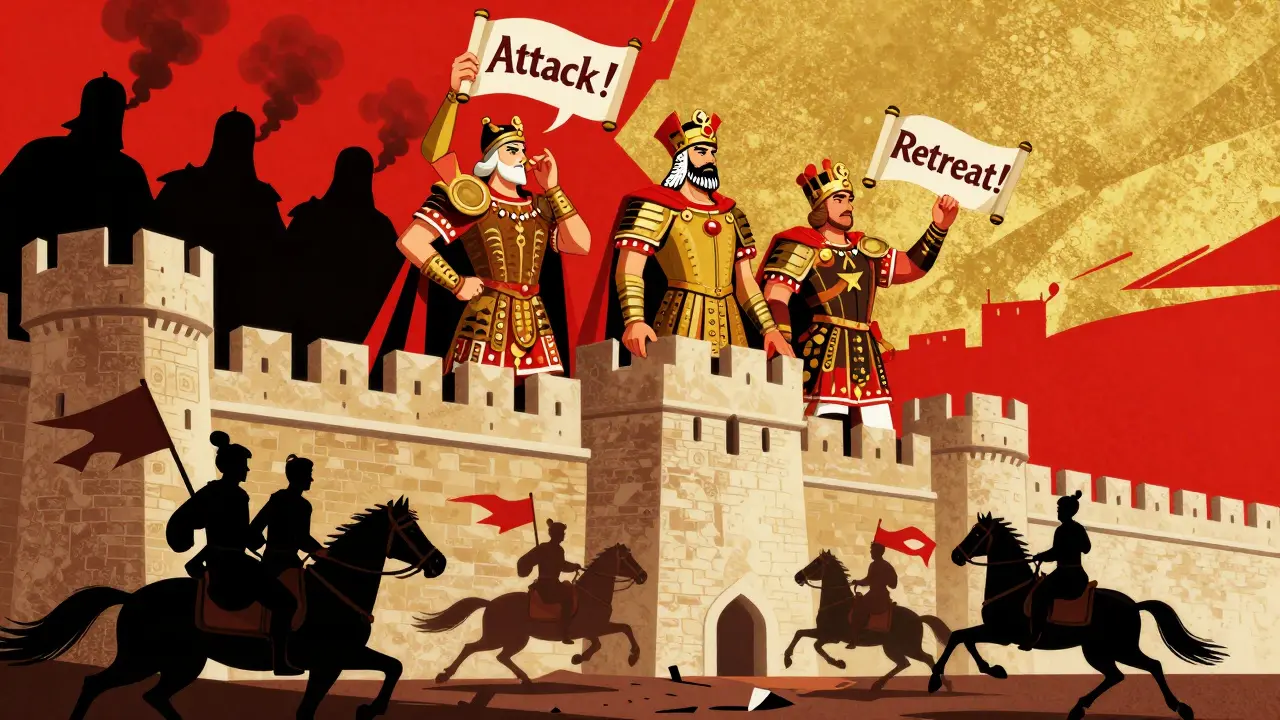
The Byzantine Generals Problem isn’t just a historical analogy-it’s the reason your Bitcoin transactions work, even when some nodes are lying or broken. Imagine a group of generals, each commanding a division of the Byzantine army, surrounding a city. They need to agree: attack at the same time, or retreat together. But some generals are traitors. They might send conflicting messages-telling one group to attack while telling another to retreat. The messengers carrying these orders could be intercepted, altered, or even bribed. How do the loyal generals agree on a single plan, without knowing who’s lying?
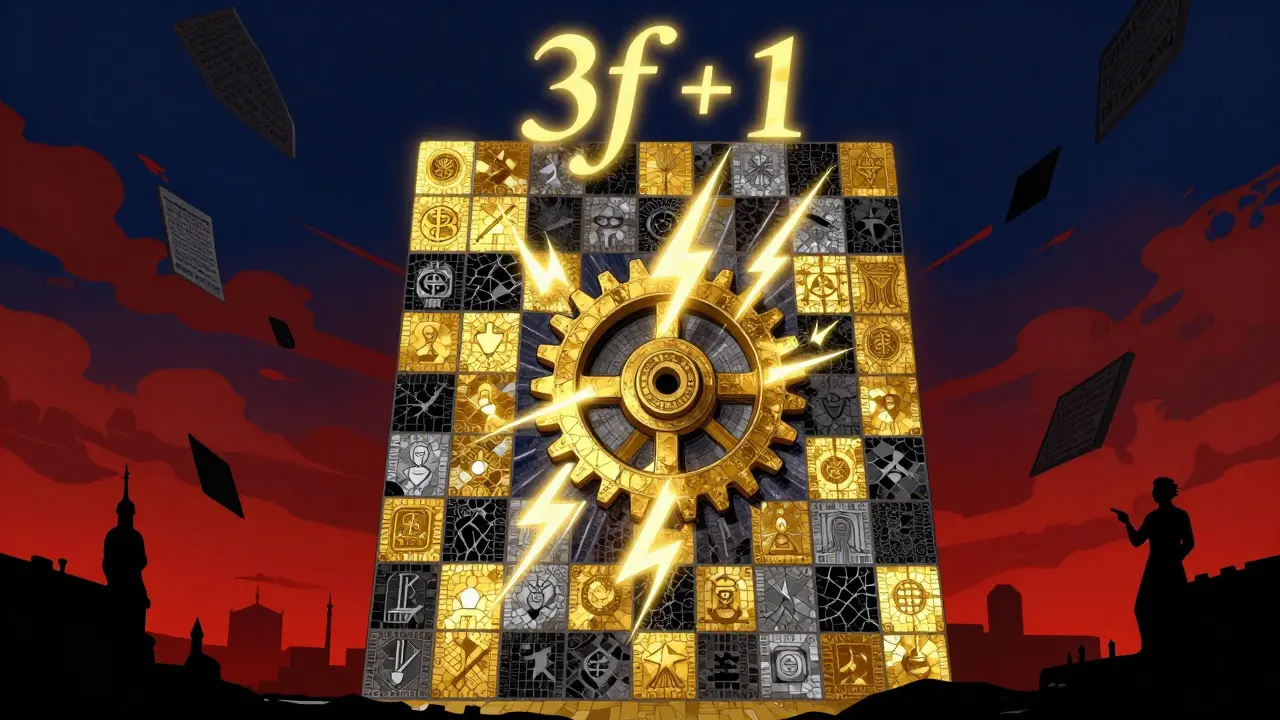
This isn’t a story from ancient warfare. It’s the core problem that makes decentralized systems like blockchain possible. In 1982, computer scientists Leslie Lamport, Robert Shostak, and Marshall Pease turned this military puzzle into a mathematical challenge. They proved that if you have n generals and up to f traitors, you need at least 3f + 1 generals total to reach reliable agreement. That’s the magic number. Three traitors? You need ten generals. One traitor? You need four. No exceptions.
Why This Matters for Blockchain
Blockchain networks are exactly like those Byzantine generals. Every node is a general. Every transaction is a battle plan. And in public blockchains like Bitcoin or Ethereum, you don’t know who’s running each node. Some might be honest. Others might be hacked. Others might be trying to double-spend or censor transactions. There’s no central authority to check who’s telling the truth.
Before Bitcoin, most distributed systems assumed nodes would only fail by crashing-stopping, not lying. Algorithms like Paxos and Raft solved that. But they’d collapse if even one node started sending fake data. That’s fine for a company’s internal servers. It’s useless for a global, open network where anyone can join.
Bitcoin changed that. Satoshi Nakamoto didn’t invent Byzantine Fault Tolerance (BFT). But he was the first to solve it in an open, permissionless system. He did it with proof-of-work. Miners compete to solve a hard math puzzle. The winner gets to add the next block. The cost of cheating? You’d have to control more than half the network’s computing power-expensive, wasteful, and hard to hide. That’s the economic incentive. It turns the Byzantine problem from a technical nightmare into an economic one.
Proof-of-Work vs. Proof-of-Stake
Bitcoin’s solution works, but it burns electricity. A single Bitcoin transaction uses as much power as an average U.S. household does in two days. That’s not sustainable. Ethereum switched to proof-of-stake in September 2022. Instead of miners, validators lock up 32 ETH to participate. If they act dishonestly, they lose their stake. It’s like replacing brute force with financial risk.
Ethereum’s new system, called LMD-GHOST, combines proof-of-stake with a modified BFT protocol. It can reach consensus across over 5,120 validators with 99.998% reliability. Latency dropped from 15 seconds to under a second. Energy use? Down 99.95%. The math still holds: if up to one-third of validators are malicious, the network stays safe. But now, the cost of being a traitor isn’t just electricity-it’s your entire deposit.
Other systems use different flavors of BFT. Tendermint, used by Cosmos, relies on Practical Byzantine Fault Tolerance (PBFT). It’s faster and uses less energy than proof-of-work, but it needs known validators. That’s great for private blockchains, but not for open ones. PBFT works best when you know who’s on the network-like a board of directors voting, not strangers on the internet.
Real-World Failures and Fixes
It’s not just theory. People run into this every day.
A developer on GitHub built a 4-node test network using PBFT. It worked fine-until one node got hacked. Suddenly, the whole network stalled. Why? Because 4 nodes can only handle 1 traitor (3f + 1 = 4 → f = 1). One bad actor was enough to break consensus. They had to scale to 7 nodes to handle up to 2 traitors safely.
Enterprise teams building private blockchains often underestimate this. One Reddit user spent three months debugging a BFT system that a crash-tolerant system took two weeks to build. The difference? Crash-tolerant systems assume nodes just go offline. BFT assumes they lie. That’s a whole different level of complexity.
And performance? It drops as you add nodes. Every extra node beyond 100 slows things down by 15-20%. That’s why most public blockchains cap validator counts. Ethereum’s 5,120 is already pushing the limits. Too many nodes, and the network gets sluggish. Too few, and it’s vulnerable.
Where Else Is This Used?
Blockchain isn’t the only place the Byzantine Generals Problem matters.
NASA requires BFT in all spacecraft control systems for the Artemis lunar missions. If one computer sends a false thruster command, the whole mission could fail. They use the 3f + 1 rule-no exceptions.
Modern cars use BFT in vehicle-to-vehicle communication. If one car falsely reports a stop sign, others could crash. ISO 21448:2022, the new automotive safety standard, mandates BFT for over 78 of the top 100 suppliers.
The U.S. Department of Homeland Security just mandated BFT for all new electrical grid control systems by 2026. Why? Because if hackers can trick a grid node into thinking a power line is offline when it’s not, they could cause blackouts. The same math that secures Bitcoin now protects the power grid.

The Future of Consensus
Researchers are still improving BFT. IBM just announced Q-BFT-a protocol designed to survive quantum computing attacks. Facebook’s Diem team created HotStuff, which cuts communication overhead from O(n²) to O(n), letting networks scale to 10,000+ nodes without collapsing.
Market research predicts the BFT market will grow from $2.1 billion in 2023 to $9.7 billion by 2028. Financial services lead adoption, but healthcare, logistics, and energy are catching up. Every system that needs trust without a central boss will need BFT.
But here’s the catch: BFT doesn’t guarantee perfect security. It guarantees that as long as fewer than one-third of participants are malicious, the system will work. That’s strong-but not absolute. If 34% of nodes are compromised, the whole thing collapses. That’s why decentralization matters. More nodes, spread across more people, more countries, more devices, make it harder for any single group to take over.
And that’s the real lesson of the Byzantine Generals Problem. You don’t need perfect people. You just need enough people who have more to lose by cheating than by cooperating. Bitcoin did that with mining rewards. Ethereum does it with staked ETH. Future systems might use reputation, identity, or even social graphs. But the math stays the same: 3f + 1. Always.
What Happens If You Ignore It?
Some projects try to skip BFT. They assume “most nodes are honest.” That’s a gamble. In 2022, a blockchain startup claimed to have a “fast, lightweight consensus” with only 5 nodes. They didn’t use BFT. One node got compromised. The attacker double-spent $2.3 million in 17 minutes. The company shut down two weeks later.
There’s no shortcut. If your system is open, decentralized, and trustless, you need BFT. No exceptions. The math doesn’t care if you’re a startup or a Fortune 500 company. If you have f traitors, you need 3f + 1 honest ones. That’s the price of trust without a middleman.
What is the Byzantine Generals Problem in simple terms?
It’s a problem about getting a group of people to agree on a plan when some of them might be lying. Imagine generals trying to coordinate an attack, but some are traitors sending fake messages. The challenge is to make sure the honest ones still agree on the same plan-even if some messages are corrupted or false.
Why is it called the Byzantine Generals Problem?
It’s named after the Byzantine Empire, where armies were spread across distant cities and had to coordinate attacks using messengers. The messengers could be captured, bribed, or killed. The problem was how to ensure loyalty and coordination without a central commander. Computer scientists used this as a metaphor for distributed systems with unreliable or malicious nodes.
How does Bitcoin solve the Byzantine Generals Problem?
Bitcoin uses proof-of-work. Miners compete to solve a hard math puzzle. The first to solve it gets to add a block and earn rewards. Cheating is expensive-you’d need to control over half the network’s computing power. The cost of cheating is higher than the reward, so most miners play fair. This turns trust into economics.
What’s the difference between crash faults and Byzantine faults?
Crash faults happen when a node stops working-like a server going offline. Byzantine faults happen when a node acts maliciously-sending fake data, lying, or sabotaging. Byzantine faults are harder to handle because you can’t tell if a node is broken or lying. That’s why BFT needs 3f + 1 nodes, while crash fault tolerance only needs 2f + 1.
Can you have a blockchain without Byzantine Fault Tolerance?
Yes-but only if it’s not trustless. Private blockchains, like those used by banks or corporations, often know who the participants are. They can use simpler consensus methods because they can exclude or punish bad actors. But if anyone can join the network-like with Bitcoin or Ethereum-you need BFT. Otherwise, one bad actor can break everything.
Why does BFT need 3f + 1 nodes?
It’s a mathematical guarantee. If you have f traitors, you need at least 3f + 1 total nodes to outvote them. For example, with 1 traitor, you need 4 nodes: 3 honest ones can agree and ignore the liar. With 2 traitors, you need 7 nodes: 5 honest nodes can agree and overpower the 2 liars. This ratio ensures the loyal majority can always reach consensus, even if traitors send conflicting messages.
Is proof-of-stake better than proof-of-work for solving this problem?
It’s more efficient, not fundamentally better. Proof-of-stake replaces energy use with financial risk: validators lose their stake if they cheat. It’s faster, uses less power, and scales better. But both rely on the same BFT math: 3f + 1 nodes. Proof-of-stake doesn’t change the rules-it just changes the cost of breaking them.
What happens if more than one-third of nodes are malicious?
The network breaks. If traitors make up 34% or more of the nodes, they can outvote the honest ones and force false consensus. That’s why decentralization matters-the more nodes spread across different people and places, the harder it is for any group to reach that 34% threshold. No system is 100% safe, but BFT makes it extremely hard.
How do real companies implement BFT?
Most use existing protocols like PBFT, Tendermint, or HotStuff. Enterprise platforms like Hyperledger Fabric or Ethereum’s consensus layer include built-in BFT. But it’s complex. Over 68% of companies hiring BFT engineers need outside consultants. It takes 6-8 weeks of training just to understand the basics. Many fail because they underestimate how hard it is to handle message ordering, view changes, and cryptographic signatures correctly.
Is the Byzantine Generals Problem solved?
No-it’s not solved, it’s managed. We have working solutions like proof-of-work and proof-of-stake, but they come with trade-offs: energy use, centralization risk, scalability limits. Researchers are still improving them. Quantum-resistant BFT, faster protocols, and better incentive designs are all active areas of work. The problem is fundamental. The solutions evolve.
Jennah Grant
January 7, 2026 AT 02:21The 3f+1 rule is such an elegant mathematical anchor-makes you realize how much of blockchain’s security is just arithmetic dressed in crypto jargon. It’s not magic, it’s just counting. And yet, most people treat it like witchcraft. The fact that NASA uses this for lunar missions? That’s the real flex. We’re using 1980s math to secure the future.
Dennis Mbuthia
January 7, 2026 AT 23:25Let’s be real-proof-of-work is the only real solution. All this proof-of-stake nonsense is just Wall Street trying to privatize decentralization. Ethereum’s now just a corporate server farm with fancy acronyms. LMD-GHOST? Sounds like a Starbucks drink. And don’t get me started on ‘validators’-they’re not validators, they’re bankers with ETH. The math might hold, but the soul? Gone. Bitcoin’s wasteful? Yeah. But at least it’s honest waste. This new stuff is just greenwashing with blockchain buzzwords.
Becky Chenier
January 9, 2026 AT 07:12It’s fascinating how the Byzantine Generals Problem reveals that trust isn’t about people-it’s about incentives. The system doesn’t need everyone to be good. It just needs cheating to be more expensive than cooperating. That’s why Bitcoin works. Not because miners are virtuous. But because their ASICs cost millions. The elegance is in the economics, not the code.
Staci Armezzani
January 11, 2026 AT 03:35Really appreciate this breakdown-it’s easy to get lost in the tech, but the real takeaway is how human behavior shapes systems. That 3f+1 rule? It’s not just for blockchains. Think about team dynamics, voting systems, even online moderation. You don’t need perfect people-you just need enough people who have skin in the game. And that’s why proof-of-stake is smarter: it turns your wallet into your conscience.
Also, the car safety angle? Mind blown. We’re using the same math to keep drivers from crashing as we are to stop double-spending. That’s the beauty of foundational math-it transcends domains.
Tracey Grammer-Porter
January 11, 2026 AT 21:05sathish kumar
January 13, 2026 AT 03:25It is imperative to underscore that the Byzantine Generals Problem constitutes a foundational paradigm in distributed computing, and its application in blockchain technology represents not merely an engineering innovation but a philosophical evolution in the architecture of trust. The mathematical rigor of 3f + 1, as elucidated by Lamport et al., remains immutable, irrespective of the consensus mechanism employed. The transition from proof-of-work to proof-of-stake does not alter the underlying theorem; rather, it reconfigures the cost function of adversarial behavior. This evolution, while economically and environmentally advantageous, must be implemented with rigorous adherence to formal verification protocols, particularly in safety-critical domains such as aerospace and critical infrastructure.