Using Multiple Crypto Exchanges to Avoid Restrictions: Risks, Methods, and Real-World Consequences
 Oct, 16 2025
Crypto Exchange Risk Checker
This tool helps you assess whether your cryptocurrency exchange practices comply with regulations and avoid money laundering risks. Based on your responses, you'll receive a risk assessment and actionable guidance.
Risk Assessment Questions
Answer these questions to evaluate your exchange strategy
Your Risk Assessment
Many people think using multiple crypto exchanges is just a smart way to get around trading limits or access coins not available on one platform. But what looks like a simple workaround can quickly turn into a legal minefield - especially when regulators are actively shutting down platforms built for exactly this purpose.
Why People Use Multiple Exchanges
Some traders spread their activity across exchanges to get better prices, access rare tokens, or avoid withdrawal caps. That’s not illegal. But when users start hopping between platforms to hide where their money came from or where it’s going, they’re crossing a line. This isn’t just about convenience anymore - it’s about evasion.Imagine you live in a country where buying Bitcoin is heavily restricted. You sign up on Exchange A, buy BTC, then move it to Exchange B, which doesn’t ask for ID. From there, you send it to Exchange C, which lets you cash out in local currency without questions. Sounds clever? It’s also exactly how criminals launder money. And regulators are catching on.
How Evasion Actually Works
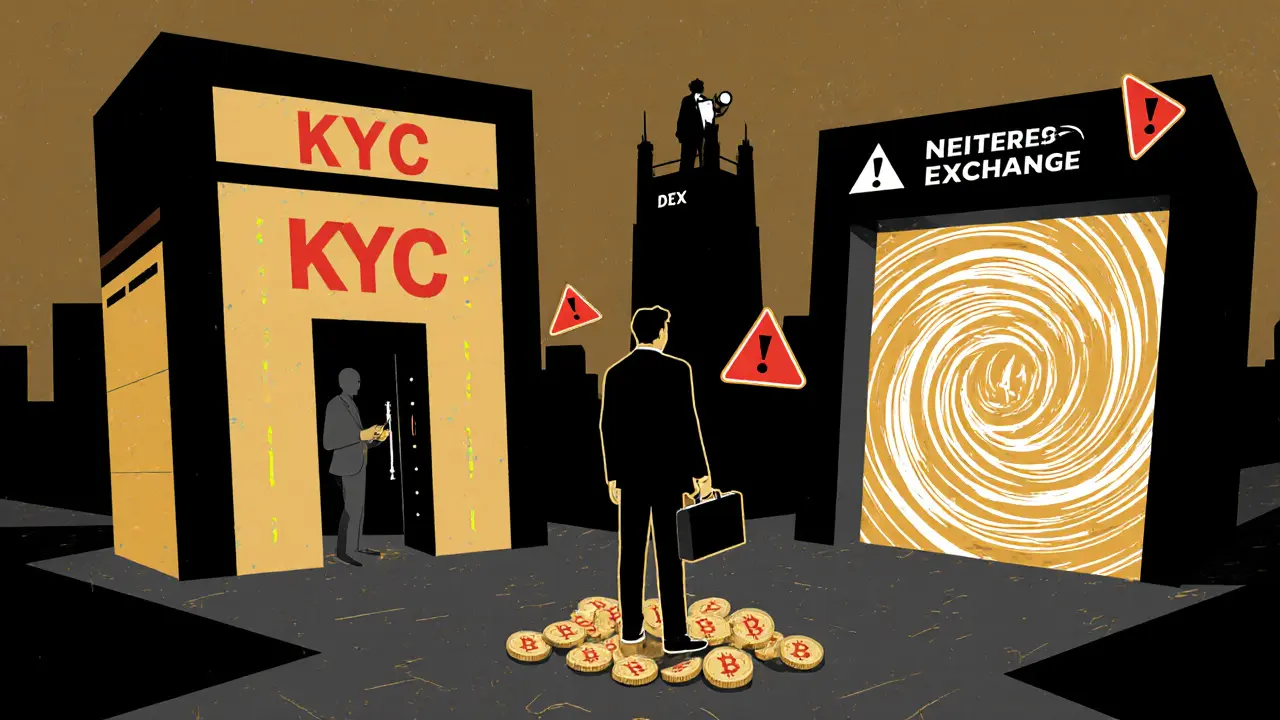
There are three main ways people bypass restrictions using multiple exchanges:- Nested exchanges - These act like middlemen. You deposit funds with them, and they trade on your behalf using accounts on bigger exchanges like Binance or Kraken. The problem? Many nested exchanges skip KYC entirely. They don’t verify your identity, don’t track your source of funds, and don’t report suspicious activity. That makes them perfect for hiding illicit money.
- Non-compliant exchanges - Some exchanges operate in countries with weak or no sanctions enforcement. These include platforms based in Russia, North Korea, or other sanctioned jurisdictions. Criminals specifically target them as exit points to turn dirty crypto into clean cash.
- Decentralized exchanges (DEXs) - Unlike centralized platforms, DEXs like Uniswap or PancakeSwap don’t require accounts or personal info. You connect your wallet and swap tokens directly on the blockchain. Because there’s no central company to shut down or subpoena, these are nearly impossible for governments to control. That’s why sanctioned entities use them to move funds without leaving a paper trail.
The most dangerous part? These methods often work together. A criminal might steal a verified user’s account (via phishing), deposit stolen crypto into a nested exchange, trade it on a DEX, then cash out through a non-compliant platform in a country with no extradition treaty. By the time law enforcement traces it, the trail is cold.
Real Cases: When the Government Catches Up
In March 2025, the U.S. Treasury’s Office of Foreign Assets Control (OFAC) designated Grinex as a sanctioned entity. Why? Because it was created by former employees of Garantex, a Russian-based exchange that had just been shut down for helping evade sanctions. Grinex’s own website openly admitted it was founded to replace Garantex and keep the same services running - including moving money for sanctioned individuals.Within weeks of its launch, Grinex processed over $2 billion in transactions. The U.S. Secret Service moved fast, freezing assets and arresting key operators. But the damage was done. Hundreds of users who thought they were just trading crypto ended up tangled in a federal investigation.
Meanwhile, the SEC has been cracking down on unregistered platforms that act like exchanges. Chair Gary Gensler made it clear: if a platform brings together buyers and sellers automatically, it’s legally an exchange - and it needs to register. Most crypto platforms don’t. That means thousands of users could be unknowingly participating in illegal activity.
Red Flags You Can’t Ignore
If you’re using multiple exchanges, ask yourself these questions:- Does the exchange let me trade instantly without ID verification? If yes, walk away.
- Can I trace where my funds came from using a blockchain explorer? If the platform hides transaction history or uses obfuscation tools, it’s a warning sign.
- Do they offer “coin swap” services via Telegram or WhatsApp? That’s a classic money laundering tactic - no sign-up, no records, no accountability.
- Is the exchange based in a country under U.S. or EU sanctions? Even if you’re not from there, using it makes you a target.
Legitimate exchanges take days to verify your identity. That’s not a bug - it’s a feature. It protects you. If an exchange skips that step, it’s not helping you - it’s putting your money and freedom at risk.
The Hidden Cost: Your Money Isn’t Safe
Using nested or non-compliant exchanges doesn’t just get you in trouble with the law - it puts your crypto at risk. These platforms don’t have insurance. They don’t have customer support. They don’t have legal obligations to return your funds if they get hacked, shut down, or disappear.In 2024, over $1.2 billion in crypto was stolen from non-KYC exchanges. Most victims never got a cent back. And if your funds are linked to a sanctioned transaction, even a legitimate exchange can freeze your account - no warning, no appeal.
There’s no such thing as anonymous crypto. Every transaction is recorded on the blockchain. Regulators don’t need to know your name to track your wallet. They just need to connect your wallet to a known criminal address - and that’s easier than you think.
What You Should Do Instead
If you’re trying to avoid restrictions because your local exchange doesn’t support certain coins or has low limits, here’s what actually works:- Use Coinbase or Kraken - both are fully compliant and support a wide range of tokens.
- Use a hardware wallet to store your crypto securely, then swap tokens on a DEX like Uniswap or Curve - but only if you understand the risks.
- Use a crypto debit card to spend your crypto like cash, avoiding withdrawal limits entirely.
There’s no shortcut that’s both safe and legal. Trying to outsmart the system doesn’t make you clever - it makes you a target.
The Bigger Picture: Why This Matters
The crypto industry is at a turning point. Legitimate users want freedom, privacy, and access. But criminals are using the same tools to fund terrorism, ransomware, and drug trafficking. Regulators aren’t trying to kill crypto - they’re trying to stop it from becoming a criminal playground.When you use multiple exchanges to avoid restrictions, you’re not just playing a game. You’re helping fund illegal activity. And when the crackdown comes - and it will - you won’t be the one with the answers. You’ll be the one with frozen assets and no legal recourse.
There’s a better way. Play by the rules. Use regulated platforms. Understand the risks. And remember: if something looks too easy to do, it’s probably illegal - and someone is already watching.
Is it illegal to use multiple crypto exchanges?
It’s not illegal to use multiple exchanges for legitimate reasons - like accessing different tokens or getting better prices. But if you’re doing it to hide the source of funds, evade sanctions, or bypass KYC rules, then yes - it’s illegal. Regulators treat this as money laundering, and penalties can include fines, asset seizures, or even criminal charges.
What’s the difference between a nested exchange and a regular one?
A regular exchange handles your trades directly and requires identity verification. A nested exchange acts as a middleman - you deposit with them, and they trade on your behalf using accounts on other exchanges. They often skip KYC, don’t disclose which platforms they use, and don’t protect your funds like regulated exchanges do. They’re risky, opaque, and frequently used for money laundering.
Can decentralized exchanges be used legally?
Yes, DEXs like Uniswap and PancakeSwap can be used legally for personal trading. But if you’re using them to move funds from a sanctioned wallet, or to convert illicit crypto into clean assets, that’s illegal. DEXs don’t ask for ID, but every transaction is public on the blockchain. Regulators track wallet addresses - not names - so anonymity is an illusion.
How do regulators track crypto used for evasion?
Regulators use blockchain analysis tools from companies like Chainalysis and Elliptic. These tools trace transaction flows across exchanges and wallets, even when funds are moved through multiple hops. If a wallet is linked to a known criminal address, or if it sends funds to a sanctioned entity, that triggers an investigation - regardless of how many exchanges you used.
What happens if I accidentally use a sanctioned exchange?
If you unknowingly send crypto to a sanctioned platform, your funds may be frozen. You’ll need to prove the transaction was unintentional, which can take months - and even then, there’s no guarantee you’ll get your money back. The best defense is to avoid any exchange that doesn’t clearly state its compliance status or is based in a high-risk country.
Are there legal alternatives to bypass trading limits?
Yes. Use regulated exchanges with higher limits, like Kraken or Coinbase Pro. You can also use crypto debit cards to spend your holdings directly. For larger amounts, consider peer-to-peer trading on platforms like LocalBitcoins or Paxful - but only with verified, reputable traders. These methods are slower but safe and legal.
Eddy Lust
November 26, 2025 AT 08:49man i just wanted to buy some shib and now i feel like i’m in a spy movie 🤯
every time i swap tokens i keep thinking the feds are gonna knock on my door with a subpoena and a coffee
why does crypto feel like playing russian roulette with your life savings?
Rachel Thomas
November 27, 2025 AT 02:09lol so using more than one exchange is illegal now? next they’ll ban using multiple bank accounts too.
this is just government control dressed up as ‘safety’.
fanny adam
November 28, 2025 AT 16:30Have you considered that this entire narrative is orchestrated by the Fed to consolidate financial control? The ‘sanctioned exchanges’ are merely decoys. The real target is the decentralization of value. Chainalysis? A tool of the surveillance state. Every blockchain transaction is being logged, mapped, and weaponized against ordinary citizens. They don’t want you to have freedom-they want you to be compliant. And the ‘legal alternatives’? They’re gated traps. Coinbase doesn’t protect you-it reports you. This isn’t about crime. It’s about power.
Felicia Sue Lynn
November 29, 2025 AT 01:03There’s a profound tension here between autonomy and accountability. We crave financial freedom, yet we live in systems built on trust and verification. To reject KYC entirely is to reject the social contract that underpins modern economies-even digital ones. The problem isn’t regulation-it’s the absence of thoughtful, human-centered regulation that respects privacy without enabling harm. The real tragedy is that those who seek legitimate access are now painted with the same brush as criminals, because the system lacks nuance. We need bridges, not walls.
SARE Homes
November 30, 2025 AT 02:39YOU’RE ALL IDIOTS!!!!
IF YOU’RE USING NESTED EXCHANGES YOU DESERVE TO GET ROBBED!!!
NOBODY CARES IF YOU ‘DIDN’T KNOW’-IF YOU’RE TOO STUPID TO READ THE TERMS, YOU DESERVE TO LOSE EVERYTHING!!!
AND DON’T EVEN GET ME STARTED ON ‘DEX’ USERS-YOU THINK YOU’RE SO CLEVER?? YOUR WALLET IS ON A PUBLIC LEDGER, YOU IDIOT!!!
THEY’RE NOT CRACKING DOWN ON CRYPTO-THEY’RE CRACKING DOWN ON YOUR STUPIDITY!!!
Sam Daily
November 30, 2025 AT 05:43you’re not alone, fam 😊
just got my first crypto debit card last week-no more withdrawal limits, no KYC drama, just spend like cash!
and yeah, i use Kraken + Uniswap, but only after i verified my ID. no shady stuff.
crypto’s wild, but you don’t need to be reckless to be free 🙌
Kristi Malicsi
December 1, 2025 AT 02:58so like… if i buy btc on coinbase and send it to metamask and swap on uniswap am i a criminal now?
or is that just… how crypto works?
why does everything have to be so complicated
Sierra Myers
December 1, 2025 AT 13:47wait so using 3 exchanges = money laundering? what if i just wanted to get a better rate on dogecoin?
you act like people are running drug cartels when they hop between platforms
this article is just fearmongering with a side of corporate propaganda
Ian Esche
December 2, 2025 AT 20:53Let’s be real-this whole thing is a distraction. The real issue isn’t crypto users hopping between exchanges. It’s that the U.S. government can’t compete with innovation. They’d rather shut down platforms than improve their own financial infrastructure. Grinex? Yeah, it was sketchy. But the fact that they had $2B in volume means people were desperate. And why? Because our banks still take 3 days to process international transfers. Meanwhile, crypto moves in seconds. So yeah, people use loopholes. But don’t act like they’re the villains. The system failed them first.