Virtual Digital Assets Taxation in India: Complete Guide for 2025
 Oct, 12 2025
VDA Tax Calculator
Calculate Your Tax Liability
Calculation Results
What Are Virtual Digital Assets (VDAs) in India?
Virtual Digital Assets (VDAs) in India include cryptocurrencies like Bitcoin and Ethereum, NFTs, and other digital tokens that hold value and can be traded or transferred electronically. They are not legal tender, meaning you can’t use them to buy groceries or pay bills like rupees. But you can buy, sell, hold, or gift them - and the government wants a cut when you make money from them.
The official definition under Section 2(47A) of the Income Tax Act, 1961, is broad: any digital code, number, or token that represents value, whether created through cryptography or not. This covers everything from Bitcoin to a digital artwork NFT sold on OpenSea. Even if you trade one crypto for another - say, ETH for SOL - that’s still a VDA transaction and taxable.
How Is VDA Profit Taxed in India?
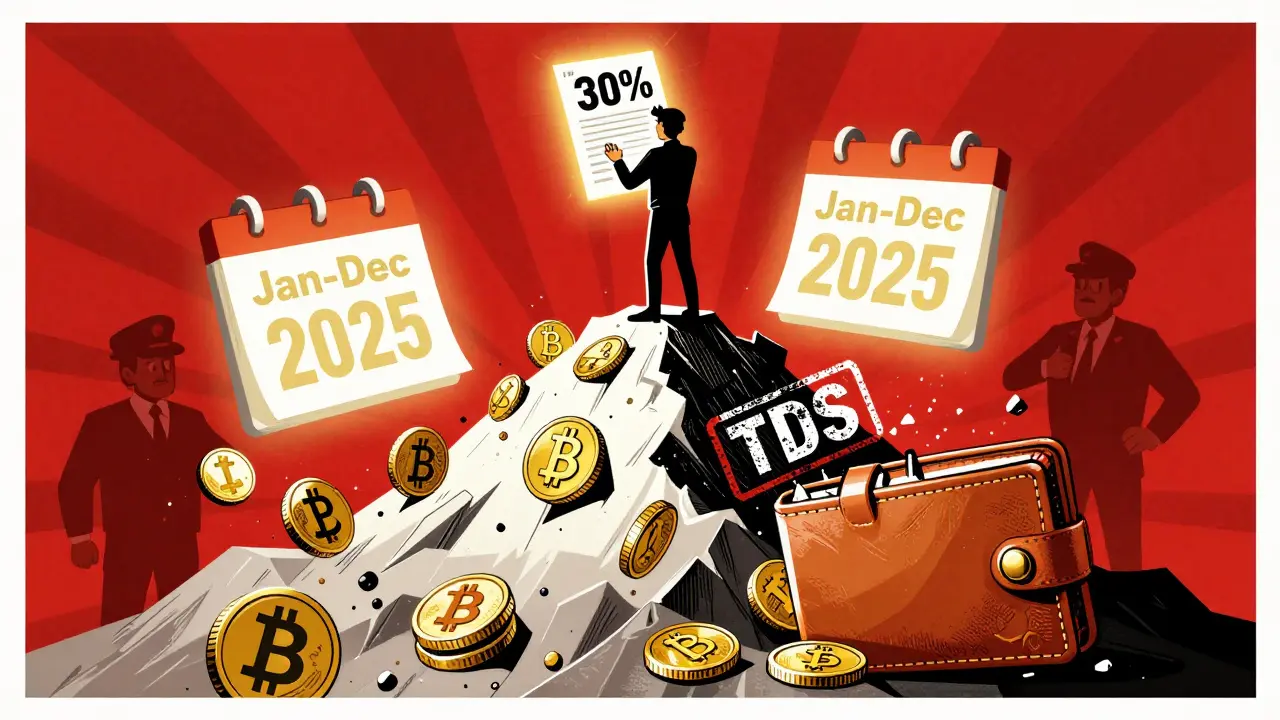
Since April 1, 2022, all gains from VDAs are taxed at a flat 30%. No exceptions. No sliding scale. Even if you’re in the 5% income tax slab, your crypto profit is taxed at 30%. This is a huge shift from the old system, where long-term gains (held over 36 months) were taxed at 20% with indexation - meaning you could adjust your purchase price for inflation and pay less tax.
Here’s what you can and can’t deduct:
- Only allowed: The actual cost of buying the asset - like how much you paid for 0.5 BTC in 2021.
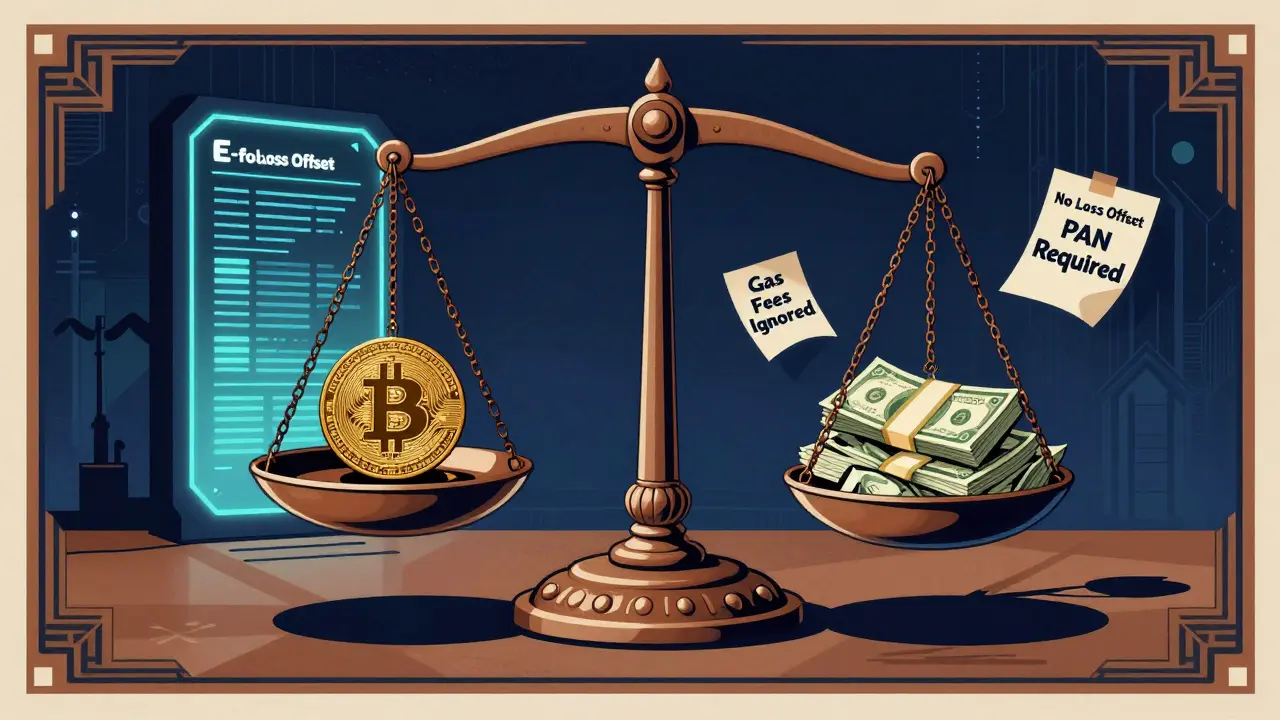
- Not allowed: Exchange fees, gas fees, mining costs, wallet charges, or even advisor fees. Nothing else counts.
For example: You bought 1 ETH for ₹2,50,000. You sold it for ₹4,00,000. Your taxable gain is ₹1,50,000. You pay ₹45,000 in tax (30%). Even if you spent ₹2,000 on gas fees to send it to a different wallet, that ₹2,000 doesn’t reduce your tax bill.
Losses Can’t Offset Other Income
This is one of the toughest parts of India’s VDA tax rule. If you lose money on crypto - say you bought Solana for ₹1,20,000 and sold it for ₹80,000 - you lose ₹40,000. But you can’t use that loss to reduce your salary tax, business income, or even gains from stocks or real estate.
Losses from VDAs can only be used to offset future VDA gains. And even then, you can carry them forward for only eight years. So if you have a big loss in 2025, you need to make crypto profits between now and 2033 to recover it. If you stop trading crypto after 2026, that loss disappears forever.
Many traders call this a "punitive" rule. On Reddit, users like CryptoSaverIN shared stories of losing lakhs on Ethereum but being unable to use those losses to lower their overall tax burden. The result? People are holding onto losing assets longer, hoping for a rebound - not because they believe in the project, but because selling means accepting a permanent tax loss.
TDS: 1% Deducted at Every Transaction
Every time you sell or trade VDAs on an Indian exchange, 1% of the transaction value is automatically deducted as Tax Deducted at Source (TDS). This applies if your total VDA transactions in a year exceed ₹10,000 (₹50,000 for specified persons like small businesses or salaried individuals with no business income).
For example: You sell ₹5,00,000 worth of Bitcoin on WazirX. ₹5,000 (1%) is withheld and sent to the government. You get ₹4,95,000 in your bank account. That ₹5,000 is not an extra tax - it’s an advance payment. When you file your return, it’s adjusted against your final 30% tax liability.
But here’s the catch: If you don’t give your PAN, the TDS jumps to 20%. And if you’re a non-filer of income tax returns, you might face higher TDS under old rules - though those were removed as of April 1, 2025.
Exchanges like CoinDCX and ZebPay handle TDS automatically. But many users report errors - Trustpilot reviews show 62% of tax complaints are about TDS being calculated wrong. Some get charged 1% on every swap, even if it’s crypto-to-crypto. Others get double-deducted because they used multiple wallets.
How to Report VDA Income in Your Tax Return
You must report all VDA transactions in Schedule VDA of ITR-2 or ITR-3. This isn’t optional. The Income Tax Department now cross-checks data from exchanges, wallet providers, and blockchain analytics firms.
What you need to report:
- Date you bought the asset
- Cost of acquisition (in INR at the time of purchase)
- Date you sold or transferred it
- Full value of consideration (what you received in INR)
- Wallet addresses involved
For crypto-to-crypto trades, you must convert both sides into INR using the exchange rate from government-approved platforms like CoinDCX or WazirX. You can’t use CoinGecko or Binance rates - only those listed by CBDT.
Most people underestimate the paperwork. Active traders spend 15-20 hours a year just tracking transactions. Tools like Koinly and CoinTracker help, but you still need to manually verify data against your exchange statements. Poor record-keeping caused 28% of tax notices in FY2023-24, according to PwC India.
What’s New in 2025?
The Income Tax Act, 2025, came into force on August 22, 2025. It didn’t change the 30% rate - but it made enforcement sharper.
- Tax Year replaces Financial Year: Your tax period now aligns with the calendar year (Jan-Dec), not April-March. This matches global norms.
- Digital-first compliance: All VDA reporting is now done through the e-filing portal. Paper records are no longer accepted as primary proof.
- Special dispute channel: If you disagree with a tax notice, you can now file a digital appeal directly with the VDA Tax Dispute Cell.
Finance Minister Nirmala Sitharaman said the goal is to grow VDA tax revenue by 15% annually until 2030. That means more audits, more data sharing, and stricter penalties for underreporting.
How Do Other Countries Compare?
India’s approach is among the strictest in the world:
- USA: Crypto taxed as property. Long-term gains get lower rates (0-20%), losses can offset stock gains. No TDS.
- Portugal: No tax on personal crypto gains.
- Singapore: Only business crypto income is taxed - not personal trading.
- Japan: Crypto gains taxed as miscellaneous income - up to 55% for top earners.
India’s 30% flat rate with no loss offset and 1% TDS makes it uniquely restrictive. KPMG’s 2023 survey found 68% of institutional investors cut their Indian crypto exposure by half after the rules came in. BlackRock’s India head said the tax structure makes India "non-competitive" for global crypto funds.
Are There Legal Ways to Reduce Your Tax?
Yes - but they’re limited and risky if done wrong.
- Gifting to family: You can gift VDAs to spouse, parents, or children. They pay tax only when they sell. If they’re in a lower tax bracket, you save. But gifting to siblings or friends triggers gift tax rules.
- Convert to ETFs: Some traders buy Bitcoin ETFs listed on Indian stock exchanges. These are taxed as securities - meaning long-term gains (held >1 year) are taxed at 10% without indexation. That’s better than 30%.
- Hold for 8+ years: Since losses can be carried forward for 8 years, holding assets that long gives you a chance to offset future gains.
Reddit user NiftyGainer claimed a 3.2% higher net return by switching from direct Bitcoin to a Bitcoin ETF before year-end. But this strategy only works if the ETF is listed on a recognized exchange and you can prove acquisition cost.
What Happens If You Don’t Report?
The government has full access to exchange data. If you don’t report a ₹5 lakh sale and the exchange reported it, you’ll get a notice. Penalties include:
- 100% to 300% of evaded tax
- Interest at 1% per month
- Prosecution under Section 276CC (criminal penalty for willful evasion)
Even if you used a non-Indian exchange like Binance, you’re still liable. The law applies to all Indian residents, regardless of where the transaction happened.
Who Is Affected the Most?
Not just traders. Anyone who:
- Bought crypto as a side investment
- Received crypto as salary or bonus
- Mined or staked crypto
- Got paid in crypto for freelance work
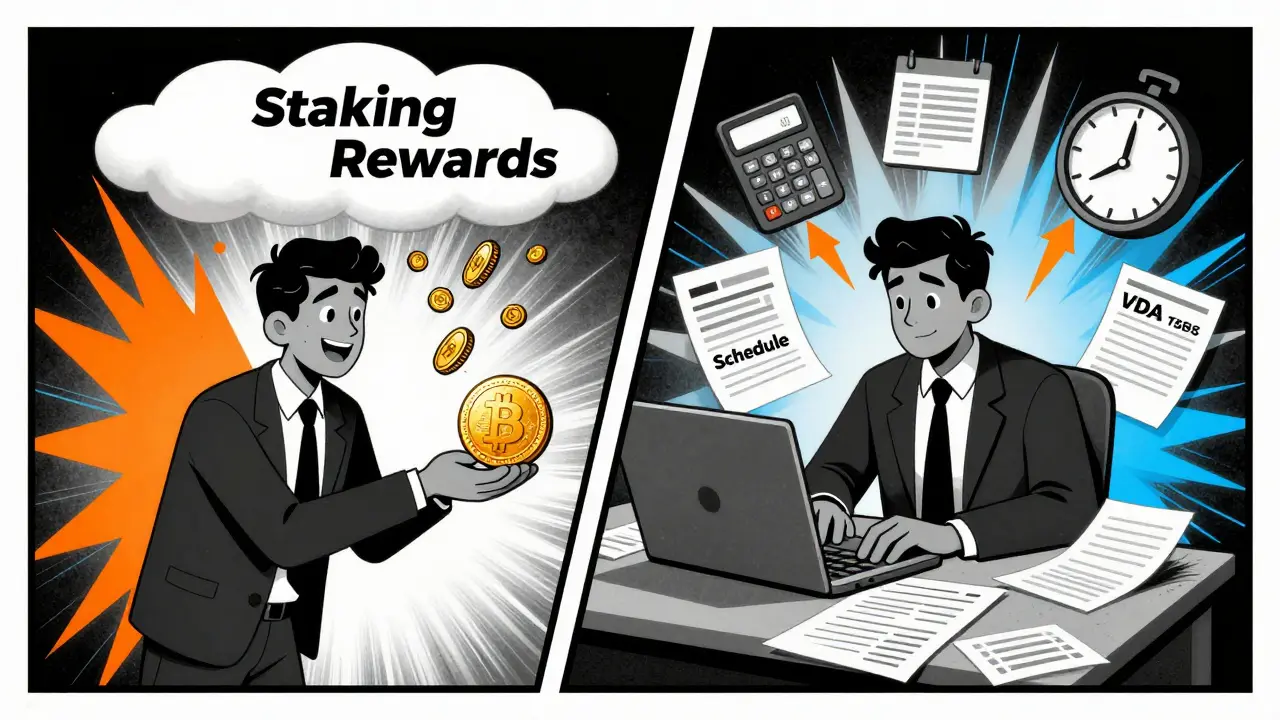
Staking rewards? Taxable as income at the time you receive them. Mining income? Taxed as business income - meaning you can deduct expenses, but you’ll still pay 30% on any profit from selling the mined coins.
82% of Indian crypto users are under 35. Most are students, freelancers, or young professionals. For them, the 30% tax hits hard - especially when returns are volatile. Yet, 61% keep trading because they believe the upside still outweighs the tax burden.
Final Advice: Keep Records, Don’t Guess
India’s VDA tax system isn’t perfect. It’s complex, rigid, and sometimes unfair. But it’s here to stay. The best move isn’t to avoid crypto - it’s to manage it smartly.
Do this:
- Track every purchase, sale, and swap in a spreadsheet or app
- Save screenshots of transaction IDs and exchange confirmations
- Use only PAN-linked wallets and exchanges
- File your ITR on time - even if you have losses
- Consult a CA familiar with crypto tax - don’t rely on Reddit advice
The government isn’t trying to kill crypto. It’s trying to tax it. And if you play by the rules, you can still profit - even with a 30% tax rate.
Is crypto legal in India?
Yes, buying, selling, holding, and trading crypto is legal in India. But it’s not legal tender - you can’t use it to pay for goods or services like rupees. The government taxes it heavily but doesn’t ban it.
Do I pay tax if I lose money on crypto?
You don’t pay tax on losses, but you also can’t use them to reduce tax on your salary, stocks, or property. Losses can only be used to offset future crypto gains, and only for up to eight years.
Is TDS applied on crypto-to-crypto trades?
Yes. Any trade between two different cryptocurrencies - like ETH for SOL - is treated as a sale and triggers 1% TDS if your annual transaction value exceeds ₹10,000. The value is calculated in INR at the time of trade.
Can I use foreign exchanges like Binance to avoid tax?
No. Indian tax law applies to all residents, regardless of where the transaction occurs. If you’re an Indian resident, you must report all global crypto gains. Foreign exchanges don’t report to Indian tax authorities - but the government can access blockchain data and cross-check with bank statements.
What happens if I don’t file my crypto tax return?
You’ll likely get a notice from the Income Tax Department. Penalties can include up to 300% of the unpaid tax, interest at 1% per month, and in extreme cases, criminal prosecution. Even if you didn’t make a profit, failing to report losses can trigger scrutiny.
Are NFTs taxed the same as Bitcoin?
Yes. Any NFT bought, sold, or traded is a Virtual Digital Asset. The same 30% tax rate, TDS rules, and loss carry-forward rules apply. If you mint an NFT and sell it, the profit is taxable. If you buy one and sell it later for more, you pay tax on the gain.
Do I need to report gifts of crypto?
Yes. If you receive crypto as a gift from someone who isn’t a close relative (spouse, parents, children, siblings), it’s taxable as income at fair market value. If you gift crypto to a close relative, no tax is due on receipt - but they’ll pay tax when they sell it.
Can I claim deductions for crypto mining expenses?
Only if you report mining as a business. In that case, electricity, hardware, and software costs can be deducted from mining income. But when you sell the mined crypto, the profit is taxed at 30% - and no expenses are allowed for that portion.
Is staking crypto taxable?
Yes. Staking rewards are treated as income at the time you receive them. You pay tax on the INR value of the reward on the day it hits your wallet. When you later sell the staked coins, you pay 30% on any gain over the original reward value.
What if I bought crypto before 2022?
You still pay 30% tax on any gain from selling it now. The purchase cost is your original buy price - even if you bought it in 2018. There’s no grandfathering. The 30% rule applies to all VDA sales after April 1, 2022, regardless of when you bought the asset.
Stanley Wong
December 5, 2025 AT 21:32And the TDS on every swap? That's just adding friction for no real benefit. If you're trading ETH for SOL, you're not cashing out-you're just moving around your portfolio. Why tax that like a sale? It's like taxing someone for switching bank accounts.
Also, the fact that you can't use losses to offset other income makes zero sense from an economic standpoint. It's like saying your stock losses don't matter unless they're from crypto. That's not taxation, that's discrimination.
Brooke Schmalbach
December 6, 2025 AT 03:17Also, forcing users to use only CBDT-approved exchange rates? That's absurd. CoinDCX and WazirX aren't arbitrage-free price feeders-they're profit-driven platforms. Using their rates as gospel is like trusting a casino to set the odds. This isn't transparency, it's control.
Nina Meretoile
December 7, 2025 AT 02:47And yeah, the TDS on swaps is annoying, but at least you know where you stand. I used to stress about tracking every tiny transaction, but now I just use Koinly and file early. It’s a pain, sure-but I’d rather pay 30% and sleep well than get a notice from the tax department at 3am.
Also, gifting to parents? Genius move. My mom’s in the 5% bracket. I gifted her some SOL last year and she sold it this year-paid less than I would’ve. Win-win. 💪
Yzak victor
December 8, 2025 AT 13:28And the TDS errors? Oh man, I got charged 1% twice on a single ETH-to-SOL swap because I used two different wallets. Had to file a complaint with CoinDCX and wait three weeks to get ₹120 back. That’s not tax collection, that’s bureaucratic chaos.
Still, I keep trading. Because even with 30%, crypto’s still the only place where a 22-year-old freelancer can actually build real wealth. Just wish the system didn’t feel so punitive.
Richard T
December 9, 2025 AT 18:40jonathan dunlow
December 10, 2025 AT 16:01