Wealth Tax Treatment of Crypto in Switzerland: What You Need to Know in 2025
 Apr, 23 2025
Swiss Crypto Wealth Tax Calculator
How Swiss Wealth Tax Works
Switzerland doesn't tax capital gains on crypto for private individuals, but applies a wealth tax on your total crypto holdings as of December 31. Tax rates vary by canton (0.3% to 1% annually). This tool helps you estimate your annual wealth tax.
Important Note: Wealth tax applies to all assets including crypto, stocks, real estate, and cash. Your taxable wealth is your total assets minus debts. No capital gains tax applies to private individuals.
Estimated Annual Wealth Tax
Results will appear here after calculation
Important Notes
- • Wealth tax applies to all crypto holdings as of December 31 each year
- • Payment tokens are taxed at market value as of December 31
- • Tax rates vary by canton (0.3% to 1.0% annually)
- • No capital gains tax applies to private individuals
- • Taxable wealth includes all assets minus debts
Switzerland doesn’t tax your crypto profits - but it does tax your crypto holdings. That’s the key difference that makes Swiss crypto rules unique. If you own Bitcoin, Ethereum, or any other digital asset and live in Switzerland, you don’t pay capital gains tax when you sell. But every year, on December 31st, the Swiss government wants to know exactly how much your crypto is worth - and they’ll take a small cut of your total wealth.
How Switzerland Classifies Crypto
Switzerland doesn’t treat crypto like cash. The Federal Tax Administration (FTA) calls it a kryptobasierte vermögenswerte - crypto-based asset. That means it’s grouped with stocks, bonds, and gold under private wealth. It’s not currency. It’s not property. It’s an asset you own, and like any asset, it’s subject to wealth tax. The FTA breaks crypto into three types:- Payment tokens - like Bitcoin and Litecoin. These are the most common. They’re used to send value, not to access services or represent ownership.
- Utility tokens - these give you access to a platform or service, like a token that lets you use a decentralized app.
- Security tokens - these act like shares or bonds. They promise returns, dividends, or profit-sharing.
Valuing Your Crypto for Wealth Tax
You can’t just guess what your crypto is worth. The FTA publishes official year-end exchange rates for major coins - Bitcoin, Ethereum, Ripple, Bitcoin Cash, Litecoin - as of December 31 each year. You must use these rates if they’re available. But what if you own Solana, Cardano, or some obscure DeFi token? The FTA doesn’t list those. Then you use the price from the exchange where you traded it. If you bought it on Coinbase, use Coinbase’s closing price on December 31. If you used a decentralized exchange like Uniswap, use the average price across major liquidity pools that day. No data at all? Then you fall back to your original purchase price in Swiss francs. That’s called the cost of acquisition. Keep your receipts. Keep your transaction history. If you can’t prove what you paid, the tax office might assume you paid nothing - and tax you on the full market value.Wealth Tax Rates Vary by Canton
Switzerland isn’t one country when it comes to taxes. It’s 26 cantons, each with its own rules. Wealth tax rates range from 0.3% to 1% per year, depending on where you live. Zurich? Around 0.5%. Geneva? Closer to 0.7%. Lucerne? 0.4%. Some rural cantons charge almost nothing. Others hit you harder. Your total taxable wealth includes everything: your bank account, your house, your car, your jewelry, and your crypto. The tax is calculated on your net worth after subtracting debts. So if you have CHF 500,000 in assets and CHF 100,000 in loans, you’re taxed on CHF 400,000. Crypto is included at its full market value. No discounts. No exemptions. No special treatment - except for one big thing: no capital gains tax.Capital Gains? Not for Private Investors
Here’s where Switzerland stands out globally. If you’re a private individual - not a trader, not a business - you pay zero capital gains tax on crypto, no matter how much you make. Sell Bitcoin for a CHF 1 million profit? No tax. Trade Ethereum for Solana and make CHF 300,000? No tax. Hold for five years and cash out? Still no tax. This applies to all private assets - stocks, real estate, art, crypto. Switzerland doesn’t care if you made a profit. They only care how much you own on December 31. But if you’re classified as a professional trader? That’s a different story.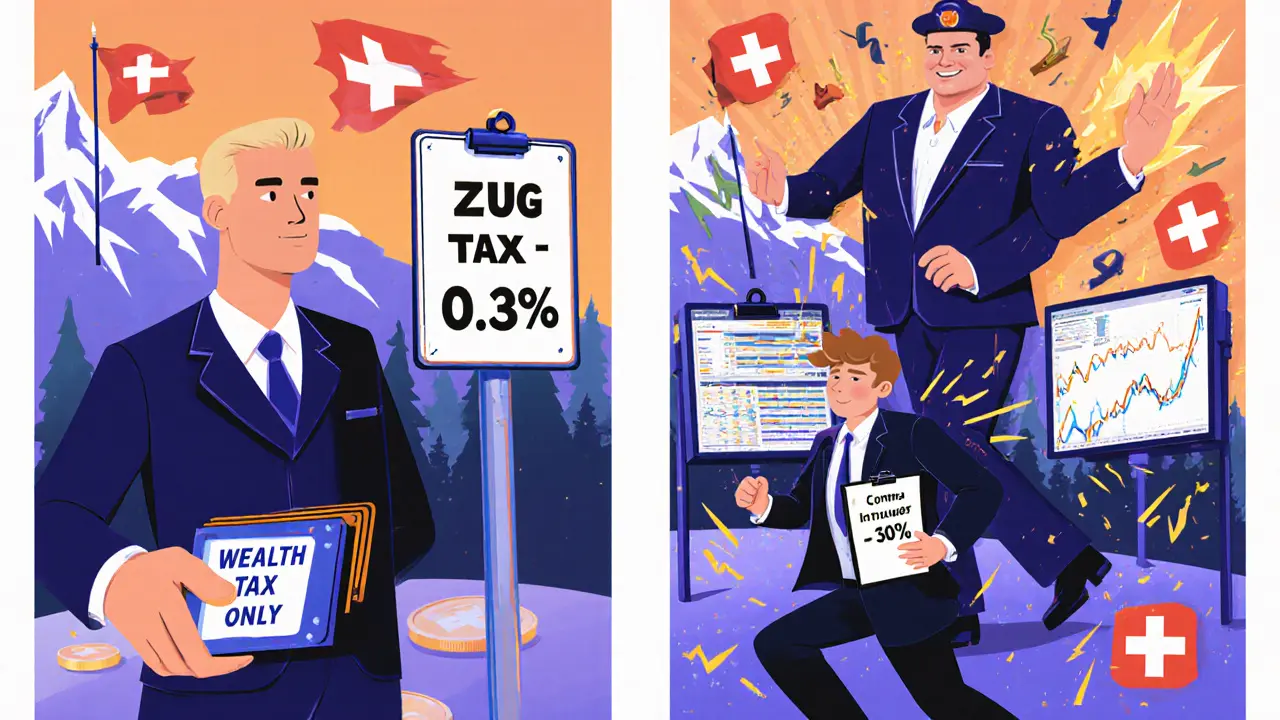
Who Counts as a Professional Trader?
The FTA uses Circular No. 36 to decide who’s a hobbyist and who’s a pro. If you’re trading crypto daily, using leverage, running a newsletter, or earning more than 50% of your income from trading, you’re likely a professional. Professionals pay income tax on crypto gains - not capital gains tax, but regular income tax. That means federal tax (up to 11.5%), plus cantonal and municipal taxes. In Zurich, that can total over 30% on crypto profits. The line is blurry. One trade a month? Probably fine. Five trades a week? You’re on thin ice. The tax office looks at frequency, volume, and intent. If you’re treating crypto like a job, they’ll treat it like a job.Staking, Mining, and DeFi - What’s Taxed?
Staking Ethereum and earning rewards? That’s income. You pay income tax on the CHF value of the rewards when you receive them. Mining? If you’re doing it as a side hustle, it’s income. If you’re running a full-scale mining operation with hardware and electricity costs, it’s a business. You need to file a business tax return. DeFi liquidity pools? If you earn interest or fees, it’s income. If you swap tokens and make a profit, it’s still not capital gains - unless you’re a professional. NFTs? If you buy and sell them as a collector, they’re part of your wealth. If you sell them for profit as a trader, it’s income. The rules don’t change for new tech. Switzerland’s tax system is technology-neutral. If it generates value, it’s taxed - but only if it’s income. Not if it’s wealth.What Investors Say
Swiss crypto investors often say the system is simple - if you keep good records. The tax rate is low. The capital gains exemption is rare. The rules are clear. But the paperwork? That’s the pain. Many report spending hours each December gathering transaction data from multiple exchanges. Some use tools like Koinly or Accointing to auto-import trades. Others hire accountants who specialize in crypto. One investor in Basel told a local forum: “I pay about CHF 800 a year in wealth tax on my crypto. If I lived in Germany, I’d pay over CHF 15,000 in capital gains tax on the same holdings. I’d rather fill out forms than write a big check.”
Optimizing Your Crypto Wealth
Smart investors use three strategies:- Choose your canton wisely. Move to a low-wealth-tax canton like Zug or Schwyz. You’ll save hundreds - sometimes thousands - per year.
- Use family trusts. Split crypto holdings among family members to stay under higher tax brackets. Each person gets their own exemption threshold.
- Time your sales. Sell before December 31 if you want to reduce your taxable wealth. But remember: you still don’t pay capital gains tax, so timing is about wealth, not profit.
What’s Changing in 2025?
Nothing major. The FTA reaffirmed its stance in December 2024. The rules haven’t changed since 2021. No new crypto taxes. No blockchain-specific levies. No digital asset taxes. Switzerland’s approach remains stable because it works. Crypto businesses keep setting up here. Investors keep moving here. The country has turned tax simplicity into a competitive advantage. The only risk? If you don’t declare. The FTA knows which exchanges operate in Switzerland. They know which wallets are linked to Swiss addresses. They’re getting better at tracking.Final Take
Switzerland gives you the best of both worlds: no capital gains tax on crypto profits, and a clear, predictable wealth tax system. It’s not free. But it’s fair. And compared to the U.S., Germany, or France, it’s a dream. If you’re holding crypto and want to keep it long-term, Switzerland is one of the few places where you can do that without worrying about tax bills when you sell. Just remember: declare it. Value it right. And don’t forget to update your records every year.Do I pay capital gains tax on crypto in Switzerland?
No, private individuals do not pay capital gains tax on crypto profits in Switzerland. Whether you make CHF 1,000 or CHF 1 million, you won’t pay tax on the gain. This applies to all private assets - crypto, stocks, real estate. Only professional traders and businesses pay capital gains tax as part of their income tax.
How is crypto valued for Swiss wealth tax?
You must value your crypto as of December 31 each year using the official FTA exchange rates for major coins like Bitcoin and Ethereum. For other tokens, use the price from the exchange where you traded them. If no price is available, use your original purchase cost in Swiss francs. The FTA does not allow estimates or averages - only verifiable market data.
What happens if I don’t declare my crypto?
Failure to declare crypto assets can lead to penalties, interest charges, and audits. Switzerland shares tax data with over 100 countries through automatic exchange agreements. If your crypto is held on a foreign exchange that reports to Swiss authorities, undeclared holdings will be flagged. Penalties can reach up to 100% of the unpaid tax.
Are staking rewards taxed in Switzerland?
Yes. Staking rewards are treated as income and taxed at your regular income tax rate. The value is calculated in Swiss francs at the time you receive the reward. This applies whether you stake Ethereum, Cardano, or any other asset. The reward itself becomes part of your taxable income for that year.
Which canton has the lowest crypto wealth tax?
Cantons like Zug, Schwyz, and Nidwalden have some of the lowest wealth tax rates, often under 0.4%. These cantons are popular among crypto investors because they offer low taxes without sacrificing infrastructure or banking access. Moving to one of these cantons can reduce your annual crypto wealth tax by hundreds or even thousands of francs.
Do I need to report NFTs for wealth tax?
Yes. NFTs are considered private wealth assets and must be declared on December 31. Their value is based on the last sale price or a reasonable market estimate. If you’re holding NFTs as a collector, they’re part of your wealth. If you’re trading them frequently, you may be classified as a professional trader and subject to income tax on gains.
Can I use a Swiss crypto wallet to avoid tax?
No. Using a Swiss wallet doesn’t exempt you from tax. What matters is your tax residency, not where your wallet is hosted. If you’re a Swiss resident, you must declare all crypto assets - regardless of wallet location. Swiss wallets may offer better security, but they don’t change your tax obligations.
Is mining crypto taxable in Switzerland?
Yes. Mining rewards are considered business income if you’re doing it regularly or with significant equipment. You must report the value of mined coins as income at the time they’re received. If mining is a hobby with minimal equipment, it may still be taxed as miscellaneous income. Large-scale operations require a business tax registration.
Switzerland’s crypto tax system rewards long-term holders and punishes secrecy. It’s not perfect - record-keeping is a chore - but it’s transparent, stable, and among the most investor-friendly in the world. If you’re serious about holding crypto without being taxed on every trade, Switzerland still offers the clearest path.
Casey Meehan
November 27, 2025 AT 14:21Martin Doyle
November 27, 2025 AT 14:57Grace Zelda
November 29, 2025 AT 02:45Sam Daily
November 30, 2025 AT 11:02Kristi Malicsi
December 2, 2025 AT 05:32