What Are Gaming NFTs? A Clear Guide to Digital Ownership in Video Games
 Feb, 25 2025
Gaming NFT ROI Calculator
Play-to-Earn Financial Calculator
Estimate your potential earnings from gaming NFTs while understanding key risks. Based on real-world data from games like Axie Infinity and Splinterlands.
Estimated Monthly Earnings
- NFT value can drop 80% in months (as seen in 2023)
- Gas fees vary by blockchain (Polygon: $0.01, Ethereum: $20+)
- Most players don't earn enough to cover costs
Realistic Scenario: Based on 2023 data, 78% of players earn less than $100/month after fees.
Only top 10% of players make significant income.
Gaming NFTs are digital items in video games that you actually own-not just rent. Unlike traditional games where everything you buy or earn stays locked inside the game, gaming NFTs live on a blockchain. That means they’re yours forever, even if you stop playing. You can sell them, trade them, or use them in other games that support the same system. It sounds simple, but it’s a total rewrite of how digital stuff works in games.
How Gaming NFTs Actually Work
Gaming NFTs are built on blockchains like Ethereum, Polygon, or Solana. These are public ledgers that record every transaction without a central company in charge. Each NFT is a unique digital token-like a serial number tied to a specific item. That could be a sword, a skin, a character, or even a piece of virtual land. No two NFTs are the same. That’s what ‘non-fungible’ means: you can’t swap one for another like you would with dollars or Bitcoin.
These tokens are created using smart contracts-self-running code on the blockchain. When you buy a rare dragon skin in a game as an NFT, the smart contract proves you’re the owner. It also lets other games or marketplaces recognize that you own it. No middleman. No game company can delete it, take it back, or shut it down. That’s the big promise: real ownership.
What Can Be an NFT in a Game?
Almost anything in a game can become an NFT. Here are the most common types:
- Characters: Unique avatars with special stats or abilities, like a one-of-a-kind warrior with glowing armor.
- Weapons and Items: Rare swords, guns, or tools that give players an edge-or just look cool.
- Skins and Customizations: Visual upgrades like outfits, animations, or effects that change how your character looks.
- Virtual Land: Plots of land in games like The Sandbox or Decentraland that you can build on or rent out.
- Tickets and Access Passes: NFTs that let you enter exclusive events, tournaments, or beta tests.
- Crafting Materials: Rare resources used to make other NFT items, creating a mini economy inside the game.
Some games even let you combine NFTs to make new ones. For example, you might fuse two weapons to create a stronger version. That’s called composability-and it’s one reason gaming NFTs feel more alive than regular in-game items.
Play-to-Earn: Turning Time Into Cash
One of the biggest draws of gaming NFTs is play-to-earn. Instead of spending hours grinding for virtual rewards that mean nothing outside the game, you earn tokens or NFTs you can sell. The most famous example is Axie Infinity. In 2021, players in the Philippines earned $10 to $50 a day by battling and breeding digital creatures called Axies. For many, that was more than their daily wage.
It’s not just about winning battles. You can earn by completing quests, farming resources, or even just logging in. These rewards are often paid in cryptocurrency, which you can convert to real money. But here’s the catch: you usually need to buy your first NFT to start. That upfront cost can be $100 or more, depending on the game. So while play-to-earn sounds like free money, it often requires money to play.
Why Gaming NFTs Are Different From Regular In-Game Items
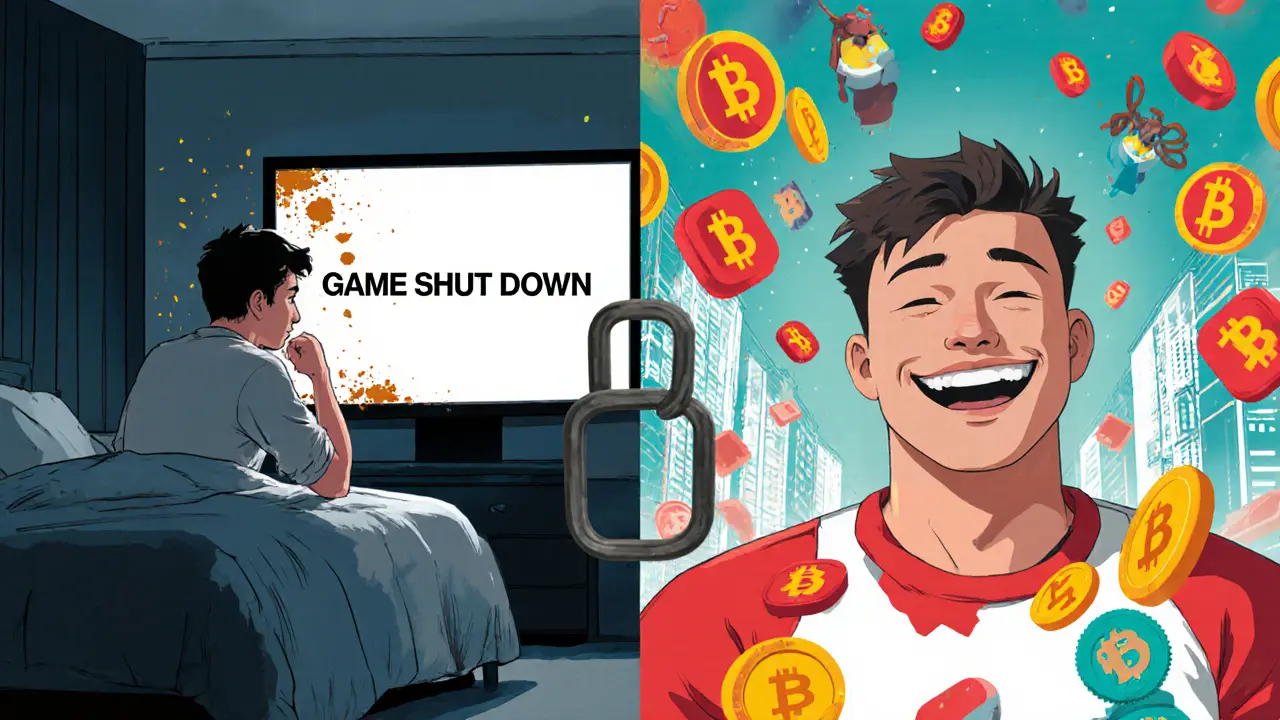
In a normal game like Fortnite or Call of Duty, you don’t own anything. You’re just renting it. If the game shuts down, your skins vanish. If the company changes the rules, they can take your items away. You can’t resell them legally. And if you switch games? All your hard-earned gear is gone.
Gaming NFTs fix that. Because they’re stored on a blockchain, they’re independent of any single game. If a game dies, your NFTs still exist. You might not be able to use them in that game anymore, but you can sell them on a marketplace like OpenSea or try to use them in another game that supports the same standard. That’s called interoperability-and it’s still rare, but growing.
Think of it like buying a physical collectible. If you own a rare Pokémon card, you can keep it, trade it, or sell it-even if the Pokémon TV show ends. Gaming NFTs are trying to make digital items work the same way.
The Downsides: Scams, Fees, and Frustration
For all the hype, gaming NFTs have serious problems.
High fees: Every action on the blockchain costs money-called gas fees. Buying a skin might cost $50 in the game, but $20 more in fees. On Ethereum, this can be worse. That’s why many newer games use Polygon or Solana, where fees are cents, not dollars.
Complex setup: You need a crypto wallet (like MetaMask), you need to buy crypto, you need to connect it to the game. For most people, this is a wall. A 2022 survey found 52% of new players gave up because the setup was too confusing.
Volatility: NFT prices swing wildly. An item worth $500 one month might be worth $50 the next. Many people bought in during the 2021 boom, only to lose 80% of their value by 2023.
Scams: Fake games, fake NFTs, and rug pulls are common. A developer might launch a game, sell NFTs, then disappear with the money. In 2022, over $1.7 billion was lost to crypto scams, and gaming NFTs were a big part of that.
Environmental concerns: Ethereum used to burn a lot of energy-about 707 kWh per transaction in 2021. That’s like running a home for a month. Ethereum switched to a greener system in 2022, but many people still remember the damage.
Who’s Behind Gaming NFTs-and Who’s Against Them?
Big companies are split. Ubisoft launched Quartz, its NFT platform, in 2021. But players flooded forums with anger. One top comment said: “NFTs feel like a cash grab that undermines the artistic integrity of games.” Ubisoft quietly scaled back.
Electronic Arts’ CEO said in 2022: “We’re watching [NFTs], but we’re not convinced yet.” Meanwhile, indie studios and blockchain-native teams are pushing forward. Games like Gods Unchained, Splinterlands, and Illuvium are built from the ground up around NFTs. They don’t try to hide it-they make it the core of the experience.
On the player side, two groups dominate: those who see it as a financial opportunity and those who see it as a betrayal of gaming. Players in countries with weaker economies often embrace NFT games as a way to earn. In contrast, Western gamers who grew up with Steam and Xbox often reject them as exploitative.
What’s Next for Gaming NFTs?
The hype has cooled, but the tech is still evolving. In 2023, the focus shifted from “get rich quick” to “what’s actually fun?”
Games now focus more on:
- Better gameplay first, NFTs second
- Lower fees using layer-2 blockchains
- Interoperability-using your NFT across multiple games
- Utility-NFTs that unlock real features, not just status
Standards like ERC-6551 are letting NFTs own other NFTs. Imagine a character that carries weapons, armor, and pets-all as linked NFTs. That’s the future.
Deloitte predicts that by 2030, interoperable digital assets will be standard. Gartner says 10% of major game studios will use NFTs by 2026. That’s up from less than 1% in 2022.
The biggest shift? Developers now say they care more about player value than speculation. In a 2023 survey, 78% of blockchain game devs said they prioritize fun and fairness over price pumps.
Should You Get Into Gaming NFTs?
If you’re curious, start small. Don’t spend money you can’t afford to lose. Try free-to-play NFT games like Alien Worlds or Blankos Block Party. They let you earn without buying anything upfront.
Learn the basics: how wallets work, how to check if a game is legit, how to avoid phishing scams. Use trusted platforms. Never click random links. Never share your private key.
If you’re looking for a side income, be realistic. Most people don’t make money. A few do-but only after spending time learning, playing, and managing risk.
Gaming NFTs aren’t magic. They’re a new tool. Like any tool, they can be used well-or abused. The best ones aren’t about flipping items. They’re about making games that feel more alive, more personal, and more yours.
Are gaming NFTs the same as cryptocurrency?
No. Cryptocurrencies like Bitcoin or Ethereum are fungible-each unit is identical and can be swapped. Gaming NFTs are unique. One NFT might be a rare sword, another a character with special powers. You can’t trade them 1-to-1 like money. NFTs represent ownership of specific items; crypto represents value you can spend.
Can I lose my gaming NFTs?
You can lose access if you lose your wallet password or private key. The NFT itself stays on the blockchain forever, but without your key, you can’t prove you own it. That’s why backing up your wallet is critical. Also, if a game shuts down, you might not be able to use your NFT in that game anymore-but you can still sell it elsewhere.
Do I need to spend money to play NFT games?
Not always. Some games let you earn NFTs by playing, like Axie Infinity’s scholarship system, where you borrow a team and share earnings. Others, like Splinterlands, let you play for free with basic cards. But if you want to compete at a high level or earn more, you’ll likely need to buy better NFTs. There’s no free lunch-but there are low-cost ways to start.
Are gaming NFTs legal?
Yes, in most countries-but regulations are changing. The U.S. SEC is watching closely and may classify some NFTs as securities, which would change how they’re sold. Some countries, like China, ban NFT trading entirely. Always check your local laws before buying or selling.
Can I use my gaming NFT in other games?
Right now, very few games support this. But it’s the goal. New standards like ERC-6551 let NFTs carry other NFTs, so your character could bring weapons from one game into another. Games like The Sandbox and Decentraland already allow cross-game item use. Wider adoption is still years away, but the tech is being built.
Are gaming NFTs worth it in 2025?
Only if you care about ownership, not profit. The speculative bubble has burst. Prices are lower, scams are fewer, and better games are emerging. If you enjoy the gameplay and believe in digital ownership, yes-it’s worth exploring. If you’re hoping to get rich quick, you’re likely to be disappointed. The real value now is in the experience, not the resale price.
Next Steps: How to Get Started Safely
- Download MetaMask (or another wallet) and set it up on your browser or phone.
- Buy a small amount of Ethereum or Polygon (not Bitcoin)-just enough to cover gas fees.
- Try free-to-play NFT games like Alien Worlds or Blankos Block Party.
- Join a Discord server for the game you like. Ask questions before spending money.
- Never share your private key. Never click links from strangers. Always double-check URLs.
Gaming NFTs aren’t going away. They’re getting better. The next few years will show whether they’re a passing trend-or the future of digital ownership. Either way, knowing how they work gives you power-not just as a player, but as someone who owns their digital stuff.
Eddy Lust
November 27, 2025 AT 01:45man i just tried to get into one of these nft games and got lost in wallet setup hell. i spent 45 minutes trying to figure out why my metamask wouldn't connect and ended up just closing the tab. why does everything have to be so complicated now? i just wanna play a game without becoming a crypto accountant.
Sierra Myers
November 27, 2025 AT 09:10if you think nfts are bad wait till they start selling your gameplay data as nfts too. next thing you know your killstreaks are tokenized and you gotta pay royalties to play your own matches. this isn't ownership it's surveillance with extra steps.
Sam Daily
November 28, 2025 AT 20:51yo i get the hate but check out blankos block party - you can earn nfts just by playing, no upfront cost! i made a sweet robot avatar last week and traded it for a funky hat. it's not about flipping, it's about having fun and collecting stuff that's actually yours 😊
SARE Homes
November 30, 2025 AT 08:29Rachel Thomas
November 30, 2025 AT 17:51so let me get this straight - you’re telling me i can own a sword in a game but if the game shuts down i can’t use it? that’s not ownership, that’s a digital tombstone. why would anyone want that?
SHIVA SHANKAR PAMUNDALAR
December 2, 2025 AT 11:56the entire concept is a distraction. real ownership is not about blockchain tokens. it’s about freedom from systems that profit off your labor. nfts are just a new way to make you feel like you’re winning while the rich get richer. you’re not owning anything - you’re being sold a fantasy wrapped in smart contracts.
Felicia Sue Lynn
December 4, 2025 AT 06:07There is something profoundly poetic about the idea that our digital artifacts - once ephemeral, disposable, and controlled - might one day be as enduring as a hand-carved artifact or a signed book. The blockchain, flawed as it is, offers a fragile but real promise: that our digital creations, our time, our effort, might not vanish into corporate servers. Perhaps this is not about money. Perhaps it is about dignity.
fanny adam
December 4, 2025 AT 22:46Did you know that 87% of NFT gaming platforms have been flagged by blockchain security firms for suspicious tokenomics? The ‘play-to-earn’ model is a Ponzi scheme disguised as innovation. The early adopters profit. The latecomers fund the exit. And the companies? They vanish with the liquidity pool. This isn’t a revolution - it’s a digital heist with a whitepaper.
Kristi Malicsi
December 5, 2025 AT 00:36Ian Esche
December 6, 2025 AT 05:28They call it ownership? More like a digital leash. You think you own your sword? Nah. You’re just renting it from the blockchain. And who controls the blockchain? Big tech. Big finance. Same wolves, new sheepskin. We’re not breaking free - we’re just giving them a better way to track us. And don’t even get me started on the energy waste. This isn’t progress. It’s performance art for billionaires.