What is Bifrost (BFC) Crypto Coin? A Clear Breakdown of Its Purpose, Tech, and Market Status
 Mar, 12 2026
When you stake your crypto, you’re helping secure a blockchain network - but you usually lock up your coins for weeks or months. That’s fine if you’re in it for the long haul. But what if you want to use those staked coins elsewhere? What if you want to trade them, lend them, or earn more yield? That’s where Bifrost comes in.
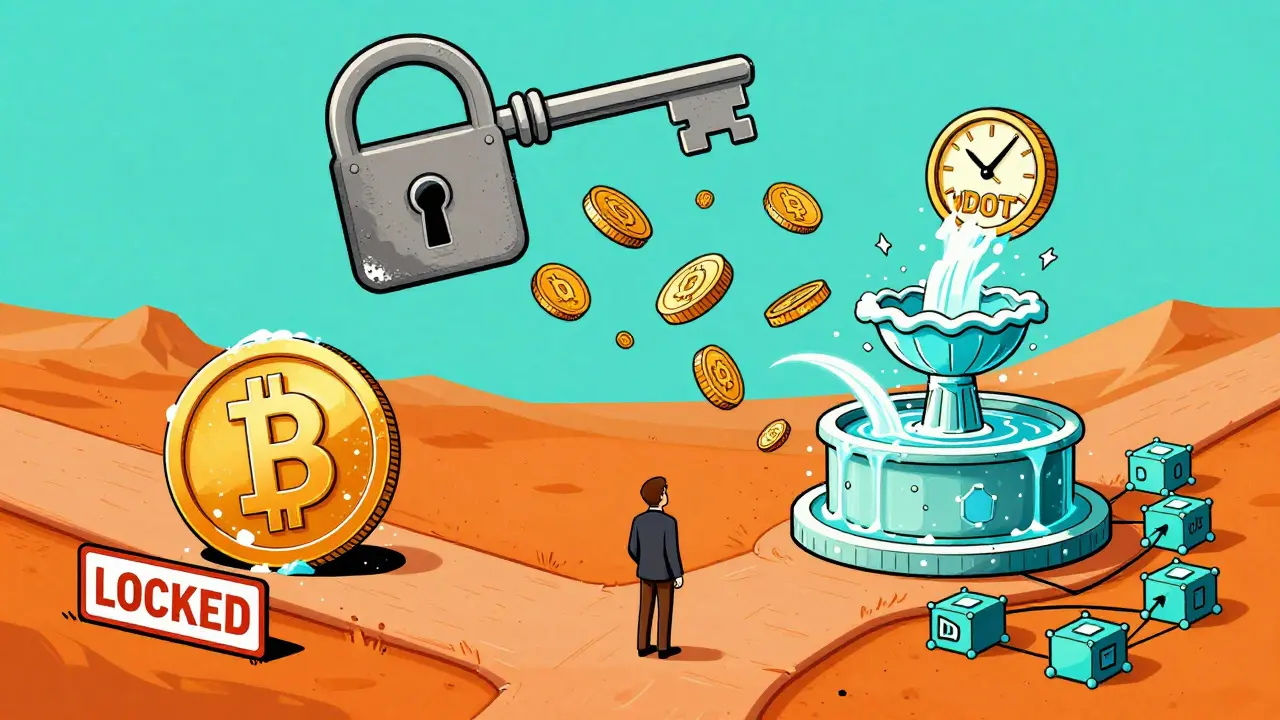
Bifrost (BFC) isn’t just another coin. It’s a system built to solve a real problem: locked-up staking rewards. Imagine you stake 10 DOT (Polkadot) to earn 5% yearly. Great. But now those 10 DOT are frozen. You can’t use them in DeFi, can’t swap them for other tokens, can’t even use them as collateral. Bifrost changes that. It gives you a digital twin - a token called vDOT - that acts exactly like your staked DOT, but it’s fully liquid. You can trade it, send it, or use it in other apps. Your original DOT keeps earning rewards behind the scenes. And you still get the yield.
How Bifrost Works: The vToken System
Bifrost doesn’t just lock your coins. It gives you a voucher. That voucher is called a vToken. For every DOT you stake, you get vDOT. For every ETH, you get vETH. These aren’t fake tokens. They’re programmable, on-chain representations of your staked assets. And they’re backed 1-to-1. If you stake 100 DOT, you get exactly 100 vDOT. No inflation, no dilution. The system is designed so your original coins stay safely locked on their native chain - Polkadot, Ethereum, Tron, etc. - while the vTokens move freely across the DeFi world.
This isn’t magic. It’s built on smart contracts and a network of validators called collators. These collators run the Bifrost parachain on Polkadot. They monitor staking activity, issue vTokens, and handle redemption. When you want your original DOT back, you burn your vDOT and the system releases your DOT. There’s no liquidation risk. No slashing. No hidden fees. Just a clean swap.
The real power? You can use vDOT like cash. Deposit it into a lending platform. Use it as collateral for a loan. Trade it on a DEX. Even stake it again in another protocol to earn double yield. That’s called stacking yields. Bifrost makes it possible.
The BFC Token: More Than Just a Coin
The BFC token is the engine behind Bifrost. It’s not just a currency. It’s the glue that holds the whole system together. Here’s what it does:
- Pay fees - You use BFC to mint vTokens or redeem them. It’s the gas that keeps the system running.
- Governance - Hold BFC and you can vote on upgrades. Should Bifrost add support for Solana? Should transaction fees go up? The community decides.
- Staking rewards - You can stake BFC to become a collator. If you help run the network, you earn more BFC as a reward.
- Liquidity mining - If you provide liquidity for vTokens on exchanges, you get BFC as a bonus.
There’s a maximum supply of 4.2 billion BFC tokens. But not all of them are out yet. As of March 2026, around 1.39 billion BFC are in circulation. The rest are locked in team wallets, ecosystem funds, or scheduled for future releases. That’s common in crypto - it’s not a surprise.

Where Bifrost Lives: Cross-Chain Bridges
Bifrost isn’t stuck on one blockchain. It’s built to move between them. Its core is a parachain on Polkadot, which gives it fast, cheap transactions and shared security. But that’s just the start. Bifrost has bridges to Ethereum, Tron, Metadium, and Fantom. That means if you’re an Ethereum user, you can still use Bifrost. You don’t need to switch chains.
On Ethereum, you interact with Bifrost through a smart contract: 0x0c7D5ae016f806603CB1782bEa29AC69471CAb9c. That’s your gateway to minting vETH. The same contract lets you redeem vETH for ETH. It’s seamless.
This cross-chain design is what sets Bifrost apart. Most liquid staking apps - like Lido on Ethereum - only work on one chain. Bifrost works across five or more. That’s a big deal. It means your staked assets aren’t trapped. They can flow where the best yields are.
Market Status: What’s BFC Worth Today?
As of March 12, 2026, BFC is trading between $0.01775 and $0.02 per token. That’s a long way from its all-time high of $0.55 - a drop of over 95%. Market cap sits around $25-35 million, with a fully diluted cap of $42 million. It’s ranked around #686 by market cap.
Trading volume is low. CoinGecko reports about $561,000 in 24-hour volume. Some exchanges show zero volume. That’s a red flag. Low volume means less liquidity. If you want to sell a lot of BFC, you might struggle to find buyers without crashing the price.
The last 24 hours saw a -1.36% drop. Over the past week, it’s down -6%. That’s not unusual in crypto. But it does show the market is still shaky. Bifrost’s value is tied to adoption. If more DeFi apps start using vTokens, demand could rise. If not, it’ll keep drifting.
Why Bifrost Matters: The Staking Yield Layer
Bifrost calls itself a “staking yield layer.” That’s a fancy way of saying it turns locked staking rewards into something useful. Think of it like this: staking is like putting money in a savings account. Bifrost turns that savings account into a debit card. You still earn interest. But now you can spend it.
That’s huge for DeFi. Most yield strategies require you to move assets around. But if your staked ETH is frozen, you can’t use it. Bifrost removes that barrier. It lets you earn yield from staking, then earn more yield from lending, trading, or farming - all at the same time.
It’s not perfect. Bifrost competes with Lido, Rocket Pool, and others. But those are mostly single-chain. Bifrost’s multi-chain approach is rare. And it’s growing. As of early 2026, it supports at least eight staked assets, with more on the way. The team is focused on speed, security, and expanding integrations.
Is Bifrost Right for You?
If you’re staking DOT, ETH, or another PoS token and want to use your staked assets elsewhere - yes. Bifrost gives you freedom. You’re not forced to choose between earning yield and staying liquid.
If you’re just speculating on BFC’s price - maybe not. The token’s value depends entirely on how much the protocol is used. If no one mints vTokens, BFC has no utility. And with low trading volume, it’s risky.
If you’re a developer? Bifrost’s open architecture and cross-chain tools make it a compelling platform to build on. There are already DApps using Bifrost Linkers to connect staking, lending, and trading in one flow.
The bottom line: Bifrost isn’t a coin you buy to get rich. It’s a tool you use to unlock value. The BFC token is the key. Without usage, it’s worthless. With adoption, it could become essential.
What is Bifrost (BFC) used for?
Bifrost (BFC) is used to unlock liquidity from staked crypto assets. It lets users stake tokens like DOT or ETH and receive vTokens (like vDOT or vETH) in return. These vTokens can be traded, lent, or used as collateral in other DeFi apps - while the original staked assets continue earning rewards. The BFC token itself is used to pay fees, govern the protocol, stake for collator rewards, and earn liquidity incentives.
How does Bifrost make money?
Bifrost doesn’t take a cut like a centralized exchange. Instead, it earns through transaction fees paid in BFC tokens. When users mint or redeem vTokens, they pay a small fee in BFC. These fees go to collators who secure the network and to the protocol treasury, which funds future development. There’s no hidden revenue - everything is transparent and on-chain.
Can I stake BFC directly?
Yes. You can stake BFC tokens to become a collator node operator. Collators help validate transactions and manage the minting of vTokens. In return, you earn newly minted BFC as rewards. This is how the network stays decentralized and secure. You don’t need to stake your DOT or ETH to stake BFC - it’s a separate system.
Is Bifrost safe?
Bifrost is built on Polkadot’s secure parachain architecture and uses a decentralized network of collators. The system has no liquidation risk - your original staked assets stay locked on their native chain. vTokens are 1-to-1 backed and redeemable at any time. However, like all DeFi protocols, smart contract bugs or exploits are possible. Always use trusted interfaces and never invest more than you can afford to lose.
What blockchains does Bifrost support?
Bifrost natively runs as a parachain on Polkadot. It also connects to Ethereum, Tron, Metadium, and Fantom via cross-chain bridges. This allows users on any of these chains to stake their native assets and receive vTokens that work across the ecosystem. Support for additional chains is planned as the protocol evolves.
Where can I buy BFC?
BFC is listed on several major exchanges, including Gate.io, KuCoin, and MEXC. You can trade it against USDT, BTC, or ETH. Always verify the contract address before trading. Avoid unofficial or unverified platforms. For direct access, you can also interact with Bifrost’s official website and connect your wallet to mint vTokens or stake BFC.
What’s the difference between BFC and vDOT?
BFC is the native governance and utility token of the Bifrost protocol. vDOT (or vETH, vTRX, etc.) is a derivative token you receive when you stake DOT (or ETH, TRX). vTokens represent your staked position and can be used in DeFi. BFC is used to pay fees and vote on upgrades. They serve completely different roles - one is a utility token, the other is a staking derivative.
Why is BFC’s price so low compared to its all-time high?
BFC’s price drop reflects broader crypto market conditions and low adoption. When the market peaked in 2021-2022, speculative demand pushed BFC to $0.55. Since then, most liquid staking projects have struggled to gain mainstream traction. Bifrost’s cross-chain model is technically strong, but user adoption hasn’t scaled fast enough to drive demand. Until more DeFi apps integrate vTokens, the price will likely remain under pressure.
William Montgomery
March 12, 2026 AT 21:25Bifrost is just another overhyped DeFi gimmick. You think vDOT is magic? It’s still just a IOU. If the collators go down or the smart contract gets hacked, you’re left holding worthless paper. And don’t even get me started on BFC’s trading volume - $561k? That’s not a market, that’s a ghost town. Stop pretending this is innovation - it’s just leverage wrapped in blockchain buzzwords.
Allison Davis
March 14, 2026 AT 20:27There’s real utility here that’s being ignored. Bifrost solves a fundamental bottleneck in staking: liquidity. If you’re staking ETH or DOT and can’t use it in Aave, Curve, or Uniswap, you’re leaving yield on the table. vTokens aren’t speculative - they’re functional. The fact that BFC’s price is low doesn’t mean the protocol is broken. It means adoption hasn’t caught up yet. Look at how Lido grew - slow, then explosive. This could be the same.
And yes, the volume is low. But the integrations are growing. Cross-chain bridges to Ethereum and Fantom mean users aren’t forced into one ecosystem. That’s not trivial. It’s the future of DeFi interoperability.
Tom Jewell
March 16, 2026 AT 11:55There’s something poetic about Bifrost, isn’t there? It’s like turning your savings account into a Swiss army knife - you still earn interest, but now you can open a bottle, cut rope, and tap into a whole new economy with the same tool. We’ve been conditioned to think of staking as a prison: lock it up, wait, collect. But Bifrost whispers: what if you could move it? Trade it? Use it to build something else?
It’s not about the price of BFC. It’s about the quiet revolution happening beneath it - assets that refuse to be frozen, that refuse to be siloed. The market hasn’t woken up yet, but the builders have. And in crypto, the builders always win - eventually.
I wonder if we’ll look back in five years and call this the moment we stopped seeing crypto as a series of isolated islands, and started seeing it as a flowing river.
Sherry Kirkham
March 17, 2026 AT 21:09Stop pretending this isn’t a rug pull waiting to happen. vTokens are just debt instruments with a blockchain sticker. If you’re staking BFC to become a collator, you’re betting your capital on a protocol that has zero real user adoption. And you call this innovation? This is the exact same playbook as every failed DeFi project since 2021 - create a token, inflate demand with yield farming, then vanish when the money dries up. BFC’s market cap is $30M? That’s a joke. Real protocols don’t trade under $0.02 with $500k volume. Wake up.
Sharon Tuck
March 18, 2026 AT 10:20I get why you’re skeptical - I was too. But I’ve used vETH on Aave as collateral and it worked flawlessly. No delays, no surprises. My original ETH kept earning staking rewards, and I got to borrow against it. That’s not theory - that’s real life. Bifrost isn’t perfect, but it’s one of the few protocols that actually delivers on its promise. The price will come when more DeFi apps start integrating vTokens. Until then, it’s quiet innovation. And sometimes, the quiet ones change everything.