What is Joseon Mun (JSM) crypto coin? Full breakdown of the cyber-nation currency
 Mar, 22 2026
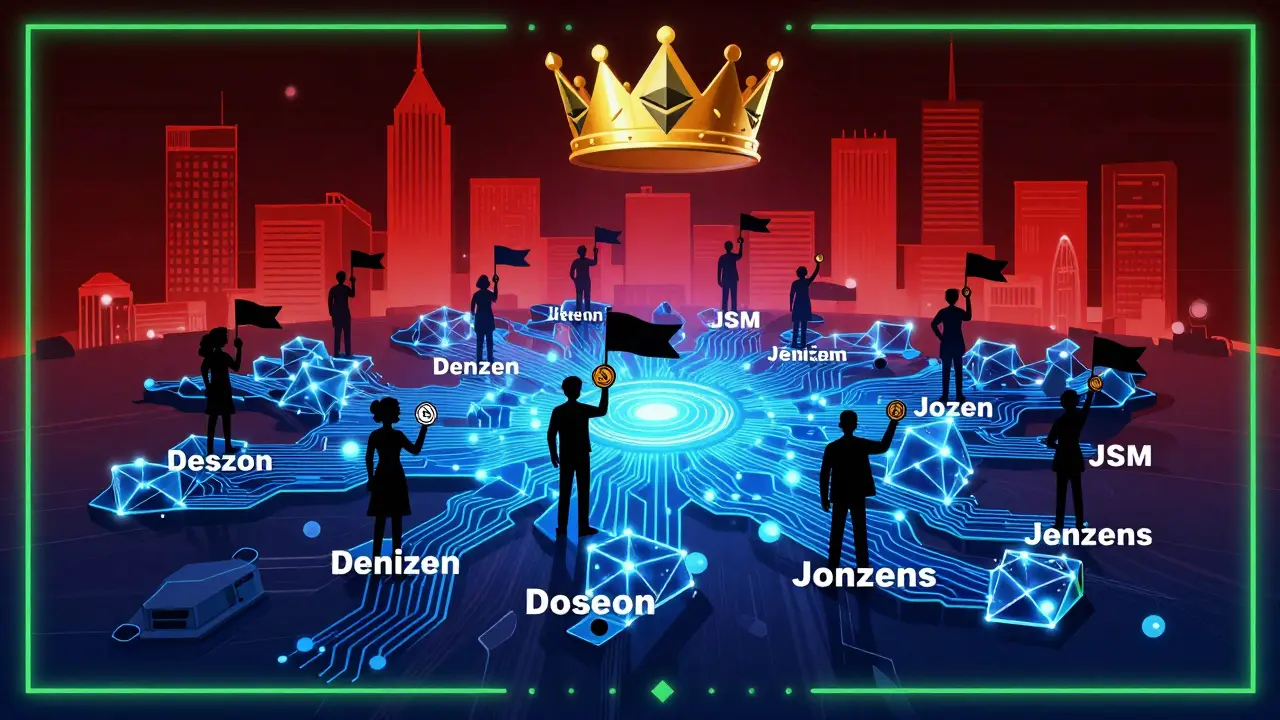
Joseon Mun (JSM) isn't just another altcoin. It's a digital currency tied to something no other cryptocurrency claims: a self-declared sovereign cyber nation-state called Joseon. Think of it as a country that exists online, with its own laws, citizens, and money - and JSM is that country's official currency. Unlike Bitcoin or Ethereum, which operate outside traditional governments, Joseon Mun tries to act like one - legally recognized as a foreign currency in places where crypto is banned or restricted.
How Joseon Mun Works
Joson Mun runs on blockchain technology, but its design goes beyond just being a token. It was built to function as a national currency for a digital nation. The idea? Create a space where crypto investors, developers, and entrepreneurs can operate without fear of government crackdowns. Joseon doesn't have borders or physical territory - it exists as a legal entity online. Its citizens, called "Denizens," aren't tied to real-world identities. Instead, they hold digital reputations that can be transferred, traded, or protected under Joseon's own rules.
This isn't science fiction. The project claims legal standing in jurisdictions that recognize cyber-nation status, allowing JSM to be treated as a foreign currency - not a security or commodity. That distinction matters. In countries where crypto is heavily regulated or banned outright, JSM might still be usable because it's classified as foreign money, not digital assets.
Supply and Technical Specs
JSM has a fixed total supply of 2.4 trillion tokens. That’s 2,400,000,000,000 JSM - and no more will ever be created. This makes it a deflationary asset by design, unlike many coins that have inflationary mechanisms or unlimited supplies.
The token contract address is 0x04c618cdbc1d59142dfeb4b9864835a06983ec2d. You can add it to MetaMask manually using this address. Once added, you can store, send, or trade JSM on any platform that supports Ethereum-based tokens. It’s also listed on decentralized exchanges after being imported into a wallet.
Where to Trade JSM
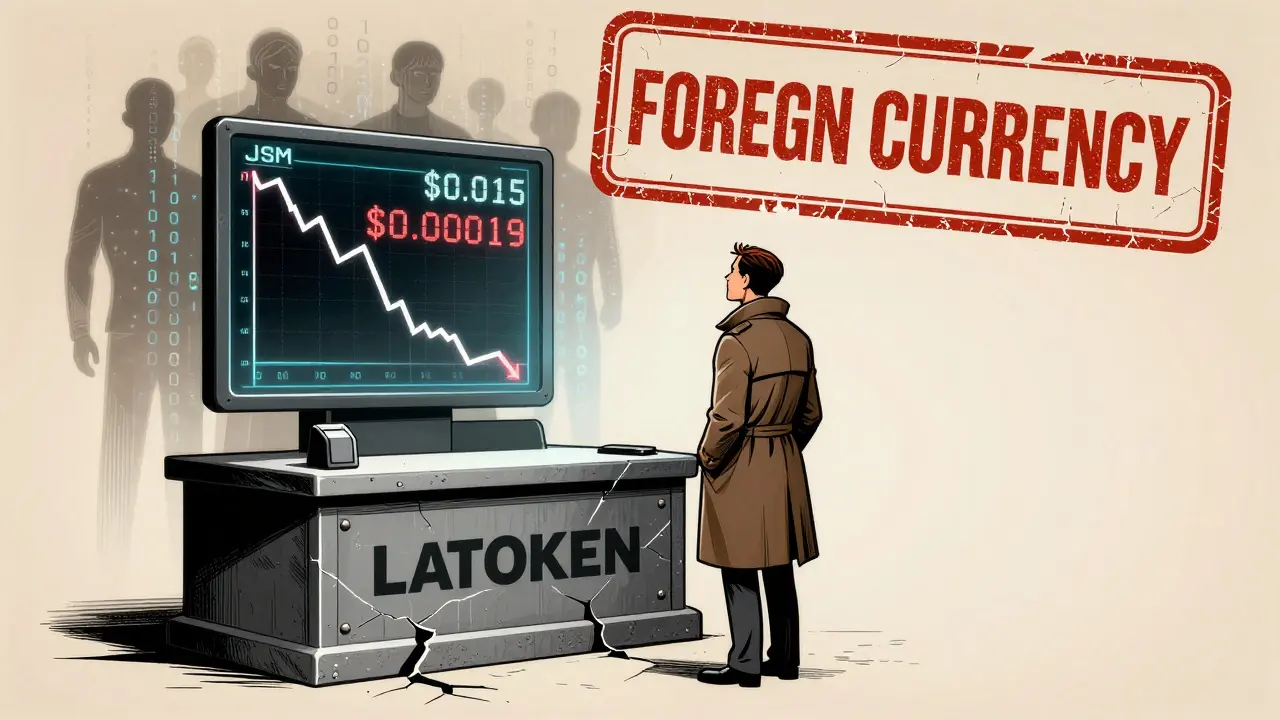
As of early 2026, JSM trades on a handful of exchanges, with LATOKEN being the most active. The JSM/USDT pair recorded a 24-hour trading volume of just $3,918.64 - extremely low compared to major cryptocurrencies like Bitcoin or even smaller altcoins.
Bybit also lists JSM and provides price data. As of February 2026, JSM was trading at $0.00019373. That’s far from its peak. On July 9, 2024, JSM hit an all-time high of $0.01510 - a drop of over 97% since then. The lowest point came in April 2025 at $0.0003041, and current prices are about 34% above that low. So while there’s been some recovery, it’s nowhere near former highs.
Trading volume is the biggest red flag. With under $4,000 traded daily on its most active pair, JSM has almost no liquidity. That means big buyers or sellers can’t enter or exit positions without crashing or inflating the price. For most investors, this makes JSM a risky, speculative play - not a stable asset.
Market Performance: Why It’s Falling Behind
JSM hasn’t just stagnated - it’s falling behind. In the 7 days leading up to February 2026, the broader crypto market rose 6.9%, and Ethereum-based tokens jumped 12.7%. JSM? It barely moved, up just 0.10%. Over 30 days, it lost 2.14%. Even during a market rally, JSM underperformed.
The fully diluted valuation (FDV) - what the market cap would be if all 2.4 trillion tokens were in circulation at current prices - stands at BTC8,195.2315. That’s roughly $250 million USD, but since most tokens aren’t circulating, the real market cap is likely far lower. Many exchanges don’t even list a market cap for JSM because the data is too thin to calculate reliably.
Is Joseon a Real Country?
Here’s the twist: Joseon isn’t recognized by the United Nations, any national government, or international law. It doesn’t have embassies, armies, or physical infrastructure. But it does have a legal framework - a constitution, a governance model, and a concept of digital citizenship. Its creators argue that because it operates under international cyber law principles, it qualifies as a sovereign entity in cyberspace.
This isn’t just marketing. The "Denizen" status allows users to build digital identities separate from their real-world names, addresses, or governments. That appeals to people in authoritarian regimes, those under financial sanctions, or developers who want to build apps without fear of being shut down.
But here’s the catch: no court in the world has formally accepted Joseon’s legal claims. So while JSM might be usable in some places, its "legal currency" status is untested and unproven. If a government cracks down, there’s no international backing to protect JSM users.

Who Is JSM For?
JSM isn’t for casual crypto investors. It’s not a good long-term store of value. Its price has crashed 97% from its peak. Its trading volume is microscopic. It doesn’t have a strong community, active development team, or real-world utility beyond speculation.
But it might appeal to:
- People in countries where crypto is banned, looking for a workaround using a "foreign currency" label
- Investors who believe in the cyber-nation concept and think Joseon could gain legal recognition someday
- Speculators chasing extreme volatility - the kind of price swings that can lead to big wins (or losses)
If you’re looking for a reliable investment, JSM isn’t it. If you’re curious about the idea of a digital nation with its own money, then JSM is a real-world experiment - messy, risky, and fascinating.
Can You Buy JSM Today?
Yes - but only on a few platforms. Here’s how:
- Get a MetaMask wallet (or any Ethereum-compatible wallet)
- Add the JSM token: Contract address
0x04c618cdbc1d59142dfeb4b9864835a06983ec2d - Go to LATOKEN or Bybit and trade USDT or ETH for JSM
- Store it in your wallet or trade it as needed
Don’t send large amounts. The liquidity is too thin. If you try to sell a big stack, you’ll likely drag the price down hard.
Final Thoughts
Joseon Mun (JSM) is one of the strangest experiments in crypto history. It tries to blend the idea of a nation-state with blockchain technology - and for now, it’s mostly a speculative token with almost no trading activity. The concept of a cyber-nation is bold. The execution? Still unproven.
Its price has collapsed. Its volume is tiny. Its legal standing is theoretical. But it’s still trading. People are still buying. And that’s what makes it worth watching - not as an investment, but as a social experiment in digital sovereignty.
Is Joseon Mun (JSM) a scam?
JSM isn’t a traditional scam like a rug pull - the contract is live, the tokens exist, and trading continues. But it lacks transparency. There’s no public team, no official website with verifiable details, and no audited roadmap. Its value is based entirely on belief in an unproven legal concept. So while not fraudulent, it’s extremely high-risk and lacks the fundamentals most investors look for.
Can JSM be used as real money?
No - not in any practical sense. You can’t use JSM to pay for groceries, rent, or services in the real world. Its only use is as a tradable token on crypto exchanges. The claim that it’s a "legal foreign currency" is untested and unenforced. No bank, business, or government accepts it as payment.
Why did JSM lose 97% of its value?
JSM surged in mid-2024 due to hype around the cyber-nation idea, drawing speculative buyers. But as interest faded and no real adoption followed, demand dropped. With no utility, no team updates, and minimal trading volume, the price collapsed. The 97% drop reflects the end of the speculation bubble - not a market correction, but a complete loss of investor confidence.
Is JSM built on Ethereum?
Yes. JSM is an ERC-20 token built on the Ethereum blockchain. That means it uses Ethereum’s network for transactions and can be stored in any wallet that supports ERC-20 tokens, like MetaMask, Trust Wallet, or Coinbase Wallet.
Can I mine JSM?
No. JSM has a fixed supply of 2.4 trillion tokens, and none are being mined. All tokens were created at launch. There’s no staking, mining, or new issuance mechanism. The only way to get JSM is to buy it on an exchange.
Neil MacLeod
March 23, 2026 AT 17:23Let’s be honest - Joseon Mun is the crypto equivalent of a dystopian fanfic written by someone who binge-watched Cyberpunk 2077 and then read a Wikipedia article on the Treaty of Trianon. 2.4 trillion tokens? That’s not deflationary - it’s an inflationary joke dressed up in legal jargon. And calling it a 'foreign currency' while having zero recognition from any sovereign entity is like claiming your backyard is a principality because you drew a flag on a napkin. The 97% price drop isn’t a correction - it’s the market sighing and walking away.
Still, I admire the audacity. Someone had to try turning blockchain into a cult of digital nationalism. I just hope the next one isn’t called 'Neo-Byzantium Coin' with a constitution written in Comic Sans.
Misty Williams
March 23, 2026 AT 23:57This isn’t an experiment - it’s a predatory scheme disguised as ideology. People are being lured into buying a token based on the fantasy that a non-existent nation with no legal standing, no infrastructure, and no transparency is somehow 'protected' under 'cyber law.' That’s not innovation; it’s financial exploitation wrapped in Orwellian buzzwords. The fact that anyone still holds this is a testament to how desperate and gullible the crypto space has become. No court, no government, no bank - and yet people are risking real money on a digital ghost. This is why regulation exists.
Anand Makawana
March 25, 2026 AT 09:27From a macroeconomic and tokenomics perspective, JSM presents a fascinating case study in speculative asset formation under non-traditional sovereignty frameworks. The fixed supply of 2.4 trillion tokens, while seemingly excessive, may serve as a mechanism to mitigate hyperinflationary pressures inherent in meme-driven assets - provided there exists sufficient demand-side liquidity, which, as evidenced by the $3,918.64 daily volume on LATOKEN, is critically insufficient. The ERC-20 architecture ensures interoperability with Ethereum-based DeFi protocols, yet the absence of a verifiable governance model or development roadmap introduces extreme counterparty risk. Furthermore, the legal fiction of 'cyber-nation currency' status, while rhetorically compelling, lacks enforceability under international monetary law, rendering its utility purely speculative. Investors must therefore evaluate JSM not as a currency, but as a behavioral experiment in collective belief systems - with all the attendant volatility and moral hazard.
Consider this: if the FDV is $250M but 98% of supply is locked, is the market cap even meaningful? Or is it merely a psychological anchor for a narrative?
Mohammed Tahseen Shaikh
March 26, 2026 AT 03:08You’re all overthinking this. JSM isn’t supposed to be a currency - it’s a middle finger to every government that’s tried to control crypto. The fact that it’s down 97%? Good. That means the early buyers got out. The ones still holding? They’re not investors - they’re believers. And in crypto, belief is the only asset that matters.
Forget liquidity. Forget legal status. Forget the ‘official’ narrative. Look at the community - people in Iran, Nigeria, Venezuela - they’re using JSM because it’s one of the few tokens that doesn’t ask for their passport. That’s power. That’s freedom. The market will never understand it. But the people who need it? They already do.
And yeah - it’s messy. It’s chaotic. It’s not for your 401(k). But if you’re not willing to bet on weird, you’re already dead in this space.
Buy the dip. Or don’t. But don’t pretend you’re smart because you checked the trading volume.
Sarah Terry
March 26, 2026 AT 08:12One sentence: JSM isn’t an investment - it’s a statement.