What is Joule (JOULE) crypto coin? Explained: Uses, price, and blockchain projects behind the token
 Mar, 14 2026
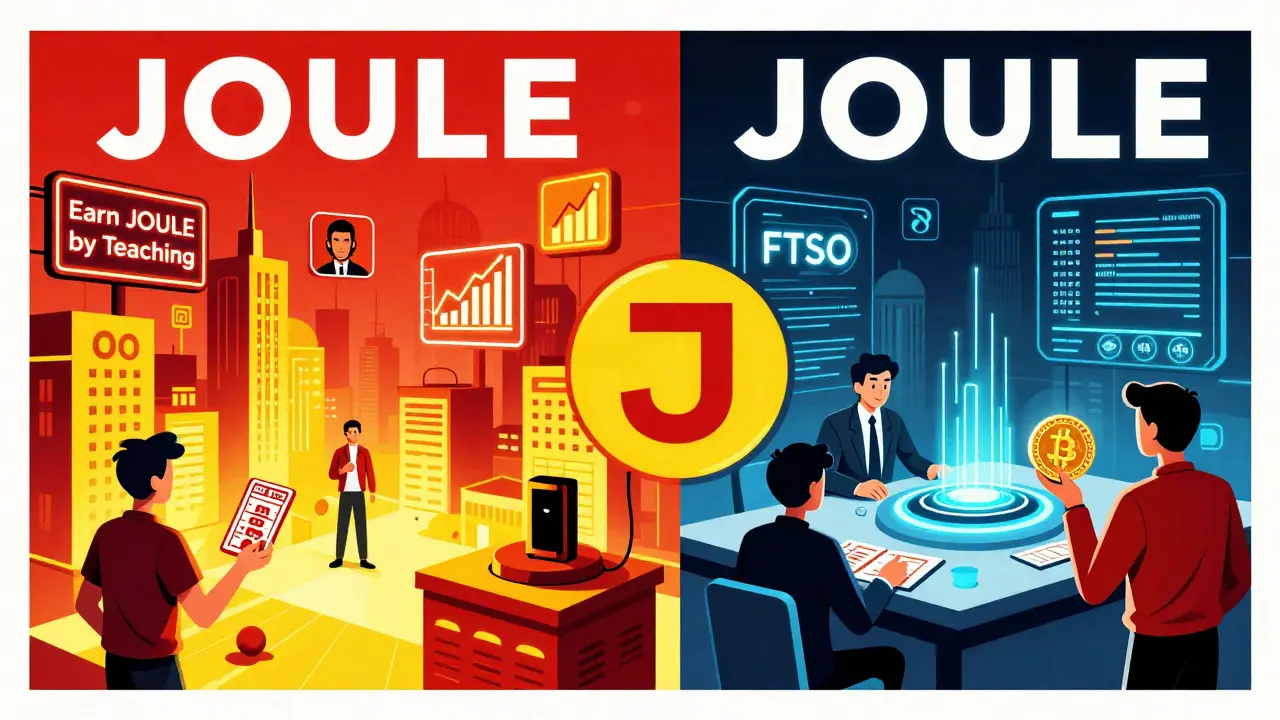
The Joule (JOULE) crypto coin isn’t one project-it’s two very different things sharing the same name and ticker. That’s not a typo. If you’re looking at JOULE on CoinMarketCap, you might be seeing a lending protocol on the Flare Network. If you’re on the Joule Index website, you’re looking at a referral-based token built on EOS. Both claim to be JOULE. Neither has clear leadership, official documentation, or a unified roadmap. And yet, people are trading it.
So what’s really going on? Let’s cut through the noise.
Two Projects, One Ticker
The JOULE token exists in two separate worlds. One lives on the EOS blockchain. The other runs on the Flare Network. They don’t talk to each other. They don’t share code. And they don’t share a team.
The first version, known as Joule Index, launched as a community-driven platform. It lets users earn JOULE tokens by teaching others how to use it as payment. Merchants who accept JOULE pay a 2% transaction fee. Referrers get 1/10 of that fee. If you teach someone else to refer others? You get 1/5 of the fee from their referrals too. It’s a multi-level commission system, but it only pays out when real trades happen-no free money from just signing up.
There’s also a feature called the Global Popularity Index. Users bet on whether public figures like celebrities or politicians will rise or fall in popularity. Those who guess right earn JOULE from transaction fees. The whole thing runs on a web app with a wallet, portfolio tracker, and referral system built in. No bank. No approval. Just internet access.
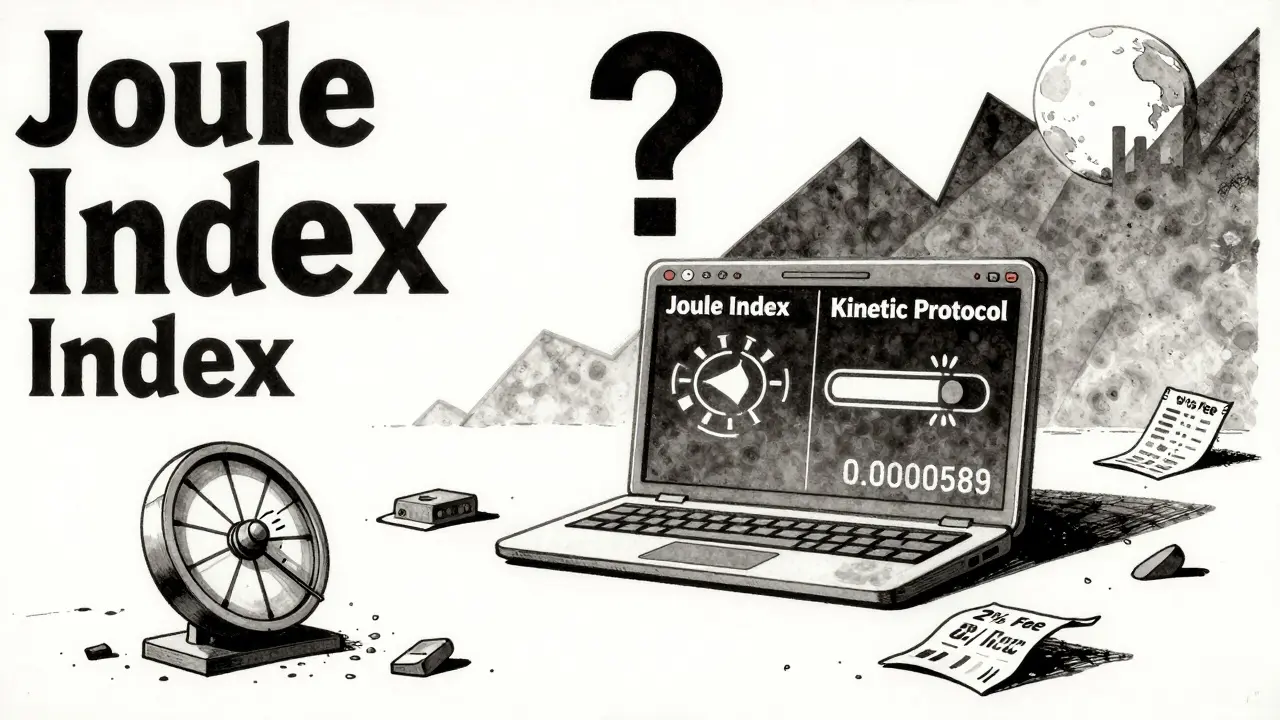
The second JOULE is tied to Kinetic, a DeFi lending protocol on the Flare Network. Here, JOULE isn’t about referrals-it’s about governance and utility. Kinetic uses Flare’s FTSO (Flare Time Series Oracle) to get real-time prices for Bitcoin, Dogecoin, and XRP. Then it lets users borrow against those assets as if they were native to Flare. Think of it like using your Bitcoin as collateral to borrow USDT, even though Bitcoin doesn’t natively exist on Flare. JOULE tokens let holders vote on protocol changes and pay for services within the system.
So why do both use JOULE? No one’s saying. There’s no official statement. No merger announcement. No shared team. It’s possible one project copied the name. Or maybe someone rebranded. Or maybe it’s just a coincidence. Either way, if you’re buying JOULE, you need to know which one you’re getting.
Price, Supply, and Market Data
As of March 2026, JOULE’s price is all over the map. CoinGecko says it’s trading at around $0.000589. CoinMarketCap reports $0.0005. LiveCoinWatch lists $0.000589 on SparkDEX and $0.000597 on Blazeswap. These aren’t rounding errors-they’re different markets.
The token’s all-time high was $0.067681 in 2024. That’s over 100 times what it’s worth now. It hit a low of $0.00004654 in November 2025, then bounced back 974% in just a few months. That kind of swing doesn’t happen from steady growth. It happens when hype spikes, then crashes, then spikes again.
The circulating supply is 680 million JOULE. That’s not huge, but it’s enough to make liquidity a problem. Daily trading volume hovers around $360 on some trackers and $27,932 on others. That’s a 77x difference. Which one is right? Probably neither. The real number is somewhere in between-but even then, it’s tiny.
On the market cap scale, JOULE ranks around #5184. That’s way below even the smallest altcoins with real traction. It’s not a top 1000 coin. It’s not even in the top 5000 with consistent volume.
Where Can You Trade JOULE?
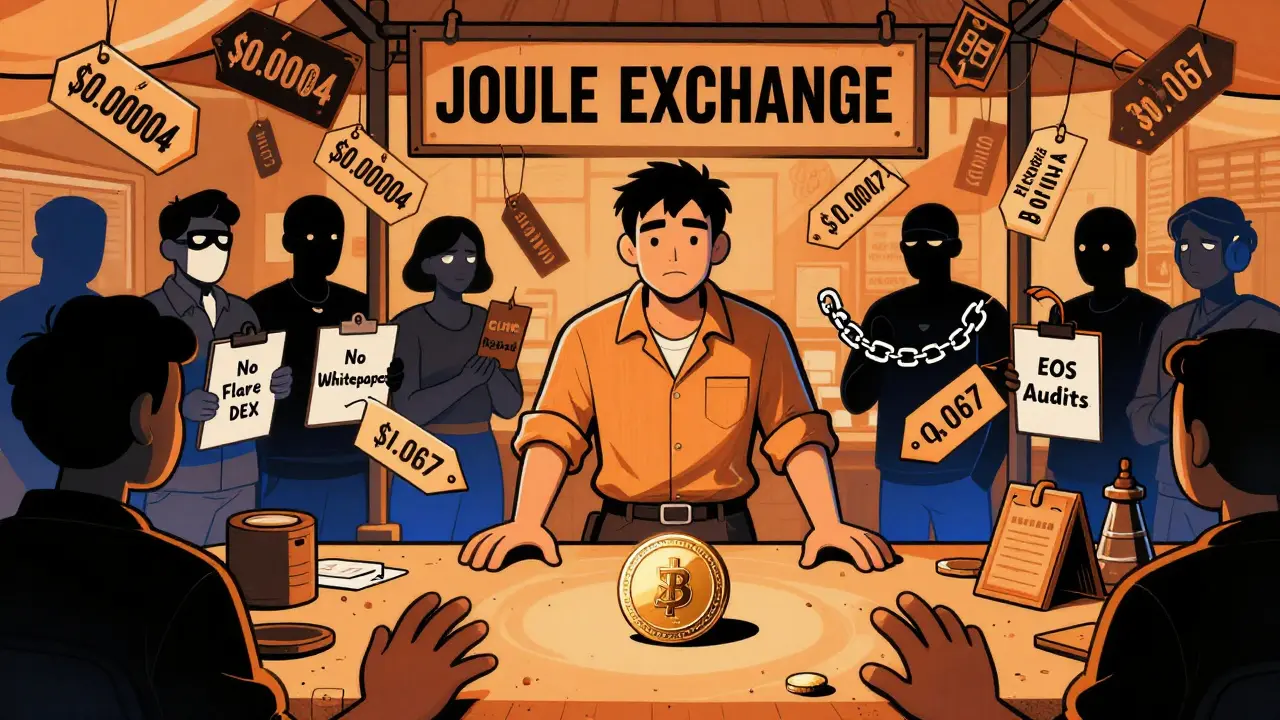
You won’t find JOULE on Binance or Coinbase. It trades only on decentralized exchanges built on the blockchains it lives on.
For the Flare Network version:
- Blazeswap (Flare) - JOULE/USDT0 and JOULE/FLR pairs
- SparkDEX v3 - JOULE/FLR pair
- SFLR/JOLE - a less common pair
Most of the trading happens on Blazeswap, but even there, 24-hour volume is only $59 on one pair. That’s not enough to move the price without a single big buyer.
For the EOS version, trading is even harder to find. Some sources suggest it’s only available on small EOS-based DEXs, but none are listed clearly. If you’re trying to buy JOULE for the Joule Index platform, you’re likely expected to earn it through referrals-not buy it.
The contract address for the Flare version is 0xE6505f92583103AF7ed9974DEC451A7Af4e3A3bE. If you’re trading on Flare, make sure you’re using this one. Any other address? Probably a scam.
Is Joule a Scam?
It’s not labeled as a scam. But it’s also not labeled as legitimate.
There’s no whitepaper. No team names. No GitHub activity. No official Twitter account with verified status. No press releases from credible crypto news sites. The Joule Index site looks like a basic web app built in 2021. The Kinetic site is sparse, with minimal technical detail.
The referral model of Joule Index has red flags. Multi-level commissions tied to transaction fees sound like a pyramid-but the platform says it’s not. They claim income only comes from real trades, not from recruiting. That’s technically true. But in practice, if no one is trading, no one gets paid. And if you’re relying on new people to join just to earn, that’s still a pyramid in disguise.
The Kinetic version has better technical grounding. Flare Network is real. FTSO and FAssets are legitimate tech. But Kinetic itself has no public roadmap, no audits, no community forums. It’s a protocol with no clear direction.
Bottom line: Neither version has enough transparency to be trusted. You’re not investing in a company. You’re betting on a token with no clear owner, no clear use case, and no real market demand.
Should You Buy JOULE?
If you’re looking for a stable, long-term crypto asset-walk away.
If you’re a speculator who chases volatile tokens with wild swings? Maybe. But only if you treat it like a lottery ticket.
Here’s what you need to know before buying:
- Price changes 20% in a day. Don’t hold it expecting growth.
- Liquidity is near zero. You might not be able to sell when you want to.
- You don’t know which JOULE you’re buying. The Flare version is more technically sound, but the EOS version is more active in trading.
- There’s no regulatory oversight. No protections. No recourse if the project vanishes.
- It’s not listed on any major exchange. You’re stuck on obscure DEXs with high slippage.
There’s no reason to hold JOULE for its utility. No one uses it for payments. No major DeFi app integrates it. No wallet supports it as a default asset. It’s not a currency. It’s not a store of value. It’s just a ticker symbol with a few hundred people trading it.
What’s Next for JOULE?
No one knows.
There’s no roadmap. No team update. No announcement of partnerships or upgrades. The last major price spike happened in September 2024. Since then, it’s been a rollercoaster with no destination.
It’s possible one project will absorb the other. Or one will die off. Or both will fade into obscurity. Or a new team will take over and relaunch it with real tech.
But right now? There’s no signal. Just noise.
If you’re curious, try the Joule Index app. Earn a few tokens by referring friends who actually trade. Or connect your wallet to Blazeswap and buy a tiny amount of JOULE on Flare. But don’t invest. Don’t stake. Don’t hold. Just experiment-if you’re okay with losing it all.
Because here’s the truth: JOULE isn’t a crypto coin. It’s a puzzle. And no one has the full picture yet.
Is Joule (JOULE) a real cryptocurrency?
Yes-but not in the way most people think. JOULE exists as two separate tokens: one on the EOS blockchain tied to a referral platform called Joule Index, and another on the Flare Network used by a lending protocol called Kinetic. Neither is backed by a major team or has official documentation. So while the token is real, the projects behind it lack transparency and long-term credibility.
Can I buy Joule on Coinbase or Binance?
No. JOULE is not listed on any major centralized exchange like Coinbase, Binance, or Kraken. It only trades on decentralized exchanges (DEXs) such as Blazeswap and SparkDEX, which run on the Flare Network. You’ll need a Web3 wallet like MetaMask or Flare Wallet to trade it.
Why is JOULE’s price so volatile?
JOULE’s price swings because of extremely low liquidity. With daily trading volumes under $30,000 and a circulating supply of 680 million tokens, even small buys or sells can move the price dramatically. It also lacks real-world utility, so price changes are driven by speculation, not adoption. The 974% recovery from its 2025 low was likely due to short-term hype, not fundamental growth.
Is the Joule Index referral system a pyramid scheme?
It’s structured like one, but technically it’s not. Unlike pyramid schemes that pay you just for recruiting, Joule Index only pays commissions when real transactions occur. You earn from 2% fees on merchant payments and user trades. But if no one is trading, you earn nothing. Still, the system heavily relies on bringing in new users to keep the fees flowing, which makes it risky and unsustainable long-term.
What’s the contract address for JOULE?
For the Flare Network version (Kinetic), the contract address is 0xE6505f92583103AF7ed9974DEC451A7Af4e3A3bE. Always verify this before trading. Any other address claiming to be JOULE is likely a scam. There is no official contract for the EOS version-it operates differently and doesn’t use Ethereum-style smart contracts.
Should I invest in JOULE for the long term?
No. JOULE lacks a clear team, roadmap, audit, or real adoption. Its price history shows extreme volatility with no underlying value. Even if you believe in one of the two projects behind it, neither has demonstrated the ability to grow beyond a small group of speculators. Treat it as a high-risk experiment, not an investment.
Prakash Patel
March 14, 2026 AT 19:42Everyone’s acting like JOULE is some mysterious crypto puzzle, but honestly? It’s just a dumpster fire with two labels. One’s a referral scam wrapped in blockchain jargon, the other’s a half-baked DeFi prototype with zero traction. If you’re trading this, you’re not investing-you’re playing roulette with a loaded dice.
Zachary N
March 16, 2026 AT 16:30Let me break this down plainly, because this is the kind of thing that trips up new crypto folks who don’t realize how fragmented the ecosystem really is. The JOULE token isn’t a single asset-it’s two separate tokens on two different chains, with zero coordination between them. That’s not a bug, it’s a feature of how chaotic DeFi has become. The Flare version at 0xE6505f92583103AF7ed9974DEC451A7Af4e3A3bE has actual utility as a governance token for Kinetic’s lending protocol, which uses FTSO oracles to bring real-world asset prices onto Flare. That’s legit tech. The EOS version? Pure community gamification-referrals, popularity bets, transaction fee splits. It’s not a pyramid if real trades happen, but if the trading volume is under $30k/day and you’re relying on new users to generate fees? That’s a house of cards. The price swings aren’t just volatility-they’re liquidity death spirals. You can’t sell 10,000 JOULE if the bid depth is 500. And no, you won’t find this on Coinbase because no exchange wants to list a token with no team, no audit, and two conflicting whitepapers. If you’re curious, dip a toe in-buy 100 JOULE on Blazeswap, see how the market behaves. But don’t stake it. Don’t hold it. And definitely don’t believe the hype that it’s ‘the next big thing.’ It’s not. It’s a cautionary tale.
Elizabeth Kurtz
March 16, 2026 AT 19:36I’m from the U.S., but I’ve been watching crypto communities in India and Brazil, and honestly? The JOULE situation is wild because it’s not unique. We’ve seen this before-tokens with duplicate names, fragmented communities, no clear ownership. It’s like two bands with the same name, one playing rock, the other playing jazz, and fans fighting over who’s ‘real.’ The Flare version has technical merit, sure, but without audits or a dev team, it’s still a gamble. The EOS version? That referral model feels like Web2 hustle culture grafted onto blockchain. People think they’re building something, but really they’re just trying to get paid to recruit. I’ve seen this in MLMs. It’s not illegal, but it’s not sustainable. If you’re going to trade JOULE, know which one you’re buying. And maybe don’t tell your grandma.
john peter
March 18, 2026 AT 11:50One must ask: What is the ontological status of a token that exists in two irreconcilable forms, each claiming legitimacy while neither possesses the authority to validate its claim? The JOULE token is not merely a financial instrument; it is a metaphysical paradox wrapped in smart contracts. The Flare iteration, with its FTSO-backed utility, attempts to anchor itself in the material realm of decentralized finance-yet lacks the epistemic foundation of transparency. The EOS iteration, by contrast, is a performative ritual of social capital, where value is generated not through production, but through the recursive extraction of human attention. Neither possesses a governing body. Neither offers recourse. Neither is accountable. Thus, to invest in JOULE is not to invest in a currency-it is to participate in a postmodern farce, where the only certainty is the absence of certainty. One might say it is the perfect cryptocurrency for our age: meaningless, volatile, and entirely devoid of meaning.
Marc Morgan
March 18, 2026 AT 19:55So JOULE’s basically crypto’s version of that one song that got remixed by three different DJs and now everyone’s arguing over which version is ‘the real one.’ You’ve got one guy building a referral empire on EOS like it’s 2017, and another guy quietly running a lending protocol on Flare like he’s trying to fix a leaky faucet in a haunted house. The price goes up 974%? Cool. Then it drops 90%? Also cool. The only thing consistent here is the chaos. I bought 50 JOULE just to see what would happen. It’s still sitting in my wallet. I don’t know if it’s worth anything. I don’t know if I’ll ever sell it. But hey-at least I got a good story out of it. And that’s worth more than the token.