What is Kanga Exchange Token (KNG) Crypto Coin? A Clear Breakdown of Its Use, Value, and Risks
 Oct, 8 2025
KNG Fee Savings Calculator
Kanga Exchange offers a 25% discount on trading fees when you pay with KNG tokens. Calculate your potential savings below.
Your monthly savings:
$0.00
Based on 25% fee discount applied to your trading volume
If you’ve heard of Kanga Exchange Token (KNG) and are wondering if it’s just another crypto coin with no real purpose, you’re not alone. Many people look at KNG and see a small, obscure token with low trading volume and wonder why anyone would care. But here’s the thing: KNG isn’t meant to be a speculative coin like Dogecoin or a flashy altcoin chasing viral trends. It’s a utility token built for one specific platform - Kanga Exchange - and its value comes from how it’s used inside that ecosystem, not from hype.
What Exactly Is KNG?
KNG is the native token of Kanga Exchange, a centralized crypto trading platform launched in 2019. Unlike Bitcoin or Ethereum, KNG doesn’t have its own blockchain. Instead, it runs on two existing ones: Ethereum and Polygon. That means it uses the same technical standards as thousands of other tokens - ERC-20 - but with a twist. It works on both networks, letting users choose between Ethereum’s security and Polygon’s cheaper, faster transactions.
There are only 21 million KNG tokens ever created. No more will be made. That’s a fixed supply, and it’s not something you see with every crypto project. As of mid-2024, about 178,890 KNG have already been burned - permanently removed from circulation - and another 1 million are scheduled to be burned by the end of 2024. That’s a deflationary move. Fewer tokens in the wild could mean higher demand over time, assuming people keep using the platform.
Why Do People Use KNG?
KNG isn’t just a trading pair on an exchange. It’s the key to unlocking real benefits on Kanga Exchange. If you hold KNG, you get:
- 25% discount on trading fees - every time you pay fees in KNG, you save a quarter of what you’d normally pay. That adds up fast if you trade often.
- Daily staking rewards - you can lock up your KNG and earn interest. The APY hovers around 15%, which is solid for a token of this size.
- Access to the Kanga VIP program - if you stake 10,000 KNG or more, you get higher reward tiers, priority support, and exclusive features.
- Collateral for loans - KNG can be used as collateral to borrow other cryptocurrencies on Kanga’s lending platform. That’s rare for a small exchange token.
- Governance rights - holders can vote on platform upgrades and new features, though the final say still rests with Kanga’s team.
These aren’t gimmicks. They’re functional tools that make the platform cheaper and more rewarding for active users. If you trade on Kanga Exchange regularly, paying fees in KNG saves you money. If you hold and stake, you earn passive income. That’s the core value.
How Much Is KNG Worth?
As of November 2025, KNG trades between $1.50 and $1.80 across exchanges. CoinMarketCap lists it at $1.52, Crypto.com at $1.77, and CoinPaprika at $1.75. These aren’t wild swings, but they’re not stable either. Price changes of 5-10% in a day aren’t unusual.
Its market cap is under $10 million - tiny compared to BNB ($92 billion) or even OKB ($4.8 billion). That means low liquidity. If you try to sell a large amount of KNG, you’ll likely drag the price down. Most traders only buy small amounts, which is why 24-hour trading volume often stays under $250,000.
Bitget’s 2025 forecast predicts KNG could reach $1.60 by year-end - a modest 5% increase from current levels. That’s not a moonshot. It’s a slow, steady expectation based on platform growth, not speculation.
Where Can You Buy KNG?
KNG is listed on only five exchanges total, with 12 trading pairs. That’s a big red flag if you’re used to buying tokens on Binance, Coinbase, or Kraken. You can’t just open your app and buy it. You need to go to Kanga Exchange directly or find one of the few third-party platforms that list it.
Here’s how most people get KNG:
- Create a Kanga Exchange account and complete KYC (identity verification).
- Deposit Bitcoin, Ethereum, or another major crypto.
- Trade it for KNG on the exchange’s spot market.
- Transfer it to your wallet if you want to stake it off-platform - though most users keep it on Kanga for easier access to rewards.
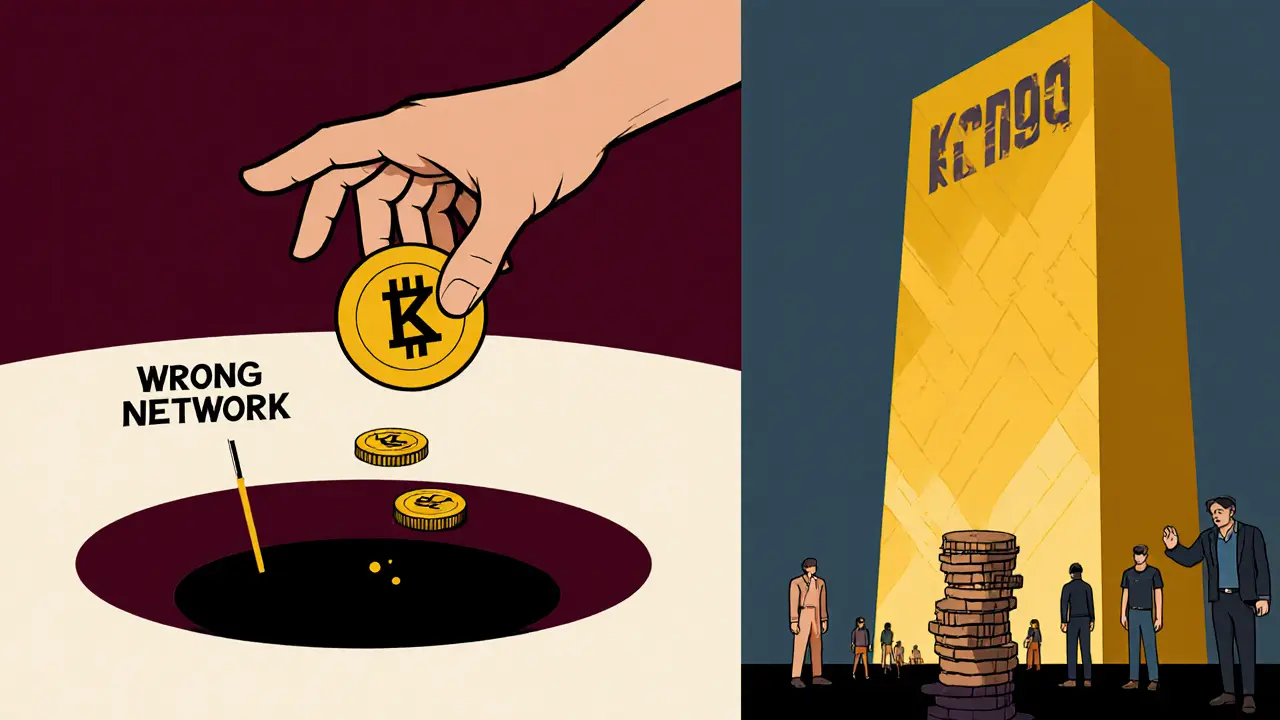
One common mistake? Sending KNG to the wrong network. Since it runs on both Ethereum and Polygon, you must match the network you’re sending from with the one you’re sending to. If you send KNG on Ethereum to a Polygon address, your tokens are lost. About 22% of support tickets on Kanga’s platform are from users who made this error. Always double-check the network before sending.
Is KNG Safe?
KNG is a utility token, not a security, according to Kanga Exchange’s legal team. That’s important because it avoids regulatory headaches in many countries. But here’s the catch: Kanga Exchange is centralized. That means they control the token burns, the staking rules, the fee discounts, and even the roadmap. If the platform shuts down or changes its policies, KNG loses most of its value.
Compare that to a decentralized exchange token like UNI or SUSHI, where the community votes on changes. With KNG, you’re trusting one company to do the right thing. And while Kanga has been around since 2019 and has over 15,000 active stakers, its customer support ratings on Trustpilot are only 3.8/5. Users complain about slow responses and delays in withdrawals.
There’s also no independent audit of the smart contracts behind KNG. While the token follows standard ERC-20 rules, that doesn’t guarantee security. If there’s a bug or hack, you could lose your tokens. There’s no insurance.
Who Is KNG For?
KNG isn’t for everyone. It’s not a good long-term investment if you’re just looking to “HODL” and wait for a 10x. It’s also not ideal if you want to trade it frequently - low liquidity makes that risky.
But if you:
- Trade on Kanga Exchange regularly
- Want to earn daily staking rewards
- Plan to use Kanga’s loan or VIP services
- Are comfortable with a centralized platform
…then KNG makes sense. It’s a tool, not a gamble. Think of it like a loyalty card for a store you shop at often. You don’t buy the card to flip it - you buy it to save money and get perks.
What’s Next for KNG?
Kanga Exchange has a clear roadmap for KNG 2.0:
- Burn 1 million more KNG by December 2024
- Launch KNG as collateral for loans (already live)
- Expand to six new blockchains: Polkadot, Cardano, Avalanche, zkSync, Polygon zkEVM, and Base
- Add 2,000 OTC points and 1,000 Kanga Pay points in Vietnam, Indonesia, Turkey, and the Philippines
- Develop its own blockchain - currently in testing
If they pull this off, KNG could become more than just an exchange token. It could become a bridge between Kanga and other ecosystems. But that’s a big “if.” Most small exchange tokens never grow beyond their own platform.
Final Thoughts
KNG is not going to make you rich overnight. It won’t be on CoinGecko’s top 100 anytime soon. But if you’re already using Kanga Exchange, holding KNG is smart. It saves you money on fees, gives you passive income, and unlocks better features. It’s a practical choice, not a speculative one.
Don’t buy KNG because you think it’s the next Bitcoin. Buy it because you trade on Kanga - and you want to get the most out of it.
Grace Zelda
November 27, 2025 AT 06:09Sierra Myers
November 28, 2025 AT 13:08ola frank
November 30, 2025 AT 07:09Michael Fitzgibbon
December 2, 2025 AT 04:28Komal Choudhary
December 2, 2025 AT 21:41fanny adam
December 4, 2025 AT 09:00Abby cant tell ya
December 5, 2025 AT 13:16Ben Costlee
December 5, 2025 AT 18:02Vaibhav Jaiswal
December 7, 2025 AT 16:54