What is MIA (MIA) crypto coin? The truth behind the three different tokens sharing the same ticker
 Oct, 10 2025
MIA Token Identifier
Check Which MIA Token You're Looking At
Avoid scams by identifying which of the three different MIA tokens you're dealing with. The wrong choice could cost you money.
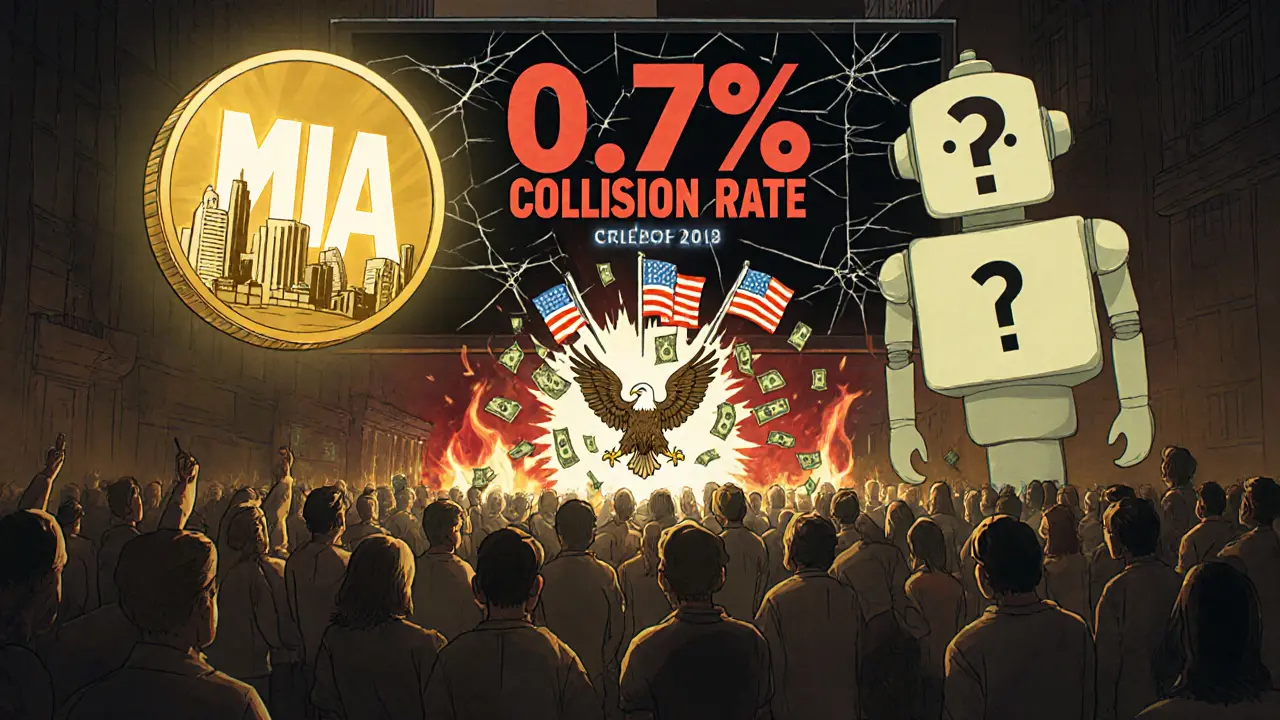
When you search for "MIA crypto," you’re not looking at one coin. You’re stepping into a mess - three completely different projects all using the same ticker: MIA. And if you buy the wrong one, you could lose money without even realizing it. This isn’t a glitch. It’s a systemic problem in crypto, where anyone can pick a short, catchy name like MIA and launch a token with zero oversight. The result? Confusion, scams, and wasted cash.
MiamiCoin: The City-Backed Experiment
The oldest and most recognized MIA is MiamiCoin. Launched in August 2021, it’s part of the CityCoins protocol built on the Stacks blockchain. The idea was simple: let cities create their own crypto to raise money. Miners send STX (Stacks tokens) to a smart contract, and 30% of those rewards go directly to Miami’s city wallet. It wasn’t a fundraising campaign. It was a new kind of public finance.
At its peak in September 2021, MiamiCoin hit a $39.5 million market cap. Today, it’s worth almost nothing - down 99.2%. Why? Because the mining rewards dropped 87% as fewer people participated. The city never committed to using the funds. Mayor Francis Suarez said they were "evaluating" crypto revenue, but nothing concrete happened. The community still exists - about 15,000 people hold it - but the project is fading. The Stacks 2.1 upgrade in 2023 improved speed, but it didn’t fix the core problem: no real use case for the money collected.
Still, MiamiCoin has something the others don’t: official documentation, a GitHub repo, and active community support on Discord. It’s not dead, but it’s barely breathing.
Made in America: The Meme That Tried to Be a Movement
Then there’s Made in America (MIA). This token launched with a patriotic pitch: "a movement that embodies the resilience, innovation, and unmatched quality that define the American spirit." No utility. No team. No roadmap. Just flags, eagles, and a promise to "support American values."
Its price swung wildly - from a high of $0.008590 in January 2025 to a low of $0.00005295 in June 2025. Today, it trades at $0.00001618. That’s 99.2% below its peak. The 24-hour trading volume? Around $23.59. That’s less than the cost of a coffee. And yet, it has a 1 billion token supply. That’s inflation on purpose.
Users on Trustpilot and CoinMarketCap give it a 1.9/5 rating. Comments like "scam token with no development" and "zero utility beyond meme status" are common. The Telegram group has over 1,200 members, but responses to questions take up to three days. No updates since March 2023. No code commits. No team disclosure. This isn’t a project. It’s a pump-and-dump waiting to happen.

MIA Base: The AI Token That Doesn’t Exist
Enter MIA Base. This one claims to be "the permanent hub of our thriving agent" - an AI-powered assistant that plans, strategizes, and handles finance. Sounds futuristic. But here’s the catch: there’s no whitepaper. No technical specs. No open-source code. Just a website and a Twitter account.
As of late 2023, it had a $14 million market cap and a $3 million trading volume. But Bitget, one of the exchanges listing it, showed zero liquidity across all trading pairs. Users on Telegram reported being unable to withdraw their tokens. The team promised AI integration in Q4 2023 - and missed the deadline. No explanation. No update.
CertiK, a top crypto audit firm, flagged MIA Base in its Q3 2023 report for making "unverifiable claims about autonomous capabilities." That’s a red flag. If you can’t prove your AI works, you’re just selling a fantasy. And in crypto, fantasies get expensive.
Why This Ticker Collision Matters
Three tokens. One ticker. Zero clarity.
According to the Blockchain Transparency Institute, this kind of ticker collision affects 0.7% of all cryptocurrencies. That translates to $127 million in misdirected trades every year. People think they’re buying MiamiCoin. They end up buying Made in America. Or worse - they send their STX to the wrong contract and lose it forever.
The SEC and DOJ have both flagged these kinds of tokens. CityCoins like MiamiCoin are under scrutiny as potential securities. Patriotic tokens like Made in America are on anti-fraud watchlists. AI tokens with no proof? They’re outright scams waiting for a crackdown.
How to Avoid Getting Scammed
If you’re thinking about buying MIA, stop. First, ask yourself: which MIA are you buying?
- MiamiCoin is on the Stacks blockchain. You need an STX-compatible wallet like Hiro Wallet. Its contract address is
SP1H1733V5MZ3SZ9XRW9FKYGEZT0JDGEB8Y634C7R.miamicoin-token-v2. If you’re not using that, you’re not buying MiamiCoin. - Made in America has no official website. Any site selling it is a third-party pump. Check CoinGecko or CoinMarketCap - if the 24h volume is under $100, walk away.
- MIA Base has no code, no team, no roadmap. If someone tells you it’s "the future of AI crypto," they’re trying to sell you a dream.
Never trust a token just because it has a catchy name. Always check:
- The blockchain it runs on
- The contract address
- The trading volume (not just market cap)
- Whether the team is public and active
- Whether there’s real documentation or just marketing fluff
What’s Next for MIA Tokens?
Gartner’s 2023 Crypto Outlook predicts 73% of low-market-cap tokens with duplicate tickers will be delisted within 18 months. MiamiCoin might survive because it has a history and a community. Made in America? It’s already dead - just not officially buried. MIA Base? It’s a ghost project.
The bigger lesson here isn’t about these three coins. It’s about crypto’s wild west problem: anyone can launch a token, and no one checks if it’s real. Until exchanges and wallets start blocking duplicate tickers or forcing clear labeling, this will keep happening.
If you’re looking for real value in crypto, don’t chase short names. Look for projects with transparent code, active development, and real utility. MIA isn’t one of them. It’s a cautionary tale.
Is MIA crypto a good investment?
No. The MIA ticker represents three different tokens, none of which have strong fundamentals. MiamiCoin has lost 99% of its value and lacks city support. Made in America is a meme with no utility. MIA Base has no technical proof of its AI claims. All three have extremely low trading volumes, making them easy targets for manipulation. Investing in any of them carries high risk with little chance of return.
How do I know which MIA I’m buying?
Check the blockchain and contract address. MiamiCoin runs on Stacks and uses the address SP1H1733V5MZ3SZ9XRW9FKYGEZT0JDGEB8Y634C7R.miamicoin-token-v2. Made in America and MIA Base are on other blockchains, often BSC or Ethereum. Never trust a ticker alone - always verify the contract address on a trusted platform like Etherscan or Stacks Explorer before sending funds.
Can I mine MIA crypto?
Only MiamiCoin can be mined - and only if you’re mining STX tokens on the Stacks blockchain. You don’t mine MIA directly. You send STX to a smart contract, and MIA is awarded as a reward. Made in America and MIA Base cannot be mined. They’re pre-mined tokens with fixed supplies. If someone tells you you can mine MIA without STX, it’s a scam.
Why does MiamiCoin have such a low market cap now?
MiamiCoin’s value collapsed because miner participation dropped sharply after the initial hype. The rewards system was designed to incentivize long-term participation, but as STX prices fell and city benefits never materialized, miners left. Without enough participants, the network lost momentum. The $39.5 million peak in 2021 is now a relic. It’s a case study in how community-driven crypto can fail without real-world adoption.
Are any of the MIA tokens regulated?
MiamiCoin is under review by the SEC as a potential security because it promises city-backed rewards. Made in America is flagged by the DOJ for deceptive marketing under anti-fraud statutes. MIA Base is under scrutiny by audit firms like CertiK for making false claims. None are officially regulated, but all are under watch. Trading them carries legal risk, especially in the U.S.
Tina Detelj
November 27, 2025 AT 07:55Oh my god, this post is like finding three different ghosts all wearing the same Halloween mask-and you just handed over your wallet to the one that whispers "I’m the real one" in a voice that sounds suspiciously like your ex’s LinkedIn pitch.
MiamiCoin? More like Miami-Coin-That-Used-To-Be-Important. It’s the crypto equivalent of a high school reunion where everyone still talks about the band they played in back in 2012-nostalgic, slightly sad, and nobody remembers why they cared.
And Made in America? Please. It’s not a movement-it’s a TikTok trend with a contract address. They didn’t build a token; they built a mood board and called it blockchain.
But MIA Base? That’s not even a scam-it’s a fever dream someone had after binge-watching Black Mirror and eating a whole pizza alone at 3 a.m. "AI-powered agent"? Bro, your agent hasn’t replied to your DMs in 18 months, and you’re still trusting it with your life savings?
I keep thinking: why do we keep doing this? Why do we fall for the shiny name, the bold font, the promise of revolution when the only thing being revolutionized is our bank balance?
It’s not that crypto is broken-it’s that we’re the ones who keep handing out the keys to the kingdom to people who can’t even spell "whitepaper" without autocorrect saving them.
And yet… I still check CoinGecko every morning. Like a junkie. Like a fool. Like someone who still believes in fairy tales.
But hey-if you’re gonna lose money, at least lose it with style. MIA Base? At least it had the audacity to dream.
priyanka subbaraj
November 28, 2025 AT 06:25This is why crypto is a nightmare.
Three tokens. One ticker. Zero accountability.
People are losing money. Every. Single. Day.
And no one is held responsible.
It’s not innovation. It’s theft with a website.
I’m done.
George Kakosouris
November 30, 2025 AT 02:50Let’s break this down with some real metrics, because this isn’t just chaos-it’s systemic arbitrage exploitation.
MiamiCoin’s 99.2% drawdown? That’s a classic hyperinflationary tokenomics failure-reward decay + zero on-chain utility = death spiral. The Stacks 2.1 upgrade didn’t fix the incentive alignment; it just made the chain faster at burning value.
Made in America? 24h volume under $25? That’s not illiquid-that’s a honeypot. The 1B supply? That’s not inflation-it’s a rug-pull multiplier. You’re literally trading a meme with negative entropy.
And MIA Base? Zero liquidity on Bitget? That’s not a ghost project-it’s a front-end scam. CertiK flagged it for unverifiable AI claims? That’s a polite way of saying "they’re lying about having a functional AI."
The real red flag? The SEC’s scrutiny of CityCoins as securities. That’s not a footnote-it’s the beginning of regulatory dominoes. Once they start treating these as unregistered offerings, the entire ticker collision ecosystem collapses.
Bottom line: this isn’t a crypto problem. It’s a market structure failure. Exchanges need to enforce ticker uniqueness or face liability. Until then? You’re not investing-you’re gambling in a casino with no dealer, no rules, and no payout.
Ben Costlee
November 30, 2025 AT 11:50I read this whole thing with my coffee gone cold and my heart heavy.
It’s not just about the money. It’s about the trust. We’re supposed to believe in decentralization, in transparency, in a new kind of economy-and then we get three different tokens with the same name, and no one’s even trying to fix it.
Someone out there is reading this right now, thinking they’re buying MiamiCoin to support their city. And they’re not. They’re buying a ghost.
I’ve seen people lose everything in crypto-not because they were greedy, but because they were hopeful.
And that’s the saddest part.
This isn’t just a warning. It’s a plea.
If you’re building something, build it right. If you’re investing, dig deeper than the ticker. And if you’re just here for the hype? Walk away before you get burned.
We don’t need more tokens. We need more honesty.
Mark Adelmann
December 1, 2025 AT 12:09Man, I just got back from a trip to Miami and saw people walking around with MiamiCoin merch-stickers, shirts, even a coffee cup.
It made me feel kinda warm inside, you know? Like, people still care.
Then I read this and realized… they have no idea they’re holding digital confetti.
But hey-at least they’re still talking about it. That’s more than I can say for MIA Base, which feels like it got deleted from the internet and no one noticed.
Point is: if you’re gonna jump into crypto, don’t just look at the name. Look at the people behind it. Are they real? Are they active? Do they answer questions?
And if the answer’s "no"? Save your money. Buy a real coffee. Talk to someone. That’s the real ROI.
ola frank
December 1, 2025 AT 20:57The fundamental flaw here is not the ticker collision-it’s the absence of a canonical registry for token identifiers.
Blockchains are permissionless, yes-but that doesn’t absolve the ecosystem of responsibility for semantic integrity. The fact that three distinct assets can share a ticker without any on-chain or off-chain differentiation is a failure of governance architecture, not merely user error.
Exchanges, wallets, and indexers must implement mandatory metadata binding: ticker + blockchain + contract address as a composite key. Without this, the entire semantic layer of crypto trading is corrupted.
Moreover, the SEC’s potential classification of CityCoins as securities introduces a new regulatory vector: if MiamiCoin’s rewards are construed as a profit-sharing mechanism, then the entire Stacks-based model may be deemed an unregistered investment contract.
Meanwhile, MIA Base’s claims of autonomous AI agents without verifiable code or audit trail constitute a material misrepresentation under SEC Rule 10b-5.
This isn’t a cautionary tale-it’s a systemic vulnerability that requires protocol-level intervention. User education is insufficient. We need enforced standards. Now.