What is PureFi Protocol (UFI) Crypto Coin? A Realistic Look at the DeFi Compliance Tool
 Jan, 24 2026
PureFi Protocol isn’t another meme coin or speculative token. It’s a tool built to solve a real problem in DeFi: how to follow the law without giving up privacy or decentralization. The token, UFI, is the fuel for that system. But here’s the catch - while the idea sounds smart, the market doesn’t seem to believe in it anymore.
What PureFi Protocol Actually Does
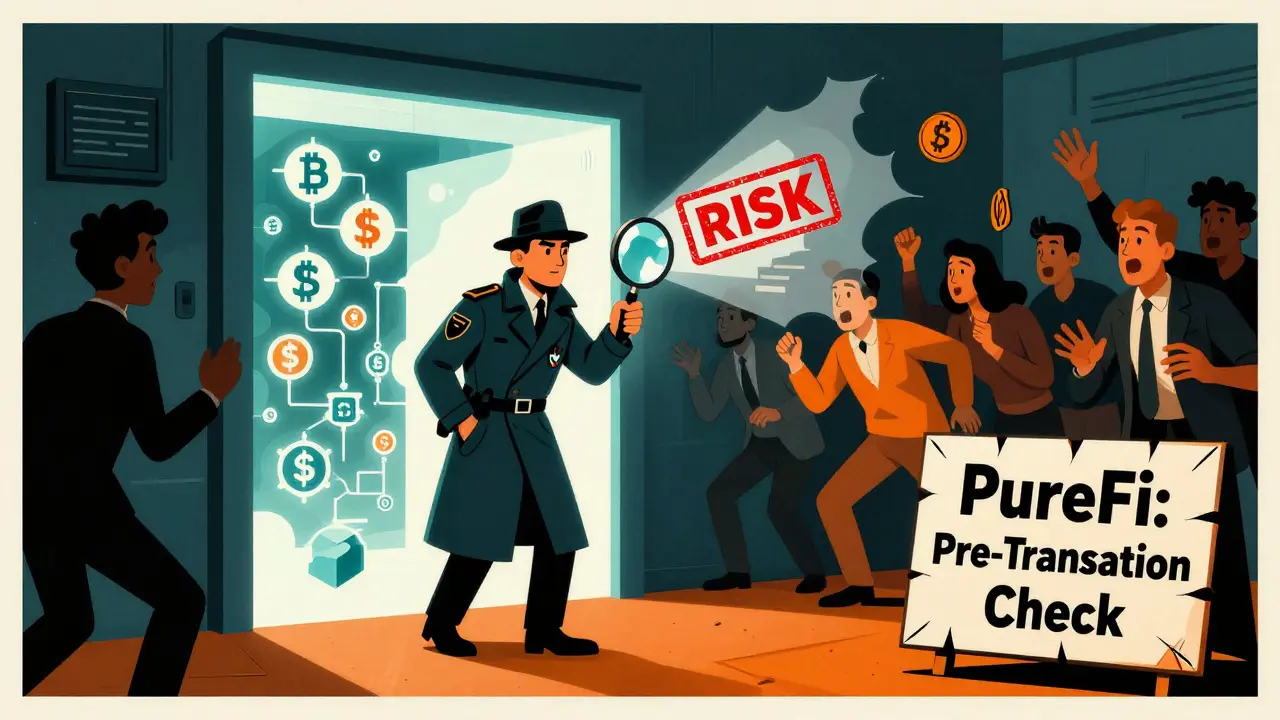
PureFi Protocol is a compliance toolkit for decentralized finance. Most DeFi platforms let you swap, lend, or stake crypto without knowing who you’re dealing with. That’s great for freedom - but terrible for regulators. Governments want to stop money laundering, terrorist financing, and scams. Traditional AML tools like Chainalysis or Elliptic check transactions after they happen. By then, the money’s gone.
PureFi flips that. It checks for risk before a transaction goes through. If a wallet is linked to a darknet market, a sanctioned entity, or has a history of suspicious behavior, PureFi blocks the trade before it’s finalized. Think of it like a security guard at a club who checks IDs at the door instead of after someone’s already inside causing trouble.
This isn’t about collecting names or addresses. PureFi uses privacy-preserving tech - like zero-knowledge proofs - to verify risk without exposing personal data. That’s why it’s pitched as a bridge between traditional finance rules and DeFi’s anonymous nature.
The UFI Token: How It Works
UFI is the native token of PureFi Protocol. You don’t buy it to flip it. You use it to pay for compliance services. If you’re a DeFi project - say, a decentralized exchange or lending platform - you need to integrate PureFi’s SDK into your smart contracts. To do that, you pay in UFI.
The protocol works across multiple blockchains. If your platform runs on Polygon or Arbitrum, but UFI isn’t native there, PureFi has a conversion system that lets you swap other tokens into UFI to pay for compliance. It’s not perfect, but it’s designed to be flexible.
There are 100 million UFI tokens total. About 58.4 million are in circulation. That’s not a lot compared to Bitcoin or Ethereum, but it’s enough to support the system - if anyone was actually using it.
Market Reality: A Token in Crisis
Here’s where things get uncomfortable. PureFi launched around 2021. Its all-time high was $0.5745 in November 2021. As of January 2026, it’s trading at $0.002929. That’s a 99.49% drop.
Its market cap is $171,120. That’s less than the cost of a small apartment in some U.S. cities. For context, Chainalysis is worth over $4 billion. Elliptic is worth $1.1 billion. PureFi’s entire market value is 0.00014% of the total crypto market.
Trading volume? $0 over the last 24 hours. Zero. That means no one is buying or selling. There are 8,900 token holders - not a tiny number, but almost no activity. On a platform like CoinMarketCap, it ranks #2864 by market cap. You won’t find it on Coinbase or Binance. It’s on obscure exchanges like MEXC and Bitrue.
This isn’t a slow start. This is a collapse. Even in a bear market, projects with zero trading volume and a market cap under $200K rarely survive. Delphi Digital’s January 2026 report called it a "near-impossible" case for long-term viability.
Who’s Using PureFi? (Spoiler: Almost No One)
There’s no public list of DeFi projects using PureFi. No big names like Uniswap, Aave, or Compound have integrated it. That’s a red flag. If a compliance tool doesn’t get adopted by major platforms, it’s not solving the problem - it’s just sitting there.
Developers need to use PureFi’s Solidity V5 SDK to plug it into their smart contracts. That’s not easy. You need to understand blockchain compliance, smart contract security, and legal risk. Most DeFi teams are focused on yield farming or new features, not compliance engineering. Why would they spend months integrating a tool that no one else is using - and that costs UFI tokens they can barely buy?
There’s also pushback from the community. On Reddit, users argue that building compliance into the protocol itself creates censorship points. If PureFi can block a transaction, who decides what’s "risky"? What if the system gets hacked? What if it’s pressured by regulators to block certain users? That’s the opposite of decentralization.
How PureFi Compares to the Competition
| Feature | PureFi Protocol | Chainalysis | Elliptic | TRM Labs |
|---|---|---|---|---|
| Pre-transaction blocking | Yes | No | No | No |
| Privacy-preserving | Yes (ZK proofs) | No (requires data) | No (requires data) | No (requires data) |
| Integrated into DeFi protocols | Yes | External API | External API | External API |
| Market Cap (2026) | $171,120 | $4.2B | $1.1B | $800M |
| Trading Volume (24h) | $0 | N/A (private company) | N/A (private company) | N/A (private company) |
PureFi’s only real advantage is pre-transaction blocking and privacy. But that’s useless if no one uses it. Chainalysis and Elliptic work with exchanges, banks, and regulators. They’re already in the system. PureFi is trying to build a new system from scratch - and it’s losing.

Future of PureFi: Hope or Hallucination?
PureFi’s website mentions future plans: a Compliance Dashboard for AML officers, governance rewards for UFI holders, and expansion to more chains. But without users, these are just ideas on a roadmap.
The regulatory pressure is real. The Financial Action Task Force now requires AML checks on all crypto transactions. That’s a huge opportunity. But PureFi isn’t capitalizing on it. It’s not partnering with regulators. It’s not getting media coverage. It’s not even being talked about in industry reports beyond a footnote.
The only reason PureFi still exists is because someone - maybe the team, maybe early investors - is still holding UFI. But holding isn’t adoption. And without adoption, there’s no future.
Should You Buy UFI?
Let’s be blunt: if you’re looking to invest, don’t. This isn’t a speculative play with upside. It’s a sinking ship with no lifeboats.
If you’re a developer looking to build a compliant DeFi app, consider the alternatives. Chainalysis, Elliptic, and TRM Labs have proven track records. They’re expensive, but they work. PureFi? You’d be betting on a team that hasn’t delivered anything meaningful in years.
There’s no shame in wanting compliance that respects privacy. That’s a real need. But PureFi isn’t the answer. Not yet. Maybe someday, if they rebuild from scratch with real partnerships and real traction. But right now? It’s a ghost.
Is PureFi Protocol a scam?
No, it’s not a scam in the traditional sense. The team built a real technical product with a clear goal. But it’s a failed project. The tech works in theory, but it’s not being used. There’s no fraud, but there’s also no future - at least not with the current model.
Can I earn money by holding UFI?
Almost certainly not. The token has lost 99.5% of its value. Trading volume is zero. There’s no staking, no yield, and no liquidity. Even if the protocol somehow gains traction tomorrow, the token supply is too large and the market too dead for a meaningful rebound.
Why does PureFi still exist if no one uses it?
Because the team hasn’t shut it down. Many crypto projects continue operating even after losing market interest - often to maintain the illusion of activity, protect token holder claims, or wait for a miracle. PureFi’s website is still updated, and the GitHub repo still has commits. But there’s no evidence of real development or adoption.
Does PureFi comply with global regulations?
It claims to, but compliance isn’t about claims - it’s about adoption. No major exchange, regulator, or financial institution recognizes PureFi. Without that, it’s just code on a blockchain. Real compliance means being accepted by the system - not just building something that looks good on paper.
Is PureFi compatible with my wallet or DeFi app?
Technically, yes - if you’re a developer and willing to integrate the Solidity V5 SDK. But you’d need to pay in UFI, which you can’t easily buy. There’s no user-friendly plugin. No documentation for non-developers. For the average crypto user, PureFi doesn’t exist.