Why Pakistan Ranks 3rd-4th in Global Crypto Adoption
 Feb, 20 2026
For years, Pakistan was one of the most hostile countries toward cryptocurrency. In 2018, the State Bank of Pakistan banned banks from dealing with crypto exchanges. Anyone caught using Bitcoin or Ethereum risked penalties. Fast forward to 2025, and Pakistan is now 3rd or 4th in the world for crypto adoption - depending on who you ask. How did this happen? And more importantly, why does it matter?
How Pakistan Jumped to the Top of Crypto Rankings
The most trusted source for tracking global crypto use is Chainalysis. Their 2025 Global Adoption Index placed Pakistan at 3rd place, behind only India and the United States. That’s a huge leap. Just two years earlier, Pakistan was barely in the top 10. What changed? Chainalysis doesn’t just count how many people own crypto. They look at how much value flows through crypto networks - from retail users sending money to businesses accepting payments, to institutional investors trading on decentralized platforms. Pakistan scored high across all these areas. In 2025, an estimated 20 million Pakistanis held digital assets worth between $20 billion and $25 billion. That’s nearly 9% of the country’s population - far above the global average of 6.9%. Other rankings, like one from May 2025, placed Pakistan at 9th. Why the difference? Because not all rankings measure the same thing. Some count how many people own crypto. Others look at transaction volume. Chainalysis adjusts for purchasing power, so it shows real economic activity, not just numbers. Pakistan’s rise isn’t about hype. It’s about survival.The Real Reason People Use Crypto in Pakistan
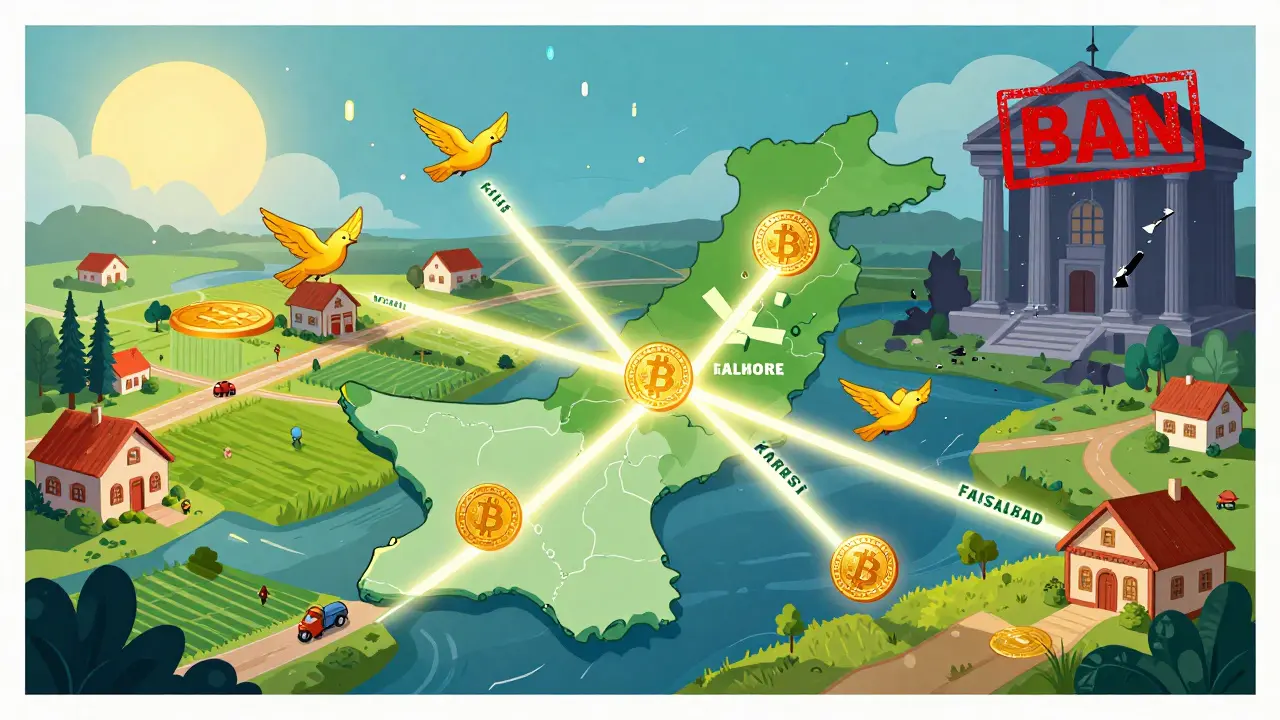
Forget gambling on Bitcoin. That’s not why most Pakistanis use crypto. The real reason? Stablecoins. Pakistan’s economy has been stuck in a cycle of inflation, currency devaluation, and limited access to foreign money. The Pakistani rupee has lost over 60% of its value against the US dollar since 2020. People can’t easily send or receive money from abroad. Banks are slow. Remittance services charge high fees. Crypto offered a way out. USDT (Tether), the most popular stablecoin, became the unofficial digital dollar for millions. Families in Lahore or Karachi now use USDT to receive money from relatives working in Saudi Arabia, the UAE, or the UK. Instead of waiting days and paying $30 in fees, they get the money in minutes for less than $1. It’s faster, cheaper, and more reliable than traditional banking. Small businesses use crypto too. A shop owner in Faisalabad might accept USDT for goods, then convert it to rupees when needed - avoiding the chaos of currency swings. Even farmers in Sindh are using crypto platforms to get paid directly by buyers overseas, cutting out middlemen who used to take half the profit. Chainalysis chief economist Kim Grauer put it simply: “Crypto adoption is mostly accelerating in emerging markets where stablecoins are transforming how people manage money.” That’s Pakistan in a sentence.
The Regulatory U-Turn: From Ban to Blueprint
In 2018, the government told banks: “Don’t touch crypto.” By 2025, they built an entire agency to regulate it. In July 2025, Pakistan launched the Pakistan Virtual Assets Regulatory Authority (PVARA). This wasn’t just a new department. It was a full legal framework - licensing exchanges, requiring KYC checks, setting anti-money laundering rules, and defining what counts as a virtual asset. For the first time, crypto businesses could operate legally. Investors could trust the system. Alongside PVARA came the Pakistan Crypto Council, led by CEO Bin Saqib. This group isn’t just a lobby. It’s a bridge between government, banks, tech startups, and international partners. They host monthly meetings with regulators, exchange operators, and even blockchain developers from the U.S. and Singapore. This shift didn’t happen overnight. It was driven by pressure from young tech-savvy entrepreneurs, remittance workers, and diaspora communities who saw crypto as essential - not optional. The government realized it couldn’t stop the tide. So it decided to steer it.Who’s Ahead of Pakistan? And Why
India still holds the top spot in Chainalysis’ 2025 rankings. Why? Because it has 1.4 billion people - and a massive, young population that’s rapidly moving online. Over 100 million Indians now use crypto. But Pakistan’s adoption rate per capita is higher. The U.S. is second. That’s not surprising. The U.S. has Coinbase, Kraken, and a growing number of crypto ETFs approved by the SEC. But here’s the twist: U.S. adoption is mostly driven by investment and speculation. In Pakistan, it’s about daily survival. Vietnam is also in the top five. Like Pakistan, it has high inflation, weak banking access, and a young population that trusts tech more than banks. But Vietnam’s economy is twice as large. Pakistan’s growth is faster. Nigeria, once second in the world, dropped to sixth. Why? Because its government cracked down harder in 2024, banning crypto transactions through banks. Pakistan did the opposite. It embraced regulation - and that made all the difference.
The Hidden Risks: Who Benefits?
There’s a darker side to Pakistan’s crypto boom. Behind the scenes, powerful foreign interests are stepping in. In August 2025, the Pakistan Crypto Council signed a partnership with World Liberty Financial, a U.S.-based blockchain firm tied to the Trump family. Zach Witkoff, son of a former U.S. envoy, met directly with Pakistan’s army chief and prime minister. The deal promises to bring blockchain infrastructure, training, and investment - but it also raises questions. Is this about helping Pakistan’s people? Or about giving American firms access to a growing market? Michael Saylor, whose company MicroStrategy holds over $62 billion in Bitcoin, was part of high-level talks in June 2025. His company doesn’t give charity. It invests for profit. There’s also the risk of over-reliance. If the U.S. changes its crypto rules - say, by taxing stablecoin transfers or restricting foreign exchanges - Pakistan’s system could wobble. Right now, the country’s crypto economy is built on trust in U.S.-backed stablecoins like USDT. What happens if those get cut off?What Comes Next?
Pakistan isn’t done. The government plans to launch a national blockchain registry for property and business licenses by 2027. It’s testing crypto-based payroll systems for public sector workers. Schools in Islamabad now teach blockchain basics in high school economics. The real test? Will this growth last? Or will it collapse if inflation spikes again or if global regulators crack down on stablecoins? Experts say the key is keeping the focus on utility. If crypto stays a tool for remittances, savings, and small business payments - not gambling or speculation - then Pakistan’s position will hold. But if politicians start treating it like a political tool, or if foreign firms prioritize profits over people, the system could unravel. For now, Pakistan’s story is one of the most surprising in crypto history. A country once banned the technology is now using it to rebuild its economy - one USDT transfer at a time.Why does Pakistan rank higher than Nigeria in crypto adoption?
Nigeria banned crypto transactions through banks in 2024, which pushed users underground and made it harder for businesses to operate legally. Pakistan did the opposite - it created legal pathways through PVARA and the Pakistan Crypto Council. This encouraged adoption, not avoidance. Chainalysis measures actual transaction volume and institutional use, not just ownership. Pakistan’s regulated environment led to more activity.
Is crypto legal in Pakistan in 2026?
Yes. Since July 2025, crypto is fully legal under the Pakistan Virtual Assets Regulatory Authority (PVARA). Exchanges must be licensed, users must complete KYC, and transactions are monitored for money laundering. Crypto is not legal tender, but it is a regulated asset class - similar to gold or stocks.
What role do stablecoins play in Pakistan’s crypto adoption?
Stablecoins, especially USDT, are the backbone of crypto use in Pakistan. With inflation eroding the rupee, people use USDT as a digital version of the U.S. dollar to protect savings, receive remittances, and pay for goods. It’s faster, cheaper, and more stable than the local currency. Over 85% of crypto transactions in Pakistan involve stablecoins.
How many people in Pakistan use cryptocurrency?
Approximately 20 million Pakistanis hold cryptocurrency as of 2025. This represents nearly 9% of the country’s 230 million population - one of the highest adoption rates in the world. Most users are under 35, and many use crypto for daily transactions, not just investment.
Could Pakistan’s crypto boom be reversed?
Yes - but only if the government abandons its regulatory framework. If PVARA is weakened, if stablecoin access is restricted, or if foreign partnerships collapse, adoption could slow. But the demand is too strong. Millions rely on crypto for survival. Reversing it would require force, not policy - and that’s unlikely to work.
Cheryl Fenner Brown
February 21, 2026 AT 04:44Michael Teague
February 22, 2026 AT 12:25kati simpson
February 22, 2026 AT 15:12Cory Derby
February 24, 2026 AT 13:17lori sims
February 25, 2026 AT 05:45