ZK-Rollups for Ethereum Scaling: How They Work and Why They Matter
 Mar, 7 2026
Ethereum has been stuck for years trying to handle more transactions without becoming slow or expensive. You’ve probably felt it: paying $30 in gas fees to swap a token, waiting minutes for a transaction to confirm, or watching your DeFi app crash because the network is overloaded. The solution isn’t more block space-it’s moving work off Ethereum’s main chain. That’s where ZK-rollups come in.
What Exactly Is a ZK-Rollup?
A ZK-rollup is a Layer 2 scaling system that takes hundreds or even thousands of transactions off Ethereum’s main network, processes them in a separate environment, and then sends back a tiny cryptographic proof that says, "These transactions are valid." It doesn’t explain what happened. It just proves it happened correctly. Think of it like handing your accountant a receipt that says, "I spent $500 this month," and they verify it without seeing every single purchase.
Unlike other scaling methods that rely on people watching for fraud (like Optimistic Rollups), ZK-rollups use math-specifically, zero-knowledge proofs-to guarantee everything is legit. This means no waiting 7 days to withdraw your funds. Once the proof is verified on Ethereum, your transaction is final in 15 to 30 minutes.
The big names in ZK-rollups right now are zkSync Era, Starknet, and Polygon zkEVM. Together, they’ve handled over 350 million transactions since 2023. That’s not just a number-it’s real people paying pennies instead of dollars to use DeFi apps, NFT markets, and gaming platforms.
How Do They Save So Much Money?
On Ethereum mainnet, every transaction is stored in full. If you swap 100 tokens, the network records every detail: who sent what, to whom, when. That’s expensive. ZK-rollups don’t store that data. They only post a compressed version-like summarizing a 100-page book into three bullet points.
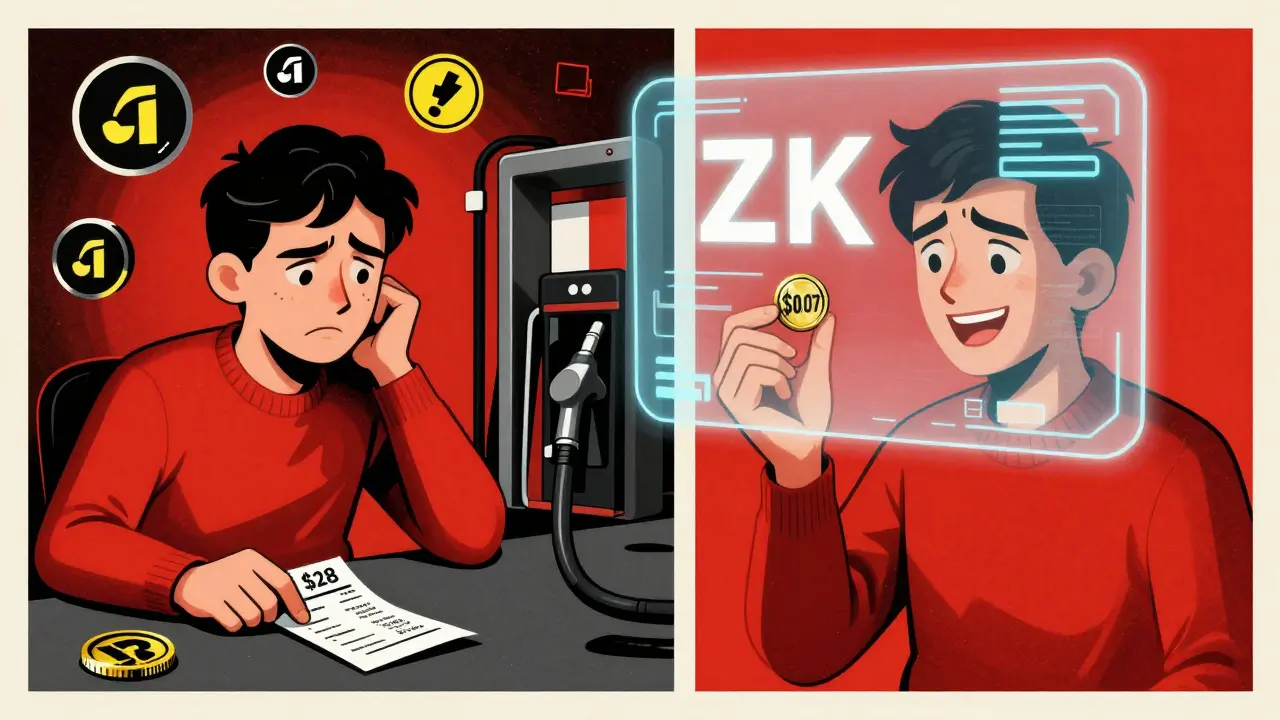
Polygon zkEVM cuts data size by 100x. zkSync Era uses advanced encoding to reduce it by 90%. That’s why transaction fees on these networks are often under $0.10, even when Ethereum is busy. One user on Reddit paid $0.07 for a swap that would’ve cost $28 on Ethereum. That’s not a fluke-it’s the design.
And it’s not just about cost. Speed matters too. While Ethereum handles about 12-15 transactions per second, zkSync Era processes up to 2,000. Starknet handles around 100. That’s not just faster-it’s usable for everyday apps, not just speculative trading.
Why ZK-Rollups Over Other Layer 2s?
There are other scaling tools. Sidechains like Polygon PoS are cheap but don’t inherit Ethereum’s security. Optimistic Rollups like Arbitrum are more compatible with existing smart contracts but require a 7-day waiting period if someone disputes a transaction. That’s risky if you’re trying to move funds quickly.
ZK-rollups win on security and finality. Because they use cryptographic proofs, there’s no need to wait for fraud challenges. The math guarantees correctness. And because they post less data, they’re more efficient than Optimistic Rollups, which must store full transaction details.
But it’s not perfect. ZK-rollups are harder to build on. Writing a smart contract that works with a ZK-proof system isn’t like coding in Solidity. You need to understand constraint systems, circuit design, and languages like Cairo (used by Starknet) or Zinc (used by zkSync). Most developers still find it tough.
Real-World Use Cases
People aren’t just theorizing about ZK-rollups-they’re using them.
- dYdX moved its entire decentralized exchange to StarkEx. It now handles $1.2 billion in daily volume.
- Uniswap on zkSync processed $4.2 billion in trades in September 2023, more than its Arbitrum counterpart.
- MetaMask now supports zkSync, letting 1.2 million users interact with the network directly from their wallet.
- JPMorgan is building a private ZK-rollup for interbank settlements, showing enterprise trust.
- Accenture deployed Starknet for a major European bank’s cross-border payments system.
These aren’t niche experiments. They’re replacing core financial infrastructure.
Where the Problems Still Are
Despite the hype, ZK-rollups aren’t flawless.
First, bridging is still messy. Users report delays of 4 to 6 hours when moving ETH from Ethereum to Starknet. The advertised 15-minute window? Rarely happens during peak times.
Second, liquidity is fragmented. If you’re using zkSync, Starknet, and Ethereum at the same time, you’re managing three separate wallets and three separate pools of assets. There’s no unified view. No DeFi dashboard handles all of them well yet.
Third, centralized sequencers are a hidden risk. Every major ZK-rollup today uses a single company to order transactions. If that company goes down-or gets hacked-users can’t submit new transactions. Starknet, zkSync, and Polygon zkEVM all rely on this model. Experts like Barry Whitehat warn this undermines decentralization, even if the math is bulletproof.
And then there’s the developer barrier. Getting started with ZK development takes 3 to 6 months of focused study. Most Solidity developers don’t know how to build circuits or verify proofs. Tools are improving, but the learning curve is steep.

What’s Coming Next?
The next 12 to 18 months will change everything.
Ethereum’s proto-danksharding (EIP-4844), launching in Q2 2024, will reduce ZK-rollup data costs by 90%. That means even lower fees and higher throughput.
zkSync is rolling out zkSync 3.0 in late 2024 with native account abstraction-letting users pay gas in any token and enabling social recovery wallets.
Starknet’s Starknet 1.0 cut proof generation time by 40%. That means faster batch confirmations and more transactions per second.
Polygon is pouring $1 billion into ZK tech through 2025. JPMorgan, Accenture, and other enterprises are testing ZK-rollups for real-world finance. This isn’t speculation anymore-it’s infrastructure.
Should You Use Them?
If you’re a regular user: yes. The fees are low, the speed is good, and the security is strong. Start with zkSync Era or Polygon zkEVM. They’re the most user-friendly right now.
If you’re a developer: maybe. If you’re building a high-volume app-DeFi, gaming, payments-ZK-rollups are the future. But be ready to invest time learning new tools. Don’t expect to deploy a standard Solidity contract and call it a day.
If you’re an investor: watch the TVL. ZK-rollups grew from $800 million to $5.2 billion in just nine months. They’re still only 15% of Ethereum’s Layer 2 ecosystem, but growing 320% year-over-year. Optimistic Rollups are still dominant, but they’re slowing down. ZK-rollups are accelerating.
The Bottom Line
ZK-rollups aren’t just another upgrade. They’re the first Layer 2 solution that can scale Ethereum to millions of users without sacrificing security. They’re faster than sidechains, safer than Optimistic Rollups, and cheaper than mainnet. The tech is still young. The tools are still clunky. But the direction is clear.
By 2026, Gartner predicts ZK-rollups will process 40% of all Ethereum transactions. By 2028, Electric Capital says there’s an 85% chance they become the dominant scaling layer. That’s not hype-it’s the math.
Ethereum’s future isn’t about bigger blocks. It’s about smarter layers. And ZK-rollups are leading the way.
What is the main advantage of ZK-rollups over Optimistic Rollups?
ZK-rollups offer immediate transaction finality because they use cryptographic proofs to verify transactions on-chain. Optimistic Rollups require a 7-day challenge period where anyone can dispute a transaction, which delays withdrawals and increases risk. This makes ZK-rollups better for applications needing fast settlement, like decentralized exchanges or payments.
Are ZK-rollups more secure than sidechains like Polygon PoS?
Yes. Sidechains like Polygon PoS rely on their own validator sets and have separate security models. If those validators are compromised, funds can be stolen. ZK-rollups inherit Ethereum’s security by submitting cryptographic proofs to Ethereum’s main chain. Even if the rollup’s operators go rogue, the proof ensures only valid transactions are accepted.
Why are ZK-rollup fees so low?
ZK-rollups batch hundreds of transactions off-chain and only post a tiny proof and minimal state data to Ethereum. They don’t store full transaction details, which cuts data costs by 80-90%. This efficiency translates directly into lower fees-often under $0.10 per transaction, compared to $1.50-$50 on Ethereum during congestion.
Can I use MetaMask with ZK-rollups?
Yes. MetaMask now supports zkSync Era and Polygon zkEVM directly. You can switch networks in the wallet and interact with apps without installing new extensions. Other wallets like Phantom and Rabby also support ZK-rollups, but MetaMask remains the most widely used.
Do ZK-rollups work with all Ethereum smart contracts?
Not yet. Early ZK-rollups had limited EVM compatibility. zkSync Era and Polygon zkEVM now support most Solidity code, but some complex operations (like certain cryptographic functions) still don’t work. Starknet uses a different virtual machine (Cairo) and requires rewriting contracts. Full compatibility is improving, but developers still need to adapt.
Is there a risk that ZK-proofs could be broken?
The math behind ZK-proofs is based on well-tested cryptography. STARK proofs, used by Starknet, are quantum-resistant and don’t rely on trusted setups. SNARKs, used by zkSync, require a trusted setup but have been audited extensively. While no system is 100% immune to future breakthroughs, ZK-proofs are among the most secure cryptographic tools we have today.
Emily Pegg
March 9, 2026 AT 02:12Jeffrey Dean
March 9, 2026 AT 15:25nalini jeyapalan
March 9, 2026 AT 19:02Drago Fila
March 11, 2026 AT 03:38James Burke
March 12, 2026 AT 22:49Christina Young
March 14, 2026 AT 19:58