1% TDS on Crypto Transactions in India Explained: Rules, Thresholds & Impact
 Jun, 2 2026
Imagine you’re ready to buy Bitcoin or Ethereum on an Indian exchange. You enter the amount, click confirm, and suddenly, a small percentage of your money vanishes before the trade even completes. This isn’t a hidden fee or a glitch; it’s the 1% TDS on crypto transactions mandated by the Indian government. For millions of investors, this rule has become the new normal since July 2022, fundamentally changing how we trade digital assets.
If you are navigating the Indian crypto landscape in 2026, understanding this deduction is not just helpful-it is essential for keeping your finances compliant and efficient. The rules aren't always intuitive, especially when they involve swapping one cryptocurrency for another or trading peer-to-peer. Let's break down exactly what this tax is, who owes it, and how it affects your wallet.
What Exactly Is the 1% TDS?
TDS stands for Tax Deducted at Source. In simple terms, it is a mechanism where the buyer (or the platform acting on their behalf) deducts a portion of the payment as tax and sends it directly to the government. Think of it like income tax deducted from your salary by your employer, but applied to every crypto trade you make.
This specific rule falls under Section 194S of the Income Tax Act, 1961. It was introduced in the Union Budget of 2022 and became effective on July 1, 2022. The primary goal, according to the Income Tax Department, is to create a paper trail. By capturing transaction details at the source, the government aims to track investments in virtual digital assets (VDAs) more effectively.
It is crucial to understand that TDS is not a final tax bill. It is an advance payment toward your annual income tax liability. If your total tax liability for the year is higher than the TDS deducted, you pay the difference when filing your returns. If the TDS exceeds your liability, you can claim a refund. However, for many retail traders, the 30% flat tax on crypto gains means the TDS often covers only a fraction of the eventual tax due.
Who Has to Pay? Understanding the Thresholds
Not every single rupee spent on crypto triggers the 1% deduction immediately. The law sets specific annual thresholds based on your taxpayer profile. These limits apply to the aggregate value of all crypto transactions in a financial year (April to March).
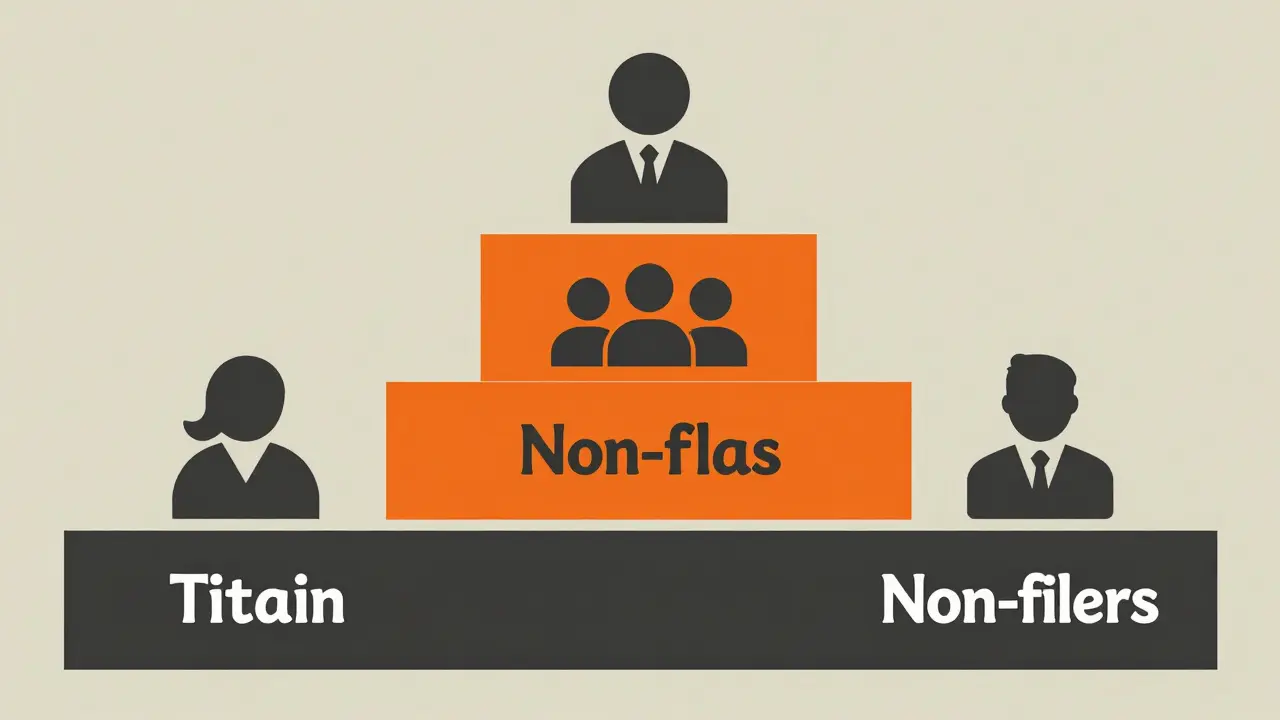
| Taxpayer Category | Annual Transaction Limit | TDS Rate |
|---|---|---|
| Specified Persons (Individuals/HUFs not liable for tax audit) |
₹50,000 | 1% |
| Other Persons (Companies, individuals liable for tax audit) |
₹10,000 | 1% |
| Non-Filers (Failed to file returns in last 2 years with high TDS) |
No threshold | 5% |
For most regular salaried individuals and Hindu Undivided Families (HUFs) who do not require a tax audit, the first ₹50,000 worth of crypto trades in a financial year is free from TDS. Once your cumulative trades cross this mark, the 1% deduction kicks in for any subsequent transactions. If you are a company or an individual business owner subject to tax audits, the limit is much stricter at just ₹10,000.
There is a punitive measure for those who ignore their tax obligations. Under Section 206AB, if you have failed to file your income tax returns for the previous two assessment years and had TDS exceeding ₹50,000 annually, you face a steep 5% TDS rate with no exemption threshold. This serves as a strong incentive to stay compliant with your general income tax filings.
How Does It Work in Practice?
The experience of paying TDS depends heavily on how you trade. Are you using a centralized exchange like WazirX or CoinDCX, or are you dealing directly with another person?
Trading on Centralized Exchanges
When you use a registered Indian crypto exchange, the process is largely automated. The exchange acts as the 'deductor.' When you execute a buy order, the platform calculates the 1% TDS if you have crossed your threshold and deducts it from your INR balance before completing the purchase. You receive the crypto, and the exchange deposits the tax with the government.
You don't need to file separate forms for these trades. The exchange will issue Form 16A, which details the TDS deducted. You can verify these entries in your Form 26AS (your annual tax credit statement) after a few weeks. This automation makes compliance easy for users, though some platforms have faced technical glitches in the past, leading to delayed credits in Form 26AS.
Peer-to-Peer (P2P) and International Platforms
Things get complicated when you move off regulated exchanges. If you buy crypto from another individual via P2P or use an international platform that doesn't automatically deduct Indian TDS, the responsibility shifts to you. As the buyer, you are legally required to deduct 1% TDS from the payment made to the seller.
To do this correctly, you must:
- Obtain the seller's Permanent Account Number (PAN).
- Deduct 1% from the transaction value.
- Deposit this amount with the government within 7 days of the end of the month in which the deduction was made.
- File Form 26QE quarterly.
- Issue a TDS certificate (Form 16A) to the seller within 15 days of filing the return.
Failing to comply here carries penalties. Many retail traders find this administrative burden too heavy, which is why P2P trading volumes have seen fluctuations. Some users mistakenly believe they can avoid TDS by splitting transactions below the threshold, but tax authorities look at the aggregate annual volume, making such workarounds risky.
The Hidden Cost: Crypto-to-Crypto Swaps
One of the most surprising aspects of Section 194S is its application to crypto-to-crypto trades. In traditional finance, swapping stocks might not trigger immediate withholding taxes in the same way. But in India, transferring ownership of one VDA for another counts as a 'transfer.'
Here is the catch: both the buyer and the seller are considered to be making a payment. Therefore, the buyer deducts 1% TDS, and the seller also deducts 1% TDS on the value received. Effectively, this creates a 2% drag on the transaction value for every swap. If you are actively trading altcoins against Bitcoin, this compound effect can significantly erode your capital over time, especially for high-frequency traders.
Valuation becomes tricky here. Since no fiat currency changes hands, the value is determined by the market price of the cryptocurrencies involved at the time of the transaction. Exchanges handle this calculation internally, but manual P2P swaps require careful documentation of fair market values to justify the TDS amount during audits.
Impact on Traders and the Market
The introduction of the 1% TDS, combined with the 30% flat tax on gains and the 4% health and education cess, has reshaped the Indian crypto ecosystem. Initially, there was a sharp decline in user activity. Reports indicated that the number of active wallets dropped significantly in the quarters following the implementation. Many casual investors exited the market, deterred by the complexity and the perceived high cost of entry.
However, the market has stabilized. By mid-2025, user bases began to recover as traders adapted to the new reality. Institutional players and serious long-term holders remained unaffected by the TDS, as their transaction frequency is low. The real impact was felt by day traders and arbitrageurs, whose profit margins were squeezed by the cumulative deductions.
Experts remain divided on the policy's effectiveness. Dr. Vijay Kelkar, former Chairman of the Economic Advisory Council, argued that such measures could stifle blockchain innovation by driving activity underground. Conversely, proponents like Dr. Reetika Khera from IIT Delhi highlight that the TDS has successfully increased transparency, bringing a previously opaque sector into the formal tax net. Data suggests that transaction reporting among registered exchanges has risen by over 40% since 2022.
Future Outlook and Compliance Tips
As we move through 2026, the regulatory framework continues to evolve. The Goods and Services Tax (GST) clarification of 2025 added another layer, applying 18% GST to exchange services. This means you now pay TDS on the principal amount and GST on the trading fees. While distinct charges, they contribute to the overall cost of trading.
Looking ahead, there are discussions about integrating crypto transaction data with India's Account Aggregation Framework. This could automate reporting further, reducing the manual burden on P2P traders but increasing surveillance. Potential revisions to the threshold limits-possibly raising them to ₹1,00,000 for individuals-are being debated in response to industry feedback.
To stay compliant and minimize friction:
- Track Your Cumulative Trades: Don't assume each trade is independent. Monitor your total annual volume against the ₹50,000 or ₹10,000 limit.
- Verify Form 26AS Regularly: Check your tax credit statement monthly to ensure exchanges are depositing the TDS correctly. Discrepancies should be reported immediately.
- Keep Records for P2P: If you trade outside exchanges, maintain detailed logs of PAN numbers, transaction dates, and values. You are the de facto tax collector here.
- Plan for Final Liability: Remember, TDS is just an advance. With a 30%+ tax on gains, ensure you set aside sufficient funds for your annual tax filing.
Is the 1% TDS refundable?
Yes, the 1% TDS is an advance payment toward your income tax liability. If the total TDS deducted exceeds your actual tax liability for the financial year, you can claim a refund when you file your Income Tax Return (ITR). However, given the 30% tax rate on crypto gains, most traders end up owing additional tax rather than getting a refund.
Does TDS apply if I transfer crypto to my own wallet?
No. The Income Tax Department defines a 'transfer' as a change of ownership. Moving crypto from one wallet to another that you control does not constitute a sale or trade, so no TDS is applicable. TDS is triggered only when you sell, trade, or spend the crypto with a third party.
What happens if I trade on an international exchange?
If you use an international exchange that does not automatically deduct Indian TDS, the legal responsibility to deduct and deposit the 1% TDS falls on you as the buyer. You must follow the manual compliance process: obtain the seller's PAN, deduct the tax, deposit it with the government, and file the necessary forms. Failure to do so can result in penalties and interest.
Can I offset crypto losses against TDS paid?
Under current Indian tax laws, losses from Virtual Digital Assets cannot be set off against gains from other sources or even against other crypto gains. Each transaction is taxed independently. Therefore, while TDS is credited to your tax account, you cannot use prior crypto losses to reduce your current tax liability or claim a refund based on those losses.
Why is there a 5% TDS for some people?
The 5% TDS rate applies under Section 206AB to taxpayers who have failed to file their income tax returns for the previous two assessment years and had TDS/TCS exceeding ₹50,000 annually. This punitive measure is designed to encourage timely filing of tax returns. To avoid this higher rate, ensure your ITRs are filed on time.
Debbie Lewis
June 2, 2026 AT 17:04It’s wild to think about how much the landscape has shifted since 2022. I remember when we could just buy and hold without worrying about these immediate deductions on every little trade. Now it feels like you’re paying a toll just to enter the highway. The part about crypto-to-crypto swaps creating a 2% drag is particularly brutal for anyone trying to rotate assets. It really does feel like they are designing the rules to discourage active trading rather than just taxing profits. I suppose it forces people to be more deliberate, but at what cost to liquidity?
Eric Grosso
June 3, 2026 AT 01:32wait so if i do p2p trades i have to act like a tax collector?? that sounds insane. i mean who has time to file form 26qe quarterly just for buying some bitcoin from a guy online? this seems like it would kill the whole p2p market unless everyone just ignores it or uses exchanges exclusively. also does this apply if im swapping stablecoins too? cause thats basically just moving money around.
Edith Mair
June 3, 2026 AT 05:23You are missing the point entirely. The law doesn't care about your convenience; it cares about compliance. If you are doing P2P, you are legally the deductor. Ignoring it isn't a strategy, it's negligence. The reason P2P volumes fluctuate is because people are realizing the administrative nightmare involved. You either use an exchange that handles it for you, or you accept the burden of being a de facto tax agent. There is no loophole here, just responsibility. Stop looking for ways to dodge it and start learning the rules.
Sam Dashti
June 3, 2026 AT 15:16Oh, Edith, calm down! Not everyone wants to read a lecture on civic duty. Eric makes a fair point about the sheer absurdity of asking retail folks to handle quarterly filings. It’s like asking someone to perform surgery on themselves. The system is designed for corporations, not guys trading ETH in their pajamas. We need better tools, not more finger-wagging. Maybe the government should step up and build a user-friendly portal instead of blaming us for not wanting to fill out Form 26QE. It’s a bureaucratic mess, plain and simple.
Joe Clements
June 3, 2026 AT 17:03I totally get where Sam is coming from. It’s overwhelming for sure. But honestly, sticking to major exchanges like WazirX or CoinDCX takes the sting out of it. They automate the deduction, so you don’t have to worry about the paperwork. Just make sure you check your Form 26AS occasionally so everything matches up. It’s annoying, yeah, but it keeps you safe from penalties. Just treat the 1% as a cost of doing business and focus on your long-term gains. Don’t let the stress eat you up!
Rosie Morris
June 5, 2026 AT 07:23thats soo true joe. its just exhausting sometimes. i love crypto but all this tax stuff makes me wanna quit lol