Crypto Billing Costs at $1k, $10k, and $100k MRR: A Real-World Breakdown
 Jul, 11 2026
Running a subscription business means you're constantly fighting the 'MRR tax'-the percentage of your revenue that vanishes into payment processing fees. If you're on traditional card networks like Stripe or PayPal, you're likely paying between 2.9% and 3.4% plus a fixed fee per transaction. That's a steep price to pay for convenience.
Crypto billing promises lower fees, instant settlement, and zero chargebacks. But does it actually save you money at different stages of growth? The answer isn't as simple as "yes." It depends entirely on which gateway you choose, how big your average invoice is, and whether you settle in fiat or keep your funds on-chain.
Let's break down exactly what you'll pay at three critical milestones: $1,000, $10,000, and $100,000 in monthly recurring revenue (MRR). We'll look at the math behind popular processors like BitPay, Coinbase Commerce, OpenNode, and self-hosted options like BTCPay Server.
The Hidden Variable: Average Ticket Size
Before we dive into the specific gateways, there's one variable that changes everything: your average subscription price. Why? Because some crypto processors charge a flat percentage, while others add a fixed fee per transaction.
If you have a small SaaS with a $5/month plan, a $0.25 fixed fee eats up 5% of that transaction instantly. If you have an enterprise tool charging $500/month, that same $0.25 fee is negligible. For this analysis, I'm using a standard $50/month subscription as our baseline. This gives us:
- $1,000 MRR: 20 active subscribers
- $10,000 MRR: 200 active subscribers
- $100,000 MRR: 2,000 active subscribers
This scenario helps us see how fixed fees impact smaller businesses versus larger ones.
BitPay: The Volume-Tiered Model
BitPay is one of the oldest and most established crypto payment processors, known for its tiered pricing structure based on monthly volume. BitPay doesn't offer a single flat rate for everyone. Instead, they scale their fees as you process more money. However, until you hit massive volumes, you're stuck in the highest fee bracket.
As of early 2026, merchants processing under $500,000 per month fall into the base tier. Here’s the deal: 2% of the transaction value + $0.25 per invoice.
Let's run the numbers for our $50 subscription:
| MRR Level | Subscribers | Fee Per Transaction | Total Monthly Cost | Effective Rate |
|---|---|---|---|---|
| $1,000 | 20 | $1.25 (2% of $50 + $0.25) | $25.00 | 2.5% |
| $10,000 | 200 | $1.25 | $250.00 | 2.5% |
| $100,000 | 2,000 | $1.25 | $2,500.00 | 2.5% |
Notice something interesting? The effective rate stays at 2.5% regardless of your MRR, because the fee scales linearly with the number of transactions. You only start saving if your total volume crosses $500,000/month, dropping the percentage to 1.5%. For most growing SaaS companies, BitPay feels expensive compared to newer competitors.
Coinbase Commerce & OpenNode: The Flat 1% Standard
Coinbase Commerce is a merchant solution from Coinbase that historically charged a 1% transaction fee on crypto payments, though recent updates suggest potential shifts toward 0% processing fees with optional conversion costs. Meanwhile, OpenNode is a Bitcoin-focused payment processor that charges a flat 1% fee with no setup or monthly costs.
These two platforms represent the "standard" for managed crypto gateways. They are easy to integrate, require minimal technical knowledge, and handle the complexity of blockchain interactions for you. Both typically charge a flat 1% fee on the transaction value.
Here is how those costs stack up against our baseline:
- At $1,000 MRR: You pay $10/month. That's 1% of your revenue.
- At $10,000 MRR: You pay $100/month. Still just 1%.
- At $100,000 MRR: You pay $1,000/month. Consistent 1% cost.
This is significantly cheaper than BitPay's 2.5% effective rate. Compared to Stripe's ~2.9%, you're saving roughly 1.9% of your revenue. At $100k MRR, that's nearly $1,900 saved every month. Plus, unlike credit cards, these transactions cannot be reversed by a customer changing their mind.
Note on Coinbase Commerce: Some recent industry reports suggest Coinbase may be shifting its model, potentially offering 0% processing fees but charging for instant fiat conversion. If this holds true, the cost drops to near-zero for merchants willing to hold crypto, making it incredibly competitive. Always verify current terms before integrating.
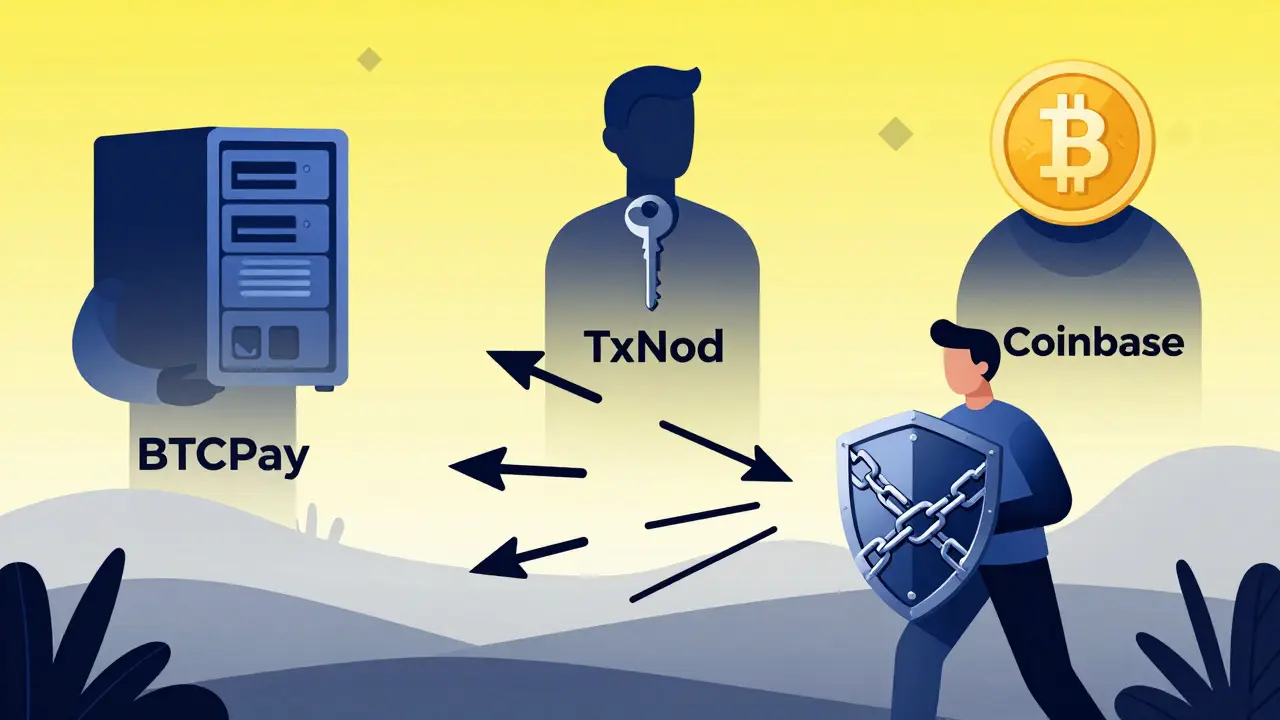
BTCPay Server: The Self-Hosted Zero-Fee Option
BTCPay Server is an open-source, self-hosted Bitcoin payment gateway that charges 0% processing fees, requiring merchants to host the software themselves. This is the gold standard for sovereignty. There is no middleman taking a cut. No platform fees. Ever.
So, why isn't everyone using it? Because "free" has a hidden cost: infrastructure. You need to host the server yourself. You can rent a Virtual Private Server (VPS) from providers like LunaNode or use managed hosting like Elestio.
A typical setup might cost around $16 to $18 per month for a VPS instance capable of running a full node or light client. Let's use $16/month as our fixed infrastructure cost.
| MRR Level | Fixed Hosting Cost | Processing Fee | Total Monthly Cost | Effective Rate |
|---|---|---|---|---|
| $1,000 | $16.00 | $0.00 | $16.00 | 1.6% |
| $10,000 | $16.00 | $0.00 | $16.00 | 0.16% |
| $100,000 | $16.00 | $0.00 | $16.00 | 0.016% |
Look at that drop. At $1,000 MRR, BTCPay is slightly more expensive than Coinbase Commerce (1.6% vs 1%) because the fixed hosting cost weighs heavily on low volume. But once you cross $10,000 MRR, BTCPay becomes dramatically cheaper. At $100k MRR, you're paying fractions of a percent. This makes self-hosting ideal for high-volume operations or developers who want maximum control over their data and funds.
Strike & Fiat Settlement: The Spread Trap
Strike is a Bitcoin Lightning wallet and business payment solution that advertises ultra-low fees, often charging no explicit transaction fees but applying a spread when converting to fiat. Strike is popular because it integrates well with platforms like Shopify and offers a smooth user experience. They claim "no added transaction fees" for sending and receiving Bitcoin.
However, if you don't want to hold volatile Bitcoin, you'll convert it to USD or EUR immediately. Strike applies a spread of approximately 1% on these conversions. In practice, this functions exactly like a 1% processing fee.
If you settle in fiat via Strike:
- $1,000 MRR: ~$10 cost (1% spread)
- $10,000 MRR: ~$100 cost (1% spread)
- $100,000 MRR: ~$1,000 cost (1% spread)
The key difference here is transparency. With Coinbase or OpenNode, the 1% is clearly labeled as a "processing fee." With Strike, it's hidden in the exchange rate. If you're comfortable holding Bitcoin, Strike can be even cheaper, costing only the minimal network routing fees (often less than a penny per transaction).

The Emerging Contender: TxNod
There's a new player gaining traction among solo founders and indie hackers: TxNod is a non-custodial multi-chain crypto payment gateway that uses a flat subscription model rather than a percentage take-rate. Unlike BitPay or Coinbase, TxNod doesn't take a cut of your sales. Instead, it operates on a flat $20/month subscription per operator, with a 0% take-rate on payment volume.
This model flips the script on traditional economics. Let's see how it compares:
| MRR Level | Subscription Cost | Transaction Fee | Total Monthly Cost | Effective Rate |
|---|---|---|---|---|
| $1,000 | $20.00 | $0.00 | $20.00 | 2.0% |
| $10,000 | $20.00 | $0.00 | $20.00 | 0.2% |
| $100,000 | $20.00 | $0.00 | $20.00 | 0.02% |
At $1,000 MRR, TxNod is slightly more expensive than the 1% gateways ($20 vs $10). But as soon as you pass $2,000 MRR, it becomes cheaper than any percentage-based model. At $100k MRR, you're saving thousands compared to BitPay or even Coinbase. Plus, since it's non-custodial, funds go straight to your hardware wallet (Ledger or Trezor), eliminating counterparty risk entirely. No account freezes, no payout holds.
Which Gateway Should You Choose?
Your choice depends on your technical comfort level, volume, and custody preferences.
- For Beginners / Low Tech Skill: Stick with Coinbase Commerce or OpenNode. The 1% fee is fair, integration is plug-and-play, and support is readily available. It's the easiest way to start accepting crypto without worrying about servers or keys.
- For High Volume / Technical Teams: Go with BTCPay Server. The upfront effort of setting up a VPS pays off massively as you scale. You get 0% fees and total sovereignty. Ideal if you have a developer on staff.
- For Solo Founders / Indie Hackers: Consider TxNod. The flat $20/month fee is predictable and scales beautifully. You get non-custodial security (your own Ledger/Trezor) without the headache of managing a server. It's designed specifically for builders who want to ship fast and keep their margins.
- For Shopify Merchants: Strike offers a seamless integration. Just remember that converting to fiat will cost you roughly 1% in spreads.
Remember, the goal isn't just to lower fees-it's to reduce friction for your customers and protect your revenue from chargebacks. Crypto billing delivers on both fronts, provided you pick the right tool for your stage of growth.
Is crypto billing cheaper than Stripe?
Yes, generally. Stripe charges around 2.9% + $0.30 per transaction. Most crypto gateways charge between 0% and 1%. Even with the lowest-tier BitPay fees (2.5% effective), you save money compared to standard card processing, and you eliminate chargeback risks entirely.
What happens if Bitcoin crashes after a customer pays?
If you hold the Bitcoin, you bear the market risk. To avoid this, many merchants use gateways that automatically convert crypto to stablecoins (like USDC) or fiat (USD) instantly. Gateways like Coinbase Commerce and Strike offer this feature, though it may incur a small spread or conversion fee.
Can I accept subscriptions with crypto?
Yes, but it works differently than credit cards. Since crypto is a "push" technology, customers must authorize recurring payments. Solutions like MoonPay Commerce, Rocketfuel, and smart-contract-based systems on Ethereum allow for automated recurring debits. Alternatively, gateways can send a new invoice each month, which the customer pays manually or via auto-pay features in wallets like Strike.
Is BTCPay Server really free?
The software itself is free and open-source with 0% processing fees. However, you must host it on a server, which costs money (typically $15-$30/month for a VPS). So, it's not "free" in absolute terms, but it is free of platform transaction fees.
Do I need a registered company to use crypto payment gateways?
It depends on the provider. Large exchanges like Coinbase often require KYC and business verification. However, newer platforms like TxNod and self-hosted solutions like BTCPay Server do not require a registered company or extensive KYC checks, making them accessible to solo founders and individual developers.
Jessie Smith
July 12, 2026 AT 04:47most peopel dont get it. its not about the fees, its about the philosophy of money itself. when u pay stripe, ur paying for the illusion of stability in a collapsing fiat system. crypto is just the raw truth of value exchange without the middleman leeching off your labor. its elegant in its simplicity if you have the brain capacity to grasp it.
Drew M
July 12, 2026 AT 15:48This breakdown is absolutely stellar! 🌟 I’ve been using Coinbase Commerce for my small design agency and the 1% fee is a dream compared to what I was paying with PayPal. The peace of mind knowing there are zero chargebacks is worth every penny. Plus, the integration was so smooth! 💸✨
Deep Rahman
July 14, 2026 AT 01:29I think that we need to look at this from a much broader perspective because the issue is not just about the numbers on the page but also about how people feel when they are sending their hard earned money across the internet and whether they trust the system or not which is why some people prefer the old ways even if it costs more because familiarity breeds comfort and safety in uncertain times.
Melissa Beckwith
July 15, 2026 AT 08:25The assumption that BTCPay is viable for anyone other than a dedicated sysadmin is frankly delusional. You are ignoring the massive opportunity cost of maintenance, security patches, node synchronization issues, and the sheer technical debt incurred by self-hosting financial infrastructure. Most indie hackers would rather pay the 1% fee than spend twenty hours debugging a Lightning node connection timeout during a peak sales period. It is not 'sovereignty,' it is a hobby disguised as business strategy.
Josephine Finlayson
July 15, 2026 AT 08:58Thank you so much for sharing this detailed analysis!!! It really helps to see the numbers laid out like this. I am always worried about hidden fees so knowing that TxNod has a flat rate makes me feel much more secure about trying it out for my small shop. I appreciate your kindness in helping us understand these complex options!! 😊
Tuan Nguyen
July 15, 2026 AT 19:52Typical superficial analysis. You fail to account for the liquidity slippage inherent in high-volume conversions on centralized exchanges like Strike. The 'spread' is not static; it widens during volatility events, effectively punishing merchants who rely on instant fiat settlement. Furthermore, the regulatory risk associated with non-custodial gateways like TxNod is exponentially higher than you imply. This is amateur hour economics.
Ray Arney
July 17, 2026 AT 08:43Yeah, I totally agree with the point about ticket sizes. When you're charging $5, those fixed fees kill you. But once you hit that $50 mark, the difference between 1% and 2.5% adds up fast. I switched to OpenNode last year and haven't looked back. Super easy to set up too.
Andrew Schneider
July 18, 2026 AT 10:32Boring!!! 🙄 Everyone is obsessed with saving a few pennies while the whole system burns down around them. Who cares if you save 1%? The real drama is in the market swings! If Bitcoin drops 10% overnight, your savings mean nothing! 😱📉 Stop counting beans and start taking risks!
Eric Braddock
July 19, 2026 AT 08:54Don't trust any of this. They want you to use their platforms so they can track your transactions and feed data to the global surveillance state. Even 'non-custodial' solutions have backdoors. The only way to be safe is cash under the mattress. These crypto gateways are just another layer of control designed to enslave your digital identity. Wake up sheeple! 🐑
Nick G
July 21, 2026 AT 01:36I find it fascinating how different cultures approach financial sovereignty, and perhaps we should consider the communal aspect of trust in traditional banking versus the individualistic nature of blockchain technology, which might explain why some regions are more hesitant to adopt these new systems despite the clear economic benefits outlined here.