Decentralization: Staking vs Mining - Which Blockchain Validation Method Is Right for You?
 May, 4 2025
Staking vs Mining Calculator
Compare Your Options
See how your potential earnings and costs stack up between mining and staking based on your specific situation.
Mining Setup
Staking Setup
Results
Earnings Comparison
Mining
Staking
Key Differences
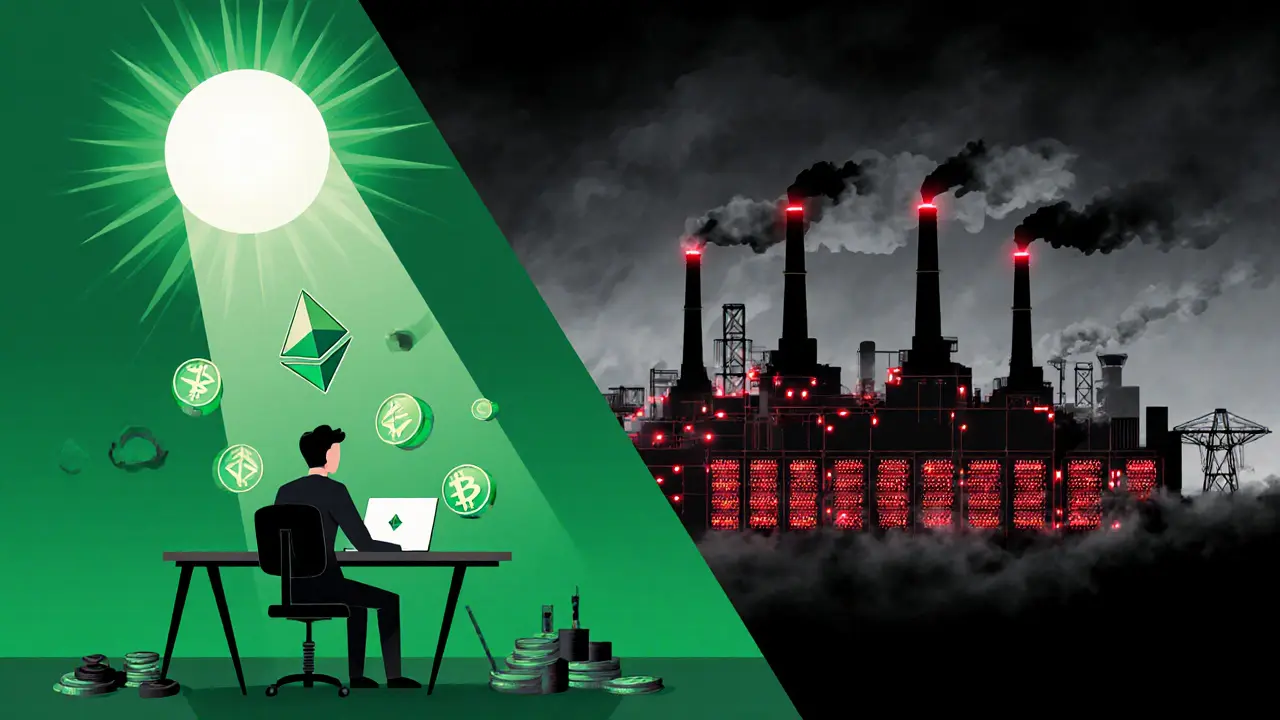
Staking and mining are the two main ways blockchains keep themselves secure and validate transactions - but they’re nothing alike. One burns electricity like a power plant. The other runs on your laptop. One locks your money away for months. The other needs a warehouse full of machines. If you’re trying to understand which one makes sense for you - whether you’re looking to earn passive income, support a network, or just avoid ruining the planet - you need to know the real differences, not the hype.
How Mining Works (And Why It Uses So Much Power)
Mining is how Bitcoin and other Proof-of-Work (PoW) blockchains work. Miners use powerful computers to solve crazy-hard math problems. The first one to solve it gets to add the next block of transactions to the chain and collects a reward - newly minted coins plus transaction fees. This isn’t just running a program. It’s a hardware arms race. You need specialized machines called ASICs, which cost thousands of dollars. They run 24/7, get incredibly hot, and eat electricity like a desert town in summer. In 2023, Bitcoin mining alone used more power than the entire country of Argentina - over 120 terawatt-hours a year. That’s not a typo. That’s more than 30 million homes use in a year. The problem? As more miners join, the difficulty goes up. You need newer, faster gear just to stay in the game. Your old GPU? Worthless in six months. Your electricity bill? Doubles. And if the price of Bitcoin drops? You might be losing money even if you’re mining. Miners who survive are either in places with cheap power (like Texas or Kazakhstan) or running massive farms with industrial cooling. For most people, it’s not an option. It’s a business - not a side hustle.How Staking Works (And Why It’s So Much Simpler)
Staking is how Proof-of-Stake (PoS) blockchains like Ethereum, Cardano, and Solana work. Instead of solving math problems, you lock up your own coins as collateral. The network picks validators based on how much they’ve staked and how long they’ve held it. If you’re chosen, you help verify transactions and get rewarded. You don’t need a single ASIC. You don’t need to cool a room. You don’t need to be a tech wizard. All you need is a computer, an internet connection, and the native coin of the blockchain you want to stake on. For Ethereum, you need 32 ETH to run your own validator. That’s about $100,000 right now - not cheap. But here’s the twist: you can join a staking pool. Put in $100, $500, $5,000 - any amount - and you still earn a share of the rewards. Platforms like Coinbase, Kraken, and Lido make this super easy. Just click a button. Your coins get locked, you start earning, and you don’t touch a single wire. When Ethereum switched from mining to staking in 2022, its energy use dropped by more than 99%. That’s not a marketing claim. That’s what happened. One network, one change, and it went from a power hog to a quiet background process.Hardware: Your Laptop vs. A Data Center
Mining requires specialized gear. You’re buying ASICs, power supplies, cooling fans, and racks. You’re dealing with noise, heat, and the risk of your machine dying mid-mining cycle. If you’re not comfortable with soldering, wiring, or reading voltage meters, you’re not ready. Staking? You can do it on a $300 laptop. Or even your phone, if the platform supports it. No fans. No heat. No wires. Just your wallet and your coins. The difference isn’t just convenience - it’s accessibility. Mining is for people with capital and technical skills. Staking is for anyone with a few hundred dollars and a crypto wallet. That’s why staking has exploded. It opened up participation to millions who would never have touched a mining rig.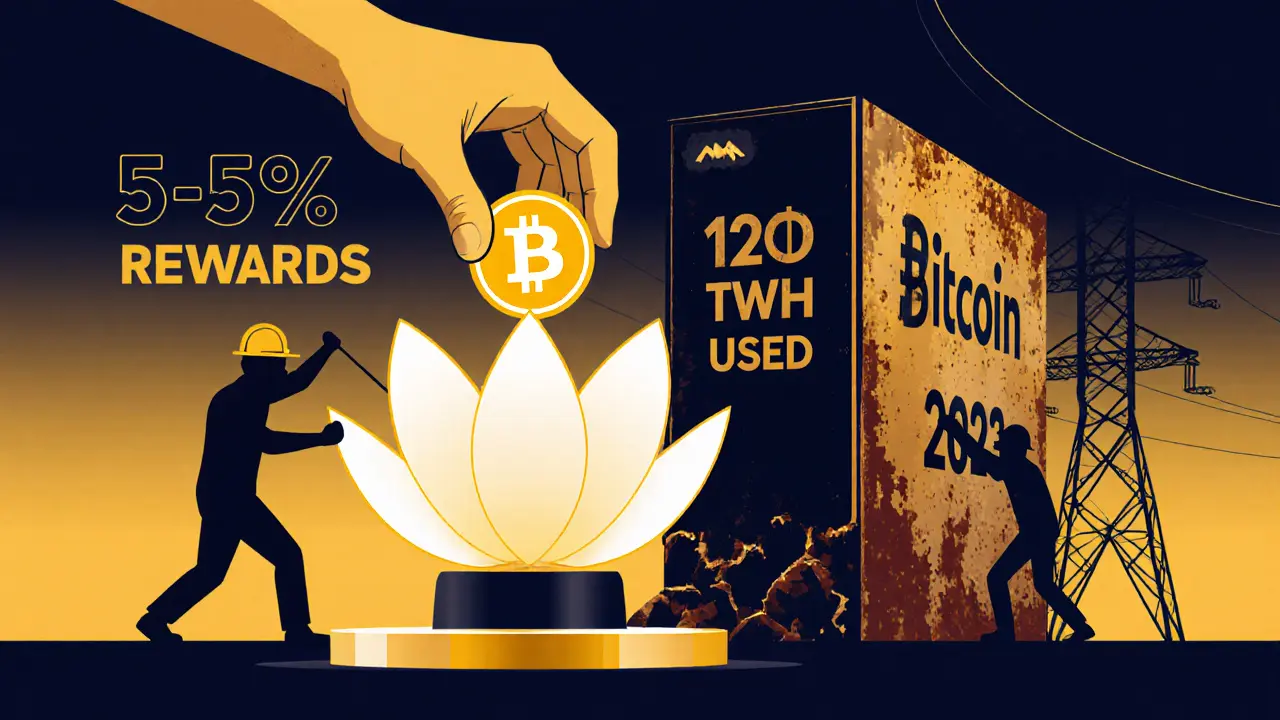
Costs: Upfront Investment vs. Locked Funds
Mining’s costs are obvious: hardware, electricity, maintenance. You might spend $5,000 on a mining rig. Then you pay $200 a month in power. If Bitcoin drops 30%, you’re underwater. And you can’t just sell your rig and walk away - it’s worth half what you paid. Staking’s cost is different. You don’t spend cash on hardware. You spend your crypto. You lock it up. For Ethereum, that’s 32 ETH. For Cardano, you can stake 1 ADA. But once you stake, your coins are frozen. You can’t sell them. You can’t move them. You can’t use them in DeFi. You’re betting your coins will grow in value over time - and that the network won’t slash your rewards. Slashing? Yes. If your validator node goes offline too often or tries to cheat, you lose a portion of your staked coins. It’s a built-in penalty to keep people honest. It’s not common, but it’s real. And it’s not something you see in mining.Rewards: Volatility vs. Predictability
Mining rewards are unpredictable. They depend on:- How much hash power you have
- How hard the network difficulty is
- What the coin price is
- What your electricity cost is
Environmental Impact: The Real Dealbreaker
Let’s be blunt: mining is bad for the planet. Bitcoin’s energy use is comparable to small nations. The carbon footprint? Massive. Even if miners use renewables, the scale of consumption is unsustainable. Staking? It uses less electricity than charging your phone. The network runs on existing hardware. No extra power needed. No extra emissions. No debate. This isn’t just a moral issue. It’s a regulatory one. The EU has proposed banning PoW mining. The U.S. is starting to look at energy caps. Cities like New York are banning crypto mining outright. If you care about the future of crypto - and whether governments will let it exist - staking wins by default.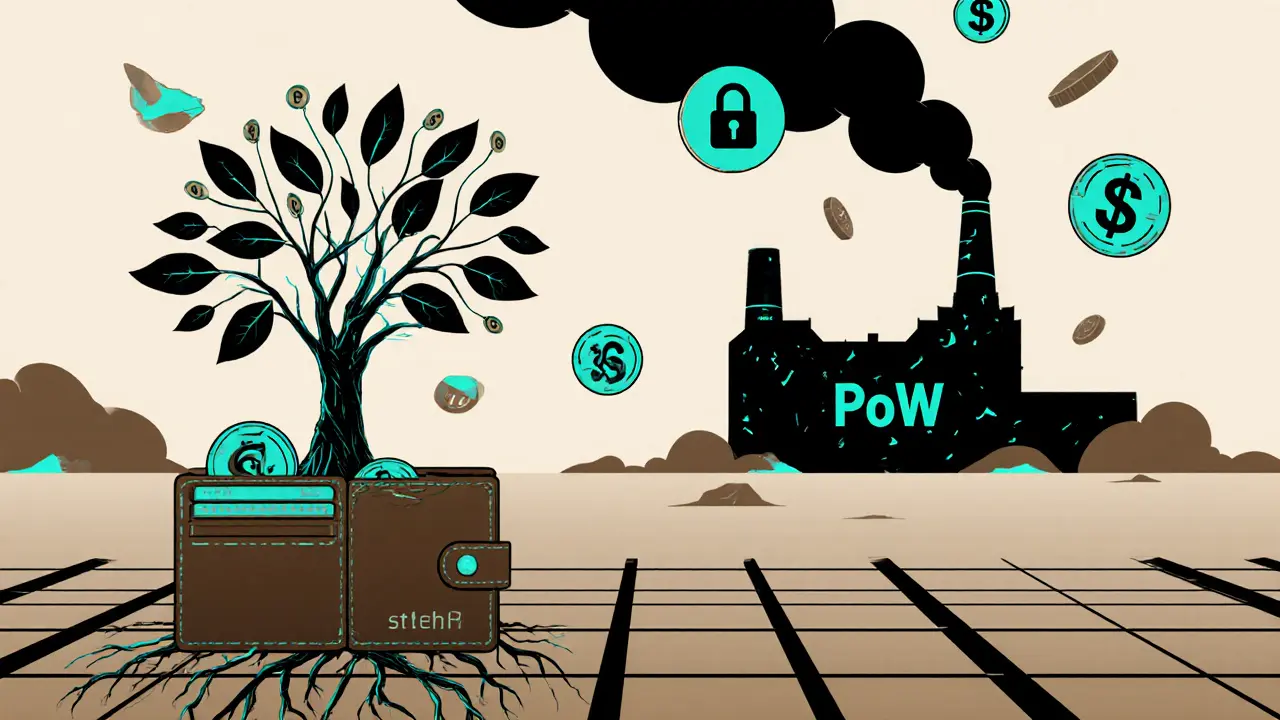
Who Should Do What?
If you’re a tech-savvy investor with $10,000+ to spend and you like tinkering with hardware - mining might be tempting. But you’re not just earning crypto. You’re running a small business. You’re betting on Bitcoin’s price, your electricity rates, and the lifespan of ASICs. It’s high risk, high reward - and it’s getting harder every year. If you’re someone who wants to earn passive income without buying a warehouse - staking is your path. You can start with $50. You can use your existing exchange account. You get steady returns. You help make the network greener. And you don’t need to know what a GPU is. The truth? Most people should stake. Mining is a relic of the early crypto days. It’s not dead - Bitcoin still runs on it. But for new blockchains, new investors, and new users, staking is the future.What’s Next? Liquid Staking and the Future
One big complaint about staking is that your coins are locked. What if you need cash? That’s where liquid staking comes in. Platforms like Lido and Rocket Pool let you stake your ETH and get a token in return - say, stETH - that you can trade, use in DeFi, or even borrow against. Your coins are still locked on the network, but you get liquidity. It’s a game-changer. Ethereum’s transition proved that big blockchains can shift from mining to staking. More are following. Solana, Polygon, Avalanche - all PoS. Even newer projects like Sei and Celestia launched with staking from day one. Mining? It’s holding on because of Bitcoin. But Bitcoin isn’t growing. It’s staying. And staking? It’s expanding. Fast.Final Thought: It’s Not About Which Is Better - It’s About What You Want
Mining is about control, power, and technical mastery. It’s the original crypto dream: decentralization through brute force. Staking is about simplicity, sustainability, and accessibility. It’s the next chapter: decentralization through participation. You don’t have to choose one forever. Some people mine Bitcoin and stake Ethereum. But if you’re starting out? Skip the rig. Skip the noise. Skip the electricity bill. Stake. It’s easier, cheaper, cleaner - and just as powerful.Can I mine and stake at the same time?
Yes, but not on the same network. You can mine Bitcoin (PoW) while staking Ethereum (PoS). They’re completely separate systems. Many people do this to diversify their crypto income. Just make sure you understand the costs and risks of both.
Is staking safe?
Staking is safe if you use reputable platforms. Exchanges like Coinbase and Kraken have insurance and professional validator setups. If you run your own node, you need to keep it online and secure - otherwise, you risk slashing. But the biggest risk isn’t hacking - it’s price drops. Your coins are locked, so if the value falls, you lose money even if you earn rewards.
How much can I earn from staking?
It depends on the blockchain. Ethereum gives 3-5% annually. Solana gives 6-8%. Cardano gives 4-5%. Some newer chains offer 10% or more, but those often come with higher risk. Always check the official network documentation before staking.
Do I need to be tech-savvy to stake?
No. If you use an exchange like Coinbase or Binance, you can stake with one click. You don’t need to know what a validator is. You just select the coin, click ‘Stake,’ and you’re done. Only if you want to run your own node do you need technical skills - and even then, it’s far easier than mining.
What happens if I want to unstake my coins?
There’s always a waiting period. On Ethereum, it takes 18-24 hours to start unstaking and another 1-3 days to fully withdraw. On other chains, it can be longer - up to 21 days. This delay is built in to keep the network stable. You can’t instantly cash out, but you can use liquid staking tokens (like stETH) to access liquidity while still earning rewards.
Is mining still worth it in 2025?
Only if you’re mining Bitcoin and have access to very cheap electricity - under $0.05 per kWh. For most people, it’s not. The hardware is expensive, the difficulty keeps rising, and the environmental backlash is growing. Mining Bitcoin is now a corporate business, not a hobby. For other coins like Litecoin or Dogecoin, returns are tiny and often not worth the setup.
George Kakosouris
November 27, 2025 AT 08:11Let’s be real - mining isn’t dead, it’s just been corporatized. If you’re not mining Bitcoin with a 5MW data center in Texas powered by flared gas, you’re already losing. Staking? Sure, it’s convenient. But you’re just giving your coins to Coinbase and calling it decentralization. Where’s the sovereignty? Where’s the ethos? You’re not a validator - you’re a bondholder with a wallet.
And don’t get me started on liquid staking. stETH? More like ‘stupid ETH’ - a synthetic asset backed by a protocol that can be slashed, frozen, or regulated into oblivion. You think you’re earning yield? You’re just leveraged in a regulatory time bomb.
True decentralization means running your own node. Not clicking ‘Stake’ on Binance. If you can’t run a Linux VM and monitor your validator’s uptime, you don’t deserve to earn rewards. You’re a spectator, not a participant.
Tony spart
November 28, 2025 AT 03:34USA built the internet, USA built crypto, and now some soft europeans wanna shut down mining bc they dont wanna hear the fans? lol. mining is patriots work. staking is for people who think ‘passive income’ is a personality trait. if you cant handle 120db noise and a 2000$ electric bill, go back to your solar panel yoga retreat. bitcoin is digital gold - gold dont care about your carbon footprint, it cares about security. stay mad, woke stakers.
also why do you think the us gov is trying to ban mining? bc they know if you own your own hash, you dont need the fed. and that scares them.
Ben Costlee
November 29, 2025 AT 16:25I’ve watched this transition from mining to staking up close, and honestly? It’s one of the most beautiful shifts in tech history. I used to run a rig in my garage - loud, hot, constantly worrying about the next power surge. Then I staked my ETH. No noise. No heat. Just peace.
And the environmental difference? It’s not just a number - it’s real. My niece asked me last week why I still believe in crypto. I showed her the energy graphs. One side: a city’s worth of lights. The other: a single LED bulb.
Staking didn’t just make crypto greener. It made it human. You don’t need to be a tech bro with a warehouse to be part of this. You just need to believe in it. And that’s powerful.
Yeah, there’s risk. Yeah, your coins are locked. But so are your values when you stake - you’re betting on a future that doesn’t burn the planet to make a buck. And that’s worth more than any ROI.
Mark Adelmann
December 1, 2025 AT 06:49Just wanted to say - if you’re new to this and thinking about staking, don’t overthink it. Start small. $50 on Cardano or Solana. Use your exchange. Click stake. Wait. Get rewards. Repeat.
It’s not glamorous. No fans. No wires. No drama. Just steady growth while you sleep. I’ve been doing it for two years. My first staking reward was $3.50. Now it’s $120/month. Not life-changing, but consistent.
And honestly? The fact that you can do this on your phone while waiting in line for coffee? That’s the real win. Crypto was supposed to be for everyone. Staking finally made it true.
ola frank
December 3, 2025 AT 01:24There’s a deeper ontological distinction here that’s being overlooked. Mining embodies a Hobbesian model of security - brute force, competition, scarcity as a feature. Staking, by contrast, reflects a Lockean paradigm: property as consent, participation as legitimacy.
The transition from PoW to PoS isn’t merely technological - it’s epistemological. We’re moving from a system where value is derived from energy expenditure to one where value is derived from economic commitment.
This raises profound questions: Is security truly proportional to energy consumption? Or is it proportional to the alignment of incentives? The latter model scales infinitely; the former does not.
Furthermore, the regulatory vulnerability of PoW isn’t incidental - it’s structural. Energy-intensive systems are inherently more visible, more contestable, more politically exposed. PoS, by contrast, operates as a quiet, distributed consensus mechanism - far harder to regulate, precisely because it doesn’t scream for attention.
So while staking appears ‘easier,’ it’s actually more sophisticated. And sophistication, in decentralized systems, is not a bug - it’s the feature.
Abby cant tell ya
December 3, 2025 AT 09:51Wow. So you’re telling me I’m supposed to trust some random exchange with my life savings just because they say ‘we’re secure’? Lol. I’ve seen the news. Kraken got hacked. Coinbase got fined. And now you want me to stake my coins with them and call it ‘passive income’? What a joke.
At least with mining, you know where your hardware is. With staking? You’re just trusting a black box. And if the network decides to slash you? Too bad. No recourse. No appeal. Just gone.
Don’t fall for the greenwashing. This isn’t progress. It’s control dressed up as convenience.