Decentralized Exchange Order Books: How On-Chain Trading Works
 Nov, 23 2026
You’ve probably swapped tokens on Uniswap a dozen times. You click a button, the price updates, and the trade settles in seconds. It’s smooth, but it’s also opaque. You don’t see who is selling to you or what the actual supply and demand look like behind that single number. Now imagine if every buy and sell order for Bitcoin was visible on a public ledger, sorted by price and time, just like on a traditional stock exchange, but without a bank holding your money. That’s the promise of Decentralized Exchange (DEX) Order Books. Unlike the automated market makers (AMMs) that dominate current DeFi, order book DEXs bring the transparency and precision of traditional finance to the blockchain.
The Core Difference: AMMs vs. Order Books
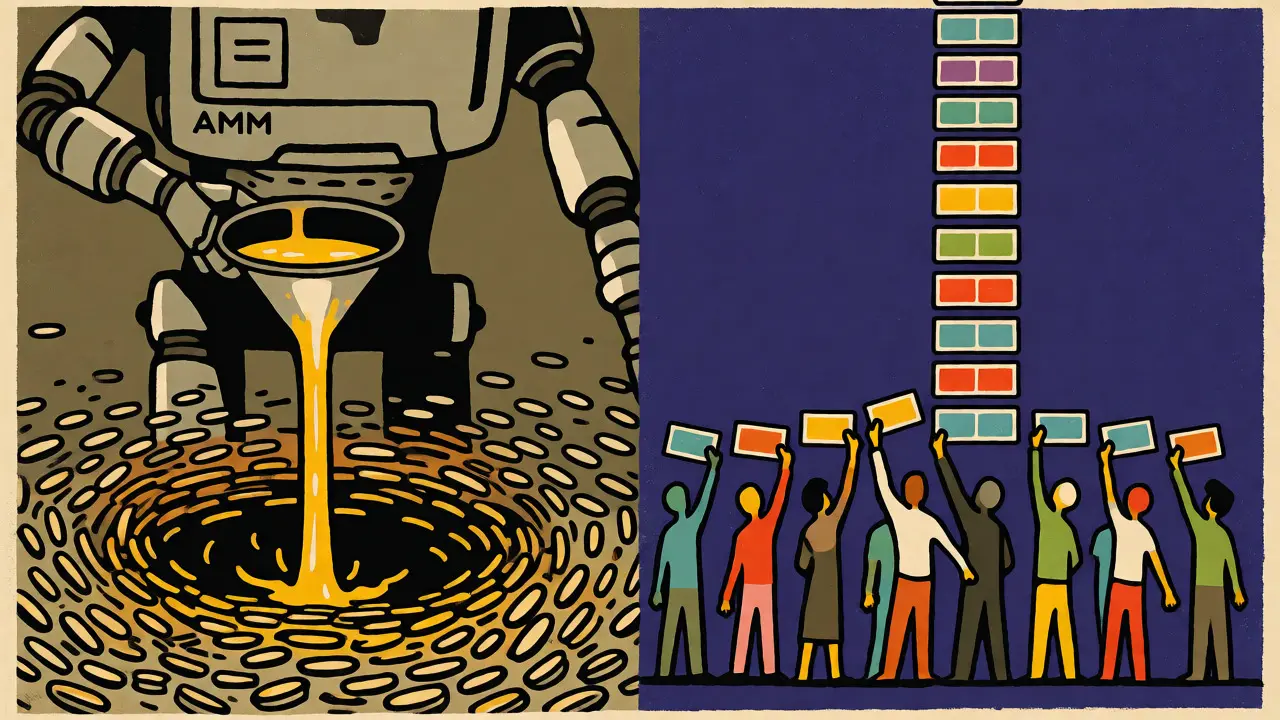
To understand why this matters, you have to look at how prices are actually made. Most popular DEXs today use Automated Market Makers (AMMs). In an AMM, like Uniswap, there are no individual buyers or sellers matching with each other. Instead, everyone trades against a shared pool of funds. The price changes based on a mathematical formula as tokens leave or enter the pool. It’s efficient for small swaps, but it lacks nuance. You can’t say, "I want to buy exactly when the price hits $100," unless you use complex workarounds.
Order Book DEXs work differently. They maintain a real-time list of all open buy and sell orders for a specific trading pair. This is called the order book. Buy orders (bids) are listed from highest price to lowest, and sell orders (asks) are listed from lowest to highest. When a buyer’s bid matches a seller’s ask, the trade executes. This structure allows for true price discovery driven by human intent, not just algorithmic rebalancing.
| Feature | Automated Market Maker (AMM) | Order Book DEX |
|---|---|---|
| Price Discovery | Formula-based (constant product function) | Supply and demand interaction |
| Order Types | Limited (mostly market orders) | Limit, Market, Stop-Loss, etc. |
| Liquidity Source | Pooled funds from LPs | Individual user orders / Market Makers |
| Slippage | High for large trades against pool | Low if depth is sufficient |
| Transparency | Pool reserves only | Full visibility of pending orders |
How the Matching Engine Works
If the order book is the list of intentions, the Matching Engine is the brain that makes trades happen. In a centralized exchange (CEX), this engine is a highly optimized server process running in a data center. In a DEX, it’s more complicated because we’re trying to avoid trusting a central server.
The engine follows a strict rule called price-time priority. If two users place a buy order at $100, the one who placed it first gets filled first. If someone places a buy order at $101, they jump ahead of the $100 bidders, regardless of time. This ensures fairness and predictability.
There are three main ways developers build these engines:
- Fully On-Chain: Every order placement, cancellation, and match happens directly on the blockchain. This is the most decentralized but often the slowest and most expensive due to gas fees. Ethereum’s base layer, for example, struggles with the high frequency of updates required for an active order book.
- Off-Chain Order Book, On-Chain Settlement: The matching happens off-chain using a trusted operator or a network of nodes, but the final transfer of assets is settled on the blockchain. This offers CEX-like speed while keeping custody of funds secure via smart contracts. Platforms like dYdX v3 used this model.
- Hybrid Models: These combine elements of both. For instance, some systems use Layer 2 solutions or specialized chains to handle the matching logic more efficiently than Ethereum L1, while still relying on the main chain for security guarantees.

The Liquidity Challenge
Here is the catch: order books need people to post orders. In an AMM, you just deposit funds into a pool, and the protocol handles the rest. In an order book DEX, if nobody places a limit order to buy ETH at $2,500, your sell order at that price sits there indefinitely. This is known as liquidity fragmentation.
Because of this, order book DEXs rely heavily on Market Makers. These are professional traders or firms that constantly place buy and sell orders on both sides of the trade to ensure there is always depth in the book. They earn profits from the spread (the difference between the buy and sell price) and sometimes receive fee rebates from the exchange.
For casual users, this means less liquid pairs can have wide spreads. If you try to trade a obscure altcoin on a thin order book, you might get a terrible price compared to the mid-market rate. During low-volume periods, such as weekends or holidays, the order book can become "thin," leading to significant slippage even for moderate-sized trades. This is a stark contrast to AMMs, where liquidity is always available as long as the pool has funds, though the price impact might be higher.
Why Traders Prefer Order Books
So, why bother with the complexity? Because control matters. Professional traders and sophisticated investors prefer order book DEXs for several reasons:
- Precision Execution: You can set a limit order to buy exactly at your target price. With AMMs, you accept whatever the current pool price is, plus slippage.
- Advanced Order Types: Many order book DEXs support stop-losses, take-profits, and iceberg orders (large orders hidden from view to prevent moving the market).
- Visualizing Market Sentiment: By looking at the depth chart, you can see where the big walls of buyers and sellers are. This helps in making informed decisions about potential price breakouts or breakdowns.
- No Impermanent Loss: While not a direct feature of the order book itself, providing liquidity in an order book context (by being a market maker) doesn't expose you to the same impermanent loss risks associated with AMM liquidity pools.
User feedback highlights this shift. Traders on platforms like dYdX often cite the ability to manage entries and exits precisely as a key advantage over AMMs. One common sentiment is that while AMMs are great for quick swaps, order books are necessary for serious trading strategies.

Technical Hurdles and Security
Building an order book DEX isn’t easy. Developers face unique challenges that don’t exist in AMMs. The biggest one is state management. An order book is dynamic; it changes with every new order. Storing this entire state on a blockchain like Ethereum is expensive and slow. Every update costs gas. This is why many successful order book DEXs migrate to Layer 2 solutions or dedicated blockchains.
Security is another critical area. Smart contracts governing the order book must be bulletproof. A bug in the matching logic could allow a hacker to manipulate prices or drain funds. Rigorous auditing is non-negotiable. Furthermore, front-running attacks are a constant threat. Since transactions are visible in the mempool before being mined, bots can detect a large incoming buy order and race to buy the asset first, driving up the price for the original trader. Solutions like private transaction pools or batch auctions help mitigate this.
The Future: Convergence and Institutional Adoption
The line between DEXs and CEXs is blurring. As institutional capital enters crypto, the demand for order book functionality grows. Institutions need deep liquidity, precise execution, and audit trails-things order books provide naturally.
We are seeing a trend toward hybrid architectures. Projects like dYdX v4 moved to its own Cosmos-based chain to achieve higher throughput and decentralization. Others are exploring zkRollups to bundle thousands of off-chain matches into a single on-chain proof, drastically reducing costs. The goal is to offer the speed of a centralized exchange with the trustlessness of a decentralized one.
While AMMs will likely remain dominant for simple retail swaps due to their ease of use, order book DEXs are carving out a strong niche for derivatives, spot trading of major assets, and professional trading desks. As Layer 2 scaling matures, the friction of gas fees decreases, making on-chain order books increasingly viable for everyday users.
What is the main difference between an AMM and a DEX order book?
An AMM uses liquidity pools and mathematical formulas to determine prices, whereas a DEX order book lists individual buy and sell orders that match based on price and time priority. Order books offer better price discovery and advanced order types but require active market makers to provide liquidity.
Are DEX order books slower than centralized exchanges?
Fully on-chain order books can be slower and more expensive due to blockchain confirmation times and gas fees. However, hybrid models using Layer 2 solutions or off-chain matching with on-chain settlement can achieve speeds comparable to centralized exchanges.
Do I need to pay gas fees for every order on a DEX order book?
It depends on the architecture. On fully on-chain DEXs, yes, placing and canceling orders requires gas. On hybrid or Layer 2 DEXs, order placement is often free or very cheap, with fees only applied upon settlement or trade execution.
What are limit orders in a DEX context?
A limit order is an instruction to buy or sell a token at a specific price or better. Unlike market orders which execute immediately at the current best price, limit orders sit in the order book until the market reaches your specified price.
Which DEXs use order books?
Popular examples include dYdX, Injective, Loopring, and Serum (now OpenBook). Each uses different technical approaches, ranging from Layer 2 rollups to dedicated app-chains, to balance speed, cost, and decentralization.