How Proof of Work Stops Sybil Attacks: The Economics of Blockchain Security
 Sep, 24 2026
Imagine you walk into a voting booth. You have one vote. Simple, right? Now imagine you can create 10,000 fake identities on your laptop and cast 10,000 votes in seconds. That’s the Sybil attack. It’s the Achilles' heel of any digital network that tries to be open to everyone without checking IDs. If identity is free, control is cheap. So, how does Proof of Work (PoW) stop someone from flooding the network with bots? The answer isn't cryptography alone-it's physics and economics.
The Core Problem: Why Identity Doesn't Scale Digitally
In the physical world, being "you" costs something. You can’t clone yourself to vote ten times because moving your body takes time and energy. In the digital world, copying a file is nearly instantaneous and free. This creates a massive vulnerability for decentralized networks like Bitcoin. Without a way to prove that each participant is unique and has invested real resources, an attacker could spin up thousands of nodes and pretend to be a majority of the network.
This is where Proof of Work acts as a digital firewall against Sybil attacks. Instead of asking "Who are you?", PoW asks "What did it cost you to get here?" By requiring miners to solve complex mathematical puzzles using real electricity and hardware, PoW ties voting power directly to physical resource expenditure. You can’t fake the heat generated by a server rack or the bill from the power company. As of December 2025, this model remains the gold standard for high-value settlement layers, securing over $1.2 trillion in market capitalization.
How Computational Cost Creates a Barrier
The genius of Satoshi Nakamoto’s design lies in making participation expensive. To add a block to the Bitcoin blockchain, a miner must find a nonce-a random number-that, when hashed with the block’s data, produces a result below a specific target. This process, known as mining, is probabilistic. There’s no shortcut; you just have to guess millions or billions of times per second.
Let’s look at the numbers. Bitcoin uses the SHA-256 algorithm. As of late 2025, the network demands approximately $2^{67}$ operations per block. If you want to participate meaningfully, you need specialized hardware called ASICs (Application-Specific Integrated Circuits). A modern rig like the Bitmain Antminer S21 costs around $4,200 and burns 3,350 watts of electricity while delivering 200 terahashes per second. Running just one of these machines is a hobbyist move. To actually influence the network, you need warehouses full of them.
This creates a natural defense against Sybil attacks. An attacker trying to double-spend transactions or rewrite history needs more than 50% of the total network hash rate. With Bitcoin’s network hash rate hovering around 650 exahashes per second (EH/s), controlling 51% would require roughly 332 EH/s. That’s not just a software update; that’s billions of dollars in hardware and operational costs.
The Economic Reality of Attacking Bitcoin
You might ask, "Can’t a rich entity just buy enough machines to take over?" They can try, but the math makes it painful. According to recent analyses from the Cambridge Centre for Alternative Finance, acquiring the hardware to reach that 51% threshold would cost upwards of $12.7 billion in capital expenditure. But buying the machines is only half the battle. You also need to run them.
Electricity costs alone would exceed $1.8 million daily. And here’s the kicker: if you succeed in attacking the network and causing chaos, the value of Bitcoin likely crashes. You’d spend billions to devalue your own asset. This economic irrationality is what keeps attackers honest. It’s cheaper to mine honestly and earn rewards than to launch a hostile takeover that destroys the very thing you’re trying to exploit.
| Factor | Honest Miner | Sybil Attacker |
|---|---|---|
| Hardware Cost | Amortized over years | $12.7B+ upfront |
| Daily Electricity | Offset by block rewards | $1.8M+ net loss during attack |
| Risk to Asset Value | Low (supports price) | High (crashes price) |
| Network Trust | Maintained | Destroyed |
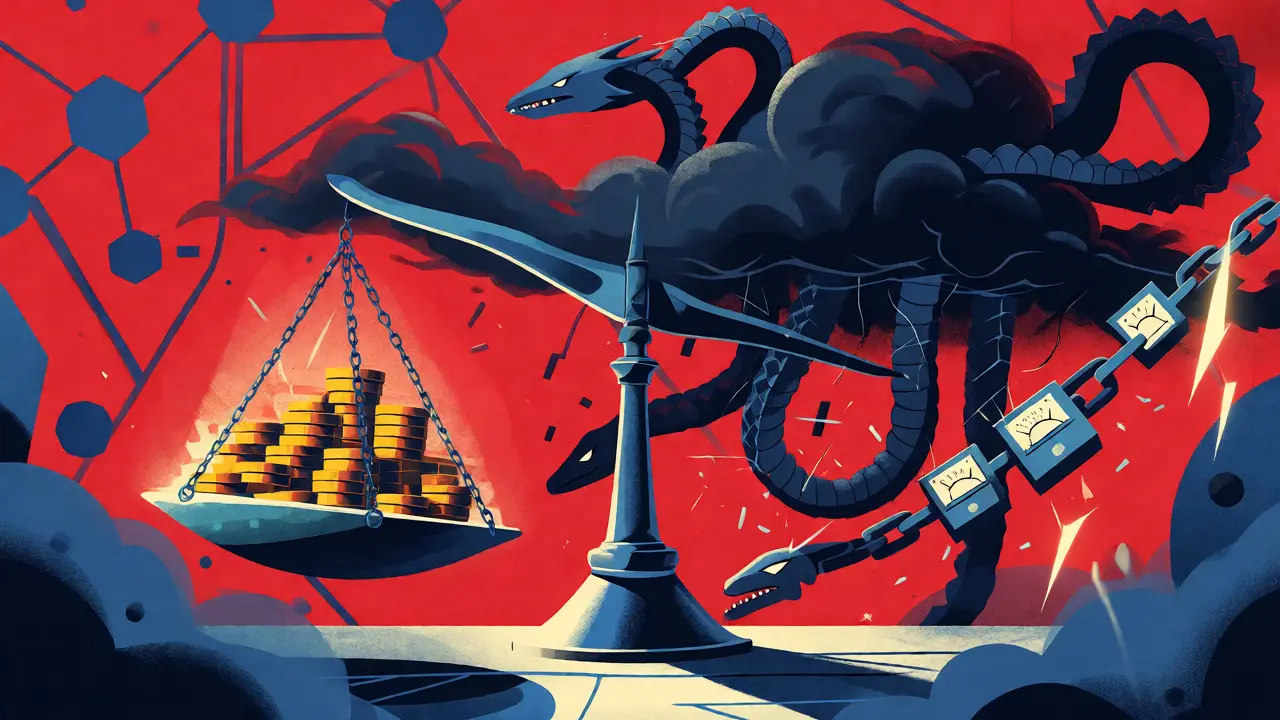
PoW vs. Proof of Stake: Different Flavors of Resistance
It’s worth noting that PoW isn’t the only way to stop Sybil attacks. Proof of Stake (PoS) is the main competitor, used by Ethereum and many newer chains. In PoS, validators lock up cryptocurrency as collateral. If they act maliciously, they lose their stake. This is often called "economic skin in the game."
So, which is better? It depends on what you value. PoW relies on external energy consumption-burning coal, hydro, or nuclear power to secure the chain. This makes it incredibly robust against long-range attacks and ideal for assets that need maximum neutrality, like Bitcoin. PoS relies on internal capital efficiency. It’s greener and faster, but critics argue it leads to centralization among the wealthy, who can afford to stake more coins.
For example, Ethereum requires a minimum of 32 ETH to become a validator. While this prevents casual Sybil attacks, it doesn’t prevent a whale from accumulating a massive stake and gaining disproportionate influence. PoW, by contrast, distributes power based on hardware availability, which is more geographically dispersed. As of 2025, Bitcoin maintains over 15,000 public nodes across 96 countries, showing a level of decentralization that purely financial staking models struggle to match.
Vulnerabilities: When PoW Isn't Enough
Don’t let the Bitcoin success story fool you into thinking PoW is invincible. It works best on large, mature networks. Smaller Proof of Work chains are vulnerable. Take Ethereum Classic (ETC), for instance. It suffered three separate 51% attacks in 2020 because its hash rate was low compared to its market cap. An attacker could rent enough hash power from cloud mining services to temporarily overpower the network, double-spend transactions, and make off with about $5.6 million.
This highlights a critical rule: PoW security scales with network size. A small coin with a low hash rate is easy to attack. A large coin with a massive hash rate is economically impossible to attack. This is why new projects launching with PoW face a "chicken and egg" problem-they need security to attract users, but they need users to build security. Many now use hybrid models or checkpointing to bridge this gap until they reach critical mass.

Practical Implications for Users and Developers
If you’re running a node, do you need to worry about Sybil attacks? Not really. Your node validates rules locally. Even if an attacker floods the network with bad blocks, your node will reject them if they don’t meet the difficulty requirements. However, developers building applications on top of PoW chains need to be aware of "node isolation" attacks. In these scenarios, an attacker connects to your node exclusively, feeding it false information so it thinks the rest of the network is broken.
To mitigate this, most clients limit inbound connections from single IP ranges. For instance, Bitcoin Core limits connections to ensure you’re talking to diverse peers. This simple configuration change drastically reduces the risk of being isolated. For institutional players, the stakes are higher. JPMorgan’s Onyx division processes billions daily in Bitcoin settlements, relying on the fact that PoW provides finality that is backed by real-world energy. They aren’t trusting code; they’re trusting thermodynamics.
The Future: Energy, Regulation, and Quantum Threats
PoW’s reliance on energy is its biggest strength and its biggest PR headache. The network consumes about 143 terawatt-hours annually-comparable to medium-sized countries. Critics argue this is wasteful. Supporters counter that it’s a feature, not a bug, because it converts volatile energy sources into stable digital money.
Regulators are taking notice. The EU’s MiCA regulations, effective January 2026, require PoW blockchains to disclose carbon footprints. This could push smaller chains toward greener energy mixes or force them to adopt hybrid consensus models. Meanwhile, quantum computing looms on the horizon. IBM’s recent 1,121-qubit processor raises questions about whether current cryptographic puzzles will remain hard for quantum computers. Most experts agree we have decades before this becomes a practical threat, giving the community time to upgrade algorithms.
For now, Proof of Work remains the most battle-tested defense against Sybil attacks. It turns the infinite scalability of digital identity into a finite resource constrained by physics. Until we find a way to verify uniqueness without burning energy or locking capital, PoW will continue to underpin the most valuable assets in the crypto ecosystem.
What exactly is a Sybil attack?
A Sybil attack occurs when a single adversary creates multiple fake identities (nodes) to gain disproportionate influence over a network. In peer-to-peer systems, this allows the attacker to manipulate routing, censor transactions, or dominate voting mechanisms without needing to control the majority of actual users.
Why is Proof of Work considered resistant to Sybil attacks?
Proof of Work requires participants to expend significant computational resources and electricity to validate transactions. Because creating a new identity still requires solving these costly puzzles, an attacker cannot cheaply generate thousands of valid identities. The cost of entry scales linearly with the number of identities, making large-scale Sybil attacks economically prohibitive.
Can a 51% attack happen on Bitcoin?
Technically, yes, but it is extremely unlikely due to the immense cost. To perform a 51% attack on Bitcoin, an adversary would need to control more than half of the network's hash rate. As of 2025, this would require investing over $12 billion in hardware and paying millions daily in electricity, all while risking a collapse in Bitcoin's price, which would devalue the attacker's holdings.
Is Proof of Stake safer against Sybil attacks than Proof of Work?
Both have different strengths. Proof of Stake prevents Sybil attacks by requiring validators to lock up capital, making it expensive to hold many identities. However, it can lead to wealth concentration. Proof of Work relies on physical energy costs, which are harder to monopolize globally. PoW is generally seen as more neutral for high-value assets, while PoS is favored for scalability and energy efficiency.
Do smaller cryptocurrencies suffer more from Sybil attacks?
Yes. Smaller Proof of Work chains with lower hash rates are much easier to attack. An attacker can rent hash power from cloud providers to temporarily exceed the network's capacity, allowing them to double-spend transactions. This is why new PoW projects often start with centralized checkpoints or hybrid consensus mechanisms until they achieve sufficient decentralization.