How the FATF Blacklist Is Reshaping Crypto Use in Iran
 Apr, 5 2025
Iran Crypto Premium Calculator
How Sanctions Affect Daily Life
Due to FATF sanctions, Iranians pay 15-22% extra for crypto transactions when importing essentials. This calculator shows the real cost impact on basic needs.
Real-World Impact
At 22% premium, an essential medicine costing $50 becomes $61. This means $11 extra for life-saving treatments.
For 18.7M users (42% of Iran's population), this translates to over $2.1 billion annually wasted on transaction fees instead of basic needs.
When the world cuts you off, crypto becomes your only lifeline
In 2019, Iran was placed on the FATF blacklist-a list of countries deemed too risky for the global financial system. Since then, Iranian banks have been cut off from SWIFT, international wire transfers have collapsed, and foreign banks refuse to touch any transaction linked to Iran. For ordinary people, this meant no access to PayPal, no way to pay for online services, no way to receive money from family abroad, and no way to buy essentials like medicine or spare parts for medical equipment. The result? Millions turned to cryptocurrency-not because they loved Bitcoin, but because they had no other choice.
By 2024, Iran accounted for nearly $9.2 billion of the $15.8 billion in crypto transactions flowing into all sanctioned countries. That’s more than Russia, Venezuela, and North Korea combined. It’s not a trend. It’s a survival mechanism.
Why the FATF blacklist hit Iran harder than any sanctions before
The FATF (Financial Action Task Force) isn’t just a warning label. When a country lands on its blacklist, global banks are legally required to treat any transaction involving that country as high-risk. That means freezing accounts, rejecting payments, and even shutting down entire branches that have ever dealt with Iranian entities. By 2025, Iran had only three correspondent banking relationships left-down from 28 in 2018. That’s not a slowdown. That’s a complete shutdown of the financial system.
Before the blacklist, Iranians could still use international payment processors like Western Union or Wise. Now? Those services are blocked. Even sending $50 to a relative in Turkey requires jumping through 10 different hoops. So people started using crypto. Not as an investment. Not as speculation. As a payment network.
How Iranians are using crypto: Bitcoin, privacy coins, and P2P networks
Bitcoin is the backbone. It makes up 78% of all crypto transactions from Iran. Why? Because it’s decentralized. No bank can shut it down. No government can freeze a Bitcoin wallet unless they physically seize the device holding the private keys.
Ethereum makes up 14% of transactions, mostly for smart contracts and tokenized goods. Then there’s Monero-5% of the total. It’s not popular because it’s trendy. It’s popular because it hides transaction details. If you’re trying to buy a medical device from Turkey and don’t want your name flagged by Iranian authorities, Monero is the only option.
But here’s the catch: Iranian users can’t just sign up for Binance or Coinbase. Those platforms are required by FATF to collect personal info under the “travel rule.” So when Iranians try to verify their identity, they’re handing over data that could land them in trouble with their own government. Many report their accounts getting frozen after just a few small transactions. One Reddit user in Tehran lost $8,200 after three transfers under $1,500-each one perfectly legal under FATF’s own rules, but flagged anyway.
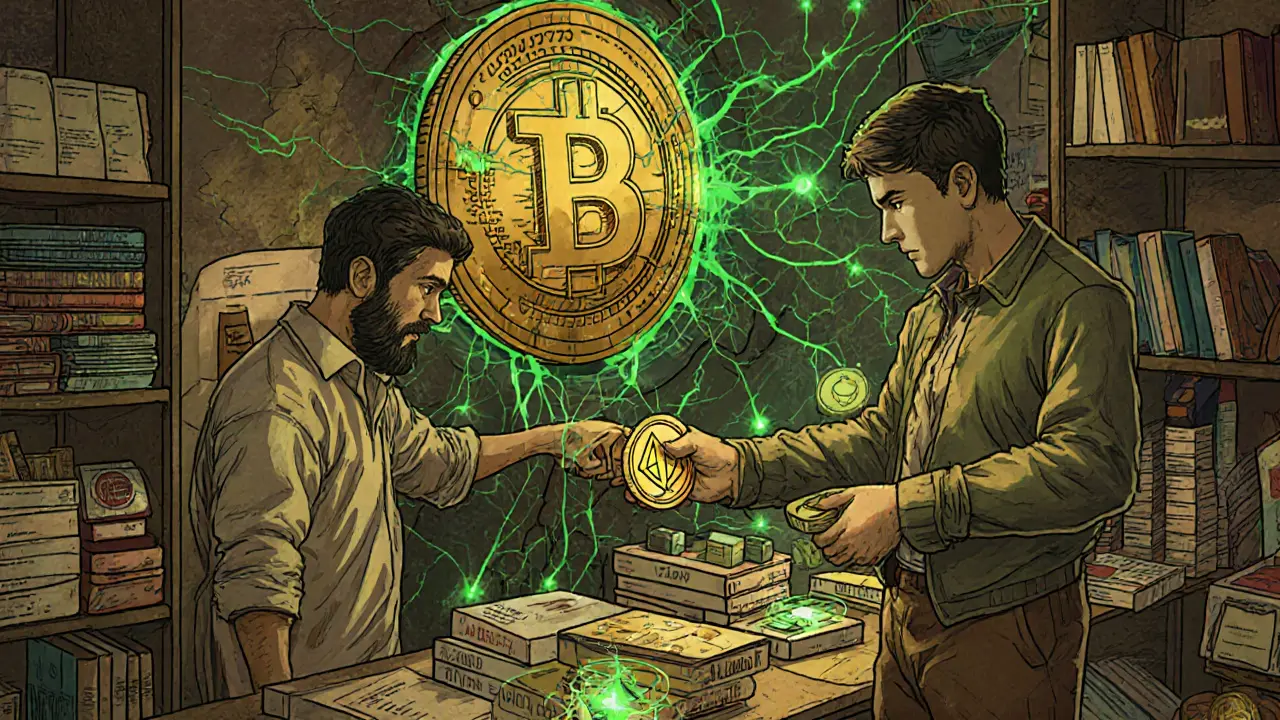
So people moved to peer-to-peer (P2P) networks. Platforms like LocalBitcoins and local Telegram groups let Iranians trade directly with users in Turkey, the UAE, and Pakistan. Success rates are around 78%, but there’s a cost: premiums of 15-22% on top of market price. That’s how much extra you pay just to get money out of the country.
The paradox: More crypto use = more risk
It’s a double-edged sword. The same tools that help Iranians bypass sanctions also make them targets.
On one side, Iranian authorities monitor crypto activity closely. All internet users must register their SIM cards. The government tracks IP addresses. Apps like Soroush+ help users hide their location, but 41% of them still get blocked. The Central Bank has even started fining people who use crypto to import goods that are legally banned.
On the other side, global exchanges are terrified of violating U.S. or EU sanctions. In September 2025, the UAE-based exchange Rain froze 317 Iranian accounts overnight, wiping out $4.1 million in total. No warning. No explanation. Just a message: “Your account has been suspended due to regulatory compliance.”
And then there’s the tech barrier. Most Iranians don’t know how to manage a seed phrase. A survey by the Iran Blockchain Academy found that 61% of new users needed help setting up a wallet-and many lost funds because they wrote down their recovery phrase wrong or stored it on a phone that got stolen.
What’s being done? Halal Stablecoins and underground networks
In August 2025, Iran’s Central Bank launched a “Halal Stablecoin” (HSC), pegged to gold. It’s designed to work inside Iran, for local payments and to avoid U.S. dollar dependency. In its first month, 4.2 million people used it to move $280 million. Sounds promising? It is-until you realize it can’t connect to the outside world. Because of FATF rules, no international exchange will touch it. No foreign bank will accept it. It’s a digital currency trapped behind a digital wall.
Meanwhile, grassroots solutions are thriving. GitHub has a project called “IranCryptoKit” with over 2,300 stars. It’s a collection of open-source tools that help users bypass national firewalls, run local nodes, and route transactions through multiple countries. But here’s the problem: 37% of users who downloaded these tools reported security breaches. Someone built a fake version. Someone stole private keys. No one’s auditing them.

Who’s really winning? No one
The FATF says its goal is to stop money laundering and terrorist financing. But in Iran, the result is different. The blacklist didn’t stop illicit activity. It forced it underground. It didn’t reduce crypto use. It made it essential.
Chainalysis data shows that 78% of Iran’s crypto activity now serves as a sanctions evasion tool. Of that, 61% helps pay for imported goods-food, medicine, car parts-that are blocked by sanctions. This isn’t drug money. This is a family buying insulin. A factory repairing a water pump. A student paying for an online course.
And yet, FATF hasn’t budged. Even after Iran ratified two international anti-terrorism conventions in 2024 and 2025, the organization hasn’t removed it from the list. Experts like Dr. Emad Kiyaei argue the blacklist has become counterproductive. “It’s accelerating crypto adoption without reducing risk,” he wrote. “It’s turning a financial tool into a national necessity.”
Meanwhile, Iranian users are stuck. They can’t go back to banks. They can’t fully trust exchanges. They can’t rely on government solutions. They’re using apps that might get hacked, paying premiums that eat into their savings, and risking arrest just to buy groceries.
The future: 25 million users by 2027-or collapse?
By 2027, FATF predicts more than 25 million Iranians will be using crypto regularly. That’s more than half the adult population. It’s not a prediction. It’s an inevitability.
But there’s another scenario. If global exchanges keep freezing accounts, if liquidity dries up, if P2P premiums climb past 30%, then the system could break. People will lose faith. They’ll stop sending money out. They’ll stop buying in. And what happens when a family can’t get insulin because the crypto network collapsed?
Right now, crypto in Iran isn’t about wealth. It’s about survival. And the world is watching-but not helping. The FATF didn’t design this outcome. But it’s the only one that’s real.
Why is Iran still on the FATF blacklist in 2025?
Iran was placed on the FATF blacklist in 2019 for failing to implement a 12-point action plan to stop money laundering and terrorist financing. Although Iran ratified two international conventions in 2024 and 2025, FATF says it hasn’t fully implemented the required legal and regulatory changes. FATF has not publicly confirmed progress, and as of October 2025, Iran remains on the list alongside North Korea.
How much crypto is Iran using compared to other countries?
In 2024, Iran accounted for $9.2 billion of the $15.8 billion in crypto transactions to all sanctioned countries-more than Russia, Venezuela, and North Korea combined. That’s 58% of all sanctioned jurisdiction crypto inflows. Iran has 18.7 million crypto users, or 42% of its adult population, making it the highest crypto adoption rate among sanctioned nations.
Can Iranians use Binance or Coinbase legally?
Technically, no. Global exchanges like Binance and Coinbase are required by FATF and U.S. sanctions to block Iranian users. Even if someone uses a VPN to sign up, their account is likely to be frozen if detected. Many Iranian users report account closures after just a few small transactions due to automated FATF compliance systems flagging their activity.
What’s the safest way for Iranians to use crypto right now?
The safest method is using non-custodial wallets (like Trust Wallet or Exodus) and peer-to-peer (P2P) trades through trusted local networks. Avoid exchanges that require KYC. Use privacy coins like Monero for sensitive transfers. But even this carries risk: Iranian authorities monitor internet use, and many P2P platforms are unregulated. Success rates are around 78%, but premiums can be 15-22% higher than market price.
Is Iran’s Halal Stablecoin a solution?
No-not for international use. Iran’s Halal Stablecoin (HSC) works only inside the country and is pegged to gold. It can’t connect to global exchanges or banks because of FATF restrictions. It’s useful for domestic payments but doesn’t solve the core problem: accessing the global economy. It’s a domestic workaround, not an international bridge.
What happens if the FATF blacklist stays forever?
If the blacklist remains, crypto use in Iran will keep growing-but so will instability. Experts predict a 60% chance of systemic collapse by mid-2026 if liquidity dries up and exchanges stop supporting Iranian users. Without access to reliable, low-cost crypto channels, ordinary people will face shortages of medicine, food, and essential goods. The system is holding, but barely.