Network Hash Rate Trends: Security, Growth, and What It Means for Bitcoin in 2026
 Jul, 6 2026
Imagine a digital fortress where the walls are built not of stone, but of billions of calculations per second. That is what network hash rate is to a blockchain. It is the heartbeat of proof-of-work systems like Bitcoin, measuring the total computational power miners contribute to secure the ledger. As we move through 2026, understanding these trends isn't just for hardcore miners; it’s essential for anyone holding crypto or watching the market. Why? Because hash rate directly dictates security, energy usage, and even price stability.
If you’ve ever wondered why Bitcoin feels so "heavy" and secure compared to newer coins, or why your mining profits might be shrinking despite buying better hardware, the answer lies in these numbers. The landscape has shifted dramatically since the early days. Today, we’re looking at exahashes-quintillions of calculations every second. This article breaks down what those numbers mean, how they affect you, and where the industry is heading as institutional players take over.
What Exactly Is Network Hash Rate?
At its core, hash rate is the speed at which a blockchain network solves cryptographic puzzles to validate transactions and create new blocks. Think of it as a collective effort. Every miner on the network is trying to solve a complex math problem. The first one to solve it gets to add the next block to the chain and earn the reward. The more computers (miners) working on this problem, the higher the hash rate.
We measure this in hashes per second (H/s). But because modern networks are so powerful, we use larger units:
- Kilohashes (KH/s): 1,000 hashes per second.
- Megahashes (MH/s): 1 million hashes per second.
- Gigahashes (GH/s): 1 billion hashes per second.
- Terahashes (TH/s): 1 trillion hashes per second.
- Petahashes (PH/s): 1 quadrillion hashes per second.
- Exahashes (EH/s): 1 quintillion hashes per second.
Bitcoin currently operates in the exahash range. To put that in perspective, when Satoshi Nakamoto mined the genesis block in 2009, the entire network had a hash rate close to zero. Today, it hovers around 600 EH/s, representing a staggering increase in global computing power dedicated solely to securing one currency.
The Security Link: Why Higher Is Usually Better
You might ask, "Does a higher hash rate actually make my money safer?" The short answer is yes. In a proof-of-work system, security is bought with electricity and hardware. To attack the network-for example, by double-spending coins-an attacker would need to control more than 50% of the total hash rate. This is known as a 51% attack.
As the hash rate climbs, the cost of such an attack becomes astronomical. According to recent analyses, attempting a 51% attack on Bitcoin would require roughly $14.8 billion in specialized hardware and nearly $39 million daily in electricity costs. That’s why major networks like Bitcoin are considered virtually unhackable via brute force. Conversely, smaller networks with lower hash rates remain vulnerable. For instance, Ravencoin suffered a double-spend incident in early 2024 because its hash rate was too low to deter attackers effectively.
However, there’s a nuance here. High hash rate doesn’t automatically mean decentralized security. If most of that power is controlled by a few large mining pools, the risk shifts from a technical hack to a coordinated collusion among pool operators. Fortunately, data from late 2025 shows Bitcoin’s top three pools controlling only about 42% of the hash rate, down from 65% in 2019, suggesting a healthier distribution of power.
Recent Trends: Explosive Growth and Institutional Entry
Looking at the charts from 2021 to 2026, the growth curve is steep. Bitcoin’s hash rate jumped from 40 EH/s in January 2021 to over 600 EH/s by late 2025. This isn’t random noise; it’s driven by two main factors: technological efficiency and institutional capital.
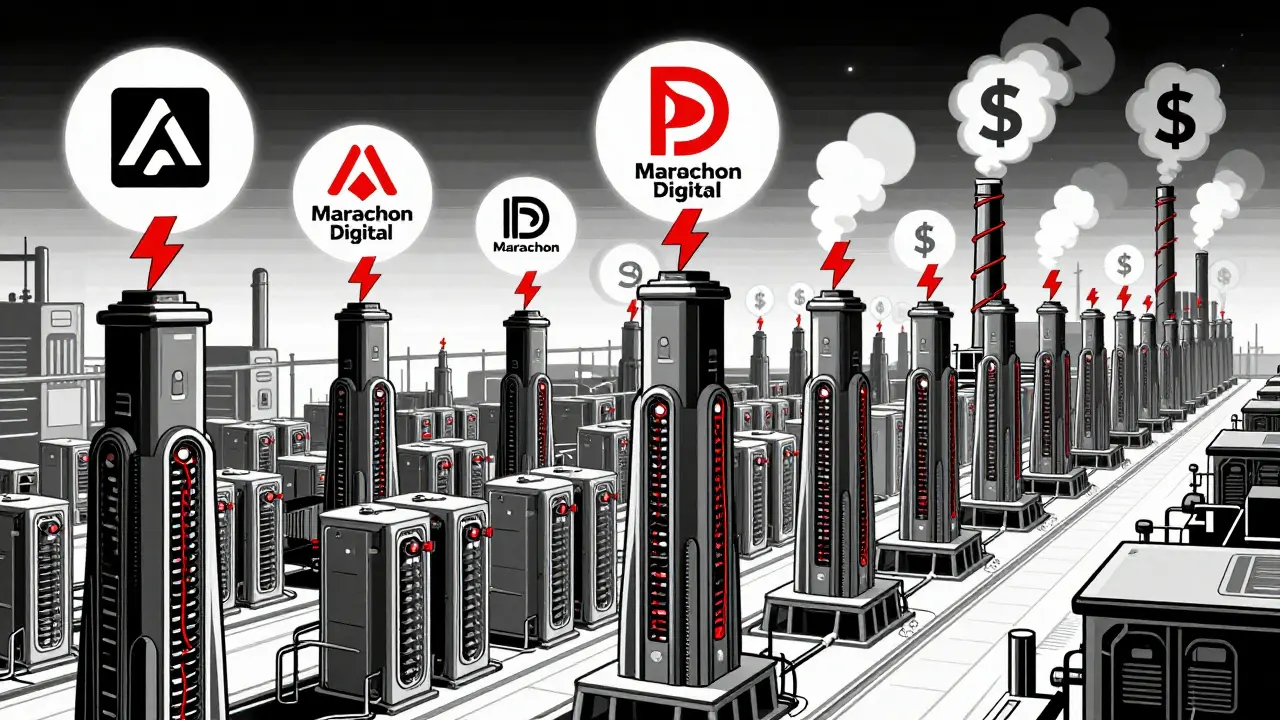
First, the hardware has gotten insanely good. The latest ASIC miners, like the Bitmain Antminer S21, deliver 200 TH/s while consuming significantly less energy per terahash than older models. When hardware becomes more efficient, miners buy more of it, pushing the network difficulty up. Second, big money has arrived. Publicly traded companies like Marathon Digital and Riot Platforms now control a significant slice of the network. Their access to cheap capital allows them to deploy massive facilities, such as Bitfarms’ 100 MW site in Texas, adding terahashes of capacity overnight.
This influx of professional miners has changed the game for hobbyists. The barrier to entry is no longer just buying a machine; it’s securing cheap electricity and managing industrial-scale heat dissipation. The average individual miner faces a steeper learning curve and higher operational costs, leading many to exit or join pools to survive.
| Network | Approximate Hash Rate | Primary Mining Hardware | Security Status |
|---|---|---|---|
| Bitcoin (BTC) | ~600 EH/s | ASIC (e.g., Antminer S21) | Very High |
| Bitcoin Cash (BCH) | ~4.2 EH/s | ASIC | High |
| Litecoin (LTC) | ~650 TH/s | ASIC (Scrypt) | Medium-High |
| Dogecoin (DOGE) | ~450 TH/s | ASIC (Scrypt) | Medium |
| Ravencoin (RVN) | ~25 TH/s | GPU/ASIC | Low-Medium |
The Energy Debate: Sustainability vs. Consumption
No discussion on hash rate is complete without addressing the elephant in the room: energy consumption. Critics point out that Bitcoin’s network consumes approximately 121.72 terawatt-hours annually, comparable to the energy usage of medium-sized countries. This translates to a carbon footprint of roughly 62.4 megatons of CO2 each year.
But the story is evolving. The narrative of "Bitcoin destroys the planet" is being challenged by data showing a shift toward renewable sources. According to the Bitcoin Mining Council’s Q2 2025 report, 58.3% of Bitcoin’s hash rate is now powered by renewable energy. Miners are increasingly locating operations near stranded energy sources-like natural gas flaring sites in Texas or hydroelectric dams in Canada-that would otherwise go to waste. This symbiotic relationship helps stabilize local grids while providing miners with ultra-low electricity costs, sometimes as low as $0.025/kWh compared to the national average of $0.147/kWh.
Still, the environmental impact remains a valid concern for many. As hash rates climb toward the projected 1,000 EH/s by mid-2026, the pressure to prove sustainability will only intensify. Regulatory bodies in regions like New York have imposed moratoriums on proof-of-work mining, forcing the industry to innovate or relocate.

What This Means for You: Investors and Miners
If you’re an investor, watch the hash rate as a leading indicator. Historically, hash rate tends to lead price increases by 60 to 90 days. When you see hash rate hitting all-time highs, it often signals strong miner confidence and network security, which can precede bull markets. However, be wary of sudden drops. A sharp decline in hash rate can indicate miner capitulation due to falling prices or rising difficulty, potentially signaling market weakness.
For aspiring miners, the reality is harsh. The era of mining on a laptop is dead. Profitability now depends on economies of scale. With electricity making up over 70% of operational expenses, you need access to subsidized power. Even then, the competition from industrial farms is fierce. Many small miners report decreased profitability in 2025 despite holding newer hardware, simply because the network difficulty adjusted upward faster than their revenue could grow.
Consider this scenario: You invest $12,500 in three high-end ASICs. After six months, after accounting for electricity and difficulty spikes, you might only recover a fraction of your initial investment. Unless you have a unique advantage in energy costs or location, self-mining is becoming a niche activity rather than a passive income stream.
Future Outlook: 2026 and Beyond
As we look ahead, several key events will shape hash rate trends. First, the upcoming Bitcoin halving in April 2026 will cut block rewards to 3.125 BTC. This typically triggers a "shakeout," where less efficient miners turn off their rigs because they are no longer profitable. Analysts predict a temporary 15-20% drop in hash rate following the event, before recovery begins as prices adjust.
Second, technological advancements continue to push boundaries. Next-generation chips using 5nm technology promise even greater efficiency, potentially driving hash rates beyond 1,000 EH/s by late 2026. Additionally, the launch of Bitcoin-focused ETFs for mining stocks could channel more traditional finance capital into the infrastructure layer, further professionalizing the sector.
While some experts argue that proof-of-stake models offer a more sustainable future, the battle-tested security of proof-of-work remains unmatched for those who prioritize decentralization and censorship resistance. The hash rate isn’t just a number; it’s the visible manifestation of trust in the network. As long as that trust holds, the lights-and the calculators-will stay on.
How does hash rate affect Bitcoin's price?
Hash rate acts as a leading indicator for Bitcoin's price. A rising hash rate suggests miners are confident in the network's future value, investing heavily in hardware and electricity. Historically, sustained increases in hash rate have preceded price rallies by 60-90 days. Conversely, a sharp drop may signal miner distress, often correlating with price declines.
Is it still profitable to mine Bitcoin at home in 2026?
For most individuals, home mining Bitcoin is no longer profitable due to high electricity costs and intense competition from industrial-scale operations. Profitability requires access to extremely cheap power (below $0.05/kWh) and efficient cooling solutions. Without these advantages, operational costs usually exceed mining rewards.
What happens if the hash rate drops suddenly?
If the hash rate drops, the network's difficulty adjusts downward within two weeks to maintain consistent block times. While this makes mining easier for remaining participants, it temporarily reduces the network's resistance to 51% attacks. Significant drops often occur after halvings or during bear markets when marginal miners shut down.
Why is Bitcoin's hash rate so much higher than other cryptocurrencies?
Bitcoin has the highest market cap and longest track record, attracting the most mining capital. Its use of Application-Specific Integrated Circuits (ASICs) creates a high barrier to entry, concentrating power among serious investors. Other coins either use different consensus mechanisms (like Ethereum's proof-of-stake) or have lower rewards, resulting in significantly lower hash rates.
How does network difficulty relate to hash rate?
Difficulty is an algorithmic adjustment that keeps block production time constant (every 10 minutes for Bitcoin). As hash rate increases, more computing power is available, so the network raises the difficulty to prevent blocks from being found too quickly. They are inversely proportional in terms of ease of mining but directly correlated in magnitude.