Quadratic Voting in DAOs: How to Stop Whales and Fix Governance
 Jun, 10 2026
Imagine you are part of a community project where everyone has an equal say. But then, one person buys half the shares. Suddenly, their opinion matters twice as much as everyone else combined. This is the daily reality for many Decentralized Autonomous Organizations, or DAOs. The promise of blockchain was decentralization, but traditional voting often leads to plutocracy-rule by the wealthy. Enter quadratic voting.
Quadratic voting is not just a tweak; it is a fundamental shift in how we measure consent. It stops big token holders from steamrolling small ones. If you have ever felt your voice didn't matter in a crypto community, this mechanism might be the solution you have been waiting for. Let’s break down how it works, why it matters, and what you need to know before implementing it.
The Problem with One Token, One Vote
In most DAOs, governance is simple: one token equals one vote. This sounds fair until you look at the distribution. In many projects, a small group of early investors or developers holds the majority of tokens. These "whales" can pass proposals that benefit them, even if 90% of the community disagrees.
This creates a disconnect. The people doing the work-the contributors, the moderators, the everyday users-have less power than the people who just bought in early. Research published in Frontiers in Blockchain highlights that linear voting systems tend to reflect the will of the few, not the many. Quadratic voting fixes this by changing the cost of influence.
How Quadratic Voting Works
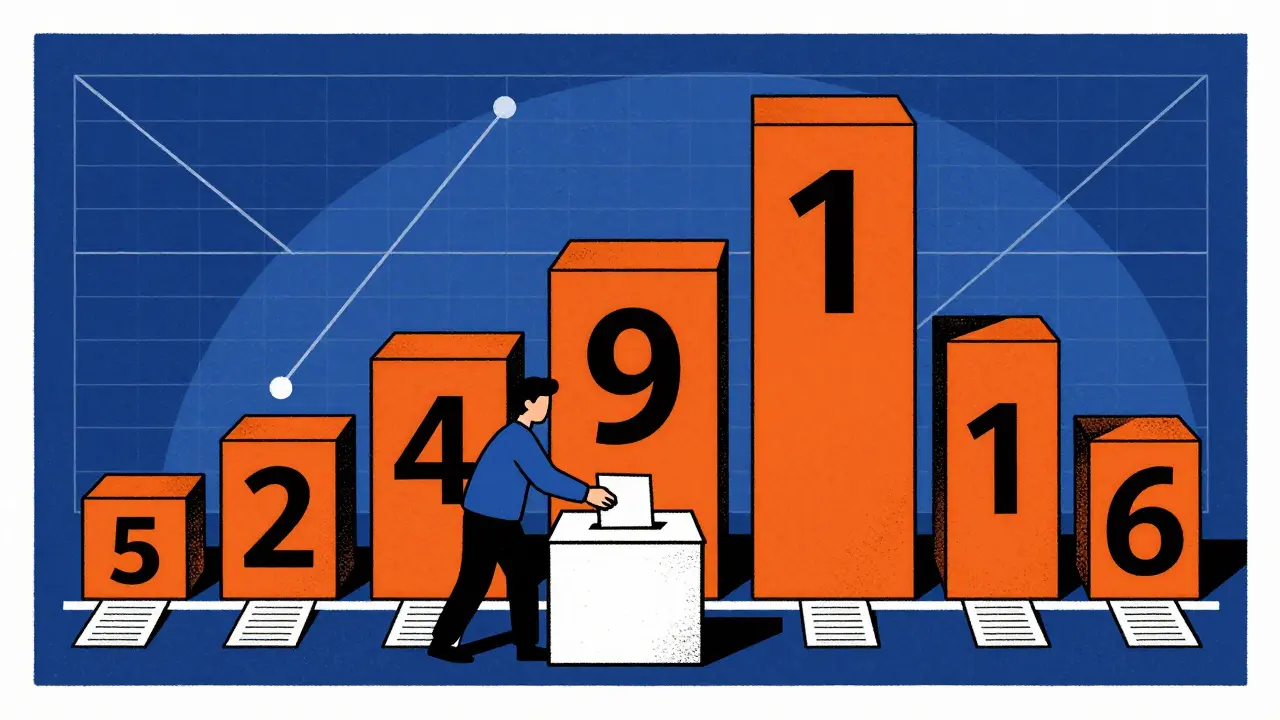
The core idea is simple: the more votes you cast on a single issue, the more expensive each additional vote becomes. Specifically, the cost scales quadratically.
Here is the math made easy:
- 1st vote costs 1 credit.
- 2nd vote costs 4 credits (total).
- 3rd vote costs 9 credits (total).
- 10th vote costs 100 credits (total).
This means if you want to exert massive influence, you have to pay a huge price. It encourages voters to spread their credits across multiple issues they care about, rather than dumping all their power into one proposal. It captures the intensity of your preference, not just the direction.
| Votes Cast | Linear Cost (Credits) | Quadratic Cost (Credits) |
|---|---|---|
| 1 | 1 | 1 |
| 5 | 5 | 25 |
| 10 | 10 | 100 |
| 50 | 50 | 2,500 |
Notice how quickly the cost explodes? This prevents whales from buying outcomes easily. They still have more power than solo voters, but not disproportionately so. In a scenario with 100 participants where one person holds 100 tokens and 99 others hold 1 each, linear voting lets the whale win. Quadratic voting compresses that whale’s power, allowing the collective will of the 99 to prevail.
Real-World Examples: Who Is Using It?
Quadratic voting is not just theory. Several platforms and DAOs have tested it with real results.
Realms is a leading DAO tool that offers a Quadratic Voting Plugin. It calculates voting power based on the square root of tokens held. This effectively boosts the relative power of smaller holders. For example, if you hold 100 tokens, your voting power is treated as 10 units, not 100. This makes it easier for minority groups to sway decisions.
CityDAO has explored quadratic voting for land acquisition and development decisions. Since these decisions affect local communities, ensuring broad consensus is critical. Quadratic voting helps ensure that a single investor cannot force through a project that locals oppose.
Another example is Codeless Conduct, which used quadratic voting to evaluate hackathon submissions. Instead of letting popular teams win simply because they had more connections, the voting system allowed judges to express how strongly they felt about specific code quality metrics. The result was a more nuanced and fair selection process.
The Sybil Attack Challenge
There is a catch. Quadratic voting relies on one assumption: each voter is a unique human being. If I can create 1,000 fake accounts, each with 1 vote, I can outvote any whale. This is called a Sybil attack.
To prevent this, DAOs using quadratic voting must implement strong identity verification. Realms integrates with Civic Pass, a digital identity service that verifies unique individuals without compromising privacy. Without such checks, quadratic voting collapses. It is only as strong as its identity layer.
This adds complexity. You are no longer just holding tokens; you are proving you are a person. Some purists argue this goes against the anonymous nature of crypto. Others say true democracy requires knowing who is voting. It is a trade-off between privacy and integrity.
Implementation Hurdles
Adopting quadratic voting is not plug-and-play. Here are the main challenges:
- User Education: Most users understand "one token, one vote." Explaining quadratic costs takes time. Interfaces must clearly show how many credits remain and what each vote costs.
- Credit Allocation: Where do the voting credits come from? Are they distributed equally? Based on token holdings? This decision shapes the entire governance dynamic.
- Technical Setup: Smart contracts must enforce the quadratic formula automatically. Errors here can lead to exploits or unfair outcomes.
- Low Participation: As noted by experts, low turnout makes collusion easier. Quadratic voting helps mitigate whale dominance, but it does not fix apathy.
LimeChain’s analysis points out that while quadratic voting reduces the risk of extreme outcomes, it requires active engagement. If only a small, coordinated group participates, they can still manipulate the results, especially if they understand the math better than the average user.
Is Quadratic Voting Right for Your DAO?
It depends on your goals. If you prioritize pure efficiency and trust your large investors, stick with linear voting. It is simpler and faster.
But if you value democratic legitimacy and want to empower your broader community, quadratic voting is worth considering. It is particularly useful for:
- Community-driven projects with diverse stakeholders.
- DAOs facing accusations of whale dominance.
- Organizations making high-stakes decisions that require broad consensus.
Start small. Use it for non-critical proposals first. Educate your members. Test the identity verification flow. And monitor participation rates closely.
The Future of DAO Governance
We are moving beyond simple token counts. As DAOs mature, they face complex decisions that require nuanced input. Quadratic voting is one piece of a larger puzzle that includes delegation, liquid democracy, and reputation-based systems.
Recent developments in 2024 and 2025 show improved tools for implementation. User interfaces are becoming more intuitive. Identity solutions like Civic Pass are gaining wider adoption. Academic research continues to refine the parameters, helping DAOs choose the right balance between cost and influence.
The goal is not perfect equality. It is fair representation. Quadratic voting gets us closer to that goal by ensuring that every voice counts, and that loud voices pay a premium for their volume.
What is the main advantage of quadratic voting over linear voting?
The main advantage is that it reduces the disproportionate influence of large token holders (whales). By making additional votes exponentially more expensive, it encourages broader participation and reflects the intensity of preferences across the community, rather than just the wealth of the few.
How does quadratic voting prevent Sybil attacks?
Quadratic voting itself does not prevent Sybil attacks. It requires integration with identity verification systems like Civic Pass to ensure each voter is a unique individual. Without this, bad actors could create multiple fake accounts to game the system.
Can I use quadratic voting on any DAO platform?
Not all platforms support it natively. However, platforms like Realms offer plugins for quadratic voting. Other DAO tools may require custom smart contract development to implement the quadratic cost structure.
Is quadratic voting more complex for users?
Yes, it has a steeper learning curve. Users need to understand how vote costs scale and manage their voting budget carefully. Good UI design and education are essential to prevent confusion and ensure effective participation.
Does quadratic voting eliminate whale dominance completely?
No, it mitigates it. Large holders still have more voting power than small holders, but the gap is significantly reduced. It shifts the balance toward the collective will of the majority rather than absolute control by the wealthiest participants.
Filbert Reeves
June 11, 2026 AT 06:05its all a big scam man they just want your data for civic pass and then the government takes over everything quadratic voting is just another way to control the masses while making you think you have power lol
Eric Scheinberg
June 12, 2026 AT 12:43The theoretical elegance of quadratic voting is undeniable, yet its practical application remains fraught with significant hurdles. The requirement for robust identity verification fundamentally alters the decentralized ethos that many participants cherish. Furthermore, the cognitive load imposed upon voters necessitates a level of financial literacy and engagement that is rarely present in broad-based communities.
Amit Thakur
June 13, 2026 AT 11:40Bros are totally ignoring the gas fees involved in executing these complex smart contracts on L1s. If you're talking about real-world implementation, you need to consider the UX friction. Nobody wants to calculate square roots before they vote. We need better abstraction layers like Account Abstraction to make this seamless otherwise adoption will be zero. Let's build the middleware that handles the math automatically so users just see 'Yes' or 'No'. This is where the alpha is right now in governance tooling.
Nick Rice
June 13, 2026 AT 19:37I really appreciate the detailed breakdown here. It is crucial that we empower every voice in our digital communities. Let us move forward with optimism and ensure that our tools reflect our shared values of fairness and inclusion. Together we can build a better system.
Charles Pawlikowski
June 15, 2026 AT 06:24typical crypto bro nonsense :/ why do we even need this complicated math when we could just trust the whales who actually have skin in the game? it's always about trying to dilute responsibility instead of taking ownership. stop whining and buy more tokens if you care so much (y)
Jessica Lane
June 15, 2026 AT 10:25This perspective highlights a critical tension between efficiency and equity. I am deeply concerned about the potential for voter fatigue when the cost structure is not intuitive. How do we ensure that new members feel welcome rather than intimidated by the mathematical barriers to entry?
pankaj chawla
June 16, 2026 AT 21:43Good points raised by everyone. I think we should collaborate on a pilot program to test these mechanisms in a low-stakes environment. It would be beneficial to gather empirical data before full implementation.
sreeja boora
June 17, 2026 AT 18:34The article presents a superficial understanding of governance dynamics. Quadratic voting is merely a band-aid solution that fails to address the root causes of centralization in blockchain ecosystems. True sovereignty cannot be achieved through algorithmic adjustments alone but requires a fundamental reimagining of community structure and cultural values.