Quantum Key Distribution for Crypto: How It Secures Blockchain Against Quantum Threats
 Oct, 8 2025
QKD vs. PQC Cost-Benefit Calculator
Calculate QKD vs. PQC Value
Determine if Quantum Key Distribution or Post-Quantum Cryptography is more appropriate for your use case based on your specific requirements.
Recommendation
Why this recommendation? Based on your inputs and the trade-offs described in the article:
- QKD is most valuable for organizations requiring the highest security with critical, long-term data
- QKD has significant distance limitations (max 500 km fiber)
- PQC is more cost-effective for most public blockchain applications
- QKD costs $50,000-$100,000 per node with specialized maintenance
What Quantum Key Distribution Really Does for Crypto
Imagine sending a secret key over the internet so securely that not even a future quantum computer can steal it without you knowing. That’s not science fiction - it’s quantum key distribution, or QKD. For blockchain systems handling billions in assets or sensitive government data, this isn’t just a nice-to-have. It’s the only known way to make encryption truly future-proof against quantum attacks.
Today’s crypto relies on math problems that are hard for regular computers to solve - like factoring huge numbers. But quantum computers? They can crush those problems in seconds using Shor’s algorithm. Once that happens, every Bitcoin wallet, every encrypted blockchain transaction, every digital signature could be broken. QKD doesn’t try to fix the math. It skips it entirely. Instead, it uses the laws of physics to share keys. If someone tries to spy, the quantum state of the photons changes - and you instantly know.
How QKD Works (Without the Physics Jargon)
Let’s say Alice wants to send a secret key to Bob. She sends each bit of the key as a single photon - a particle of light - through a fiber optic cable. Each photon is polarized in one of four directions, randomly chosen, to represent 0 or 1. Bob doesn’t know which direction to measure, so he guesses. He picks a random filter for each photon.
After the photons arrive, Alice and Bob talk over a regular internet connection (not the quantum one) and say: “Hey, I used the vertical/horizontal filter for the 3rd photon. What about you?” If Bob used the same filter, they keep that bit. If not, they throw it out. This is called “sifting.”
Now they check for errors. In a perfect world, all the bits they kept should match. But if an eavesdropper, Eve, tried to intercept and measure the photons, she’d mess them up. Quantum mechanics says you can’t copy a photon without changing it. So if the error rate jumps above 5%, they know someone was listening. They delete the key and start over.
What’s left is a perfectly random, perfectly secret key - one that no computer, quantum or otherwise, can reproduce without being detected. That key then encrypts the actual blockchain data using AES-256, the same strong encryption banks use today. QKD doesn’t replace AES. It replaces the weak link: how you share the key.
Why QKD Beats Traditional Crypto for Long-Term Security
Right now, most blockchain networks rely on RSA or ECC for digital signatures. These are vulnerable to quantum attacks. Even if a quantum computer isn’t here yet, attackers can record encrypted traffic today and decrypt it later - a tactic called “harvest now, decrypt later.”
QKD stops that cold. Because the key is generated and shared using quantum physics, not math, there’s no algorithm to crack. The security isn’t based on how strong your computer is - it’s based on how the universe works. That’s called information-theoretic security. It’s the gold standard.
Compare that to post-quantum cryptography (PQC), which tries to build new math problems that quantum computers can’t solve. NIST is standardizing these right now - CRYSTALS-Kyber for encryption, Dilithium for signatures. But PQC still assumes the math is hard. If someone finds a new quantum algorithm, you’re back to square one. QKD doesn’t make that assumption. It doesn’t need to.
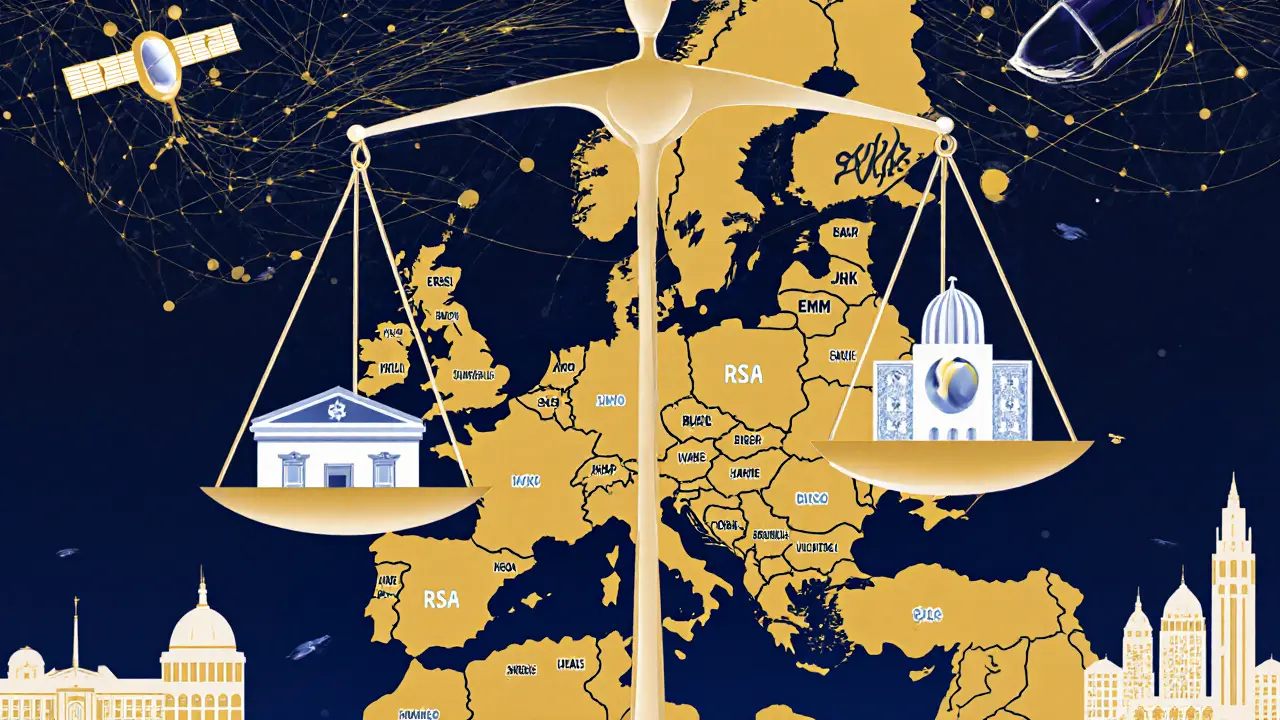
That’s why governments and financial institutions are investing. Switzerland has used QKD to secure its electronic voting system since 2007. China’s 4,600-kilometer Beijing-Shanghai quantum network handles banking and military traffic. The EU is building EuroQCI, a continent-wide quantum network set to launch by 2027. These aren’t experiments. They’re operational systems.
The Real-World Limits of QKD
QKD isn’t magic. It has serious downsides.
First, distance. Photons get lost in fiber. After 100-150 km, you’re lucky to get a usable signal. Some systems reach 500 km with special tech, but that’s the hard limit without quantum repeaters - which don’t exist commercially yet. Free-space QKD via satellite (like China’s Micius satellite) can span continents, but it only works at night, in clear weather, and needs precise alignment.
Second, cost. A single QKD node costs between $50,000 and $100,000. You need one at each end of the link. Add fiber installation, cooling systems for single-photon detectors (they need to run at -70°C), and specialized engineers. A financial firm in London spent $75,000 to link two data centers - and said the biggest headache wasn’t the tech, it was the staff training.
Third, complexity. You need optical engineers who understand quantum states, not just IT admins. One survey found 78% of QKD operators have advanced degrees in physics. Most companies don’t have that. And even then, real devices have flaws. In 2010, researchers showed they could blind QKD detectors with bright light pulses - a hack that bypassed the quantum protocol entirely. The theory is bulletproof. The hardware? Not always.
Who’s Actually Using QKD Today?
Not you. Not most startups. Not even most blockchain companies.
QKD is for high-value, low-mobility, ultra-sensitive use cases:
- Government and defense: The UK’s NCSC now requires QKD for all new high-assurance systems by 2025. NATO allies are following suit.
- Central banks and financial hubs: Banks in Switzerland, Japan, and Germany use QKD to secure inter-branch transfers of high-value settlements.
- Blockchain infrastructure: Some private blockchain networks for sovereign wealth funds or supply chain audits use QKD to protect the root keys that control access.
For everything else - DeFi, NFT marketplaces, public chains like Ethereum - it’s overkill. You don’t need quantum-proof keys for a $500 NFT sale. You need speed, scalability, and low cost. That’s where PQC wins.
Here’s the reality: Only 12% of Fortune 500 companies have active QKD pilots. Meanwhile, 67% are testing PQC. That’s not because PQC is better. It’s because it’s easier. You update software. QKD requires rewiring your network.
QKD vs. PQC: The Practical Choice
| Feature | Quantum Key Distribution (QKD) | Post-Quantum Cryptography (PQC) |
|---|---|---|
| Security Basis | Physics (quantum mechanics) | Math (hard problems) |
| Key Distribution | Hardware-based, physical channel | Software, over existing networks |
| Eavesdropping Detection | Yes - any interception causes detectable errors | No - you won’t know if someone stole your data |
| Cost per Node | $50,000-$100,000 | $0-$500 (software update) |
| Range Limit | 500 km max (fiber), satellite for longer | None - works anywhere internet works |
| Deployment Time | 6-12 months (hardware + training) | Days to weeks |
| Best For | Government, finance, long-term secrets | Public blockchains, enterprise apps, IoT |
Most experts agree: QKD and PQC aren’t rivals. They’re partners. Use QKD to protect your most critical keys - the ones that unlock your entire system. Use PQC to secure everything else. That’s the hybrid model the U.S. National Security Agency recommends.
How to Get Started With QKD (If You Really Need It)
If you’re a government agency, central bank, or high-security blockchain operator, here’s how to begin:
- Identify your critical assets. What data, if stolen in 20 years, would destroy your organization? That’s your target for QKD.
- Map your network. QKD needs a direct fiber link between two points. No routing. No wireless. No shared infrastructure.
- Choose a vendor. ID Quantique, Toshiba, and QuintessenceLabs are the leaders. Ask for ETSI-certified systems - they’ve been tested against known attacks.
- Integrate with your key management system. QKD doesn’t encrypt data. It gives you a key. You still need something like HashiCorp Vault or AWS KMS to store and rotate it.
- Train your team. Hire or train at least one quantum optics engineer. No shortcut here.
Don’t try to replace your whole crypto stack. Start with one high-value link. Test it for six months. Measure uptime, key rate, and staff burden. If it works, expand. If it doesn’t - switch to PQC and save $90,000.
The Future: Hybrid Networks and Quantum Repeaters
By 2030, QKD won’t be a standalone system. It’ll be part of a hybrid quantum network.
Quantum repeaters - devices that can entangle photons over long distances without measuring them - are being tested in labs. QuTech in the Netherlands already linked three nodes in 2022. Once they’re commercial, QKD could span continents without satellites.
Meanwhile, satellite QKD is getting smarter. China’s Micius satellite has already done 157 secure video calls between Beijing and Vienna. Future satellites might beam quantum keys directly to ground stations, bypassing fiber entirely.
And the real winner? Systems that use QKD to distribute keys, then PQC to authenticate the connection. That way, you get the physical security of QKD with the flexibility of software. That’s what Forrester predicts will dominate by 2027.
For blockchain, this means the future isn’t quantum-proof blockchains. It’s quantum-secured key management layers on top of them. The chain stays the same. The keys get bulletproof.
Final Thought: Is QKD Worth It for Crypto?
For most crypto projects? No. It’s too expensive, too slow, too fragile.
For the backbone of global finance? Absolutely.
Quantum computers are coming. The question isn’t whether they’ll break today’s crypto. They will. The question is: will you be ready with a solution that doesn’t just hope the math holds up - but actually uses the laws of physics to protect what matters most?
QKD is the only answer that gives you certainty. Not probability. Not assumptions. Certainty.
Savan Prajapati
November 26, 2025 AT 18:00Vance Ashby
November 27, 2025 AT 07:22Brian Bernfeld
November 28, 2025 AT 20:50Ian Esche
November 29, 2025 AT 03:59Felicia Sue Lynn
November 29, 2025 AT 15:32Christina Oneviane
December 1, 2025 AT 14:08fanny adam
December 2, 2025 AT 19:00Grace Zelda
December 3, 2025 AT 21:48Sierra Myers
December 4, 2025 AT 02:25