Trump Crypto Policy Reversal: The 2025 Regulatory Shift Explained
 Sep, 6 2026
Remember when the U.S. government treated Bitcoin like a radioactive isotope? For years, regulators chased crypto companies with lawsuits instead of creating clear rules. Then, in January 2025, everything flipped. President Donald J. Trump didn't just tweak the dial; he rewired the entire system. If you've been wondering why your favorite exchange suddenly feels less nervous about SEC subpoenas, or why Bitcoin spiked after specific White House announcements, this is the story behind it.
This isn't just political theater. It's a concrete shift in how America handles money. We're talking about executive orders that ban Central Bank Digital Currencies (CBDCs), a new law called the GENIUS Act, and a literal vault of seized Bitcoin becoming part of the national reserves. Let's break down what actually changed, who benefits, and where the cracks might still be hiding.
The Great Pivot: From Enforcement to Enablement
Under the Biden administration, the strategy was simple: sue first, ask questions later. The Securities and Exchange Commission (SEC) under Chair Gary Gensler filed dozens of enforcement actions against crypto firms, creating a chilling effect on innovation. Companies moved offshore. Investors got spooked. The regulatory environment felt hostile.
Then came the January 23, 2025 Executive Order, titled "Strengthening American Leadership in Digital Financial Technology." This document explicitly revoked the previous administration's framework. It declared an end to the "enforcement-focused approach" and replaced it with one designed to support growth. The message was loud and clear: if you build here, we won't try to shut you down for using blockchain technology.
To make this happen, the administration created the President's Working Group on Digital Asset Markets. Led by David Sacks, the so-called "Crypto and AI Czar," this group included heads from the Treasury, SEC, CFTC, and Commerce Department. Their mandate? Deliver a comprehensive roadmap in 180 days. They did it on time, delivering a 160-page report on July 30, 2025, that laid out exactly how the U.S. would lead the global digital economy.
The Strategic Bitcoin Reserve: A New Kind of Vault
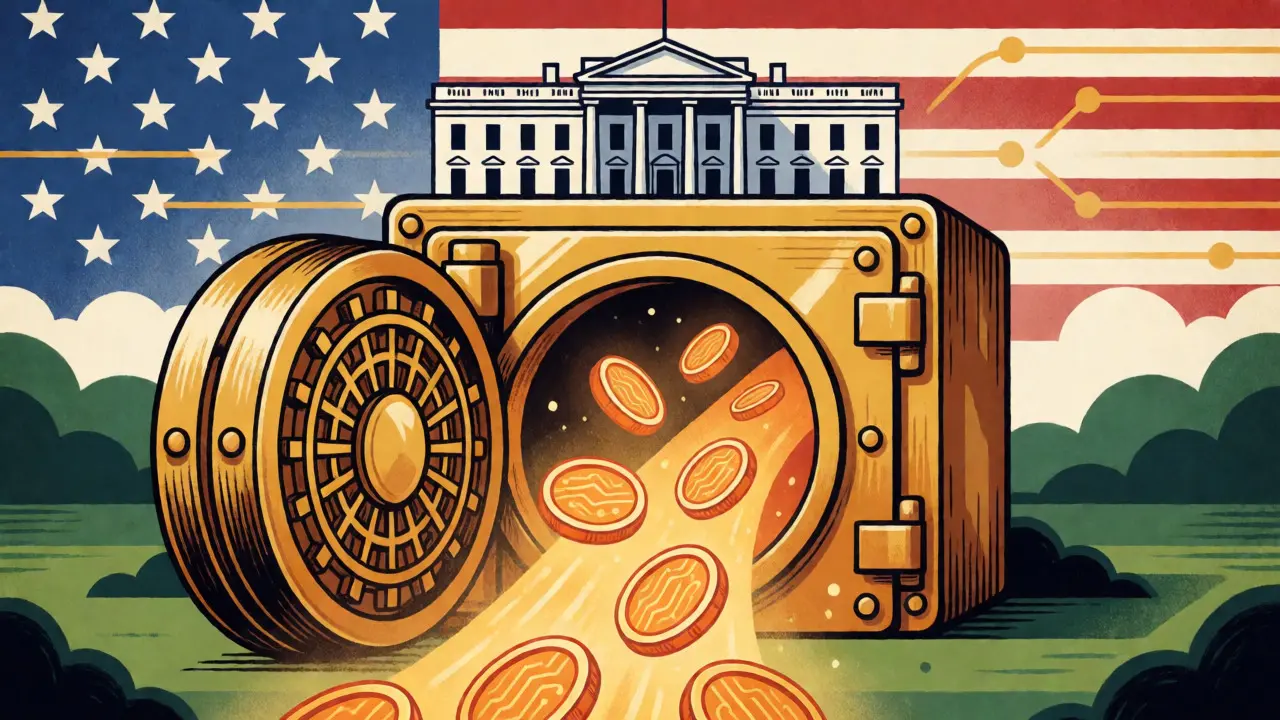
Here’s the most controversial piece of the puzzle. On March 6, 2025, Trump signed another executive order establishing the Strategic Bitcoin Reserve. Think of it as the Federal Reserve’s gold vault, but for Bitcoin.
How does the U.S. get the coins? They don't buy them with taxpayer money. Instead, the reserve is capitalized exclusively with Bitcoin forfeited through criminal and civil asset forfeiture proceedings. When drug dealers or fraudsters lose their BTC in court cases, those coins now go into this federal stockpile rather than being auctioned off immediately. The order explicitly states these assets will never be sold, locking them away as long-term national reserves.
Alongside the Bitcoin-specific reserve, they created the U.S. Digital Asset Stockpile. This holds non-Bitcoin crypto assets seized by the government. Unlike the Bitcoin reserve, the Treasury Secretary has the authority to sell these assets if needed for fiscal management. As of early 2025, the Bitcoin reserve held approximately 214,000 BTC, valued at around $14.2 billion. Projections suggest this could grow significantly as more seizures occur, potentially reaching 500,000 BTC within a few years.
| Feature | Biden Administration Approach | Trump 2025 Policy Shift |
|---|---|---|
| Regulatory Stance | Enforcement-heavy; frequent lawsuits | Growth-oriented; clear rulemaking |
| CBDC Status | Explored development of Digital Dollar | Prohibited creation of CBDC |
| Bitcoin Holdings | Auctioned seized assets regularly | Held in Strategic Bitcoin Reserve (no sales) |
| Key Legislation | No major crypto-specific laws passed | GENIUS Act signed into law |
| Market Impact | Capital flight to offshore jurisdictions | Institutional capital returning to U.S. |
The GENIUS Act: Rules of the Road
Executive orders are powerful, but they can be reversed by the next president. That’s why the signing of the GENIUS Act in July 2025 matters so much. This legislation codified many of the administrative changes into permanent law. Legal experts have called it the most significant crypto bill since Wyoming’s early blockchain experiments.
The Act addresses three main areas: market structure, stablecoin regulation, and tax treatment. Before this, defining whether a token was a security or a commodity was often up to whichever regulator showed up first. The GENIUS Act provides clearer definitions, helping exchanges and developers know which rules apply to them. It also sets standards for stablecoins, ensuring that tokens pegged to the dollar actually hold enough reserves to back them up.
For investors, this clarity reduces risk. You no longer have to worry about a sudden regulatory change invalidating your business model overnight. However, critics note that the Act focuses heavily on Bitcoin and stablecoins. Projects involving complex smart contracts or non-fungible tokens (NFTs) may still face uncertainty until further guidance arrives.
What Happened to the Digital Dollar?
If you’ve heard people complaining about "government surveillance money," they’re likely referring to Central Bank Digital Currencies (CBDCs). The Biden administration had actively studied launching a U.S. digital dollar. Many feared this would give the Federal Reserve direct control over individual spending habits.
The Trump administration took a hard line against this idea. One of the core components of the 2025 policy reversal was an explicit prohibition on developing a U.S. CBDC. The argument? Private sector innovation-like stablecoins issued by private companies-is faster, more efficient, and less prone to political abuse. By banning the government from issuing its own digital currency, the administration signaled that it wants banks and tech firms to compete to provide digital payment solutions, not the state itself.
Market Reaction: Did It Work?
Numbers don’t lie. Following the announcement of the Strategic Bitcoin Reserve in March 2025, Bitcoin prices jumped roughly 18% in 24 hours. But beyond the price action, the real indicator is institutional behavior. Data from CoinGecko shows U.S. crypto trading volume increased by 214% between January and June 2025. More importantly, 63% of that growth came from institutional investors-pension funds, hedge funds, and family offices that previously sat on the sidelines due to regulatory fear.
Job markets reflect this too. Crypto-related job postings in the U.S. rose by 189% year-over-year through May 2025. Companies that had threatened to move to Dubai or Singapore started expanding domestic operations instead. A survey of 500 industry executives found that 87% rated the new policies as favorable for business. Why? Because predictability allows for planning. You can’t build a five-year product roadmap if you’re worried about getting sued next month.
However, it’s not all smooth sailing. Smaller startups struggle with compliance. About 32% of surveyed crypto startups reported needing external legal consultants to navigate the new framework. The transition requires resources that early-stage projects often lack. Additionally, some analysts warn that holding so much Bitcoin in a single government reserve could distort markets if the U.S. ever decides to liquidate a large portion during a crisis.

Looking Ahead: What’s Next for 2026?
We are currently in September 2026, looking back at the implementation phase. The initial shockwaves have settled, and the focus has shifted to technical execution. The SEC published its first detailed guidance documents on stablecoins in late August 2025. The Commodity Futures Trading Commission (CFTC) followed with rules on crypto derivatives in March 2026.
Current trends show the Strategic Bitcoin Reserve growing steadily. The Treasury Department has implemented "seizure optimization protocols," allowing them to acquire more Bitcoin without spending new budget dollars. Analysts at Grant Thornton project that these policies could generate between $24 billion and $38 billion in annual tax revenue by 2027, driven largely by increased transaction volumes and corporate activity.
The competition hasn’t vanished. Singapore and Switzerland still attract significant venture capital. But the U.S. has regained its status as the primary hub for regulated crypto finance. The question now isn’t whether the U.S. is open for business-it clearly is-but how quickly other nations will adapt to match this level of regulatory certainty.
Frequently Asked Questions
Did the U.S. buy Bitcoin for the Strategic Reserve?
No, the U.S. government did not purchase Bitcoin with taxpayer funds for the Strategic Bitcoin Reserve. The reserve is capitalized exclusively with Bitcoin seized through criminal and civil asset forfeiture proceedings. This means the coins come from individuals or entities who lost them in legal disputes, such as fraudsters or illegal operators.
Can the government sell Bitcoin from the Strategic Reserve?
The March 2025 Executive Order explicitly states that Bitcoin in the Strategic Bitcoin Reserve will never be sold. It is designated as a long-term national reserve asset, similar to how gold was historically held. However, the separate U.S. Digital Asset Stockpile, which holds non-Bitcoin crypto assets, does allow the Treasury Secretary to determine strategies for sale if necessary.
What is the GENIUS Act?
The GENIUS Act is a piece of legislation signed into law in July 2025. It establishes a comprehensive regulatory framework for digital assets in the United States. Key provisions include clearer definitions for securities versus commodities, regulations for stablecoins to ensure they are fully backed by reserves, and updated tax guidelines. It aims to provide legal certainty for businesses operating in the crypto space.
Why did the administration ban Central Bank Digital Currencies (CBDCs)?
The administration prohibited the development of a U.S. CBDC to prevent potential government overreach into personal financial privacy and to encourage private sector innovation. They argued that privately issued stablecoins offer a more efficient and competitive alternative to a government-issued digital dollar, avoiding the risks of centralized control over daily transactions.
How did these changes affect crypto jobs in the U.S.?
The policy reversal led to a significant boom in employment. Crypto-related job postings in the U.S. increased by 189% year-over-year through May 2025. This surge was driven by institutional investors re-entering the market and companies feeling confident enough to expand domestic operations rather than moving to jurisdictions with friendlier regulations.