What Is Coinbase Tokenized Stock (COINX)? A Guide to xStock
 May, 23 2026
Imagine owning a piece of Coinbase Global, the giant crypto exchange, but holding it in your digital wallet instead of a traditional brokerage account. That is exactly what Coinbase tokenized stock (xStock) offers. Traded under the ticker COINX, this asset lets you track the price movements of Coinbase’s actual shares without going through the usual banking system.
You might be wondering if this makes you a shareholder. The short answer is no. This distinction is crucial for anyone looking to invest in tokenized stocks. While your wallet balance goes up and down with the stock market, you do not get voting rights or direct dividends from the company itself. Instead, you are buying a financial instrument designed to mirror the economic performance of the underlying asset.
How Does Coinbase xStock Work?
To understand COINX, you have to look at who creates it. The issuer is Backed Assets (Backed Finance), a Switzerland-based provider of tokenized securities. They don't just mint random tokens; they create what they call "tracker certificates." Think of these as digital receipts that prove a specific amount of value is tied to an underlying asset.
In the case of COINX, the underlying asset is Coinbase Global Class A common stock (NASDAQ: COIN). Here is how the structure works:
- The Underlying Asset: Real shares of Coinbase are held by a regulated third-party custodian. These are not fake numbers on a screen; they are actual equities sitting in a secure vault.
- The Token: Backed issues COINX tokens on blockchains. Each token represents a claim on the value of those shares.
- The Ratio: The system aims for a 1:1 backing. If one share of Coinbase costs $200, one unit of COINX should theoretically trade very close to $200, minus minor fees or market spreads.
This setup allows Real-World Assets (RWAs) to move onto the blockchain. It bridges the gap between Wall Street and crypto wallets, letting you interact with traditional finance using decentralized tools.
Where Can You Hold COINX? Networks and Standards
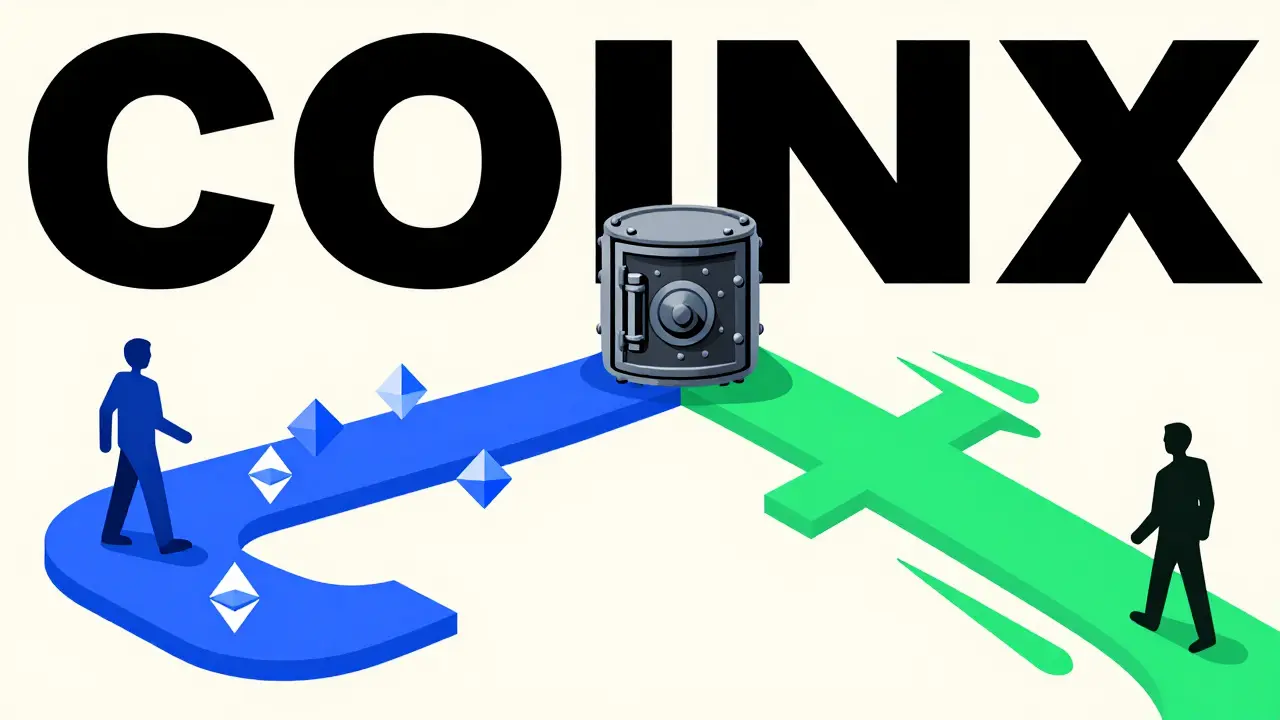
One of the biggest advantages of COINX over a standard stock purchase is flexibility. Traditional stocks live inside brokerages like Fidelity or Robinhood. You cannot easily send them to a friend or use them as collateral in a decentralized app. COINX breaks those walls down by existing on two major blockchains:
| Blockchain Network | Token Standard | Key Benefit |
|---|---|---|
| Ethereum | ERC-20 | Access to massive DeFi ecosystems like Uniswap and Aave. |
| Solana | SPL | Fast transactions and near-zero gas fees via DEXs like Jupiter. |
If you hold COINX on Ethereum, you can potentially use it in complex DeFi strategies, though you will pay Ethereum gas fees. If you hold it on Solana, transactions settle in seconds for fractions of a cent. This dual-chain approach ensures that whether you prioritize security and ecosystem depth (Ethereum) or speed and cost (Solana), you have access to the asset.
Costs and Fees: What Are You Actually Paying?
Free money does not exist in finance, and tokenized stocks are no exception. While there is currently no management fee for COINX, the terms allow for changes in the future. It is vital to know the cost structure before you buy.
According to Backed Assets documentation, here is the fee breakdown:
- Entry/Exit Fee: Up to 0.50% of your investment value when you buy or redeem directly through the primary market.
- Management Fee: Currently 0%, but capped at a maximum of 0.25% per year if introduced later.
- Trading Fees: If you buy COINX on a secondary exchange like Kraken or a DEX, you pay their standard trading fees. On Kraken, spot fees range from 0.00% to 0.26%. On DEXs, you pay liquidity provider fees plus network gas.
Compare this to traditional ETFs, which often charge 0.03% to 0.50% annually. COINX is competitive, especially if you trade frequently on low-fee networks like Solana. However, remember that every time you swap tokens on a DEX, slippage can add hidden costs if the liquidity pool is thin.
Price Discrepancies and Market Data
If you check the price of COINX right now, you might see confusing numbers. One site says $194, another says $183, and a third says $395. Why the difference?
Unlike Bitcoin, which has a global consensus price, tokenized stocks trade across fragmented markets. Kraken lists COINx with its own order book. CoinMarketCap aggregates data from various exchanges. Coinbase’s internal converter might show a different snapshot based on their specific liquidity reserves.
For example, recent data showed prices ranging from roughly $171 to $194 across major trackers like Crypto.com and Kraken, while some isolated snapshots hit higher marks. These differences arise because:
- Liquidity Variance: Some pools have more buyers than others, pushing the local price up or down.
- Timing: Stock markets open and close. Crypto trades 24/7. During weekends, the underlying Coinbase stock is frozen, but COINX keeps trading based on sentiment and futures expectations.
- Premiums/Discounts: In high demand, traders might pay slightly more than the NAV (Net Asset Value) to get exposure quickly.
Always check multiple sources. If you plan to arbitrage (buy low on one platform, sell high on another), factor in the withdrawal times and fees first.
Risks You Must Understand
Buying COINX is not the same as buying Coinbase stock on the NASDAQ. There are distinct risks involved in holding a tokenized version.
Counterparty Risk: You are trusting Backed Finance and their custodians to hold the actual shares. If they fail, get hacked, or face legal seizure, your tokens could lose value. This is the opposite of self-custody in pure crypto, where you control the keys. Here, you rely on a centralized intermediary for the underlying asset.
No Shareholder Rights: You cannot vote in Coinbase shareholder meetings. You do not receive dividend checks directly. Your return is purely capital appreciation (or depreciation) mirrored by the token's price.
Regulatory Restrictions: This is critical. Backed Assets restricts direct purchases to eligible investors outside prohibited jurisdictions, notably excluding U.S. persons due to SEC regulations. If you are in the U.S., you likely cannot buy COINX directly from the issuer. You might find it on secondary markets, but geo-blocking and KYC (Know Your Customer) checks are strict. Always verify your local laws before engaging with tokenized securities.
Liquidity Risk: With a total supply reported around 12,000 tokens and circulating supply near 6,000, the float is tiny compared to the billions of dollars in Coinbase stock outstanding. Large trades can cause significant slippage, moving the price against you.
Who Should Use Coinbase xStock?
COINX is a niche product. It is not for everyone. It fits best into specific portfolios:
- Crypto-Native Investors: Users who want exposure to traditional equity without leaving their crypto ecosystem. They prefer managing everything in MetaMask or Phantom rather than logging into a separate brokerage.
- DeFi Participants: Those who want to use equity exposure as collateral in lending protocols (if supported) or provide liquidity in AMMs.
- International Traders: Investors in regions where accessing U.S. stock markets is difficult or expensive, provided they are not in restricted zones like the U.S.
If you are a long-term investor who wants voting rights and simplicity, stick to a traditional broker. If you are a trader who values 24/7 settlement, composability, and blockchain transparency, COINX offers a unique bridge.
Is COINX the same as Coinbase stock?
No. COINX is a tracker certificate issued by Backed Assets that mirrors the price of Coinbase stock. It does not give you ownership of the shares, voting rights, or direct dividends. It is a derivative product backed by the underlying asset.
Can I buy COINX if I live in the United States?
Directly from the issuer (Backed Assets), generally no. Due to U.S. securities laws, most tokenized stocks exclude U.S. residents. You may find COINX on secondary exchanges, but availability depends on the specific platform's compliance rules.
Which blockchain is better for holding COINX?
It depends on your needs. Ethereum (ERC-20) offers deeper integration with major DeFi protocols but has higher gas fees. Solana (SPL) offers faster transactions and lower costs, making it better for frequent trading or smaller amounts.
What happens to my COINX if Coinbase stock pays a dividend?
You do not receive the dividend directly. Typically, the value of the dividend is reflected in the Net Asset Value (NAV) of the tracker certificate, meaning the price of COINX should adjust to account for the payout, preserving your total economic exposure.
Is COINX safe?
It carries counterparty risk. You trust Backed Assets and their custodians to hold the real shares. If they fail, your tokens could lose value. Additionally, smart contract risks exist on the blockchain side. It is less risky than unbacked meme coins but riskier than holding shares in a regulated bank account.