What is Evercraft Ecotechnologies ($ECET)? Tokenomics, Price & Utility Explained
 Jul, 27 2026
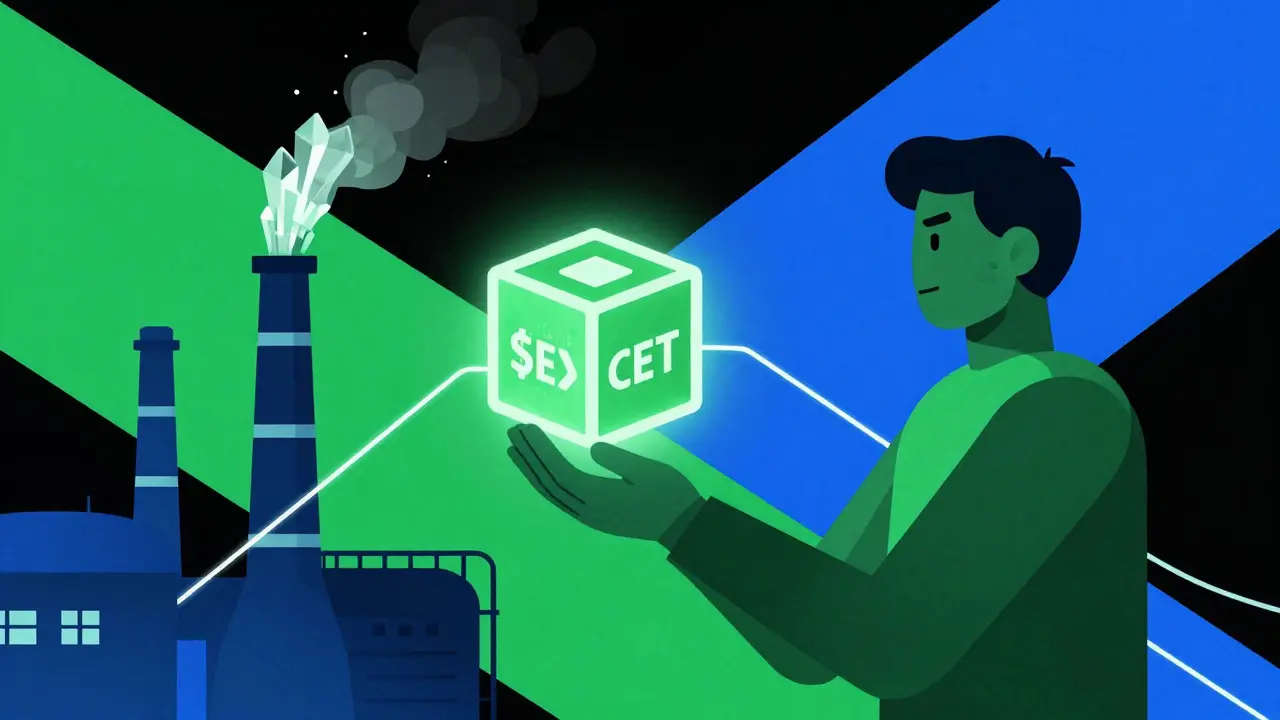
Ever heard of a cryptocurrency that claims to fund carbon nanotubes and graphene production? That’s the pitch behind Evercraft Ecotechnologies, a project trying to bridge the gap between blockchain finance and heavy industrial environmental tech. Their native currency, $ECET, isn't just another meme coin hoping for a viral moment. It’s designed as a utility token for a specific ecosystem focused on sustainability.
But here’s the catch: the data around $ECET is messy. You’ll see different prices on different sites, conflicting supply numbers, and talk about two different blockchains. If you’re looking at this token, you need to cut through the noise. This guide breaks down what $ECET actually is, how it works, and whether it has real value or if it’s just hype.
The Core Concept: Green Tech Meets Blockchain
At its heart, Evercraft Ecotechnologies positions itself as a leader in environmental protection and technological innovation. They aren’t just planting trees; they are diving into advanced materials. Specifically, they focus on producing Carbon Nanotubes (CNTs) and Graphene using sustainable methods.
Why does this matter for crypto? Because these materials are expensive to produce and require significant infrastructure. Enter the ECET token. The project uses $ECET to tokenize environmental assets. Think of it like buying shares in a carbon offset program, but instead of just paper certificates, you’re dealing with digital tokens on a blockchain. Holders can use ECET to buy tokenized carbon certificates or access environmental systems within the Evercraft marketplace.
This approach tries to solve a common problem in "green crypto": lack of tangible utility. Many eco-tokens promise impact but offer no real product. Evercraft claims to have the physical side covered with projects like the ACA facility, aiming to make their token tied to actual industrial output rather than just abstract promises.
Technical Specs: Where Does $ECET Live?
If you want to buy or hold $ECET, you need to know where it lives. Currently, the situation is a bit hybrid.
Right now, $ECET operates primarily as an ERC-20 token on the Polygon (POL) network. This is good news for accessibility. Polygon is fast, cheap, and compatible with almost all standard Ethereum wallets like MetaMask. You can find the smart contract address 0x799c98fefb094f5ef3e7850cae4a9401f9382f45 on major trackers, which allows you to verify your holdings easily.
However, the official roadmap mentions a transition. Evercraft plans to launch $ECET as a Layer-0 token on the Constellation ($DAG) Network. The goal here is zero fees for transfers and staking. While the Polygon version handles current trading, the Constellation version is pitched as the future home for internal ecosystem operations. For now, treat it as a Polygon asset unless you see explicit announcements about a migration bridge being live and widely adopted.
Tokenomics: Supply and Scarcity
One of the biggest red flags for new investors is confusion over supply. Let’s clear that up.
| Metric | Official Claim / Plan | Market Data (May 2026) |
|---|---|---|
| Total Planned Supply | 900,000,000 ECET | Varies by source |
| Max Supply (Aggregators) | - | 789.2 Million ECET |
| Circulating Supply | - | ~689.2 Million ECET |
| Launch Date | January 31, 2024 | Confirmed |
The company initially stated a plan to issue 900 million tokens. However, most major data aggregators like CoinMarketCap and CryptoRank currently list the maximum supply closer to 789.2 million. As of mid-2026, about 689.2 million tokens are in circulation. This means roughly 87% of the tradable supply is already out there. When a large percentage of supply is circulating early, it often limits the potential for massive scarcity-driven pumps later on, unless demand spikes significantly.

Utility: What Can You Actually Do With $ECET?
You don’t just hold $ECET in a wallet and hope. The project outlines three main ways to engage:
- Governance: Holders get a say in the future of the platform. This usually means voting on proposals related to fund allocation for new environmental projects or changes to the ecosystem rules.
- Staking Rewards: This is the passive income angle. Evercraft offers tiered Annual Percentage Yields (APY) for locking your tokens.
- 12-month lock: ~4.9% APY
- 24-month lock: ~6.5% APY
- 36-month lock: ~8.9% APY
- Marketplace Access: Use ECET to purchase tokenized carbon certificates or other environmental products listed on the Evercraft platform. This is the core utility that distinguishes it from pure speculation.
Price Performance and Market Reality
Let’s talk numbers. $ECET is a small-cap token, and small caps behave differently than Bitcoin or Ethereum. They are volatile, illiquid, and sensitive to single events.
When $ECET launched on the MEXC exchange in April 2024, it started at $0.12 per token. Since then, it has seen significant fluctuation. By March 2025, some trackers showed it around $0.022, while others reported prices dipping below $0.01 during low-volume periods. As of mid-2026, prices hover in the $0.01 - $0.015 range depending on the exchange.
The market capitalization reflects this niche status. Estimates vary wildly based on which circulating supply number you use, but generally sit between $4.5 million and $15 million. To put that in perspective, top-tier cryptos have market caps in the hundreds of billions. A $10 million market cap means it takes relatively little money to move the price up or down. This creates opportunity for traders but high risk for long-term holders.
Liquidity is also fragmented. While listed on exchanges like MEXC, Bybit, and HTX, daily trading volume can be thin. On quiet days, volume might drop under $10,000. This means if you try to sell a large amount of ECET at once, you could suffer from slippage-getting a much worse price than the chart shows because there aren’t enough buyers waiting.
Risks and Considerations
Before you connect your wallet, consider these factors:
- Transparency Gaps: While the tech specs are clear, details on the leadership team are opaque. Public summaries rarely name key executives, which makes due diligence harder.
- Regulatory Uncertainty: Environmental credits and carbon markets are facing increasing regulatory scrutiny globally. Changes in how carbon offsets are valued could impact the underlying assets ECET represents.
- Network Transition Risk: Moving from Polygon to Constellation Layer-0 sounds great on paper (zero fees!), but migrations can be buggy. Always check official channels before bridging assets.
- Speculative Nature: Despite the "real world" backing, the token’s price is still driven largely by crypto market sentiment. If the broader market crashes, green tech narratives often get hit hard too.
Is $ECET Worth Your Attention?
$ECET occupies a unique spot. It’s not a generic utility token, nor is it a pure speculative play. It’s an attempt to monetize environmental technology through blockchain. If you believe in the long-term growth of carbon markets and advanced materials like graphene, and you want exposure via crypto, $ECET offers a direct link.
However, treat it as a high-risk, niche investment. The liquidity is low, the supply is mostly circulated, and the price history shows volatility. It’s best suited for investors who understand how to manage risk in small-cap altcoins and who are genuinely interested in the intersection of DeFi and environmental science.
Where can I buy $ECET?
You can trade $ECET on centralized exchanges such as MEXC, Bybit, and HTX. Since it is an ERC-20 token on Polygon, you can also swap it on decentralized exchanges (DEXs) that support the Polygon network, provided you have a compatible wallet like MetaMask.
Is $ECET safe to stake?
Staking carries smart contract risks. While Evercraft offers attractive APYs (up to 8.9%), you are locking your tokens for 1-3 years. Ensure you trust the platform's security audits and be aware that if the token price crashes, your principal value will decrease despite the interest earned.
What is the difference between the Polygon and Constellation versions?
Currently, $ECET trades on Polygon as an ERC-20 token, which is easy to use with standard wallets. The Constellation Layer-0 version is planned for future ecosystem use, promising zero transaction fees. Until a migration is officially completed, the Polygon version is the primary tradable asset.
Who is behind Evercraft Ecotechnologies?
The company is headquartered in Vienna, Austria. However, public information regarding specific founders or executive leadership is limited, making it a somewhat anonymous project in terms of corporate governance transparency.
How does $ECET relate to Carbon Nanotubes?
Evercraft focuses on sustainable production of advanced materials like Carbon Nanotubes (CNTs) and Graphene. The $ECET token is used to finance these initiatives and allows users to purchase tokenized certificates related to these environmental technologies, linking the crypto asset to physical industrial output.