What is Monsta Infinite (MONI) Crypto Coin? Tokenomics, Utility & Risks
 Jun, 6 2026
You’ve probably seen the ticker MONI pop up on your screen while scrolling through crypto lists. It’s not Bitcoin. It’s not Ethereum. So, what exactly is it? Simply put, Monsta Infinite (MONI) is the primary governance and utility token for the Monsta Infinite blockchain gaming ecosystem. It runs on the BNB Smart Chain and acts as the backbone for a specific type of online game: an MMORPG card-based monster battle system.
If you are looking to buy MONI, you need to understand that this isn't just a meme coin or a speculative asset with no purpose. It has a defined role in a "play-to-earn" universe. But before you connect your wallet, let’s break down how the token works, why it exists, and whether it actually holds value in 2026.
The Core Concept: Governance Meets Gaming
At its heart, Monsta Infinite is a project built around a video game. The developers describe it as the "Monsta Universe." In this world, players engage in battles using cards representing monsters. But unlike traditional games where your progress dies when the server shuts down, here, your assets are tied to the blockchain.
So, where does MONI fit in? Think of MONI as the "share certificate" for this digital world. When you hold MONI, you aren't just holding a number in a wallet; you are participating in the ecosystem's decision-making process. The project positions MONI as a governance token. This means holders can vote on future developments, updates, and strategic directions for the game. It’s a DAO-like structure (Decentralized Autonomous Organization) applied to a gaming environment.
This distinction is crucial. Many gaming tokens are purely transactional-you use them to buy swords or skins. MONI is designed to be higher-level. You use it to steer the ship, while a different token handles the daily transactions inside the game.
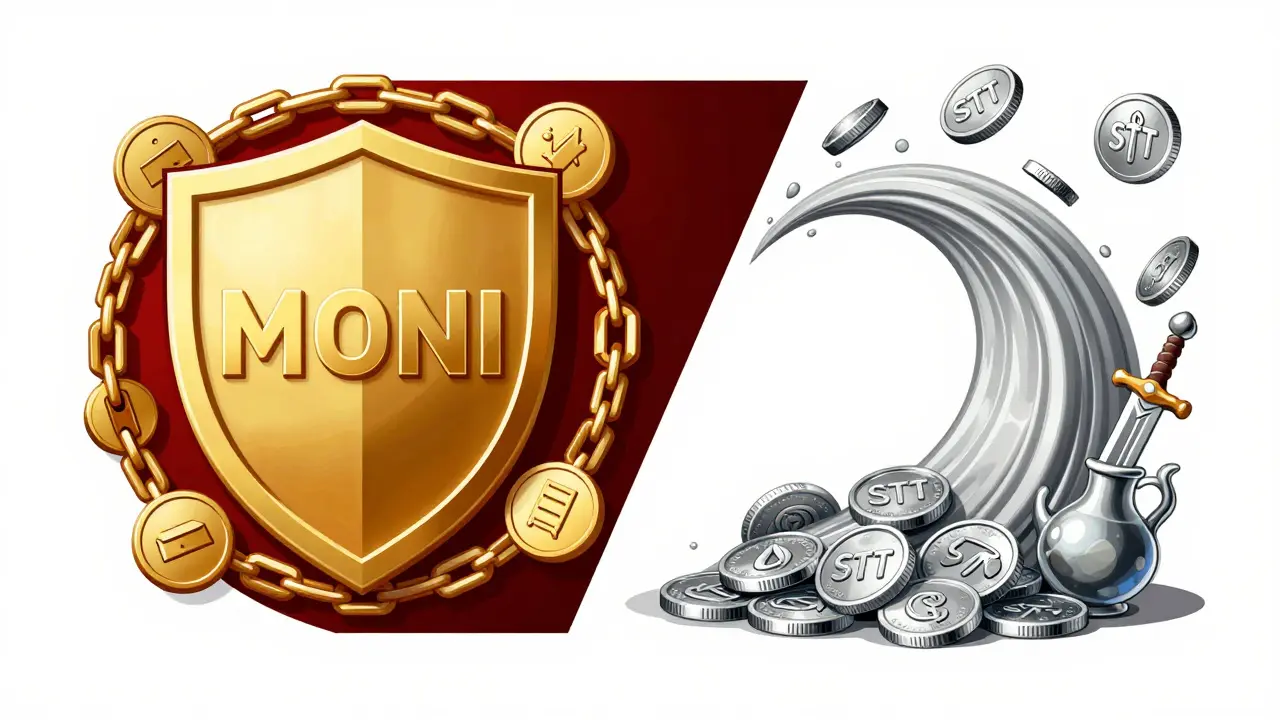
Dual-Token Economy: MONI vs. STT
To keep the economy stable, Monsta Infinite uses a dual-token model. This is a common strategy in GameFi to separate speculative value from everyday spending. Here is how the two tokens differ:
| Feature | MONI (Monsta Infinite Token) | STT (Stamen Tellus Token) |
|---|---|---|
| Primary Role | Governance, Staking, Value Capture | In-game Transactions, Marketplace Currency |
| Supply Type | Fixed Maximum Supply (270 Million) | Inflationary/Transactional (Used for purchases) |
| User Action | Vote on proposals, Stake for rewards | Buy items, Pay fees, Trade in-game assets |
| Analogy | Stock Shares / Voting Rights | Cash / Fiat Currency |
Why does this matter to you? If you plan to play the game actively, you will likely need STT for daily operations. However, if you want to invest in the long-term success of the platform or earn passive yields through staking, MONI is the asset you focus on. The separation helps prevent inflation in the governance token caused by high-volume micro-transactions in the game.
Tokenomics: Where Did the Coins Come From?
Understanding the distribution of tokens is vital for assessing potential sell pressure. MONI has a fixed total supply of 270,000,000 tokens. As of recent data, approximately 220.57 million are in circulation, meaning about 81.7% of all possible MONI coins are already out there.
Here is the breakdown of how that 270 million was allocated:
- Play-to-Earn Rewards (25%): 67.5 million MONI. This is the biggest slice, dedicated to rewarding players who participate in the game.
- Staking Rewards (24%): 64.8 million MONI. Reserved for users who lock up their tokens to support network stability.
- Team Allocation (16%): 43.2 million MONI. Held by the developers and core team.
- Marketing (9%): 24.3 million MONI. Used for promotions and partnerships.
- Private Sale (6%): 16.2 million MONI. Sold to early investors.
- CEX Reserve (5%): 13.5 million MONI. Kept for listing on centralized exchanges.
- Ecosystem Fund (5%): 13.5 million MONI. For future development and grants.
- Advisors (5%): 13.5 million MONI. Compensation for expert guidance.
- Public Presale (3%): 8.1 million MONI. Available to the general public early on.
- IDO & Liquidity (2% combined): 5.4 million MONI. Split between Initial DEX Offering and liquidity pools.
Notice that nearly half of the entire supply (49%) is earmarked for players and stakers. This suggests the project is heavily incentivized toward user participation rather than just insider profit. However, the 21% held by the Team and Advisors is significant. You should always check vesting schedules-when do they get to sell those tokens? Early releases can cause price drops.
Technical Specs: BNB Smart Chain Integration
MONI is a BEP-20 token. This technical standard means it lives on the BNB Smart Chain (formerly Binance Smart Chain). For you, the user, this has three major implications:
- Low Fees: Transferring MONI or interacting with its contracts costs fractions of a cent compared to Ethereum mainnet.
- Wallet Compatibility: You can store MONI in any wallet that supports BSC, such as Trust Wallet, MetaMask (configured for BSC), or SafePal.
- DeFi Access: Because it’s on BSC, MONI can theoretically interact with other decentralized finance protocols on the chain, like PancakeSwap, for swapping or providing liquidity.
This architecture makes it accessible for retail investors who might be priced out of high-gas-fee networks. It also aligns Monsta Infinite with a vast ecosystem of existing DeFi tools, making integration smoother for developers.
Market Reality: Price, Volume, and Risk
Let’s talk numbers. As we move through 2026, MONI remains a small-cap asset. Market data aggregators like CoinMarketCap and CoinPaprika show a market capitalization hovering around $160,000 to $170,000 USD. The price per token is typically sub-$0.001 (often cited around $0.0007).
While the low price tag might look attractive, remember that market cap tells the real story of value. A coin costing $0.0001 with a trillion supply is not "cheap" if the market cap is huge. Conversely, MONI’s low market cap indicates it is a niche player.
Liquidity is another factor. Trading volumes vary wildly across platforms. Some days see volumes under $500 on certain trackers, while others show tens of thousands in EUR volume on European-focused aggregators. Low liquidity means two things:
- High Volatility: A single large buy or sell order can swing the price significantly.
- Slippage Risk: If you try to buy or sell a large amount, you might not get the price you expected because there aren’t enough buyers/sellers in the immediate pool.
You can trade MONI on several venues including Gate.io, PancakeSwap (V2), ZT, AscendEX, and DODO BSC. Always compare prices across these exchanges before executing a trade.
How to Use MONI: A Practical Guide
If you decide to enter the Monsta Infinite ecosystem, here is the typical workflow:
- Acquire: Buy MONI on a supported exchange (CEX or DEX). Ensure you have some BNB in your wallet to pay for gas fees if using a decentralized exchange.
- Store: Transfer your MONI to a secure BSC-compatible wallet. Never leave large amounts on an exchange if you plan to stake or govern.
- Stake: Connect your wallet to the official Monsta Infinite staking interface. Lock your MONI to earn rewards. This reduces circulating supply and demonstrates commitment to the project.
- Play: Engage with the MMORPG. While STT handles transactions, your performance and participation may yield MONI rewards from the Play-to-Earn pool.
- Govern: Participate in votes. Keep an eye on the project’s announcement channels for new proposals regarding game updates or fund allocation.
One feature mentioned for the future is "stake farms," which would allow MONI holders to provide liquidity and earn additional yields. This aims to deepen the DeFi utility of the token beyond simple locking.
Risks and Considerations
No crypto investment is without risk, and MONI carries specific ones due to its nature:
- Game Dependency: The value of MONI is intrinsically linked to the popularity of the Monsta Infinite game. If players lose interest, demand for the token drops. Unlike Bitcoin, which doesn't rely on a single application, MONI relies on one product.
- Smart Contract Security: While MONI is a standard BEP-20 token, the staking and governance contracts must be secure. Always verify if audits have been conducted by reputable firms. Lack of transparent audit reports is a red flag.
- Regulatory Uncertainty: Play-to-earn models often face scrutiny regarding securities laws. Holding a "governance token" can sometimes blur the line between utility and security depending on your jurisdiction.
- Insider Selling: With 21% of supply held by the team and advisors, monitor their activity. Large unlocks or sales can depress the price.
Despite these risks, the project maintains active listings on major data trackers and exchanges, indicating ongoing operational status. Community sentiment, often reflected in YouTube analysis and forum discussions, remains mixed but engaged, with some viewing it as a high-upside speculative play within the GameFi sector.
Is Monsta Infinite (MONI) a good investment?
Whether MONI is a good investment depends on your risk tolerance. It is a high-risk, high-volatility asset tied directly to the success of a single video game. If you believe in the growth of the Monsta Infinite player base and the sustainability of its play-to-earn model, it may offer upside. However, due to its small market cap and low liquidity, it is not suitable for conservative investors.
What is the difference between MONI and STT?
MONI is the governance and staking token, acting like shares in the company. STT (Stamen Tellus Token) is the in-game currency used for buying items and paying transaction fees within the Monsta Universe. MONI is deflationary/fixed supply, while STT is transactional.
Where can I buy MONI tokens?
You can purchase MONI on several exchanges including Gate.io, PancakeSwap (V2), ZT, AscendEX (BitMax), and DODO BSC. Since it is a BEP-20 token, ensure you are using the correct network when transferring funds to avoid loss.
Does MONI have a maximum supply?
Yes, MONI has a fixed maximum supply of 270,000,000 tokens. Approximately 220.57 million are currently in circulation, meaning over 80% of all tokens exist today.
Is Monsta Infinite safe to play?
Safety depends on smart contract audits and personal security practices. While the token is listed on major exchanges, always use a hardware wallet for storage and enable two-factor authentication on your accounts. Be cautious of phishing sites mimicking the official Monsta Infinite platform.