What Is the Double-Spending Problem in Cryptocurrency? Explained Simply
 Aug, 9 2026
Imagine handing a $20 bill to a friend for lunch. You walk away, and your friend has the cash. That money is gone from your pocket. It exists in one place at one time. Now, imagine taking a digital photo of that bill, emailing it to three different people, and telling them all they can spend it. Without a central authority checking who actually holds the "real" value, chaos ensues. This is exactly what happens with digital files unless specific safeguards are in place.
This scenario describes the double-spending problem, which is the risk that a single unit of digital currency could be spent more than once. In the physical world, double-spending is nearly impossible because objects cannot occupy two spaces simultaneously. In the digital world, data is easily copied. If you send a digital token to Alice, you still have the file on your computer. You could theoretically send that same file to Bob, Charlie, and Dave before anyone realizes the trick. If the network accepts all these transactions, you have effectively created new money out of thin air, devaluing the entire system.
Why Digital Money Faces Unique Risks
To understand why this is such a big deal, we need to look at how traditional banking works versus how decentralized networks operate. When you use a credit card or a bank transfer, a central authority-like Visa, Mastercard, or your bank-acts as the referee. They maintain a single, authoritative ledger. When you try to buy something, the bank checks its records. If your balance is sufficient, they deduct the funds and authorize the payment. If you try to spend those same funds again seconds later, the bank says, "Nope, already used." The central server prevents the duplicate entry.
Cryptocurrency was designed to remove this middleman. It operates on a peer-to-peer basis, meaning there is no central bank keeping score. Instead, thousands of computers (nodes) around the world keep copies of the transaction history. The challenge arises because information travels at different speeds across the internet. If you broadcast a transaction to the network, some nodes might see it first, while others see a conflicting transaction from you moments later. Without a way to agree on which transaction happened first, the network falls into disarray. This temporal gap creates a window of opportunity for malicious actors to exploit.
How Double-Spending Works in Practice
Let’s break down a realistic attack scenario to see how a user might attempt to double-spend. Imagine you own 1 Bitcoin (BTC). You want to buy a high-end laptop from a merchant named Sarah. Simultaneously, you want to sell that same 1 BTC to a friend named Mike for cash.
- The First Transaction: You send 1 BTC to Sarah’s wallet address. This transaction enters the mempool (a waiting area for unconfirmed transactions).
- The Second Transaction: Before Sarah’s transaction is confirmed by miners, you send another transaction sending that exact same 1 BTC to Mike. Crucially, you attach a higher fee to this second transaction to incentivize miners to prioritize it.
- The Conflict: Miners pick up both transactions. Because the second one pays more, they include it in the next block instead of Sarah’s transaction.
- The Result: Mike receives his Bitcoin. Sarah’s transaction is orphaned (rejected). She gave you the laptop but received nothing in return. You successfully double-spent.
This type of attack relies on speed and confusion. It works best when transactions are not yet deeply embedded in the blockchain. The longer a transaction waits for confirmations, the harder it becomes to reverse. This is why merchants often wait for several blocks to be added before considering a large purchase final.
The Solution: Blockchain and Consensus Mechanisms
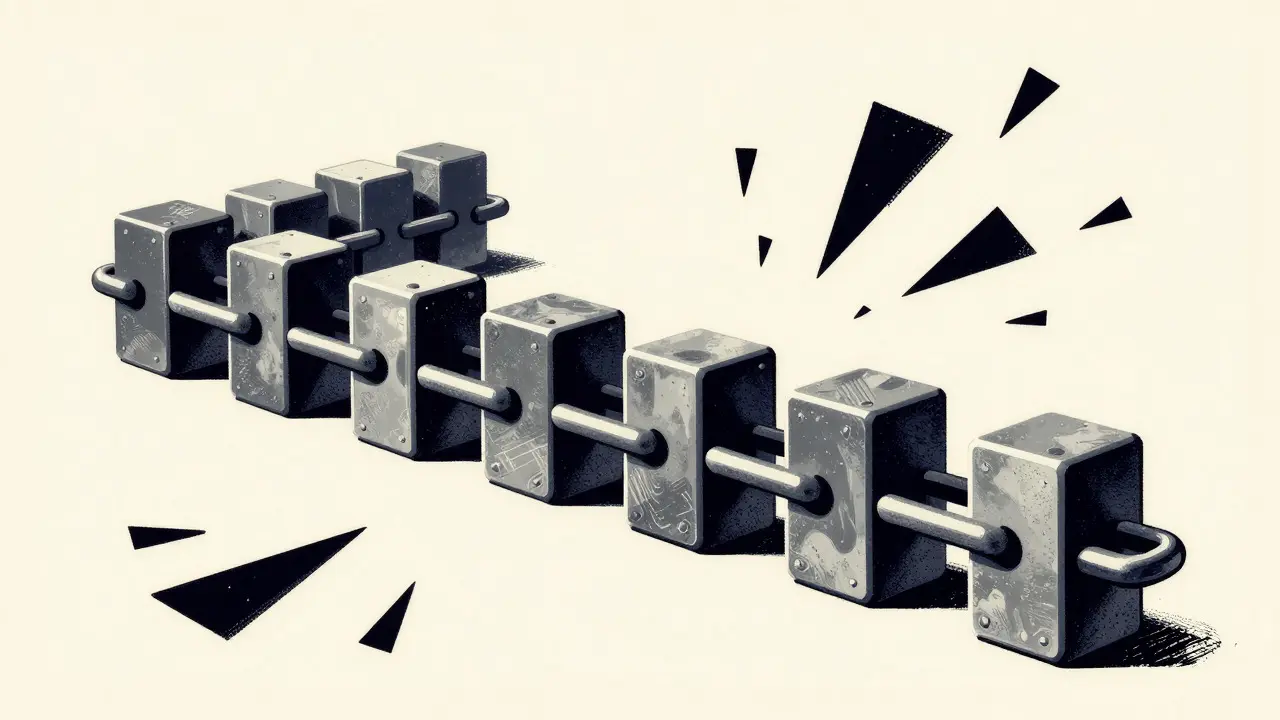
So, how do we stop this without bringing back the banks? The answer lies in the invention of the blockchain, a public, decentralized ledger that chronologically records every single transaction. Created by Satoshi Nakamoto in 2009, Bitcoin introduced a method to solve the double-spending problem through a combination of cryptography and game theory.
The core innovation is the concept of consensus. Instead of trusting one server, the network trusts math. Every node validates transactions against the existing history. If a transaction tries to spend coins that have already been spent in a previous block, the nodes reject it. But what if two valid-looking transactions appear at the same time?
This is where the consensus mechanism comes in. Bitcoin uses Proof-of-Work (PoW), a consensus algorithm where miners compete to solve complex mathematical puzzles to validate blocks. Miners bundle transactions into blocks. To add a block to the chain, a miner must find a specific hash-a unique digital fingerprint-that meets certain difficulty criteria. This process requires significant computational power and electricity.
When a miner solves the puzzle, they broadcast the new block to the network. Other nodes verify the work and the transactions within it. If everything checks out, they accept the block and start working on the next one. The longest chain of valid blocks is considered the true history of the network. If someone tries to double-spend, they would need to redo the proof-of-work for the block containing their original transaction AND all subsequent blocks, faster than the rest of the honest network. As more blocks are added, this becomes computationally impractical and economically unfeasible.
Understanding Confirmations and Security
In the cryptocurrency world, a transaction isn't truly "safe" the moment it appears on your screen. It needs confirmations. A confirmation occurs when a block containing your transaction is added to the blockchain. Each subsequent block added on top of that one adds another layer of security.
| Number of Confirmations | Time Approximation (Bitcoin) | Risk Level | Recommended Use Case |
|---|---|---|---|
| 0 | Immediate | High | Small tips, low-value exchanges |
| 1 | ~10 minutes | Medium | Everyday purchases, small transfers |
| 3-6 | 30-60 minutes | Low | Merchant sales, larger transactions |
| 6+ | 1+ hours | Negligible | High-value assets, institutional trades |
For a small coffee purchase, one confirmation might be enough. The cost of attempting a double-spend attack would far exceed the price of the coffee. However, for buying a house with Bitcoin, merchants and exchanges typically require six or more confirmations. By then, the transaction is woven so deeply into the blockchain that reversing it would require controlling more than 51% of the network's total computing power-a feat known as a 51% attack.
Alternative Consensus Models: Proof-of-Stake
While Bitcoin’s Proof-of-Work is robust, it consumes vast amounts of energy. This led to the development of alternative consensus mechanisms, most notably Proof-of-Stake (PoS), a consensus algorithm where validators are chosen to create blocks based on the amount of cryptocurrency they hold and are willing to 'stake' as collateral. Ethereum transitioned to PoS in 2022, significantly reducing its energy footprint.
In PoS, validators lock up (stake) their coins to participate in securing the network. If they try to validate a fraudulent transaction or attempt to double-spend, their staked coins are "slashed"-confiscated as a penalty. This economic disincentive replaces the energy-intensive mining race. While the mechanics differ, the goal remains the same: creating an immutable record that prevents the same asset from being spent twice. Both PoW and PoS rely on the principle that attacking the network is more expensive than following the rules.
Edge Cases: Centralized Exchanges vs. Decentralized Ledgers
It is important to distinguish between double-spending on the blockchain and double-spending on centralized exchanges. When you deposit Bitcoin into an exchange like Coinbase or Binance, you don’t actually control the private keys. The exchange manages an internal database. If their internal systems fail or are hacked, they might accidentally credit your account twice. This isn’t a failure of the blockchain technology itself; it’s a failure of the centralized company’s software or security protocols.
True double-spending only applies to peer-to-peer transactions on the decentralized ledger. Once a transaction is confirmed on-chain, it is irreversible. The blockchain does not allow refunds or chargebacks. This feature protects merchants from fraud but places the burden of caution on buyers. Always ensure you are sending funds to the correct address, as the network will happily execute any valid command, even if it’s a mistake.
Why This Matters for the Future of Money
Solving the double-spending problem was the missing link that made digital cash possible. Before Bitcoin, digital currencies failed because they required a central issuer to prevent counterfeiting. By removing the need for trust in a third party, blockchain technology enabled a new form of value transfer. It allows strangers across the globe to transact securely without knowing each other or relying on a bank.
As we move toward a more digital economy, understanding these fundamentals becomes crucial. Whether you are investing in cryptocurrencies, using smart contracts for business, or simply curious about the future of finance, the double-spending problem is the foundation upon which all these innovations rest. Without a reliable solution to this issue, digital money would be little more than a broken promise.
Can double-spending happen on Bitcoin?
Yes, but only before a transaction is confirmed. Once a transaction is included in a block and additional blocks are built on top of it (confirmations), the probability of double-spending drops exponentially. For practical purposes, after six confirmations, a Bitcoin transaction is considered irreversible.
What is the difference between Proof-of-Work and Proof-of-Stake in preventing double-spending?
Both mechanisms prevent double-spending by making it costly to cheat. Proof-of-Work requires attackers to possess massive computational power to rewrite the blockchain. Proof-of-Stake requires attackers to own a majority of the staked currency, which they would lose (slash) if caught cheating. PoW uses energy; PoS uses economic collateral.
How many confirmations do I need for a secure transaction?
For small amounts, one confirmation is often sufficient. For medium-sized purchases, three to six confirmations are recommended. For high-value transactions involving hundreds of thousands of dollars, six or more confirmations are standard practice to mitigate any residual risk.
Is double-spending a problem for credit cards?
Not really, because credit card systems are centralized. Banks and payment processors maintain a single source of truth. They instantly check balances and authorize or decline transactions. The risk in credit card systems is usually fraud (stolen cards), not technical double-spending of the same digital token.
What happens if a miner tries to double-spend?
If a miner includes a transaction that spends coins already spent in a previous valid block, other nodes will reject the block. The miner wastes their electricity and time, earning no reward. To succeed, a miner would need to secretly build a longer chain than the public network, which is extremely difficult and expensive.
Dominic Greco
August 10, 2026 AT 21:01They want you to think this is about math but it’s actually about control 🚨👁️ The banks lost their monopoly so they created this 'decentralized' narrative to keep us compliant while the real ledger is held by blackrock and other shadow entities. You are not sending money to a friend you are sending data to a surveillance state that tracks every single satoshi movement through chain analysis firms like chainalysis who sell your data to the IRS. The double spend problem was just a convenient lie to make you trust the system again when the whole point of crypto was to escape the system entirely. Wake up sheeple 🐑💸
Sus Sawyer
August 11, 2026 AT 00:19hey dom calm down a bit lol but yeah the tech is wild for sure i mean look at how fast transactions confirm now compared to wire transfers taking days. its kinda crazy how we went from trusting suits in buildings to trusting code on servers around the world. i still get nervous waiting for those 6 confirmations though feels like an eternity when you wanna buy something cool. but hey at least no middleman taking a cut right? well except gas fees which are also kinda nuts sometimes 🤷♂️
Aryan MISHRA
August 11, 2026 AT 12:48The article oversimplifies the Byzantine Generals Problem; it is not merely a temporal gap issue. It is a fundamental distributed systems challenge requiring consensus algorithms to achieve fault tolerance in asynchronous networks. PoW provides probabilistic finality, not absolute certainty until exponential depth is reached. One must understand Nakamoto Consensus deeply.
Sean Rowland
August 12, 2026 AT 22:32Indeed, Mr. Mishra, your pedantic correction is noted with profound indifference. While you cling to the sterile comfort of academic definitions, one might consider the socio-economic implications of such rigid technicalities. The notion that 'probabilistic finality' suffices for high-value asset transfer is, frankly, a precarious foundation upon which to build a financial revolution. It invites speculation rather than stability. Furthermore, the energy expenditure required to maintain this 'consensus' is an ecological affront that cannot be ignored in favor of cryptographic purity. We are essentially burning forests to validate digital ledgers. Is this truly progress? Or is it merely a complex game of chicken played by those with access to cheap electricity?
Earl Kott65
August 14, 2026 AT 06:51Oh wow Sean really showing off his vocabulary today aren't we 😂 I mean sure burning forests sounds bad but have you seen the interest rates on credit cards lately? Maybe the trees are worth it if it means I don't have to pay 25% APR to buy a toaster. Plus Ethereum switched to proof of stake so they don't need to burn as much stuff anymore. It's all good buddy. Just chill and let the validators do their thing 🧘♂️✨
Ethan Yuwono
August 15, 2026 AT 19:41there is truth in both perspectives i suppose. the environmental cost is real but so is the inefficiency of traditional banking. perhaps the answer lies not in choosing one over the other but in evolving the technology further. layer two solutions seem promising in reducing the load on main chains. it is a delicate balance between security decentralization and scalability. we must remain patient as these systems mature. change is slow but inevitable.
Subhash Kashyap Dm
August 16, 2026 AT 14:08you fools dont realize the exchanges are already double spending your funds internally. coinbase shows you a number on screen but they hold nothing. its fiat backed by thin air just like before. blockchain is secure yes but the on ramps are compromised. they track your ip address and link your identity to your wallet. privacy is dead long live surveillance capitalism. satoshis dream is buried under regulatory sandboxes and cbdc tracking mechanisms. prepare for the total loss of anonymity soon enough
Ryan Robinson
August 17, 2026 AT 00:06honestly subhash makes a good point about exchanges. i always keep my coins in cold storage just in case. its better safe than sorry i guess. the tech itself seems solid though. nice read overall thanks for sharing this info